
WHMIS 2015 AIX Safety V3 Quiz Answers: Free WHMIS Practice Test and Answer Key
🎯 Use this whmis answer key and free practice test to master WHMIS 2015 symbols, labels, and SDS, with clear explanations for every answer.

Searching for a WHMIS answer key usually means one thing: you have a course module or certification quiz due and you want to know whether your answers are right. This guide gives you a practical whmis answer key built around the concepts behind WHMIS 2015 AIX Safety V3 quiz answers: hazard classes, pictograms, supplier labels, and safety data sheets. Instead of memorizing letters, you will learn why each answer is correct, which is what protects you on the job.
WHMIS is the Workplace Hazardous Materials Information System, Canada's national standard for communicating chemical hazards at work. If you are wondering what does whmis stand for, that full name is the whole answer, and the meaning is simple: a shared system of labels, safety data sheets, and worker education. American readers meet WHMIS through Canadian employers, cross-border contractors, and online training vendors, and it works much like OSHA's Hazard Communication Standard.
The current version is WHMIS 2015, which aligned Canada with the Globally Harmonized System of Classification and Labelling of Chemicals, known as GHS. The change replaced the old WHMIS 1988 symbols with new pictograms, replaced material safety data sheets with 16-section safety data sheets, and introduced standardized signal words and hazard statements. The full transition finished on December 1, 2018, so every workplace label and SDS you see today should follow the 2015 rules.
Most online courses, including the AIX Safety WHMIS 2015 module that many students search for, test the same core ideas. Expect questions on the three pillars of WHMIS, the difference between supplier and workplace labels, the meaning of each pictogram, the sections of an SDS, and worker rights. This page explains each of those areas with the correct answer and the reasoning, so you can handle any reworded question instead of relying on a memorized list.
A quick note on honesty: no article can responsibly hand you a copied answer sheet for a graded certificate course, and doing so would not help you at work. What you will find here is a study-grade answer key to the concepts, plus free practice questions with explanations. If you master the logic, you will pass the AIX Safety V3 quiz, and you will also know how to read a label when it really matters.
Here is how to use the page. Start with the numbers in the stat grid, then read the study roadmap, then take the free hazard classes and symbols practice questions. Read the explanation for every question you miss, not just the ones you guessed. Finish with the labels and SDS quiz, and repeat any set where you score under 90 percent. Most learners reach a passing level after two or three focused sessions of about thirty minutes.
Everything here is written for a US audience, so you will see occasional comparisons to OSHA HazCom 2012 where they help. If you work for a Canadian company, ship products to Canada, or train staff who travel there, the WHMIS rules are what apply on their site. Keep your certificate, learn your employer's site-specific rules, and remember that general WHMIS training never replaces the hands-on instruction a workplace must give for its own hazards.
WHMIS 2015 by the Numbers
WHMIS Practice Test Study Roadmap
Every WHMIS question traces back to hazard labels, safety data sheets, or worker education. Write one sentence for each pillar in your own words. If you can explain who supplies each one and who reads it, you already own about a third of the quiz.
Do not just match pictures to names. Pair each symbol with its hazard, a real product, and one precaution, such as a flame with solvents and ignition sources. Meaning-based recall survives reworded questions far better than rote image matching.
Pick any household cleaner and find its signal word, hazard statements, and first aid advice. Then map each item to the matching SDS section number. Doing this twice with different products builds the scanning habit real workplaces expect.
Take a timed practice set, mark every miss, and read the explanation before moving on. Retake the same set two days later. Aim for 90 percent or higher on two different sets before you sit the graded AIX Safety quiz.
WHMIS Symbols Answer Key: Hazard Classes and Pictograms
WHMIS 2015 sorts every hazardous product into two groups: physical hazards and health hazards. Physical hazard classes include flammable gases, liquids, and solids, oxidizing materials, explosives, self-reactive substances, corrosive to metals, and gases under pressure. Health hazard classes include acute toxicity, skin corrosion or irritation, serious eye damage, respiratory or skin sensitization, germ cell mutagenicity, carcinogenicity, reproductive toxicity, and target organ toxicity. A common quiz answer is that there are exactly two groups.
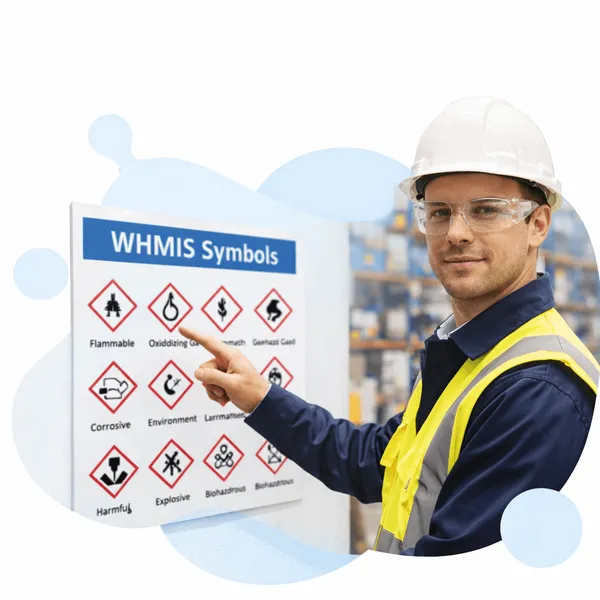
The pictogram is the quickest way to recognize a class, and these whmis symbols appear in nearly every quiz. A flame means flammable. A flame over a circle means oxidizer. An exploding bomb means explosive or self-reactive. A corrosion symbol shows a material eating through metal and skin. A gas cylinder marks gases under pressure. Keep those five in one mental group, because they cover most physical hazard questions that show up on practice tests.
The remaining health-focused symbols are just as testable. The skull and crossbones signals severe acute toxicity that can kill or seriously harm after a single exposure. The health hazard symbol, a person with a starburst across the chest, covers carcinogens, respiratory sensitizers, and organ toxicity. The exclamation mark flags less severe effects such as irritation and skin sensitization. Many students confuse the skull with the health hazard symbol, so study that pair first.
WHMIS also has a symbol you will not find in OSHA or most other GHS systems: the biohazardous infectious materials pictogram, three crescents joined in a ring. It applies to organisms or toxins that cause disease in people or animals, such as certain bacteria and viruses. If a question asks which pictogram is specific to Canada, this is the correct answer. The environment pictogram exists in GHS, but Canada does not require it on labels.
Signal words add a second layer of meaning, and the answer key is short: Danger indicates the more severe hazard, and Warning indicates the less severe one. A label shows only one signal word, never both. If a product carries hazards of different severity, the label uses Danger. Quizzes love this edge case, so memorize it along with the fact that some low-hazard categories carry a pictogram but no signal word.
Hazard statements are the standardized sentences that follow the signal word, such as Highly flammable liquid and vapour or Causes serious eye irritation. Precautionary statements tell you what to do about it, covering prevention, response, storage, and disposal. A frequent exam question asks which statement type tells workers to keep away from heat. That is a precautionary statement, specifically a prevention statement, while the hazard statement describes the nature of the danger.
For deeper background, read the definition of whmis labels and how supplier label elements are arranged. Then test yourself with the practice set below. A good drill is to cover the answer, name the hazard class, state the signal word, and describe one safe handling step. If you can do all three for each pictogram without hesitation, you are ready for the symbols section of any WHMIS 2015 quiz.
WHMIS 2015 AIX Safety V3 Quiz Answers by Topic
Hazard questions on the whmis 2015 aix safety course nearly always ask you to match a pictogram with a meaning or a class. The reliable approach is to name the hazard first and the picture second. For example, if a product can ignite from a spark, the flame is correct, and if it intensifies a fire by supplying oxygen, the flame over a circle is correct.
Watch for reworded stems such as Which symbol warns of a chemical that can damage skin and metals? The answer is corrosion. Another trap is the exclamation mark, which is correct for irritants and sensitizers but wrong for anything life-threatening. When two answers look plausible, choose the one that matches the severity described, because the quiz writers deliberately pair mild and severe options together.
Is a WHMIS Practice Test Better Than Searching for Answer Keys?
- +You learn the reasoning, so reworded questions no longer trip you up
- +Explanations show why wrong options fail, which builds real hazard judgment
- +Free practice sets can be repeated until you consistently score 90 percent or more
- +Concept mastery protects you in an actual spill, fire, or exposure incident
- +Timed sets mirror the pace of the graded AIX Safety quiz
- +You reduce retakes, which saves time and any retake fees your provider charges
- −Building the habit takes more upfront time than copying a posted answer
- −Practice questions may not match your provider's exact wording or order
- −Some course versions change question banks, so a single memorized list can fail
- −You must stay honest about weak areas instead of skipping hard topics
- −Practice alone cannot replace the site-specific training your employer must give
- −Free sets cover the basics, so rare edge cases may need extra reading
Pre-Quiz Checklist for the WHMIS 2015 AIX Safety Answers
- ✓Write the three pillars of WHMIS from memory.
- ✓Name all ten pictograms and one example product for each.
- ✓State the difference between Danger and Warning signal words.
- ✓List the seven supplier label elements without notes.
- ✓Explain when a workplace label is required.
- ✓Recite the 16 SDS sections or at least the key anchors.
- ✓Practice finding first aid and PPE data on a real SDS.
- ✓Score 90 percent or higher on two separate practice sets.
- ✓Review every missed question and write the correct reasoning.
- ✓Keep your certificate or completion record somewhere easy to find.
Hazard communication means three things working together
Labels give a quick warning, safety data sheets give the full detail, and worker education makes sure people can use both. When a quiz option seems to rely on only one of those, it is usually incomplete. Choose the answer that connects all three and you will be right far more often.
WHMIS Labels and SDS Answer Key Explained
Start with supplier labels, because they are the foundation of most label questions. A supplier label must be on the container, in English and French in Canada, and must show the seven required elements. Suppliers include manufacturers, importers, and distributors who sell hazardous products to workplaces. The key answer to remember is that the supplier is responsible for classifying the product and creating the label, while the employer is responsible for keeping it readable once the product is in use.
The product identifier is the brand name, chemical name, or code that matches the name on the SDS. That match is exam-worthy, because it is how a worker moves from a container to the right sheet. The initial supplier identifier gives the name, address, and phone number of the first supplier. Supplemental label information covers extra details such as physical state or mixing instructions. These two elements are the easiest to forget, so rehearse them with the other five.
Workplace labels deserve their own attention. When an employer pours a product into a spray bottle or a smaller container, the new container needs a workplace label unless the contents are used right away by the person who decanted them and the product is fully consumed in one shift. A correct workplace label includes the product identifier, safe handling instructions, and a statement that an SDS is available. Quiz writers often test the decanting scenario.
Next comes the safety data sheet. Its sixteen sections run from identification through to other information, always in the same order. Section 3 lists composition and ingredients, section 10 stability and reactivity, section 12 ecological information, section 13 disposal, section 14 transport, and section 15 regulatory information. Because the order never changes, you can find the answer to a practical question in seconds. That consistency is precisely why training stresses structure over memorizing content.
Do not confuse hazard information with exposure limits. Section 8 of the SDS lists exposure controls and personal protective equipment, and it may cite occupational exposure limits set by regulators or industry bodies. Section 11 lists toxicological data, including how a chemical enters the body. If a question asks where to read routes of exposure, section 11 is the match, while a question about respirators or gloves points back to section 8.
Suppliers must keep SDSs accurate, and employers must keep them accessible. In practice, that means a binder, a shared drive, or a digital system workers can reach without asking permission, on every shift. If an SDS is missing, the employer must request it from the supplier. A common test answer is that workers must be able to see the SDS at any time without delay. A locked cabinet in a manager's office would fail that standard.
US readers can compare this with OSHA HazCom 2012, which uses the same sixteen sections and nearly identical pictograms. The main differences are the biohazard symbol, the non-mandatory environment pictogram in Canada, and some terminology such as supplier labels versus OSHA's shipped container labels. Knowing both frameworks makes it easier to answer a question written for one system while you are used to the other, especially on cross-border jobs.
Many websites still post answers written for the old WHMIS 1988 system, with symbols like the dangerously reactive test tube and MSDS terminology. Those answers are outdated. Use only WHMIS 2015 material, which uses GHS pictograms, safety data sheets, and the supplier label elements described above.
WHMIS Certificate, Training, and Worker Responsibilities
People often ask to define whmis in terms of what the course really delivers, and the practical answer is a whmis certificate showing you completed hazard communication education. The certificate is typically issued by your employer or an approved training provider after you pass a final quiz. It proves you were trained, but it does not prove competence for every product at every site, which is why employers also add workplace-specific instruction on top of general WHMIS knowledge.
WHMIS education has two components. General education covers the system itself: hazard classes, labels, SDSs, and your rights. Site-specific training covers the actual products at your workplace, how to handle them, what controls are in place, and what to do in an emergency. A common quiz answer is that employers are responsible for providing both, and that general training from a previous job does not satisfy the site-specific portion at a new one.
Workers have three core rights that appear on nearly every quiz: the right to know about hazards, the right to participate in health and safety activities, and the right to refuse unsafe work. The right to refuse follows a defined process. You report the concern to your supervisor, the employer investigates, and if the issue is not resolved you may escalate to a health and safety committee or a government inspector. Retaliation for exercising these rights is prohibited.
Employer duties are the mirror image. Employers must make sure hazardous products are properly labeled, maintain current SDSs, provide education and training, and review the program regularly. In many jurisdictions they must also develop an inventory of hazardous products and consult with the joint health and safety committee. If a question asks who ensures labels remain legible at a workplace, the correct answer is the employer, not the supplier.
Supplier duties come before any of this. Suppliers classify products, create supplier labels, prepare SDSs, and provide both with the product at the time of sale. They are also expected to update the SDS when significant new hazard information becomes available. When a quiz asks who first notices that a product label is missing, the answer is the worker or employer, but who must supply a replacement is the supplier on request.
How long does a certificate last? There is no single national expiry date, because requirements are set by provinces, territories, the federal government, and individual employers. Many employers require annual refreshers, and others accept three years. If your certificate is for a US job tied to Canadian operations, check the policy of the host site. When in doubt, retrain whenever products, procedures, or hazards change, since that is the principle regulators care about most.
Finally, remember worker responsibilities. You are expected to take part in training, follow safe work procedures, use the required protective equipment, and report any damaged labels, missing SDSs, or unsafe conditions. Quiz writers frequently ask what a worker should do first when a container is unlabeled. The safe answer is to stop, avoid using it, and report it to a supervisor so it can be identified or removed.
Final Prep Tips Before You Take the Quiz
The best final-week strategy is spaced repetition. Take a practice set on day one, review mistakes, and retake a different set on day three. Return to the first set on day five. This pattern moves facts from short-term memory into durable recall. For WHMIS, that means the pictograms, the seven label elements, and the sixteen SDS sections will still be there when your quiz timer starts instead of fading after one evening of cramming.
Use comparison pairs to fix common confusions. Study the skull and crossbones next to the health hazard symbol, the flame next to the flame over a circle, and the exclamation mark next to corrosion. For each pair, write one sentence that explains the difference. Doing this on paper takes about ten minutes and eliminates many of the wrong answers that otherwise cost people points on multiple-choice questions with similar options.
Read each question twice, and underline qualifiers such as always, never, first, or most severe. WHMIS quizzes use those words to separate a correct answer from a nearly correct one. For example, Danger is not simply a stronger warning, it is the signal word reserved for the more severe hazard category. If an option uses absolute language and you can think of one exception, that option is usually the trap answer.
Apply the knowledge to a real product. Pick a bottle of bleach, drain cleaner, or paint thinner and examine the label. Identify the pictograms, the signal word, one hazard statement, and one precautionary statement. Then search for its SDS online and find sections 4, 7, and 8. This ten-minute exercise gives context to abstract terms, and learners who do it typically report that quiz scenarios feel familiar instead of theoretical.
On quiz day, manage time and stress. Answer questions you know first, flag the uncertain ones, and return after you have secured the easy points. Do not change an answer unless you can state a specific reason, because first instincts are usually grounded in what you studied. Make sure your connection and device are stable, and keep your account details handy so your certificate is issued without delay once you pass.
If you want a refresher on terminology, the guide to whmis what does it stand for and how those words connect to symbols and labels is a good last stop. It reinforces the vocabulary you will see in questions, from supplier to workplace label, so the wording of a stem never catches you off guard. A few minutes of vocabulary review often pays off on exam day.
Lastly, treat the certificate as a starting point. After you pass, keep learning at work by reading the SDS for new products before first use, checking labels each shift, and asking your supervisor when something looks unfamiliar. Hazard communication only works when people use it daily. The habits you build while preparing for this quiz are the same ones that prevent injuries, so carry them into every task involving chemicals.
WHMIS Questions and Answers

WHMIS 2015 Symbols Quiz: Complete Study Guide & AIX Safety Certification Prep

Free Printable WHMIS Labels: Requirements, Symbols, and Training Guide

WHMIS Quiz Answers: Complete WHMIS 2015 AIX Safety V3 Practice Guide

Alcohol Based Hand Sanitizer WHMIS: Symbols, Labels, and Workplace Duties
Take the WHMIS (Workplace Hazardous Materials Information System) Test
Written and edited by Nathan Beja, founder of Practice Test Geeks, with AI assistance. We have not yet matched this exam's facts to an official source, so confirm fees, dates and rules with the exam body. Editorial policy