
PIAA Baseball Umpire Practice Test: Complete Study Guide for Certification
Ace your PIAA baseball umpire practice test ✅ Free quizzes, rules coverage, signals, positioning & certification tips for new & returning umpires.

A strong score on the PIAA baseball umpire practice test is the single best predictor of whether you will pass the official certification examination on your first attempt. The Pennsylvania Interscholastic Athletic Association — along with dozens of other state athletic associations — administers written rule-knowledge tests each season, and candidates who study with realistic practice questions consistently outperform those who rely on rulebook reading alone. Understanding how to study smart, which topics carry the most weight, and where most candidates lose points is the foundation of effective test preparation.
Umpire certification exams are not designed to trick you; they are designed to confirm that you understand how to apply the Official Baseball Rules in real game situations. Questions about interference, obstruction, the infield fly rule, balks, and base-running edge cases appear frequently because these are exactly the situations where an uninformed call can change the outcome of a game. Knowing the rule is not enough — you must also know when and how to apply it under pressure, which is why scenario-based practice questions are far more valuable than simple definition flashcards.
Most state associations model their written examinations closely on the content published in the Official Baseball Rules (OBR) and the relevant federation adaptations. The PIAA specifically uses the NFHS Baseball Rules Book, which contains modifications unique to high school play. If you are preparing for a PIAA examination, you should own and read the current NFHS rulebook, but you should also supplement that reading with an umpire practice test that mirrors the style and difficulty of real exam questions.
Before diving into study strategies, it helps to understand the landscape of umpire certification in the United States. Every state has its own athletic association or umpire association that sets examination standards, but most align with either NFHS rules (for high school) or OBR (for amateur adult leagues). Some local associations also administer their own rules clinics and written tests before allowing new officials to work games. Knowing which rulebook governs your examination is the very first step, and it is a step that far too many first-time test takers skip.
The good news is that the core content tested across virtually all umpire certification programs overlaps substantially. Whether you are preparing for a PIAA exam, a local Little League training session, or an adult amateur league rules test, questions will cluster around the same high-frequency topics: ball and strike mechanics, fair and foul determinations, the force play versus tag play distinction, interference and obstruction rules, the infield fly rule, and balk rules. Mastering these clusters will serve you on any certification exam and on every game you work for the rest of your career.
Practice tests serve a dual purpose. First, they expose gaps in your knowledge before you sit for the real exam — gaps you can then close with targeted rulebook study. Second, they train you to read questions carefully, identify the controlling rule, and eliminate wrong answers systematically. Many certification exam questions are designed to test whether you know the exception to a rule rather than the rule itself, so exposure to that question style is invaluable before exam day. Each practice session should be treated like the real thing: timed, quiet, and completed without the rulebook open.
This guide will walk you through everything you need to know to prepare effectively: the structure of typical umpire certification exams, the highest-weight topic areas, proven study strategies, a preparation checklist, and answers to the most frequently asked questions from candidates. Whether you are a brand-new candidate attending your first rules clinic or a returning umpire brushing up on rule changes for the new season, the resources on this page will help you walk into exam day with confidence and walk out with a passing score.
PIAA Baseball Umpire Certification by the Numbers

Umpire Certification Exam Format
| Section | Questions | Time | Weight | Notes |
|---|---|---|---|---|
| Rules Knowledge | 40 | 48 min | 40% | OBR / NFHS rule definitions and applications |
| Game Situations | 35 | 42 min | 35% | Scenario-based calls and rulings |
| Mechanics & Positioning | 15 | 18 min | 15% | Crew coordination, positioning zones |
| Signals & Communication | 10 | 12 min | 10% | Standard umpire hand signals and verbalizations |
| Total | 100 | 2 hours | 100% |
The highest-weight topics on every umpire certification exam share a common characteristic: they involve rules that are frequently misapplied in actual games. Interference and obstruction together account for a disproportionate share of examination questions because these rules are genuinely complex.
Type 1 obstruction (when a fielder obstructs a runner who is being played on) carries an automatic award of the base being attempted, while Type 2 obstruction (when a runner is not being played on) results only in protection — the umpire allows the play to conclude and then makes an award if the obstruction affected the runner. Many candidates blur these two categories and lose multiple points as a result.
The infield fly rule is another perennial high-frequency topic.
Candidates must know all four conditions that must be met before the rule can be invoked: fewer than two outs, runners on first and second or bases loaded, a fair fly ball that an infielder can catch with ordinary effort, and the umpire must invoke it by calling "Infield fly, batter is out." The most common errors involve misidentifying who qualifies as an infielder for purposes of this rule (an outfielder who has moved into shallow infield territory may qualify) and forgetting that the runners may advance at their own risk once the ball is either caught or dropped.
Balk rules are another significant examination topic, particularly because the NFHS rules for high school play differ in one key respect from the OBR: under NFHS rules, there is no balk with a runner on base if the pitcher steps off the rubber before throwing to a base, and the penalty is assessed differently in some situations. Candidates preparing for a PIAA exam must be fluent in NFHS balk rules specifically, not just the OBR version they may have learned from watching professional baseball. Reading the current NFHS rulebook section on pitching requirements is essential preparation.
Fair and foul determinations seem simple but generate a surprising number of incorrect exam answers. The controlling factor is not where the ball lands, but where it is when it passes first or third base or where a fielder touches it. A batted ball that lands in foul territory beyond first base but rolls back and crosses first base in fair territory is a fair ball.
A ball that is touched by a fielder while it is in foul territory is foul, regardless of where it was heading. A line drive that clears the foul pole — even if it lands beyond the stadium — is a fair ball and a home run. Working through dozens of scenario questions on these topics will sharpen your instincts considerably.
Base-running rules, including force plays, tag plays, appeal plays, and the running lane rule, constitute another major cluster. Candidates must understand that a force play is removed when a runner advances beyond the base to which they were forced. They must know that an appeal must be made before the next pitch or before the infielders leave fair territory at the end of a half-inning.
They must understand that the running lane on the last half of the path to first base applies only to batters running out a batted ball, not to runners returning to first after tagging up. Each of these nuances is fair game on a certification exam.
Pitch and strike zone rules, including the dropped third strike, the hit batter rule, and the foul tip versus foul ball distinction, round out the major topic clusters. The dropped third strike rule catches many candidates because it applies only when first base is unoccupied or when there are two outs — it does not apply if a runner is on first base with fewer than two outs, because that would allow the catcher to create a force play intentionally.
Understanding the reason behind a rule often makes it easier to remember the exact conditions under which it applies, so whenever you encounter a rule that seems arbitrary, look for the underlying logic.
Mechanics and positioning questions, while constituting only 15 percent of the typical exam, reward candidates who understand the principles behind positioning rather than just memorizing diagrams. The key principle is that every umpire should be positioned to see both the fair/foul line and the play at the nearest base simultaneously whenever possible.
In a two-umpire crew, the plate umpire has primary responsibility for plays at first base when the field umpire goes to the outfield, and the field umpire rotates to cover third and home. Knowing these rotation principles makes it possible to answer positioning questions correctly even when they describe scenarios you have not explicitly memorized.
Umpire Certification Study Strategies by Topic
The most effective way to study rules knowledge is to read the rulebook in small sections and immediately test yourself with scenario questions on each section before moving on. Start with the definitions chapter — Rule 2 in the OBR and the comparable section in the NFHS rulebook — because precise definitions underpin every other rule. When you encounter a definition you cannot immediately apply to a game situation, write a practice scenario yourself and work through it before moving to the next definition.
After reading each section, attempt at least ten practice questions on that specific topic without the rulebook open. Record the questions you miss, identify the exact rule provision you misapplied, and re-read that provision before your next study session. This spaced-repetition approach — read, test, review errors, retest — has been shown to produce better long-term retention than passive re-reading. Candidates who follow this method consistently report feeling more confident on game situations questions than those who studied only by reading.

Online Practice Tests vs. Rulebook-Only Study: Which Works Better?
- +Exposes knowledge gaps before the real exam, not during it
- +Trains you to read and parse question stems quickly under time pressure
- +Scenario-based questions mirror actual certification exam formats
- +Immediate feedback allows targeted re-study of specific rule sections
- +Builds exam-day confidence by simulating test conditions
- +Tracks progress over multiple sessions so you can see improvement
- −Practice questions may not perfectly match your specific state's exam format
- −Over-reliance on practice tests without rulebook reading creates surface knowledge
- −Some free online tests contain outdated or inaccurate answer keys
- −Timed practice sessions can create anxiety for some candidates
- −Practice tests alone do not build the situational judgment needed on the field
- −Candidates may memorize specific questions rather than understanding underlying rules
Pros and Cons at a Glance
| Pros | Cons |
|---|---|
| Exposes knowledge gaps before the real exam, not during it | Practice questions may not perfectly match your specific state's exam format |
| Trains you to read and parse question stems quickly under time pressure | Over-reliance on practice tests without rulebook reading creates surface knowledge |
| Scenario-based questions mirror actual certification exam formats | Some free online tests contain outdated or inaccurate answer keys |
| Immediate feedback allows targeted re-study of specific rule sections | Timed practice sessions can create anxiety for some candidates |
| Builds exam-day confidence by simulating test conditions | Practice tests alone do not build the situational judgment needed on the field |
| Tracks progress over multiple sessions so you can see improvement | Candidates may memorize specific questions rather than understanding underlying rules |
Pre-Exam Preparation Checklist for Umpire Certification
- ✓Obtain the current NFHS Baseball Rules Book for the exam year and read it cover to cover at least once.
- ✓Attend your state association's required rules clinic and take notes on every rule change highlighted by the instructor.
- ✓Complete at least two full-length timed practice tests under exam conditions before your scheduled exam date.
- ✓Review all incorrect answers from practice tests and locate the specific rule section that governs each question.
- ✓Study the NFHS Case Book, focusing on interference, obstruction, the infield fly rule, and balk scenarios.
- ✓Memorize the standard umpire signals for all common calls and practice the physical motions until they are automatic.
- ✓Review two-umpire crew mechanics, including starting positions, rotation triggers, and base coverage responsibilities.
- ✓Confirm the date, location, format, and any materials allowed or prohibited for your specific association's exam.
- ✓Get eight hours of sleep the night before the exam and avoid cramming new material in the final twelve hours.
- ✓Arrive at the exam location fifteen minutes early with all required identification and registration documents.

The Single Highest-Value Study Move You Can Make
Candidates who score in the top quartile of umpire certification exams consistently report one shared habit: they worked through the NFHS Case Book answer by answer, covering the ruling before reading it, then traced every wrong prediction back to the exact rule provision. This active case-play method produces twice the retention of passive rulebook reading in the same amount of study time.
On exam day, the single most important skill is careful question reading. Umpire certification questions are often designed with two or three answer choices that are nearly identical except for one word — "may" versus "must," "immediately" versus "before the next pitch," "automatic" versus "at the umpire's discretion." Candidates who read questions quickly and select the first answer that sounds right will frequently miss questions that slower, more careful readers answer correctly. Budget at least ninety seconds per question on the first pass, then return to flagged questions with the remaining time.
The process of elimination is your most reliable tool on difficult questions. Even when you are uncertain of the correct answer, you can usually eliminate one or two choices that are clearly wrong. A choice that states "the runner is automatically out" is almost always wrong in situations involving interference by a fielder (obstruction), because obstruction typically protects the runner rather than penalizing them. A choice that states "the umpire has no authority" is almost always wrong, because umpires have broad authority to address unsportsmanlike conduct, unusual game situations, and anything necessary to maintain the integrity of the game.
Time management during the exam is simpler than most candidates expect. With 100 questions and 120 minutes, you have 72 seconds per question — more than enough time for straightforward rules questions. The danger is spending five minutes on a single difficult scenario question and then rushing through the final twenty questions.
A better strategy is to flag any question you cannot answer within ninety seconds, move on, and return to flagged questions after completing the rest of the exam. Most candidates find that returning to flagged questions with fresh eyes — after the intervening questions have activated related rule knowledge — produces better results than grinding through them in sequence.
The most common categories of test-day errors are not knowledge gaps but procedural mistakes. Reading the question stem without reading all four answer choices before selecting is one of the most frequent errors — many candidates select the first answer that seems correct without checking whether a more precise answer appears later in the list.
Another common error is changing correct answers to incorrect ones during review. Research on multiple-choice testing consistently shows that first instincts are correct more often than second-guessed answers, so change an answer only when you can specifically identify why your original answer was wrong and why the new answer is correct.
Special attention should be paid to questions that include the words "except," "not," or "all of the following are true except." These negatively worded questions are designed to catch candidates who read quickly and select the first familiar-sounding answer. Slow down on these questions, read every answer choice, and mentally confirm that each of the non-answer choices is indeed correct before selecting the exception.
A useful technique is to convert the question into a positive form — instead of asking "which of the following is NOT a condition for the infield fly rule," ask yourself "what ARE the conditions for the infield fly rule" and then identify the answer choice that does not appear on your mental list.
Scenario questions — where you are given a game situation and asked to make the correct ruling — should be approached in a structured way. First, identify all of the key facts: the count, the number of outs, where the runners are, what the batter did, and what the fielders did. Write these down in the margin if scratch paper is allowed.
Second, identify which rule or rules are triggered by those facts. Third, apply the rule step by step and arrive at a ruling before looking at the answer choices. Forming your own ruling first and then finding the matching answer choice is far more reliable than reading the choices and trying to find one that seems right.
After completing the exam, review your performance honestly regardless of whether you passed or failed. Most associations provide candidates with their scores broken down by topic area, which tells you exactly where your knowledge was strong and where it was weak. Even if you passed, identifying weak areas gives you a roadmap for ongoing development as an umpire.
The certification exam is not the end of your education — it is the beginning. Umpires who treat the exam as a floor rather than a ceiling consistently develop faster and earn assignment to higher-level games more quickly than those who stop studying once they have their certification card.
Most PIAA districts set umpire registration and rules exam deadlines in late fall, well before the spring baseball season begins. Missing the registration window typically means waiting a full year to attempt certification. Check your specific PIAA district's website for exact dates as soon as you decide to pursue certification, and register before studying so you have a firm exam date to anchor your preparation timeline.
Passing the written certification exam is the gateway to working games, but the development of a truly competent umpire happens through the accumulation of real game experience combined with ongoing study. New umpires should expect to work youth and recreational league games for at least one full season before advancing to high school junior varsity assignments, and JV experience typically precedes varsity assignments by another season or two.
This progression is not bureaucratic gatekeeping — it reflects the genuine complexity of managing a baseball game at progressively higher levels of competition, where players are faster, more physically powerful, and the stakes are higher.
One of the most valuable investments a new umpire can make in their development is joining a local umpire association and attending clinics, mechanics sessions, and observer evaluations regularly. Most state associations require continuing education for annual re-certification, but the minimum requirements are just that — minimums. Umpires who attend optional clinics, work scrimmage games with evaluators present, and seek feedback from more experienced officials develop demonstrably faster than those who meet only the minimum requirements. The relationships built in local associations also tend to lead to more game assignments, which accelerates development further.
Rule changes are published annually, and understanding the changes that apply to your examination year is critical. The NFHS publishes its rule changes each spring for the following academic year, and these changes are almost always tested on the following season's certification exams.
In recent years, changes have touched pitching regulations, time-of-game rules, and player equipment requirements. Candidates who study an outdated rulebook — even from just one year prior — may encounter questions about rules that no longer apply or miss questions about new rules they have never read. Always verify that your study materials reflect the current examination year.
The mental and interpersonal dimensions of umpiring are just as important as rules knowledge, and some state associations have begun incorporating professionalism and game management questions into their certification exams. These questions test your understanding of how to handle player and coach arguments, when and how to issue warnings, under what circumstances an ejection is mandatory versus discretionary, and how to communicate with coaches in a way that de-escalates tension rather than inflaming it. Candidates who approach these questions from the perspective of a professional game manager rather than a rule enforcer will find them significantly easier to answer correctly.
Equipment knowledge is a growing area of examination content, particularly as bat and helmet regulations have become more specific. Candidates should know the current NFHS bat certification requirements, the diameter and drop weight rules for bats at different levels of play, and the helmet certification standards. They should also know the umpire's authority to inspect equipment before and during a game and the proper procedure for removing non-compliant equipment from play. While equipment questions rarely constitute more than five percent of a certification exam, they are low-hanging fruit — a small investment of study time yields reliable exam points.
Long-term career development as an umpire follows a fairly predictable pathway for those who commit to it. After several seasons of high school varsity experience, the most ambitious and capable umpires pursue assignments to collegiate summer leagues, JUCO programs, and eventually NCAA Division III and Division II games. Each step up the ladder requires a new application, additional evaluations, and often an additional written exam.
The study habits and rules knowledge you build while preparing for your initial PIAA certification will serve you at every subsequent level, which is why investing in deep, genuine understanding of the rules — rather than just enough to pass the first test — pays dividends throughout your entire officiating career.
Resources for ongoing development are more accessible today than at any previous point in the history of umpiring. Online rules clinics, recorded mechanics sessions, case play databases, and forums where experienced umpires discuss difficult situations are all available to anyone with an internet connection.
The combination of formal study — rulebook reading, practice tests, clinics — with active game experience and ongoing engagement with the umpiring community is the proven path to certification success and long-term career advancement. Start with the practice resources on this page, commit to a structured study schedule, and approach exam day knowing that you have prepared as thoroughly as possible.
The final weeks before your umpire certification exam should follow a structured taper — heavy content review in weeks three and four, scenario practice in week two, and a combination of light review and confidence-building in the final week. Cramming new material the night before the exam is counterproductive; research on memory consolidation consistently shows that sleep is more valuable than late-night studying. The goal in the final week is to reinforce what you already know, not to learn new material under time pressure.
In the three-to-four week phase, focus on any topic areas where your practice test scores have been below 70 percent. Pull out the rulebook for those specific sections, re-read them carefully, and then work through additional practice questions on those topics until your accuracy improves. This targeted remediation is far more efficient than reviewing topics you already know well. Keep a running list of the specific rule provisions you have missed more than once — these are your personal high-risk areas and deserve extra attention in the week before the exam.
The two-week phase should be dominated by scenario-based practice questions and case plays. By this point, you should have read the rulebook at least once and have a working understanding of all major rule areas. Now the goal is fluency — the ability to apply rules quickly and accurately under exam conditions. Take at least one complete full-length practice test under timed conditions each week, score it carefully, and review every error with the rulebook open to the relevant rule before your next practice session. This deliberate review process is what separates candidates who improve rapidly from those who plateau.
In the final week, shift from intensive study to light review and mental preparation. Re-read your personal notes on high-risk rule areas, work through ten to fifteen case plays per day without the rulebook, and practice your umpire signals until they are completely automatic. Confirm all exam logistics — location, start time, required identification, permitted materials — so there are no surprises on exam day. A confident, well-rested candidate who has completed thorough preparation over three to four weeks will almost always outperform a candidate who crammed for a week but is exhausted and anxious on exam day.
After the exam, regardless of outcome, take an honest inventory of your preparation. If you passed, identify the topic areas where you were weakest and commit to strengthening them before the season begins — knowing the rules well enough to pass a written test and knowing them well enough to make confident real-time calls on the field are related but distinct competencies. If you did not pass, resist the temptation to schedule an immediate retest. Instead, spend two to three weeks doing a comprehensive review of the topic areas where you lost the most points before attempting the exam again.
The most important mindset shift for umpire candidates is understanding that certification is not the destination — it is the starting point. The written exam tests rule knowledge; actual umpiring requires rule knowledge plus positioning, mechanics, communication, game management, judgment, and composure under pressure. All of those skills develop through game experience, ongoing education, and a genuine commitment to improvement. Candidates who approach the certification process with that long-term mindset will find that the study habits they build during preparation serve them well for their entire officiating career.
Use every practice question, every case play, and every study session as an investment in the quality of your officiating, not just as a means to a passing score. The umpires who earn the respect of coaches, players, and administrators are those who know the rules deeply, apply them consistently, and continue learning throughout their careers. Your preparation for the certification exam is the foundation of that professional identity. Build it carefully, build it thoroughly, and walk into exam day knowing that you are ready to do the job right.
Sample Umpire Certification Practice Questions
Try these questions from our free Umpire Certification practice tests. The correct answer and an explanation follow each question.
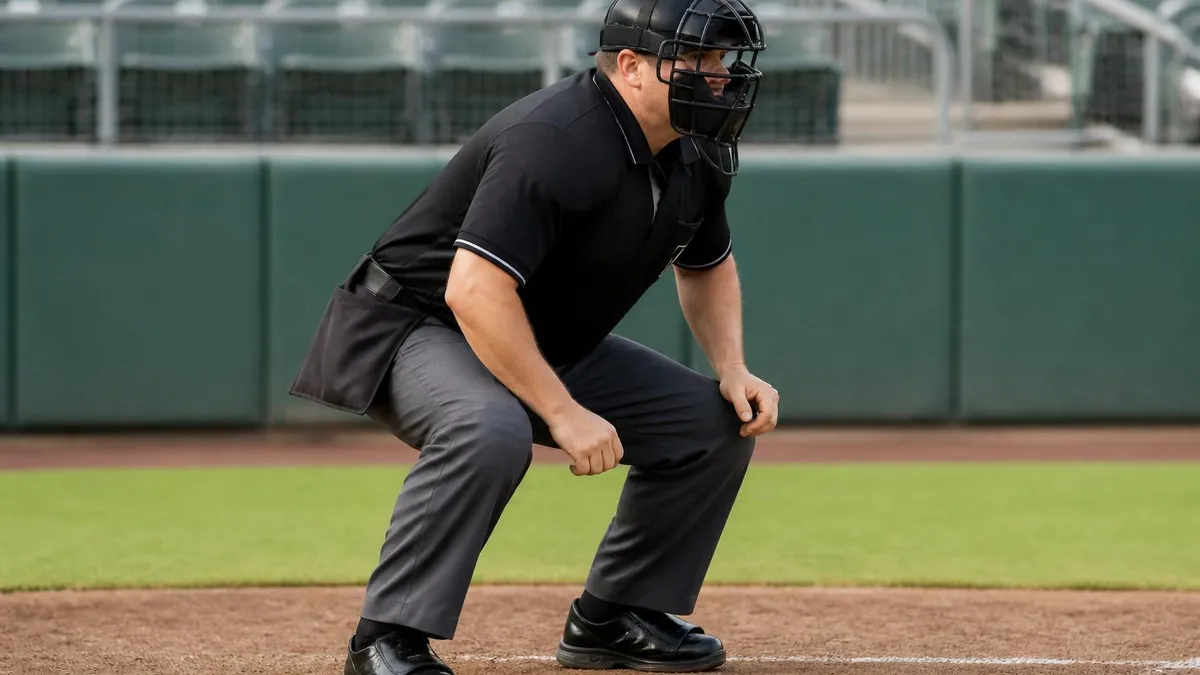
Where should a plate umpire position themselves during a pitch in baseball or softball?
- A. Directly behind the pitcher
- B. Behind the catcher, slightly offset to the slot position
- C. Near the first base
- D. Behind the shortstop
Answer: B. Behind the catcher, slightly offset to the slot position
The plate umpire's primary responsibility is to accurately call balls and strikes, and plays at home plate. Positioning behind the catcher, specifically in the 'slot' (between the catcher and batter), provides the best unobstructed view of the strike zone and the action at home plate. This optimal vantage point is essential for consistent and precise decision-making.
Which of the following is an umpire responsible for in baseball?
- A. Keeping track of player statistics
- B. Calling balls, strikes, and outs
- C. Determining the lineup order
- D. Coaching base runners
Answer: B. Calling balls, strikes, and outs
In baseball, the umpire is specifically tasked with making critical in-game decisions that directly impact play. Calling balls and strikes determines the outcome of at-bats, while calling outs dictates the progression of the game. These responsibilities are central to the umpire's role in enforcing the rules and managing the flow of baseball.
If a coach repeatedly questions the umpire's decisions, the umpire should:
- A. Argue back to defend their calls
- B. Ignore the coach entirely
- C. Issue a warning and escalate to penalties if the behavior continues
- D. Change the calls to satisfy the coach
Answer: C. Issue a warning and escalate to penalties if the behavior continues
Umpires must maintain authority and control over the game. While coaches are permitted to respectfully question calls, repeated or excessive questioning becomes disruptive and undermines the umpire's role. Issuing a warning clearly communicates that the behavior is unacceptable, and escalating to penalties like technical fouls or ejections is necessary to restore order and ensure the game proceeds without undue interference.
Who is responsible for initiating an appeal play according to proper umpire mechanics?
- A. The umpire points to the base in question to signal an appeal opportunity
- B. The plate umpire raises a hand to indicate an appeal is available
- C. The defensive team must initiate the appeal — umpires do not signal it
- D. The crew chief announces that an appeal is possible before the next pitch
Answer: C. The defensive team must initiate the appeal — umpires do not signal it
Appeals must be initiated by the defensive team — umpires do not signal or prompt appeal plays, as it is the defense's right and responsibility to choose whether to appeal.
Umpire Questions and Answers

Umpire Signals: The Complete Visual Guide to Every Call Behind the Plate and on the Bases

Umpire Positioning: The Complete Guide to Field Coverage, Mechanics, and Crew Coordination
Umpire News: Profession, Career, and Industry Updates

Umpire Jobs: A Complete Career Overview, Duties, and Path to the Field

Umpire in Arkansas: How to Get Certified, Find Games, and Build Your Career
About the Author

Educational Psychologist & Academic Test Preparation Expert
Columbia University Teachers CollegeDr. Lisa Patel holds a Doctorate in Education from Columbia University Teachers College and has spent 17 years researching standardized test design and academic assessment. She has developed preparation programs for SAT, ACT, GRE, LSAT, UCAT, and numerous professional licensing exams, helping students of all backgrounds achieve their target scores.