
Forklift Test Questions and Answers: Complete TLILIC0003 Practice Guide for Australian Operators
Master your forklift test and answers with TLILIC0003 practice questions. Real exam topics, tips & free quizzes for Australian operators. 📝

Preparing for your forklift test and answers can feel overwhelming, especially when you are not sure what the TLILIC0003 assessment actually covers. The good news is that with the right study approach, a clear understanding of the exam format, and plenty of targeted practice, most candidates walk into their assessment feeling genuinely confident. This guide breaks down everything you need to know — from the exact topics assessed in the written and practical components to the common mistakes that trip up first-time candidates across Australia every single day.
The TLILIC0003 unit, formally known as Licence to Operate a Forklift Truck, is the nationally recognised qualification required for anyone who wants to operate a forklift commercially in Australia. Whether you are looking to work in a warehouse, on a construction site, in manufacturing, or at a freight depot, this licence is your entry point. The assessment combines theoretical knowledge with a practical skills demonstration, and both components must be passed to receive your High Risk Work (HRW) licence from your state or territory regulator.
Many candidates underestimate the depth of knowledge required for the written portion of the TLILIC0003 assessment. It is not simply a matter of knowing how to drive a forklift — you need to understand load capacity calculations, stability triangle principles, pre-operational inspection procedures, workplace health and safety legislation, and the correct use of attachments and modifications. Each of these areas is assessed through scenario-based questions that require you to apply knowledge rather than simply recall facts.
One of the most effective strategies for passing your forklift test is to study using practice questions that closely mirror the style and difficulty of the real exam. When you repeatedly work through questions on topics like rated capacity, load centre distance, tilt cylinder operation, and safe travel procedures, you build both knowledge and exam confidence simultaneously. Practice tests also help you identify weak areas early, so you can focus your remaining study time where it matters most rather than reviewing material you already understand well.
For those wondering about forklift test questions and answers related to specific machine types and configurations, understanding how different forklift models behave under various load conditions is a critical part of the theoretical assessment. You will encounter questions that describe particular scenarios — such as operating on a slope, navigating through a narrow aisle, or handling an oversized load — and you must choose the safest and most correct course of action from the options provided.
This guide is structured to take you through the core knowledge areas tested in the TLILIC0003 assessment, provide realistic sample questions with explanations, and give you a proven study framework that has helped thousands of Australian candidates earn their forklift licence on the first attempt. Whether you have two weeks or two months before your assessment date, the strategies and resources here will help you make the most of your preparation time and walk in ready to succeed.
Australia's workplace safety regulators take forklift licensing seriously for good reason — forklifts are involved in a significant number of serious workplace injuries and fatalities each year. By thoroughly understanding the safety principles tested in your TLILIC0003 assessment, you are not just ticking a regulatory box. You are developing the knowledge and habits that will keep you, your colleagues, and your workplace safe throughout your entire career as a licensed forklift operator.
TLILIC0003 Forklift Licence by the Numbers

TLILIC0003 Assessment Structure: What to Expect
A multiple-choice and short-answer test covering forklift principles, WHS legislation, pre-operational checks, load calculations, and safe operating procedures. Most RTOs require a minimum score of 70% to pass this component before moving to the practical assessment.
Candidates must demonstrate competency operating a counterbalance forklift under direct assessor observation. Tasks include pre-start inspection, safe load handling, stacking, destacking, and manoeuvring in confined spaces — all performed to industry safety standards.
Unlike a scored exam, the practical component uses competency-based assessment — you either demonstrate each skill satisfactorily or require further training. There is no partial credit; every required skill element must be completed safely and correctly to achieve overall competency.
Experienced operators may apply for RPL to have existing skills formally recognised. This typically involves a skills demonstration, a portfolio of evidence, and a shortened theory assessment. RPL is available through most registered training organisations across Australia.
Understanding the core knowledge areas covered in the TLILIC0003 assessment is the foundation of effective exam preparation. The theory component draws from a clearly defined body of knowledge that encompasses forklift mechanics, load science, workplace safety, and operational procedures. Knowing exactly which topics carry the most weight allows you to allocate your study time intelligently rather than trying to memorise everything equally — a strategy that rarely works and often leaves candidates feeling underprepared in areas that matter most.
Load capacity and stability are among the most heavily tested concepts in the TLILIC0003 written assessment. You will need to understand the rated capacity plate (also called the data plate or nameplate) and what each figure on it means. This includes the maximum rated capacity at a specified load centre, how capacity changes as the load centre moves forward, and how attachments affect the rated capacity. Questions in this area often present you with a scenario and ask whether a particular load is safe to lift, or what the effective capacity is when a non-standard attachment is fitted.
Pre-operational inspection is another critical topic. Before every shift, a licensed forklift operator must complete a systematic check of the machine to identify any defects or hazards that could make it unsafe to operate. Your assessment will test your knowledge of what items must be checked — including tyres, forks, mast chains, hydraulic hoses, brakes, lights, horn, and seatbelt — as well as what action to take if a defect is found. The correct answer is almost always to tag the machine out of service and report the defect to a supervisor before operating it.
Workplace health and safety legislation features prominently in the theory assessment. You must understand the duties of operators, employers, and PCBUs (Persons Conducting a Business or Undertaking) under the Work Health and Safety Act as it applies in your state or territory. Questions may ask about the operator's obligation to refuse to perform unsafe work, the requirement to follow safe work procedures, and the correct response to a workplace incident involving a forklift. Having a solid grasp of these legal obligations is not just important for passing the exam — it is essential for operating responsibly throughout your career.
Forklift stability is a concept that underpins many of the safety procedures tested in the assessment. The stability triangle principle describes the three points of support that keep a counterbalance forklift upright — the two front wheels and the rear steer axle pivot. When the combined centre of gravity of the forklift and its load falls outside this triangle, the machine will tip. Questions about stability often involve scenarios where the operator is travelling with a raised load, negotiating a turn at speed, or operating on an uneven surface — all situations that increase the risk of tipping.
Travelling procedures are tested in both the theory and practical components. Candidates must know the correct load height for travel (typically 200–300mm above ground level), how to approach and negotiate ramps, how to travel in reverse when the load obscures forward vision, and the appropriate speed for different operating environments. Speed limits in warehouse and pedestrian areas, the proper use of spotters, and communication protocols for shared traffic zones are all fair game in the written assessment.
Emergency procedures form another testable knowledge area. You will be assessed on what to do if a forklift starts to tip over — the correct response is to hold on, brace, and lean away from the direction of fall rather than attempting to jump clear. You should also know the correct procedure for a fuel or hydraulic fluid spill, what to do if a load shifts unexpectedly during transport, and how to respond if the forklift stalls on a ramp. Each of these scenarios has a clearly correct answer that is based on established safety principles rather than personal judgement.
Forklift Test Topics: Practice by Knowledge Area
Load capacity questions are consistently among the most challenging for first-time TLILIC0003 candidates. You need to understand how to read the rated capacity plate, calculate the effective capacity with a non-standard load centre, and determine whether a given load is safe to lift. For example, if a forklift is rated at 2,500kg at a 500mm load centre but the load centre of your pallet is 600mm, the safe working load will be reduced — and you must be able to work out by how much using the moment principle.
Practice questions in this category typically present a scenario with a data plate, a load description, and four answer choices. The key is to identify the load centre distance first, then apply the capacity formula or refer to the extended capacity table if provided. Remember that any attachment — such as a side-shift, rotator, or bale clamp — adds its own weight and shifts the load centre, further reducing the effective capacity. Many candidates lose marks by ignoring attachment weight, so always factor it in when answering capacity questions.

Practice Tests vs. Textbook Study: Which Works Best for TLILIC0003?
- +Practice tests expose you to the exact question style used in the real TLILIC0003 written assessment
- +Repeated practice builds speed and confidence under time pressure
- +Instant feedback helps you identify weak areas immediately rather than after the real exam
- +Scenario-based practice questions develop applied thinking, not just rote memorisation
- +Online practice tests are available 24/7, allowing you to study at your own pace and schedule
- +Tracking your practice test scores over time shows measurable progress and builds exam confidence
- −Practice tests alone may not cover the full depth of TLILIC0003 knowledge if questions are too surface-level
- −Some free practice resources contain outdated or inaccurate information that could mislead candidates
- −Without textbook context, you may learn the right answer without understanding why it is correct
- −Over-reliance on practice tests can create false confidence if the real exam uses different scenario framing
- −Practice tests do not prepare you for the practical skills demonstration component of the assessment
- −Candidates who only practice familiar topics may neglect less comfortable but equally testable areas
TLILIC0003 Pre-Assessment Preparation Checklist
- ✓Complete at least three full practice test sessions covering all TLILIC0003 knowledge areas
- ✓Study the rated capacity plate and practise load centre distance calculations until confident
- ✓Memorise the full pre-operational inspection sequence in the correct order
- ✓Review the stability triangle principle and understand which operating conditions increase tip-over risk
- ✓Study travelling procedures including correct load height, ramp protocols, and speed requirements
- ✓Understand the correct response to an overturning forklift (brace, hold on, lean away — do not jump)
- ✓Review WHS legislation covering operator duties, right to refuse unsafe work, and incident reporting
- ✓Practise reading and interpreting forklift data plates including load capacity tables
- ✓Understand how common attachments (side-shift, rotator, clamp) affect rated capacity
- ✓Arrive at your assessment with your photo ID, any required enrolment documentation, and appropriate PPE
The Most Commonly Failed Topic: Load Centre Distance
In independent analysis of TLILIC0003 assessment results, load centre distance calculations and rated capacity reductions are the single most common source of incorrect answers in the written theory component. Spend at least 30% of your study time on capacity plate interpretation and load moment calculations — this investment pays dividends across multiple question types and is directly relevant to real-world forklift operation safety.
Even well-prepared candidates make avoidable mistakes on their TLILIC0003 assessment. Understanding the most common errors — and the reasoning behind the correct answers — is one of the highest-value things you can do in the final days before your exam. These mistakes are predictable, they appear across multiple question types, and once you know the pattern, you will recognise it clearly and choose the right answer every time instead of second-guessing yourself under exam pressure.
The most frequent mistake is choosing answers that sound practically reasonable but violate safety principles or legislative requirements. For example, when a question asks what to do if you discover a hydraulic leak during a pre-operational inspection, the practically tempting answer might be to complete the pre-start checklist and report the leak at the end of the shift. The correct answer, however, is to immediately take the forklift out of service, attach a danger tag, and report the defect before commencing operation. Safety always takes priority over productivity in TLILIC0003 assessment logic.
Another common mistake involves questions about operating on slopes and ramps. Many candidates instinctively choose to travel with the load facing uphill in all situations, but this is only correct when the load would obstruct forward vision. If the load is small and visibility is clear, the correct approach may differ depending on the specific scenario. Always read slope-related questions carefully and look for information about load size, visibility, and gradient. The specific conditions described in the question are there for a reason — they change the correct answer.
Questions about refuelling and battery charging are also frequently mishandled. Candidates sometimes underestimate the safety requirements for these procedures. LPG forklift refuelling, for instance, must be performed in a designated area away from ignition sources, with the engine turned off, and by an operator who has been trained in the specific refuelling procedure. Battery charging for electric forklifts requires adequate ventilation to disperse hydrogen gas, and chargers must be used in accordance with the manufacturer's instructions. Both scenarios carry significant safety risks that assessors expect candidates to take seriously.
Pedestrian management questions trip up candidates who are unfamiliar with traffic management plan requirements. In workplaces where forklifts and pedestrians share space, operators have specific obligations — sounding the horn at intersections, giving way to pedestrians at designated crossings, and following posted speed limits. Questions may describe a situation where a pedestrian enters the operating area unexpectedly, and the correct response is to stop immediately and wait until the area is clear before proceeding — not to slow down and proceed carefully, as many candidates initially assume.
Stack height and racking questions require knowledge of manufacturers' load ratings and the importance of storing loads correctly on shelving and racking systems. Overloading a single shelf bay or placing a load off-centre can cause cascading racking failures that result in serious injury. Assessors expect candidates to know that racking load ratings must never be exceeded and that any suspected damage to racking must be reported and the affected section taken out of service immediately rather than simply used more carefully.
Finally, many candidates underperform on questions about refusal of direction. The TLILIC0003 assessment is very clear that operators have both the legal right and the professional obligation to refuse any instruction that would require them to operate unsafely. This applies even when the instruction comes from a supervisor, manager, or site owner. The correct answer to any question describing an unsafe direction is to refuse, explain the safety concern clearly, and follow the workplace's escalation procedure. Choosing the option that involves complying with the unsafe instruction — even partially — is always wrong in this context.

Many TLILIC0003 candidates focus heavily on the written theory test and neglect practical preparation, assuming that prior forklift experience is sufficient. However, assessors look for specific safety behaviours — such as three points of contact when mounting and dismounting, seatbelt usage at all times, and correct load positioning — that must be demonstrated consistently. Even experienced operators can fail the practical assessment by reverting to habits that do not meet formal competency requirements.
The practical assessment component of TLILIC0003 is where many candidates experience their greatest anxiety — and where thorough preparation makes the biggest difference. Unlike the written test, where you can review and change your answers, the practical assessment is observed in real time. Every action you take is evaluated against the competency standard, and unsafe behaviours can result in an immediate stop to the assessment. Understanding what assessors look for and practising those specific behaviours during your training will dramatically improve your chances of passing on the first attempt.
Mounting and dismounting the forklift correctly is one of the first things assessors observe, and it sets the tone for the entire assessment. The correct procedure involves maintaining three points of contact at all times — meaning two hands and one foot, or two feet and one hand, are always in contact with the machine.
Never jump down from the cab, never mount while the engine is running unless instructed to do so, and always check that the area is clear before dismounting. These small procedural steps demonstrate safety awareness and professional conduct from the very first moment of your assessment.
Seatbelt use is non-negotiable. Assessors will fail candidates immediately if they operate the forklift without wearing the seatbelt. Before starting the engine, fasten the seatbelt. Before dismounting, turn off the engine and release the seatbelt. This sounds simple, but under assessment pressure, candidates sometimes rush through the startup procedure and forget. During practice, build the habit of touching the seatbelt clip as a physical reminder before every engine start — this tactile cue will carry through into your actual assessment without conscious thought.
Load handling technique is assessed across multiple tasks, including picking up a pallet from the floor, placing a load on a rack, and moving a load through a designated course. Assessors look for smooth, controlled hydraulic movements, correct mast tilt positioning, and appropriate travel speed at all times.
When picking up a load, approach squarely, insert the forks fully, tilt back slightly to secure the load, and lift only as high as necessary for safe travel. When placing a load on a rack, approach the designated bay, position carefully, level the mast, place the load gently, and withdraw the forks without disturbing adjacent loads.
Communication with spotters and other workers in the area is also assessed. In situations where your forward vision is obstructed, you must travel in reverse and use a spotter if one is available. Make eye contact with your spotter before moving, use agreed hand signals, and always maintain sight of your spotter. If you lose sight of your spotter for any reason, stop immediately. Assessors want to see that you understand the collaborative nature of safe forklift operation and can work effectively within a team environment rather than treating the forklift as an isolated task.
Parking and shutdown procedures are assessed at the end of the practical component. When parking the forklift, lower the forks fully to the ground, apply the parking brake, tilt the mast forward slightly so the fork tips rest on the ground, and shut down according to the manufacturer's procedure. In an LPG forklift, this includes turning off the cylinder valve before shutting off the engine. For electric forklifts, plug in the charger immediately after parking if the battery level requires it. These steps demonstrate that you understand the full operational cycle, not just the movement phase.
If you are approaching your practical assessment and still building confidence, consider requesting additional supervised practice time from your RTO. Most registered training organisations are willing to accommodate candidates who need extra machine time before the formal assessment — it is far better to delay slightly and pass comfortably than to rush through and require a reassessment. Every hour of additional practice translates directly into smoother, more confident performance on assessment day, and assessors can clearly tell the difference between a candidate who has genuinely practised and one who is performing a procedure for the first time under observation.
In the final week before your TLILIC0003 assessment, your preparation strategy should shift from learning new material to consolidating what you already know and building exam-day confidence. This is not the time to panic and try to cram new information — it is the time to review your weakest areas, complete timed practice tests under realistic conditions, and ensure that your practical procedures are smooth and automatic rather than effortful and deliberate. A calm, systematic approach in the final days is far more valuable than frantic last-minute cramming.
Start your final week review by identifying the three knowledge areas where your practice test scores are lowest. These are your priority focus areas. For each topic, read through the relevant section of your course materials, work through a targeted set of practice questions, and review the explanations for any questions you get wrong. Understanding why an answer is wrong is often more valuable than simply memorising the correct answer, because it builds the reasoning framework you need to handle unfamiliar question variations on the real exam.
Timed practice tests are an essential part of final-week preparation. Set a timer and complete a full practice test without pausing or looking anything up. This simulates the real exam environment and helps you develop the pacing and focus required to complete the assessment without running out of time. After the timed test, review every answer — not just the ones you got wrong. Understanding why your correct answers were correct reinforces your knowledge and builds confidence. Look for any patterns in your errors, as these often point to a specific misunderstanding that can be addressed quickly with targeted review.
On the day before your assessment, avoid intensive study. A light review of key concepts — load centre calculations, the stability triangle, pre-op inspection sequence — is appropriate, but marathon study sessions the night before can leave you mentally fatigued on assessment day. Instead, prepare practically: lay out your PPE and clothing, confirm the assessment location and start time, ensure you have all required documentation, and plan your route so you arrive at least fifteen minutes early. Arriving stressed and rushed is one of the most avoidable causes of poor assessment performance.
On assessment day itself, arrive early, introduce yourself to the assessor professionally, and listen carefully to all instructions before beginning. If you do not understand an instruction, ask for clarification — this is not a sign of weakness but of professionalism. During the written component, read every question fully before selecting an answer. Look for qualifying words like "always," "never," "first," and "immediately" — these words often determine the correct answer in safety-related questions. Do not rush, and use any remaining time to review your answers before submitting.
During the practical assessment, narrate your actions as you perform them if your assessor permits or encourages it. Saying aloud "checking forks for cracks and damage" as you inspect the forks, for example, demonstrates both your knowledge and your systematic approach. Even if you make a small error, remain calm, correct it professionally, and continue. Assessors understand that nerves affect performance and are generally looking for overall safety competency rather than perfection in every individual movement. What they cannot overlook is a genuine disregard for safety procedures, so always prioritise doing things safely over doing them quickly.
After completing your assessment, whether you pass or require additional training, take time to reflect on what went well and where you can improve. If you need to resit any component, ask your assessor for specific feedback on the areas that require further development.
Most RTOs are happy to provide guidance on what to work on before a reassessment, and targeted practice in those specific areas will significantly improve your result. The TLILIC0003 qualification is a genuine achievement that opens the door to rewarding and well-paid employment opportunities across a wide range of Australian industries — it is absolutely worth the investment of thorough preparation.
TLILIC0003 Questions and Answers

Forklift Models — Complete Guide (2026)

Forklift Tyne: Everything Australian TLILIC0003 Operators Need to Know

Forklift Refresher Course: Complete TLILIC0003 Training Guide for Australian Operators
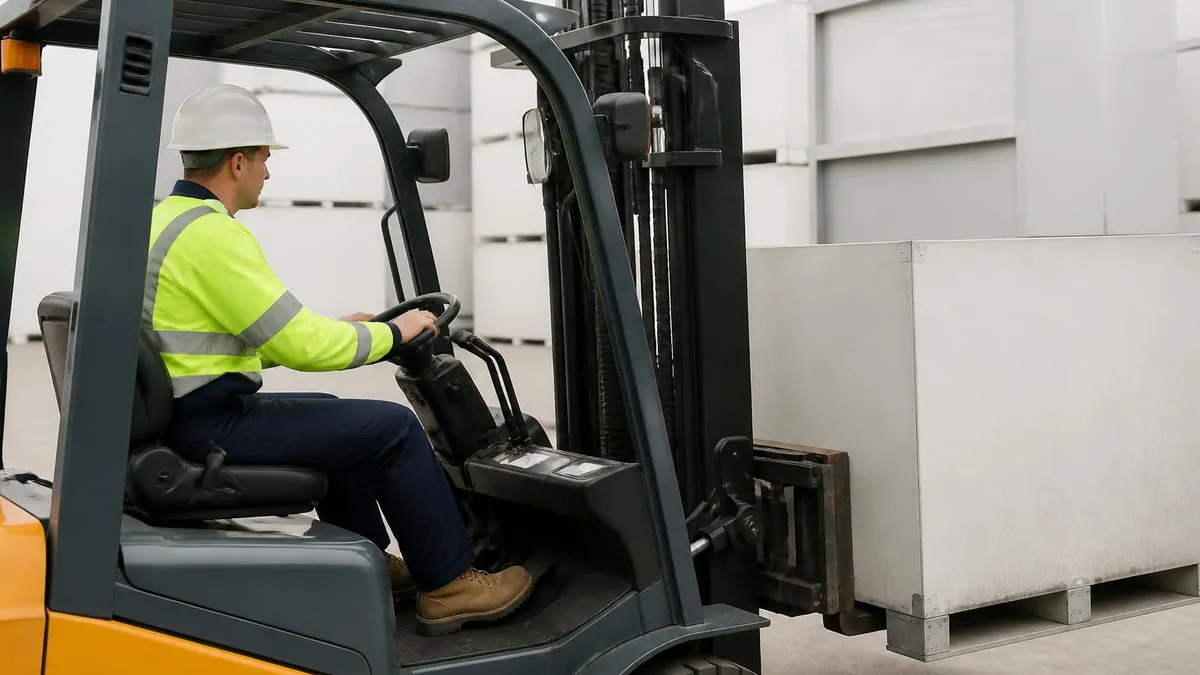
Different Forklift Types: A Complete Guide for Australian TLILIC0003 Operators

Forklift Jobs Near Me: Complete Guide to Finding Local Forklift Operator Work in Australia
About the Author

Certified Crane Operator & Skilled Trades Exam Specialist
Ferris State UniversityRobert Martinez is a Journeyman Ironworker, NCCCO-certified crane operator, and forklift trainer with a Bachelor of Science in Construction Technology from Ferris State University. He has 21 years of ironworking, rigging, and heavy equipment operation experience across high-rise and industrial construction sites. Robert prepares candidates for crane operator, rigger, forklift, and skilled trades certification examinations.