
TOEIC Past Papers and Free Practice Test Downloads: The Complete 2026 September Guide
Find real TOEIC past papers and free practice test downloads 📥, plus a section breakdown of the Listening and Reading test to guide your prep.
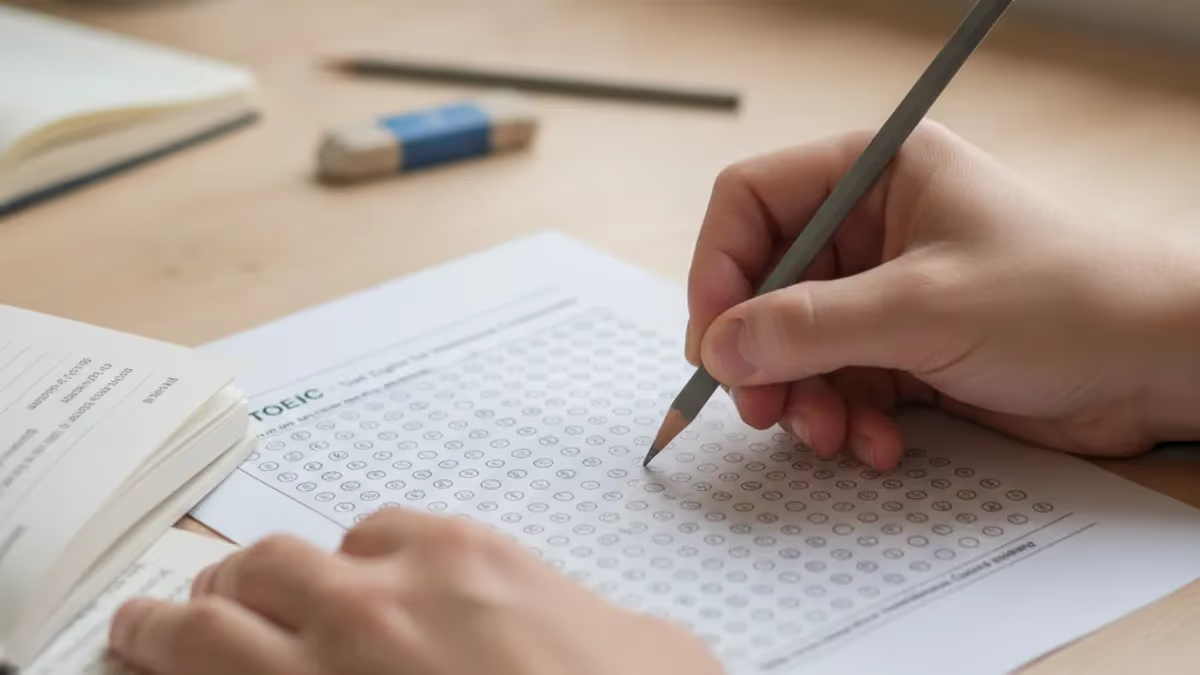
Searching for TOEIC past papers is one of the first things most candidates do once they book a test date, and for good reason: working through real question formats beats guessing at what the exam will look like. The good news is that ETS, the organization that writes the TOEIC Listening and Reading test, and IIBC, its licensed partner across Japan and Korea, both release sample material every year, and a growing library of free resources fills in the gaps.
This guide walks through where legitimate past-paper style material comes from, how the test is actually structured, and how to build a study plan around free downloads instead of paying for a stack of commercial guides you may not need. If you want a ready-made toeic practice test pdf, we cover that first, then unpack the exam itself section by section.
Whether you're prepping for a corporate placement requirement, a university admissions cutoff, or a personal score goal, the approach is the same: know the format cold, drill with authentic-style questions, and track your accuracy by section so you know exactly where the remaining points are hiding.
Many candidates start their search simply typing "TOEIC past papers" or a Japanese-language equivalent into a search engine, hoping for a single archive of retired forms. In practice, the most reliable route is a mix of official sample material plus current-format practice sets, used together rather than any single download standing in for a full course of preparation.
TOEIC Listening & Reading by the Numbers

There's no single free PDF that reproduces an actual, currently-administered TOEIC form question-for-question; ETS retires and rotates forms to protect test security, which is standard practice for any large-scale exam. What does exist, and what's worth downloading, is official sample material: ETS publishes sample questions and a downloadable audio-plus-answer-key set on its own TOEIC pages, and IIBC's 公式問題集 (official problem collections) sold in Japan and Korea are built from genuinely retired items, so they behave like real past papers even though they aren't labeled that way in English.
Beyond the official sources, a wide field of free practice sets is built by teachers and test-prep sites to mirror the same four listening parts and three reading parts, matched to current difficulty and timing. Our own toeic mock test pdf follows that same structure so you can print it, time yourself, and score it the same way the real test is scored.
When you're comparing sources, check three things: does the material match the current 200-question, two-hour format, does it include an answer key with explanations (not just answers), and is the audio for the listening parts recorded at natural conversational speed rather than slowed down. Slowed-down audio is the single most common way self-study material misleads candidates about their real listening level.
It's also worth checking the publication date on any free set you download. TOEIC updates its item styles gradually over time — question phrasing, the mix of business contexts, and even the balance of accents used in the audio (American, British, Australian, and Canadian speakers are all featured) have shifted over the years, so a set written five or six years ago may still teach the wrong instincts even if the overall format hasn't changed.
The Listening section runs about 45 minutes and covers exactly 100 questions across four parts. Part 1 (Photographs) shows six images with four spoken statements each, and you pick the one that best describes the picture. Part 2 (Question-Response) plays a question or statement followed by three spoken responses, testing whether you catch the right reply out of similar-sounding options — this part trips up more candidates than any other because there's no visual support at all.
Part 3 (Conversations) presents 13 short dialogues, each with three or four questions printed in the booklet, so you're reading ahead while listening, a skill that only improves with repeated timed practice. Part 4 (Talks) is similar but uses longer monologues — announcements, ads, and short speeches — again with multiple questions per recording.
Anyone prepping for the toeic exam should drill Parts 3 and 4 the most, since they carry the most questions per minute of audio and reward the habit of pre-reading the question stems before the recording starts.
A related skill worth building early is note-taking shorthand for Part 3 and 4 conversations — jotting down a name, a time, or a number as you hear it, rather than trying to hold every detail in memory until the questions appear. Since the questions and answer choices are already printed in the test booklet, glancing at them in the few seconds before each recording starts helps you know exactly what to listen for, which is far more effective than listening passively and hoping the answer will be obvious afterward.
Listening vs. Reading: Where Points Slip Away
Distractor answers often repeat a word from the audio out of context, or pair a correct-sounding word with the wrong tense or speaker. Candidates who translate in their head lose the thread by the second sentence of longer talks.
The fix is exposure: daily 20-minute listening drills at natural speed, followed by an immediate check against the transcript, builds the pattern recognition that slows-down audio never trains.
Registration for TOEIC Listening and Reading runs through ETS-authorized test centers or, in many countries, through IIBC or a national partner organization; test dates are typically offered monthly, sometimes twice a month in high-demand cities. Bring one form of valid government-issued photo ID that matches your registration exactly — a mismatched name or an expired ID is the most common reason candidates get turned away at check-in.
Arrive at least 30 minutes early. Test centers run through seating, ID checks, and equipment tests (for the listening audio) before the clock starts, and latecomers are frequently denied entry once the door closes, with no refund. Personal electronics, including phones and smartwatches, are typically prohibited in the test room and must be stored before you're seated.
If you're retaking the test to hit a higher score, note that TOEIC has no pass/fail line — it's a scaled score report used by employers, schools, and immigration programs, so check the specific score your program requires before you register for a retake.
Fees and exact registration windows vary by country and by the local partner organization handling test administration, so always confirm current pricing and available dates directly through your national ETS-authorized center or IIBC affiliate rather than relying on numbers from an older blog post. Most centers also offer a rescheduling option for a fee if you need to move your date, but cancellation and refund policies differ by region, so read the fine print when you register.

The Seven Parts of TOEIC Listening & Reading
36 listening questions with no reading support; tests quick aural comprehension and idiomatic responses.
64 listening questions using dialogues and monologues, each with 3-4 printed questions to pre-read.
46 reading questions on grammar, vocabulary, and completing business emails and notices.
54 questions across single, double, and triple passages — the largest single time commitment on the test.
TOEIC scores combine two independent scales of 5 to 495, one for Listening and one for Reading, added together for a total between 10 and 990 (always in multiples of 5). There's no universal passing score — instead, employers and schools set their own thresholds, commonly somewhere between 600 and 800 for professional roles that require regular English use, and higher for graduate programs or international assignments.
Scores map loosely to the CEFR framework: a total around 550-780 often lines up with B1-B2, while 945 and above typically reflects C1. If a specific program cites a CEFR level rather than a raw score, check their published TOEIC-to-CEFR conversion table directly, since mappings vary slightly by institution.
Because Listening tends to score a bit higher than Reading for most non-native speakers (audio context often gives more clues than a cold grammar question), track your two subscores separately during practice rather than only your combined total.
It's also useful to know how many correct answers roughly map to which scaled score, since the relationship isn't perfectly linear across the range. Near the middle of the scale, a handful of extra correct answers can move your scaled score noticeably more than the same number of correct answers near the very top or very bottom, which is one reason candidates in the 500-700 range sometimes see bigger jumps after a focused few weeks of prep than candidates already scoring above 900.
Free Downloads vs. Paid TOEIC Prep Books
- +No cost, so you can try multiple formats before committing to one method
- +Official ETS samples reflect the exact current format
- +Easy to redo the same set later to track improvement
- +Widely available in PDF form for printing and offline study
- +Good for a first diagnostic before deciding what to focus on
- +Pairs well with free listening audio already online
- −Free sets are limited in volume compared to a full paid course
- −Explanations are sometimes thinner than in commercial guides
- −Answer keys don't always break results out by individual part
- −Audio quality and pacing vary between free sources
- −No official score conversion or diagnostic report included
- −Harder to verify accuracy without a known publisher
Once you've found a reliable toeic test practice free pdf, the next step is turning a one-off download into a repeatable routine. Score your first attempt untimed to establish a baseline, then redo the same sections under real time limits a week later — the gap between those two scores tells you whether your issue is knowledge or speed.
Vocabulary work matters more than most candidates expect, especially for Part 5-6; building a rotating list of business-context words (invoice, quarterly, itinerary, reimbursement) pulled from whatever toeic voca sets you're using closes gaps faster than grammar drills alone, since many wrong answers on the test are vocabulary traps, not grammar traps.
Finally, treat listening practice as a daily habit rather than a weekend cram. Fifteen to twenty minutes of natural-speed English audio, five days a week, consistently outperforms a single four-hour listening marathon the night before the test.
Podcasts, workplace-focused news segments, and business-English YouTube channels all work as free listening material as long as they're spoken at a natural pace; the goal isn't finding TOEIC-branded audio specifically, but simply logging consistent minutes of real spoken English in business or semi-formal contexts, which is exactly what Parts 3 and 4 draw from.
TOEIC Prep Checklist Before Test Day
- ✓Confirm your test center address and start time the week before
- ✓Print and complete at least one full-length timed practice set
- ✓Score Listening and Reading separately, not just as one total
- ✓Review every missed question against the answer explanation, not just the key
- ✓Build a rotating vocabulary list from your weakest section
- ✓Do a 15-20 minute natural-speed listening drill daily in the final two weeks
- ✓Check your program's required score, not a generic pass/fail number
- ✓Prepare valid photo ID that matches your registration name exactly
- ✓Plan to arrive 30+ minutes early with no banned electronics
- ✓Get a full night's sleep — TOEIC has no break in its two-hour block
A common mistake is over-focusing on Part 7 because it has the most questions, while ignoring Part 2, which has no visual or textual support at all and is where non-native speakers most often lose easy points. Balance your practice time across all seven parts rather than only the ones that feel comfortable.
Another mistake is studying exclusively from translated or bilingual materials. TOEIC rewards direct English comprehension, and building the habit of thinking in English during practice — even briefly — closes the gap between your practice scores and your real test-day performance.
A third mistake is skipping review entirely after a practice set. Simply marking a question wrong and moving on wastes most of the value of the exercise; the useful step is figuring out why the wrong answer looked attractive, whether it was a vocabulary gap, a grammar rule, or a listening detail you missed, and writing that reason down so the same trap doesn't catch you twice. Candidates who keep a short running log of their most common error types tend to close those gaps far faster than candidates who just keep taking new tests without reviewing the old ones.
Time Part 7 First
Good TOEIC scores open real doors: many multinational employers in manufacturing, logistics, hospitality, and finance use a TOEIC cutoff for hiring or promotion into roles that involve regular contact with English-speaking clients or partners. Universities in several countries also accept TOEIC alongside or instead of other English proficiency tests for certain non-native-speaker programs.
Because the score is valid for two years, many professionals retake the test periodically to keep a current score on file for job applications, rather than waiting until a specific opportunity requires it. If your target score is close but not quite there, a focused four-to-six week plan built around your weakest one or two parts is usually more effective than a full retake of general prep.
Some employers and universities also accept the TOEIC Speaking and Writing tests as a companion assessment alongside Listening and Reading, particularly for roles or programs that require verbal client communication rather than just reading comprehension. If your target role involves regular spoken English with clients or colleagues, it's worth checking whether the program specifically wants the Speaking and Writing scores in addition to the more commonly requested Listening and Reading total.
For official material, start at the ETS TOEIC program pages, which list current sample questions and links to authorized test centers by country. IIBC handles registration and publishes its official problem collections directly in Japan and Korea, and many national partner organizations elsewhere maintain their own registration portals with local test dates and fees.
Keep a copy of your registration confirmation and score report once you test — most employers and schools ask for the official printed or digital score report directly from ETS or your national partner, not a screenshot, so request it as soon as your results are released.
If English isn't your first language and you're studying independently, look for a local study group or online forum tied to your test region — candidates preparing for the same national partner's test dates often share recent experiences about check-in procedures, room conditions, and which practice sets felt closest to the real thing, which can be more current and locally relevant than generic advice aimed at a global audience.
Free downloads are a legitimate and effective way to start TOEIC prep, as long as you pair them with a realistic sense of what they can and can't replicate about the real test. Use official ETS and IIBC samples to confirm format and difficulty, use free practice sets like the ones on this site to build volume and repetition, and track your two subscores separately so your study time goes where it actually helps.
With a clear plan — daily listening practice, timed full-length sets, and focused vocabulary review — most candidates can move their score meaningfully within four to eight weeks. Start with a baseline test today, and build your next few weeks of practice around whichever section needs the most work.
Keep your expectations realistic and specific: instead of a vague goal like "get better at TOEIC," set a target score tied to your actual program or job requirement, a test date to work backward from, and a weekly practice schedule you can actually sustain. Candidates who track progress with a simple spreadsheet — date, practice set, Listening subscore, Reading subscore — almost always describe the process as less stressful than those who study without measuring anything, because the numbers show real progress even on weeks that feel discouraging.
TOEIC Questions and Answers



About the Author

Educational Psychologist & Academic Test Preparation Expert
Columbia University Teachers CollegeDr. Lisa Patel holds a Doctorate in Education from Columbia University Teachers College and has spent 17 years researching standardized test design and academic assessment. She has developed preparation programs for SAT, ACT, GRE, LSAT, UCAT, and numerous professional licensing exams, helping students of all backgrounds achieve their target scores.
Join the Discussion
Connect with other students preparing for this exam. Share tips, ask questions, and get advice from people who have been there.
View discussion (8 replies)