
TOEIC Practice Exams: Complete Guide to the TOEIC Test, Format, Scoring, and Preparation
Master the TOEIC test with free practice exams, scoring breakdowns, and prep strategies. 🎯 Includes format, tips, and study plans for US test-takers.
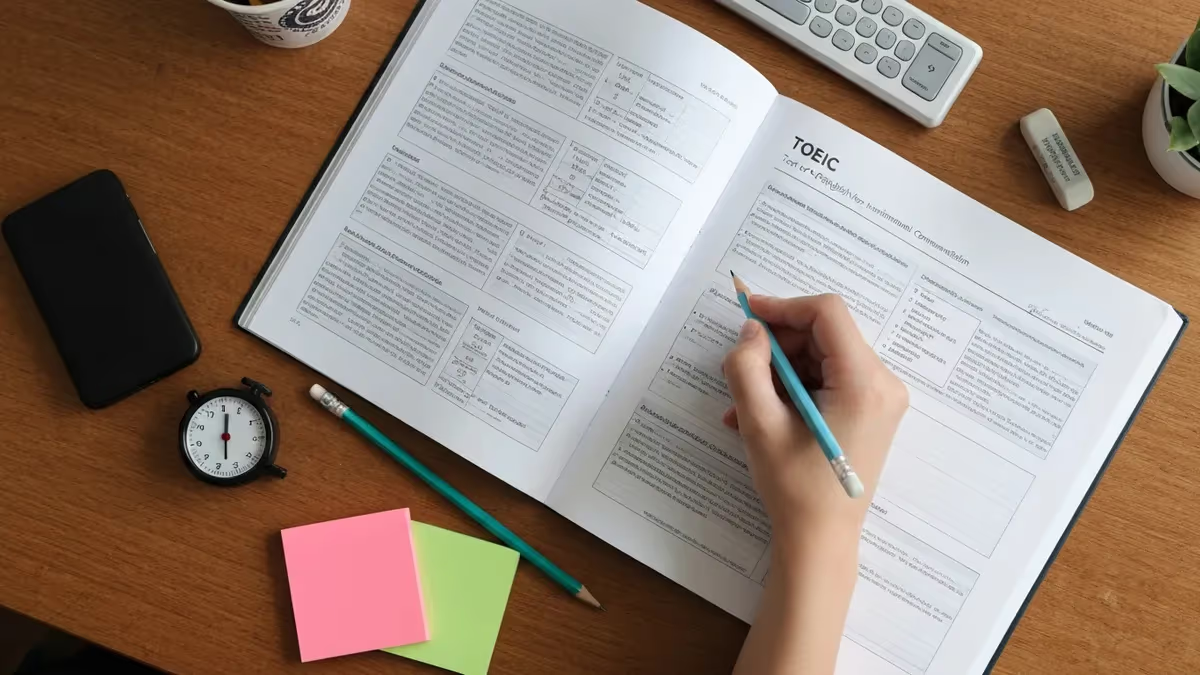
If you are preparing for the TOEIC, understanding how to use practice exams for the TOEIC test is the single most effective strategy you can adopt. The Test of English for International Communication — commonly called the TOEIC — is the world's leading English proficiency assessment for the workplace, accepted by more than 14,000 organizations across 160 countries. Whether you are applying for a multinational corporation, seeking promotion within your current company, or fulfilling a language requirement for a US-based certification program, a strong TOEIC score opens doors that other credentials simply cannot.
The TOEIC exam is divided into two main components: the Listening and Reading test, which produces scores on a 10–990 scale, and the Speaking and Writing tests, which are evaluated separately. Most employers in the United States and globally focus on the Listening and Reading TOEIC test exam, making it the section most test-takers spend the majority of their preparation time on. Familiarity with the format, timing, and question types is essential before test day arrives, and that familiarity only comes through consistent, structured practice.
One resource that experienced TOEIC instructors frequently recommend is the toeic duo study method, which pairs dedicated listening drills with simultaneous vocabulary review to maximize retention and speed. This paired approach has been shown to accelerate score gains more efficiently than isolated grammar study alone, particularly for learners in the 600–750 range who are targeting the 800-plus benchmark commonly required by top-tier employers.
Understanding what the TOEIC measures is just as important as knowing its format. The test does not assess academic English or literary comprehension. Instead, every question reflects real-world business communication scenarios: emails between colleagues, announcements over a public address system, product advertisements, financial reports, and inter-office memos. This practical orientation means that learners who immerse themselves in authentic business English content — news podcasts, corporate newsletters, and professional correspondence — gain a measurable advantage over those who rely solely on textbook exercises.
Scoring on the TOEIC follows a scaled model rather than a raw-points model. Each correct answer contributes to a raw score, which is then converted to a scaled score using equating methods that account for differences in difficulty across test forms. This means your score reflects not just how many questions you answered correctly, but how difficult those questions were relative to a standardized baseline. Knowing this, it becomes clear why practicing with materials that mirror the actual difficulty of the test — rather than oversimplified drills — is critical for accurate score prediction and genuine improvement.
For test-takers in the United States, the TOEIC is most often administered through ETS-authorized testing centers, though corporate and institutional testing arrangements are also common through the IP TOEIC program, which allows organizations to administer the test to employees on-site. This flexibility makes the TOEIC one of the most accessible English proficiency assessments available to working professionals who cannot easily take time away from their jobs to travel to a testing center on a fixed schedule.
This guide covers everything you need to know about the TOEIC — from detailed section breakdowns and TOEIC score benchmarks to a structured study schedule, expert tips, and links to free practice resources. By the time you finish reading, you will have a clear, actionable roadmap for achieving the score your career demands.
TOEIC by the Numbers

TOEIC Exam Format
| Section | Questions | Time | Weight | Notes |
|---|---|---|---|---|
| Part 1 – Photographs | 6 | ~4 min | 3% | Describe a photo using a spoken statement |
| Part 2 – Question-Response | 25 | ~12 min | 12.5% | Choose the best spoken response to a question |
| Part 3 – Conversations | 39 | ~22 min | 19.5% | Short dialogues with 3 questions each |
| Part 4 – Talks | 30 | ~17 min | 15% | Monologues with 3 questions each |
| Part 5 – Incomplete Sentences | 30 | ~15 min | 15% | Grammar and vocabulary fill-in-the-blank |
| Part 6 – Text Completion | 16 | ~10 min | 8% | Longer passages with blanks |
| Part 7 – Reading Comprehension | 54 | ~55 min | 27% | Single and double/triple passage sets |
| Total | 200 | 120 minutes | 100% |
Understanding the TOEIC score scale is essential for setting realistic goals and tracking your progress over time. The Listening and Reading test produces two separate scores — one for each section — each ranging from 5 to 495. These two scores are added together to create a total score between 10 and 990.
The test uses a scaled scoring model developed by ETS, which means that slight variations in difficulty between test forms are statistically adjusted so that a 750 on one administration is equivalent to a 750 on any other. This makes the TOEIC score a reliable, comparable metric across administrations.
Score benchmarks are typically mapped to the Common European Framework of Reference for Languages, known as CEFR. A TOEIC score of 255 or below corresponds to A1, the most basic level. Scores from 550 to 784 align with B2, which represents upper-intermediate proficiency — sufficient for most professional communication tasks. Scores of 785 and above correspond to C1, indicating advanced professional fluency. Many US-based companies that recruit internationally require a minimum TOEIC score of 600 to 700 for customer-facing roles, while technical and managerial positions often require 785 or higher.
For professionals using the tes toeic preparation pathway, it is important to distinguish between the score ranges needed for different professional contexts. Airlines, for instance, typically require pilots and cabin crew to hold a minimum TOEIC score of 700 to comply with International Civil Aviation Organization safety language standards. Financial services firms in global markets may set internal benchmarks at 800 or above. Understanding which benchmark applies to your specific career goal allows you to calibrate your preparation intensity and timeline accordingly.
One of the most common misconceptions about TOEIC scoring is that test-takers lose points for incorrect answers. This is not true. The TOEIC, like most standardized ETS assessments, does not apply a guessing penalty. Every unanswered question scores zero, so it is always in your interest to attempt every item — even when you are uncertain of the correct response. On the Reading section, where time management is often the biggest challenge, this means that intelligent guessing in the final minutes is a legitimate and advisable strategy.
The relationship between TOEIC scores and real-world communication ability is stronger than it might initially appear. Because every question is grounded in authentic business contexts — supply chain updates, HR policy announcements, client call transcripts, financial summary reports — a high score genuinely reflects the ability to function effectively in an English-language workplace.
This is in contrast to more academically oriented English tests, where high scores may reflect test-taking skill more than practical communication ability. Employers who rely on TOEIC scores understand this distinction, which is one reason the test has maintained such strong institutional trust for more than four decades.
TOEIC score reports are typically available within a few weeks of the test date for paper-based administrations, and sometimes sooner for computer-delivered tests depending on the testing center. Scores are valid for two years from the date of the test under most institutional requirements, though some organizations accept scores up to five years old for internal advancement purposes. If your score has expired, retaking the test is straightforward — there is no minimum waiting period between attempts, so you can retest immediately if your employer requires a fresh score.
For test-takers who are close to a key benchmark — say, currently scoring 740 and targeting 785 — incremental improvement strategies matter enormously. Focusing practice on Part 7 reading comprehension, which carries the highest weight of any single section, and on Part 3 conversations, which is the longest listening section, typically yields the highest return per hour of study time. Tracking your performance by part on each practice exam allows you to identify which sections are pulling your score down and prioritize accordingly.
TOEIC Test Prep Strategies by Score Goal
Test-takers in the 300–550 range should begin by building foundational business vocabulary and mastering the most common grammar patterns tested in Part 5. Aim for at least 20–30 minutes of daily TOEIC listening practice using official sample audio, focusing on identifying key nouns and verbs rather than trying to understand every word. Repetition is more valuable than variety at this stage, so replaying short audio clips multiple times before checking the TOEIC listening script is a proven method for building ear training efficiently.
For reading, concentrate on Parts 5 and 6 before attempting the longer passages in Part 7. The grammar points in Part 5 — verb tense, prepositions, conjunctions, and word form — follow predictable patterns that can be drilled systematically. Spending four to six weeks building this base before taking a full timed practice exam will prevent discouragement and give you a more accurate picture of your starting level. Track your accuracy by question type, not just overall score, so you can identify your weakest grammar categories early.

Is the TOEIC the Right English Test for You?
- +Globally recognized by 14,000+ organizations across 160 countries, making scores portable across employers and industries
- +Focuses on practical business English rather than academic or literary language, directly relevant to workplace communication
- +No guessing penalty — every item should be attempted, removing the risk of strategic omission
- +Multiple testing formats including IP TOEIC institutional testing make the exam highly accessible to working professionals
- +Scores are delivered on a continuous 10–990 scale, allowing fine-grained tracking of improvement over time
- +Widely available free and low-cost practice materials, including official ETS sample tests and online practice platforms
- −Does not assess speaking or writing in the standard Listening and Reading format — those require separate TOEIC S&W tests
- −Scores are only valid for two years under most institutional requirements, necessitating periodic retesting
- −The Reading section is heavily time-pressured — many test-takers do not finish Part 7, which can significantly hurt scores
- −Part 7 triple-passage sets are cognitively demanding and require substantial practice to navigate efficiently within time limits
- −The IP TOEIC institutional format may have different administration conditions than the public test, causing variability in experience
- −Test content is entirely multiple-choice, which may not satisfy employers seeking demonstrated productive language skills
TOEIC Preparation Checklist: 10 Steps Before Test Day
- ✓Register for the TOEIC at an authorized ETS testing center or through your organization's IP TOEIC coordinator at least three weeks before your target date.
- ✓Download or purchase the official ETS TOEIC practice test materials to benchmark your starting score before beginning structured preparation.
- ✓Identify your weakest section by analyzing your practice test results part by part, not just by total score.
- ✓Build a daily study schedule allocating at least 30 minutes per day to TOEIC-specific practice, with longer sessions on weekends.
- ✓Complete at least four full-length timed practice exams under test-day conditions, spacing them across your preparation period.
- ✓Practice the predict-before-you-listen technique for Parts 3 and 4 by reading question stems during the direction-reading pause.
- ✓Set a firm time limit of 55 seconds per question when practicing Part 7 to build the pacing discipline needed to finish on time.
- ✓Review every incorrect answer in detail — identify whether the error was a vocabulary gap, a grammar misunderstanding, or a timing issue.
- ✓Expand your business English vocabulary by reading authentic corporate emails, press releases, and financial summaries for at least 15 minutes daily.
- ✓Confirm your test-day logistics at least 48 hours in advance: valid ID, testing center address, arrival time, and permitted items.

The 785 Threshold Is the Most Sought-After Benchmark
A TOEIC Listening and Reading score of 785 or above maps to CEFR C1, indicating advanced professional English proficiency. This benchmark is the minimum required by many multinational corporations for managerial roles, international assignment eligibility, and leadership development programs. If your target role requires C1, plan for at least 8–12 weeks of structured preparation and aim to consistently score 800+ on practice exams before sitting the real test.
The IP TOEIC — Institutional Program TOEIC — is a version of the standard TOEIC Listening and Reading test that organizations administer directly to their employees or students rather than through public testing centers. Companies, universities, government agencies, and language training providers can partner with ETS to purchase test forms and administer them on-site, providing a more convenient and often lower-cost alternative to the public test. The IP TOEIC uses real, retired test forms from the main TOEIC pool, so the content and difficulty are equivalent to what test-takers encounter at official testing centers.
One important distinction between the IP TOEIC and the public test is score reporting. IP TOEIC scores are reported to the administering institution rather than directly to external employers or third parties. This means that if you take the IP TOEIC through your company's training department, your score sheet may not carry the same official ETS certification mark that a public test score report does. For internal advancement purposes this is typically acceptable, but if you need a score to submit to an external employer or institution, taking the public TOEIC at an authorized testing center is generally recommended.
For students in university settings, the IP TOEIC is frequently embedded in language courses as a diagnostic or exit assessment. Many US-based university English language programs use IP TOEIC scores to place international students in appropriate course levels or to certify that students have met language proficiency requirements for graduation. If your university uses the IP TOEIC for these purposes, preparing with full-length practice tests drawn from the same format ensures that your preparation directly mirrors the assessment you will face.
Corporate training programs built around the IP TOEIC often combine regular testing with structured coursework, meaning employees take a baseline IP TOEIC at the start of a training cycle, complete a series of lessons targeting their identified weak points, and then retest at the end of the cycle to measure growth. This model is particularly effective in large organizations where managers need quantifiable evidence of employee language development for performance reviews and international assignment decisions. The IP TOEIC's institutional flexibility makes it the practical choice for these large-scale deployments.
Preparing for the IP TOEIC versus the public TOEIC requires the same core strategies — the test content is identical — but there are a few institutional nuances worth understanding. The IP TOEIC is always paper-based, while public TOEIC administrations in many markets now offer a computer-delivered option. If you are preparing for a paper-based IP TOEIC, practicing with physical answer sheets and bubble-filling under timed conditions is worthwhile, since the mechanical process of transferring answers takes time that does not exist in the computer-delivered format.
One advantage of the IP TOEIC for organizational users is cost efficiency. When a company purchases test forms in bulk, the per-seat cost is typically significantly lower than individual public test registration fees. For organizations that test large numbers of employees annually — or that use TOEIC scores as a prerequisite for international travel approvals — this cost advantage is substantial. ETS also provides group score reporting tools that allow HR departments to analyze aggregate performance data by team, department, or training cohort, enabling evidence-based decisions about language training investment priorities.
Whether you encounter the TOEIC through a public testing center or an institutional IP TOEIC program, the preparation fundamentals remain constant. Consistent exposure to authentic business English, disciplined timed practice, and systematic analysis of your errors across question types are the pillars of effective TOEIC preparation regardless of the specific administration format you will face on test day.
TOEIC Listening and Reading scores are generally valid for two years from the test date under most employer and institutional requirements. If your score has expired or is about to expire and you need it for a job application, promotion review, or visa requirement, register for the next available test date as soon as possible. Some organizations accept scores up to five years old for internal purposes, but external submissions almost always require a score dated within the past 24 months.
Advanced TOEIC preparation goes beyond completing practice tests — it requires understanding the specific cognitive demands of each question type and building targeted skills to meet them. One of the most underutilized strategies among intermediate and advanced test-takers is working with a detailed toeic listening script to build both transcription accuracy and vocabulary recognition simultaneously. By reading along with the audio transcript while listening, learners internalize the phonetic patterns of spoken business English far more effectively than by listening alone, because they can immediately identify the gap between what they heard and what was actually said.
Part 3 conversations are among the most demanding items on the TOEIC because they require holding multiple pieces of information in working memory simultaneously — the identities of the speakers, the topic being discussed, any problems or requests mentioned, and the context of each statement.
The three questions following each conversation typically target different aspects of this information, so a test-taker who misses the opening exchange may be able to answer the third question correctly by catching details from the middle or end of the dialogue. Practicing with audio that plays at or slightly above natural speech speed helps build the processing speed needed to track all of these elements in real time.
For Part 7, the triple-passage reading sets are the most complex items on the entire TOEIC. These sets present three related documents — for example, a job posting, a cover letter, and a follow-up email — and ask questions that require synthesizing information across all three.
The most efficient strategy is to read the questions first, note which ones are single-document questions and which require cross-document synthesis, and then read the documents in the order that answers the most questions fastest. Many experienced test-takers read the first document, answer its dedicated questions, then move to the second and third documents and answer the remaining questions, returning only if a synthesis question requires re-reading.
Vocabulary building for the TOEIC should focus on the 2,000–3,000 most common business English words rather than rare or technical terms. ETS designs the test to reflect the language that appears in real-world corporate communications, which means the vocabulary is practical but not obscure.
High-frequency TOEIC word categories include financial and accounting terms, human resources and hiring language, logistics and supply chain vocabulary, office equipment and facilities terminology, and marketing and sales language. Learners who systematically study these categories in context — through real documents rather than decontextualized word lists — retain the vocabulary more effectively and recognize it faster under test pressure.
Grammar for the TOEIC concentrates on a specific, well-documented set of structures that appear repeatedly in Part 5 and Part 6. The most frequently tested grammar points include subject-verb agreement, verb tense and aspect, gerunds versus infinitives, relative clauses, participial phrases, conjunctions, prepositions, and word form (noun versus verb versus adjective versus adverb). The good news is that these patterns are finite and predictable. A focused grammar review covering these ten categories, combined with consistent practice applying them in Part 5 questions, can produce measurable score gains within two to four weeks for learners in the 500–700 range.
Time management is the dimension of TOEIC preparation that most learners underinvest in until their first full timed practice test reveals just how pressured the Reading section truly is. Many test-takers who score well on individual Part 7 passages when working untimed find that they run out of time in the final 15 minutes of the test and must guess on the last ten to fifteen questions.
To avoid this outcome, practice under strict time pressure from the beginning of your preparation, not just in the final weeks before the test. Knowing the clock is running changes the cognitive experience of reading significantly, and that experience needs to be practiced, not just understood intellectually.
Finally, test-day mindset preparation is often overlooked but genuinely consequential. The TOEIC is a cognitively demanding 120-minute assessment, and fatigue accumulates. Practicing full-length tests at the same time of day as your scheduled test, eating a substantial meal beforehand, and arriving at the testing center with time to spare all contribute to the mental readiness that allows your preparation to translate into your best possible performance on the day that counts.
Building a structured week-by-week preparation plan is the most reliable way to reach your target TOEIC score. Rather than studying randomly or focusing only on your favorite section, a structured plan ensures that every part of the test receives adequate attention and that your progress is measurable at each stage. Most test-takers who improve significantly over a preparation period follow a plan that moves from diagnostic assessment to targeted skill-building to integrated full-test practice, with review built in throughout rather than saved for the end.
In the first week of any TOEIC preparation program, take a full-length timed diagnostic practice test under real exam conditions. This establishes your baseline score, identifies your weakest sections by part, and reveals whether your primary challenges are content-based (vocabulary gaps, grammar confusion) or performance-based (time pressure, attention fatigue). Without this diagnostic, you risk spending your limited preparation time reinforcing strengths rather than addressing the weaknesses that are actually holding your score down.
Weeks two through four should focus on targeted skill-building in your two weakest sections. Use part-specific practice materials rather than full tests during this phase — isolated Part 5 drills, Part 3 audio clips with accompanying scripts, or Part 7 single-passage sets. The goal is to build accuracy and confidence in each section before reintegrating them under timed conditions. During this phase, also begin expanding your business English vocabulary systematically, spending 15 minutes each day reviewing new words in business context sentences rather than isolated lists.
From week five onward, shift toward integrated full-test practice. Take at least one complete timed practice test per week, then spend the following two days conducting a thorough review of every wrong answer. For each incorrect answer, identify the specific reason: vocabulary gap, grammar error, inference failure, time pressure, or careless reading. Keep a running log of your error types — patterns will emerge within two or three tests that guide your remaining targeted practice toward the highest-value areas.
The week before the test should involve lighter preparation — no new content, no marathon study sessions. Take one final half-length practice test three or four days before the exam to confirm your pacing, review your personal error log one final time, and then rest. Sleep quality in the two nights before the test has a measurable impact on working memory and processing speed, both of which the TOEIC heavily demands. Prioritizing rest over last-minute cramming is not laziness — it is sound test strategy backed by cognitive science research on performance under pressure.
On the morning of the test, arrive at least 20 minutes before your scheduled start time. Bring your valid government-issued photo ID and your admission ticket or confirmation number as required by your testing center. Avoid reviewing new vocabulary or grammar rules on test morning — this raises anxiety without meaningfully improving performance. Instead, do a brief three-minute warm-up by reading a short English article or listening to a brief English audio clip to activate your language processing before entering the test room.
After the test, regardless of your score, conduct a post-test reflection while the experience is fresh. Note which sections felt most pressured, which question types were most difficult, and whether any content areas caught you off guard. If you plan to retest, this reflection is invaluable input for your next preparation cycle. If you achieved your target score, document what worked in your preparation so you can apply those strategies efficiently if a score update becomes necessary before the two-year validity window closes.
TOEIC Questions and Answers




About the Author

Educational Psychologist & Academic Test Preparation Expert
Columbia University Teachers CollegeDr. Lisa Patel holds a Doctorate in Education from Columbia University Teachers College and has spent 17 years researching standardized test design and academic assessment. She has developed preparation programs for SAT, ACT, GRE, LSAT, UCAT, and numerous professional licensing exams, helping students of all backgrounds achieve their target scores.
Join the Discussion
Connect with other students preparing for this exam. Share tips, ask questions, and get advice from people who have been there.
View discussion (8 replies)