
TOEIC Listening and Reading Test: Complete Guide to Format, Scoring, and Prep
Master the TOEIC listening and reading test 🎯 — format breakdown, score ranges, prep strategies, and free practice questions for US test-takers.
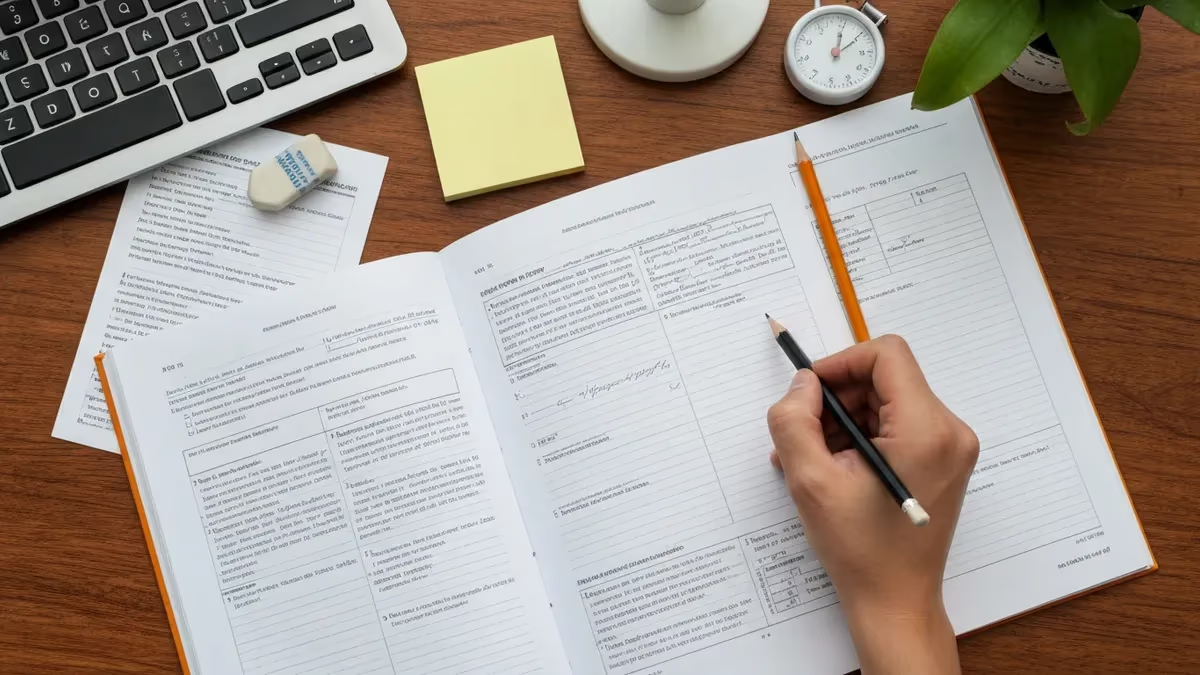
The TOEIC listening and reading test is the world's most widely used English proficiency assessment for the workplace, administered to over seven million candidates each year across more than 160 countries. Developed by Educational Testing Service (ETS), the TOEIC exam measures how well non-native English speakers can understand spoken and written English in everyday professional contexts — from office conversations and business emails to corporate announcements and multi-paragraph reports. If you're preparing for a career in an international environment, understanding this test inside and out is your first step toward a competitive score.
Unlike academic English exams that test grammar rules and literary analysis, the TOEIC test is firmly anchored in real-world workplace scenarios. Candidates hear conversations between colleagues, listen to voicemail messages, and read internal memos, advertisements, and business correspondence. This practical focus makes the toeic exam especially valuable for professionals in fields like finance, healthcare, hospitality, manufacturing, and technology — all industries where English communication is increasingly expected, regardless of where in the world a company is headquartered.
One resource that has gained popularity among candidates preparing for the toeic duo format is the toeic duo study approach, which combines video-based listening drills with targeted vocabulary building. Combining multiple study methods consistently outperforms relying on a single textbook or app, and ETS research confirms that candidates who practice with realistic test materials score significantly higher than those who study grammar rules in isolation. The key is exposure — the more authentic English you process, the more natural your comprehension becomes under timed conditions.
The toeic score scale runs from 10 to 990 points, reported in five-point increments. Each of the two sections — Listening and Reading — contributes a maximum of 495 points to the total. Most international employers set minimum hiring thresholds between 550 and 785, depending on the role and level of English interaction required. Major corporations in South Korea, Japan, France, and Brazil routinely require TOEIC scores for promotion, and U.S.-based multinationals increasingly reference TOEIC benchmarks when evaluating candidates for global assignments.
Preparing for the toeic test exam does not have to be overwhelming. A structured approach that covers each section's question types, timing constraints, and common traps gives candidates a measurable edge. Test-takers who understand the difference between Part 1 photograph questions and Part 3 conversation questions, for example, can allocate their listening attention more efficiently and avoid predictable distractors. Similarly, readers who recognize the structure of double-passage and triple-passage sets in the Reading section can predict where specific information will appear, saving precious minutes under test conditions.
This guide covers everything you need to know about the TOEIC Listening and Reading test — its format, section-by-section breakdown, scoring methodology, study schedules, and expert tips drawn from thousands of test-taker experiences. Whether you're a first-time candidate or retaking the exam to hit a higher score band, the strategies and practice resources here will help you build the skills and confidence to perform at your best. Read on to discover how the test is structured, what each question type demands, and which preparation habits consistently produce the strongest results.
Throughout this article, you'll also find free TOEIC practice quizzes targeting the exact question formats you'll encounter on exam day. These quizzes mirror the style, vocabulary level, and timing pressure of the real test, giving you a risk-free environment to identify your weak areas before they cost you points. Bookmark this page, work through each section systematically, and return to it as your test date approaches for a final review of the key concepts and score benchmarks that matter most to your goals.
TOEIC Listening and Reading Test by the Numbers

TOEIC Listening and Reading Test Format
| Section | Questions | Time | Weight | Notes |
|---|---|---|---|---|
| Part 1 – Photographs | 6 | ~5 min | 3% | Choose the statement that best describes the photo |
| Part 2 – Question-Response | 25 | ~15 min | 12.5% | Select the best response to a spoken question |
| Part 3 – Conversations | 39 | ~25 min | 19.5% | Answer 3 questions per conversation; includes visual prompts |
| Part 4 – Talks | 30 | ~20 min | 15% | Answer 3 questions per monologue |
| Part 5 – Incomplete Sentences | 30 | ~15 min | 15% | Choose the word or phrase that completes the sentence |
| Part 6 – Text Completion | 16 | ~10 min | 8% | Fill in four blanks per passage |
| Part 7 – Reading Comprehension | 54 | ~55 min | 27% | Single, double, and triple passages |
| Total | 200 | 2 hours (approx.) | 100% |
The Listening section of the TOEIC test spans approximately 45 minutes and contains 100 questions divided across four distinct parts. Each part increases in cognitive complexity, moving from simple photograph descriptions in Part 1 to extended workplace monologues in Part 4. Understanding the mechanics of each part is essential because the strategies that work for Part 1 — scanning a single image for visual clues — are completely different from the strategies needed to track a three-person conversation in Part 3 while simultaneously reading answer choices on paper.
Part 1 (Photographs) presents six black-and-white or color images depicting workplace scenes — a conference room, a factory floor, a reception desk, or an outdoor construction site. You hear four statements and must select the one that accurately describes what is visible in the image. Common traps include statements that use words phonetically similar to what you see but logically incorrect, and statements that describe people or objects not present in the photo. Training yourself to look at the image holistically before the audio begins gives you a critical head start.
Part 2 (Question-Response) is often considered the most deceptively challenging portion of the Listening section. You hear a question or statement followed by three possible responses and must choose the most appropriate reply — with no written options on your test booklet. Distractors frequently repeat key words from the question while providing a logically unrelated answer, exploiting the tendency of test-takers to associate familiar vocabulary with correctness. The best defense is to focus on the intent of the question — what type of information is being requested — rather than on individual words.
Part 3 (Conversations) features 13 two- or three-person dialogues, each followed by three questions. ETS updated this section in recent years to include graphic prompts — charts, price lists, and schedules — that require you to integrate what you hear with information shown on the page. These visual integration items now appear in roughly four to five conversations per test. Candidates who practice with realistic toeic listening script materials that include graphic-stimulus formats gain a significant advantage because the dual-channel processing required is a learnable skill, not an innate ability.
Part 4 (Talks) presents 10 monologues — recorded announcements, radio broadcasts, telephone messages, and guided tours — each followed by three comprehension questions. A key strategy for Part 4 is prediction: read the three questions and answer choices before the recording begins. The questions are typically ordered chronologically relative to the talk, meaning the answer to Question 1 appears in the first third of the monologue, Question 2 in the middle, and Question 3 near the end. Applying this mental roadmap reduces cognitive load and helps you stay on track even when vocabulary is unfamiliar.
Audio quality matters more than most candidates realize during preparation. The TOEIC Listening section uses speakers with a range of accents — American, British, Australian, and Canadian — reflecting the multinational reality of today's business world. ETS made this change deliberately to ensure the test reflects authentic global communication. If you have primarily practiced with a single accent variety, diversifying your listening diet to include podcasts, business news programs, and instructional videos from different English-speaking regions will improve your score across all four Parts.
Time management during the Listening section is largely automatic because the audio controls the pace — you cannot rewind or pause. However, you do control how you use the silence between questions. Use transition time to preview the next set of questions, not to second-guess answers you've already committed to. Research on test performance consistently shows that revisiting answers during the Listening section decreases accuracy because working memory is already occupied with incoming audio. Mark your answer confidently and move forward — this discipline alone can recover two to four points per sitting.
Building Listening section stamina is a physical as much as a cognitive challenge. The section runs approximately 45 minutes without a formal break, requiring sustained auditory attention that most people don't practice in daily life. Daily listening drills of 20 to 30 minutes — ideally using TOEIC-style audio at or slightly above your target difficulty — train the neural pathways responsible for real-time comprehension. Over four to six weeks, candidates who commit to daily listening practice routinely report score increases of 30 to 50 points in the Listening section alone, a gain that can shift an entire CEFR proficiency band.
TOEIC Score Ranges, CEFR Levels, and Employer Benchmarks
The TOEIC score runs from 10 to 990, reported in five-point increments. Each section — Listening and Reading — contributes up to 495 points, and raw scores are converted through a statistical equating process that accounts for slight differences in difficulty between test versions. This equating ensures that a 700 earned on one test date is comparable to a 700 earned six months later, making the score a reliable, time-stable credential that employers can trust across hiring cycles and global offices.
Score bands generally map to CEFR levels as follows: 255–400 corresponds to A2 (elementary), 405–600 to B1 (intermediate), 605–780 to B2 (upper-intermediate), 785–900 to C1 (advanced), and 905–990 to C2 (mastery). Most professional roles requiring regular English communication set thresholds at B2 or above, meaning a toeic score of at least 605 is the practical minimum for many international workplace environments. High-stakes roles in diplomacy, legal services, or executive management typically require C1-level scores of 785 or higher.

Is the TOEIC Listening and Reading Test Right for You?
- +Globally recognized by over 14,000 organizations across 160 countries
- +Workplace-focused content directly relevant to professional career advancement
- +No pass or fail — every score reflects a specific proficiency level employers can interpret
- +Test available year-round at authorized centers and through IP programs
- +Scores reported within 10 business days, with online score access
- +Affordable registration fee compared to other major English proficiency exams
- −Does not assess Speaking or Writing skills unless you add the separate TOEIC S&W test
- −Academic institutions often prefer TOEFL or IELTS for admissions purposes
- −IP TOEIC scores cannot be shared outside the administering organization
- −Listening section pace is fixed — cannot rewind or pause audio recordings
- −Limited official practice materials compared to TOEFL or IELTS ecosystems
- −Score validity typically expires after two years, requiring retesting for long job searches
TOEIC Test Preparation Checklist
- ✓Obtain an official ETS TOEIC score goal based on your target employer's published requirements.
- ✓Take a full-length diagnostic practice test before beginning your study plan to establish a baseline score.
- ✓Study all seven question-type formats using authentic TOEIC-style materials, not generic ESL resources.
- ✓Practice Part 2 Question-Response daily by listening to questions without reading options first.
- ✓Build vocabulary from TOEIC-specific word lists covering business, travel, finance, and healthcare domains.
- ✓Time yourself on every Reading section practice set to build the stamina needed for 75 uninterrupted minutes.
- ✓Diversify your listening practice using podcasts and news broadcasts in American, British, and Australian accents.
- ✓Review every incorrect answer in detail — identify whether errors stem from vocabulary, grammar, or attention lapses.
- ✓Simulate full test conditions at least twice before exam day, including no phone or breaks during the session.
- ✓Register at an official ETS-authorized test center and confirm your photo ID requirements at least one week before your test date.

The 785 Threshold Is a Career Milestone
A TOEIC score of 785 or above places you at the C1 (Advanced) CEFR level — the benchmark used by Fortune 500 companies, international NGOs, and government agencies when selecting candidates for roles that require regular English-medium communication. Candidates who clear 785 report significantly higher rates of promotion, international assignment, and salary increases within two years of certification. If you're within 50 points of this threshold, a structured six-week push focusing on Part 3, Part 4, and Part 7 passages typically closes the gap.
Understanding how the TOEIC score is calculated and what it signals to employers is as important as knowing how to answer individual questions. Each of the 200 questions contributes one raw point — there is no penalty for guessing, which means you should always fill in an answer even when uncertain. Raw scores for each section are then converted to scaled scores through ETS's statistical equating process, ensuring comparability across different test versions administered worldwide throughout the year.
The score report you receive lists your total scaled score, your Listening scaled score, your Reading scaled score, and your proficiency level descriptors for both sections. These descriptors describe what you can do in English — for example, a Listening score in the 400–495 range indicates that you can understand extended conversations on familiar business topics, follow complex instructions, and infer meaning from context even when speakers use idiomatic or colloquial language. Employers and HR professionals use these descriptors to make concrete hiring and placement decisions rather than relying solely on a numeric total.
CEFR mapping is one of the TOEIC exam's most powerful features for international careers. The Common European Framework of Reference for Languages (CEFR) is the recognized standard for language proficiency across Europe, Asia, and Latin America, and ETS has published validated concordance tables mapping TOEIC scores to CEFR levels. A total score of 605–780 maps to B2 (Upper-Intermediate), widely considered the professional working proficiency threshold. Reaching B2 means you can participate in meetings, write formal emails, and present complex ideas in English without significant difficulty — skills that are genuinely valued and observable in day-to-day work environments.
Score interpretation also depends heavily on context. A 650 might represent excellence for an entry-level logistics coordinator in a market where English is rarely used, while a 900 might be the minimum for a senior legal analyst at a multinational law firm. Before setting your target score, research the specific requirements of the roles and companies you're pursuing.
Many large employers publish their TOEIC benchmarks on recruitment pages or share them through HR departments. If you're unsure, aim for 750 or above — this score places you solidly at the upper B2 level and satisfies the requirements of the vast majority of professional English-language roles globally.
Score validity is another practical consideration that many candidates overlook. ETS TOEIC scores are accepted by most institutions for two years from the test date. If you're planning a long job search or applying to graduate programs with rolling admissions, factor in whether your score will still be valid by the time you receive and act on an offer.
Some institutions, particularly in South Korea and Japan where TOEIC is used extensively for internal promotions, require annual retesting regardless of prior scores. Building your preparation habits around regular English practice — not just one-time exam cramming — ensures that your proficiency remains strong and your score remains competitive over time.
The relationship between preparation time and score gain is well-documented in ETS research. Candidates starting from a B1 baseline (approximately 405–600) who invest 80 to 120 hours of structured study typically achieve B2-level scores (605–780). Moving from B2 to C1 (785–900) requires a similar investment but demands greater focus on nuanced listening comprehension and complex reading skills, particularly triple-passage sets and inferential comprehension questions. Understanding where you currently sit on this continuum — established through an honest diagnostic test — allows you to set realistic timelines and avoid the frustration of expecting rapid gains from insufficient preparation.
Finally, consider the strategic value of section balance. Because the Listening and Reading sections each contribute a maximum of 495 points, a weakness in either section disproportionately caps your total. Many candidates find that their Listening score significantly outpaces their Reading score because daily life offers more spontaneous listening opportunities than extended reading practice.
If your Reading section lags by more than 50 points, redirect at least 60% of your daily study time to Part 5, 6, and 7 practice. Closing a Reading gap of 50 points is typically faster and more reliable than pushing a strong Listening score from 450 to 490, making strategic section-focused study one of the highest-ROI decisions a TOEIC candidate can make.
TOEIC public test sessions at ETS-authorized centers typically fill up two to four weeks before the test date, especially in major metropolitan areas. Register at least one month in advance to secure your preferred date and location. On exam day, you must bring a valid government-issued photo ID that exactly matches the name on your registration — discrepancies, even minor spelling differences, can result in being turned away at the door without a refund.
Building an effective TOEIC study plan requires honest self-assessment, consistent daily practice, and strategic use of the right resources. Candidates who attempt to cram for the TOEIC test over a single weekend consistently underperform relative to their actual English ability because timed test performance is a separate skill from general language proficiency. Learning to work quickly and accurately under the exam's specific format is a trainable habit, and the earlier you begin ingraining test-taking routines into your preparation, the more automatic — and therefore less cognitively expensive — they become on exam day.
A realistic eight-week study plan for candidates targeting 700 or above might look like this: spend the first two weeks on diagnostic testing and format familiarization, identifying which parts cost you the most points. Weeks three and four focus on targeted skill-building — intensive Part 2 listening drills if Question-Response is your weakness, or daily Part 7 timed reads if Reading comprehension is the bottleneck.
Weeks five and six shift to mixed practice, combining multiple parts in single sessions to build the endurance needed for the full two-hour exam. The final two weeks are reserved for full-length simulated tests, review sessions, and confidence-building rather than introducing new material.
Vocabulary development is one of the highest-leverage activities a TOEIC candidate can pursue independently of formal study sessions. The TOEIC exam draws on a core lexicon of approximately 3,000 to 4,000 frequently used business English words covering domains like human resources, legal affairs, purchasing, customer service, and travel logistics.
Mastering this vocabulary base does not mean memorizing dictionary definitions — it means recognizing words quickly in listening and reading contexts, understanding their grammatical behavior (is this word used as a noun or a verb in this context?), and building the collocational awareness needed to select correct Part 5 answers in under 20 seconds per question.
Grammar focus for the TOEIC exam is narrower than many candidates expect. Parts 5 and 6 test a recurring set of grammatical structures: verb tense and aspect, subject-verb agreement, relative clauses, connective adverbs (however, therefore, consequently), prepositions, and word-form choices (noun vs. adjective vs. adverb). Learning to quickly identify which grammatical category is being tested in each blank — before evaluating the answer choices — reduces both decision time and error rate. This diagnostic-first approach turns Part 5 from a guessing exercise into a pattern-recognition task that rewards preparation rather than luck.
Many candidates benefit from using the toeic test exam preparation resources available through PracticeTestGeeks, which offer question-by-question explanations that go beyond simply identifying the correct answer. Understanding why incorrect options are wrong is often more instructive than confirming why the correct option is right, because the distractors in TOEIC questions are carefully crafted to exploit the most common comprehension errors. Reviewing wrong answers with this adversarial mindset — asking yourself what trap ETS set and how you fell into it — accelerates skill development in ways that passive re-reading never can.
Speaking of traps, the TOEIC Listening section uses specific distractor strategies that appear test after test. In Part 1, distractors often describe objects or actions that are present in a related but incorrect scene. In Part 2, they repeat key words from the question while answering a different question entirely.
In Parts 3 and 4, distractors frequently include information mentioned in the conversation but attached to the wrong speaker, time frame, or condition. Becoming familiar with these recurring distractor patterns through deliberate practice is one of the fastest ways to lift your raw score, because pattern recognition eliminates options that a less-prepared candidate might seriously consider.
Rest and physical preparation in the days before your exam are undervalued by most test-takers. Sleep deprivation measurably impairs auditory processing — the cognitive function most critical for the Listening section — and reduces reading speed and accuracy in the Reading section. Aim for at least seven hours of sleep the two nights before your exam.
On the morning of the test, eat a protein-rich breakfast, arrive at the test center 30 minutes early to complete check-in without rushing, and bring water if the test center permits it. These logistical details seem minor, but they reliably separate candidates who perform at their true ability level from those who underperform despite weeks of strong preparation.
The final phase of any TOEIC preparation journey is about consolidation and confidence rather than new learning. In the week before your exam, resist the urge to tackle unfamiliar question types or study new vocabulary lists — your brain needs time to consolidate the patterns and strategies you've built over weeks of practice. Instead, run one or two full-length timed simulations, review your error logs to confirm that previously weak areas have improved, and spend 15 minutes daily on light listening to keep your auditory processing active without fatiguing it.
On exam day itself, manage your mental energy like an athlete. The two-hour test demands sustained concentration, and your performance in the final 30 minutes of Part 7 depends on the reserve capacity you've conserved throughout the preceding 90 minutes. Candidates who race through the Listening section or rush early Reading questions to build a time buffer often hit a cognitive wall in the triple-passage sets. A steady, deliberate pace — moving forward confidently rather than anxiously — consistently outperforms frantic speed-racing strategies in post-test score reviews.
After you receive your results, interpret them in the context of your goals rather than comparing them to population averages. ETS publishes mean score data showing that the global average total score is approximately 590, but averages mask enormous variation by country, industry, and preparation level. What matters is whether your score meets the threshold for the opportunity you're pursuing.
If it does, submit your score report promptly and move forward. If it falls short, use the section-level score breakdown to pinpoint exactly where the gap lies, build a targeted four-week remediation plan, and retest — the TOEIC exam can be retaken as frequently as once per day, with no annual limit on attempts.
Long-term English development should not stop once you've hit your target TOEIC score. The test is a snapshot of proficiency, not a permanent certification of fluency, and workplace English expectations continue to evolve. Professionals who maintain active English reading, listening, and writing habits after passing the TOEIC consistently find that their proficiency improves year over year, making subsequent retesting less stressful and opening doors to progressively higher-level international opportunities. Consider the TOEIC not as the destination but as a waypoint on a continuous path of professional language development that will serve your career for decades.
PracticeTestGeeks offers a comprehensive set of free TOEIC practice quizzes covering all the major question formats — incomplete sentences, reading comprehension passages, and more — designed to match the difficulty level and style of the real exam. Using these resources regularly in the weeks before your test date helps you internalize the pacing, vocabulary, and reasoning demands of each question type until they feel familiar rather than foreign. The more exposure you accumulate through realistic practice, the more confident and capable you will feel when the official exam begins.
Remember that the tes toeic is ultimately an opportunity — a chance to demonstrate professional English capability in a universally recognized format that opens real doors. Approach your preparation with that perspective: every practice question you answer, every vocabulary set you review, and every timed simulation you complete is an investment in a credential that employers around the world trust and value. With the right strategy, consistent effort, and the right practice materials, reaching your target TOEIC score is not just possible — it is a predictable outcome of structured preparation.
Use the resources throughout this guide, work through the free practice quizzes linked at each section, and refer back to the format breakdown and score interpretation sections as your test date approaches. The TOEIC Listening and Reading test rewards candidates who understand its structure deeply and practice its specific demands deliberately. You now have that understanding — the consistent daily work is what turns it into the score you need.
TOEIC Questions and Answers



About the Author

Educational Psychologist & Academic Test Preparation Expert
Columbia University Teachers CollegeDr. Lisa Patel holds a Doctorate in Education from Columbia University Teachers College and has spent 17 years researching standardized test design and academic assessment. She has developed preparation programs for SAT, ACT, GRE, LSAT, UCAT, and numerous professional licensing exams, helping students of all backgrounds achieve their target scores.
Join the Discussion
Connect with other students preparing for this exam. Share tips, ask questions, and get advice from people who have been there.
View discussion (8 replies)