
How to Become a State Trooper by State: Complete 2026 September Application Guide
⏳ How to apply for Alabama state trooper and 49 other states. Complete requirements, salary, training timelines, and prep tips for every state agency.
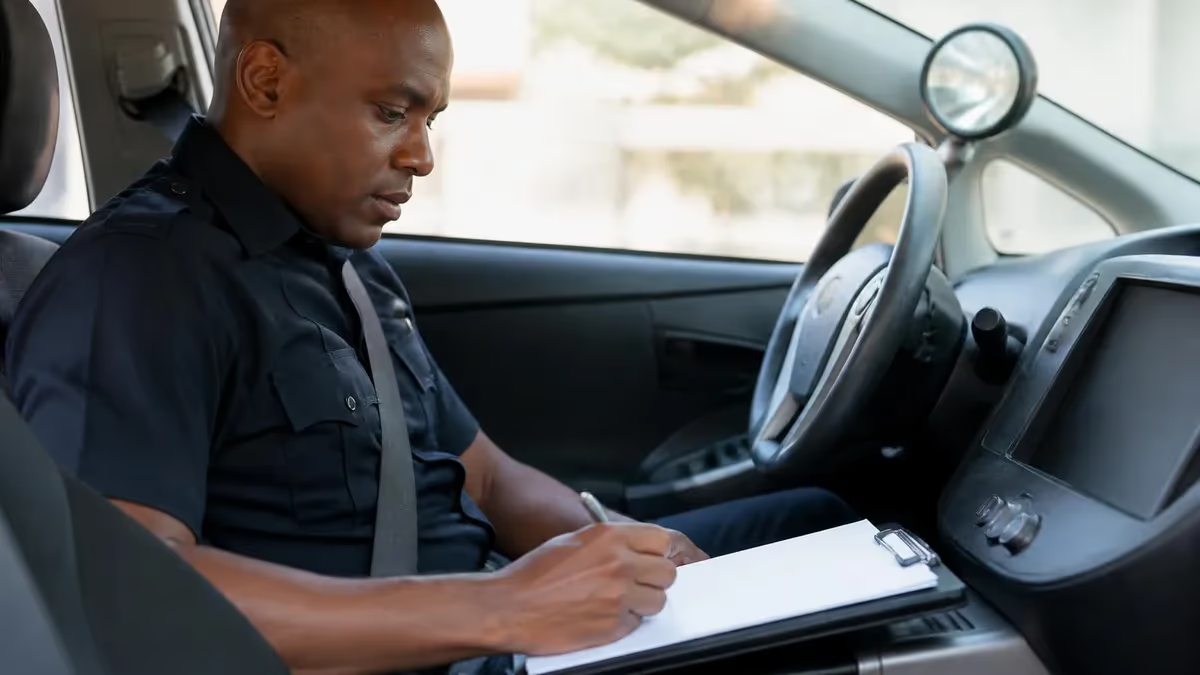
Learning how to apply for Alabama state trooper positions — or any state's highway patrol — starts with understanding that every state runs its own academy, sets its own minimum standards, and pays on its own salary schedule. While the broad framework looks similar across the country (application, written exam, physical fitness test, background check, polygraph, psychological screening, oral board, and academy), the details vary enormously. A 21-year-old high school graduate qualifies in some states but cannot apply in others until age 23 with college credits.
The viral popularity of the state trooper texas a&M meme has pushed thousands of curious viewers to research what becoming a trooper actually involves. Behind the camo Stetsons and dry one-liners sits a multi-month hiring process that washes out roughly 90% of applicants. Texas Department of Public Safety, Florida Highway Patrol, Illinois State Police, North Carolina State Highway Patrol, Arizona DPS, and Arkansas State Police each publish distinct hiring guides, and the differences matter when you decide where to apply.
This guide breaks down the state trooper hiring pipeline state by state, with a deep focus on Alabama, Texas, Florida, Illinois, North Carolina, Arizona, and Arkansas. You'll find current age and education minimums, residency rules, academy length, starting salary, signing bonuses, and the timeline from application to badge. We'll also clarify what makes the Texas A&M state trooper meme template so recognizable — and why real Texas troopers wear that distinctive campaign hat.
Most candidates underestimate how long the process takes. From submitting your initial application to graduating the academy, expect 9 to 18 months depending on the state, hiring cycle, and how quickly background investigators complete your file. Plan for the financial gap between applying and your first paycheck, especially if you'll relocate to attend a live-in academy. Some states pay cadets a full salary during training; others pay a reduced training wage or stipend.
Eligibility is the single biggest disqualifier. Felony convictions, recent drug use, dishonorable military discharge, certain misdemeanors involving violence or moral turpitude, excessive traffic violations, and significant credit problems will end your application at the background stage. Many states also disqualify candidates for visible tattoos on the face, neck, or hands, recent recreational marijuana use within 2-3 years, or undisclosed prior employment terminations. Be brutally honest on your application — investigators always find what you hide.
If you're committed, the rewards are real. Median state trooper compensation now exceeds $70,000 with overtime in many states, plus pensions that remain among the most generous in public service. Federal Bureau of Labor Statistics data shows highway patrol officers earning between $48,000 in lower-cost states and $110,000+ in California and New Jersey. Add specialty pay for K-9, SWAT, motorcycle, aviation, or detective assignments and a career trooper can comfortably exceed six figures by year 8 to 10.
The rest of this guide walks you through each state's specific requirements, the exam content you'll face, the academy curriculum, and a realistic prep schedule. Bookmark this page and revisit it as you move through each stage — the rules change, but the structure of a successful application doesn't.
State Trooper Hiring by the Numbers

Core Requirements: Top State Agencies Compared
Minimum age 21, U.S. citizen, high school diploma or GED, valid driver's license. Application via personnel.alabama.gov. Salary starts around $46,000 with raises after academy graduation and field training.
Minimum age 20 with 60 college hours or 21 without, U.S. citizen, valid Texas license at hire. Six-month live-in academy in Austin. Starting salary roughly $72,000 with structured raises through five years.
Age 19+, U.S. citizen, high school diploma or GED, valid driver's license, no felony or domestic violence convictions. 28-week academy in Tallahassee or Orlando. Starting salary around $55,000 plus benefits.
Age 21+ (or 20 with 60 college credits), U.S. citizen, valid license. POWER test, written exam, then 26-week academy in Springfield. Starting salary above $79,000 after academy with strong pension benefits.
Age 21-39 at appointment, U.S. citizen, high school diploma or GED, 20/20 corrected vision. Demanding 33-week academy in Raleigh. Starting trooper pay roughly $51,000 with steps to $70,000+.
Every state's application process follows the same core sequence, even when the names of the agencies differ. You begin with an online application or paper packet, pass an initial qualifications screen, and receive an invitation to test. The written exam evaluates reading comprehension, written communication, basic math, situational judgment, and sometimes memorization. Scoring methods vary — Texas uses a pass/fail combined with interview rankings, while Florida and Illinois publish numeric cutoff scores that fluctuate with each hiring cycle.
The physical fitness test is where most candidates lose ground. Standard components include a 1.5-mile run, push-ups, sit-ups, and sometimes a vertical jump or 300-meter sprint. Age and gender-adjusted scoring exists in some states and not in others. North Carolina, Illinois, and Texas use straight-scale fitness testing that doesn't adjust by gender. Start training six to nine months before you apply — cramming a fitness routine in 30 days almost guarantees a failed PT test.
Background investigation is the longest single stage. Investigators verify every job since high school, contact references and neighbors, pull credit reports, examine your social media history (sometimes years back), and review every traffic citation, arrest, and court record under your name. The viral state trooper salary jokes online aside, the real work begins when an investigator drives to your hometown to interview former teachers, coworkers, and exes. Honesty is non-negotiable.
The polygraph follows the background check in most states. You'll answer questions about drug use, theft, undetected crimes, sexual misconduct, and any falsehoods on prior parts of your application. The polygraph itself is less about beating the machine and more about admissions made during the pre-test interview. Examiners are trained interrogators and they catch hedging fast. If you used marijuana once two years ago, say so when asked — withholding it is far worse than admitting it.
Psychological screening combines a long written inventory (often the MMPI-2 or CPI) with a one-on-one clinical interview. The agency wants to rule out personality disorders, impulsivity, anger management issues, and any condition that might interfere with carrying a firearm in stressful situations. Answer honestly and consistently across the written and oral portions. Inconsistencies trigger disqualification more often than any single "wrong" answer.
The oral board is your final filter before a conditional offer. A panel of senior officers asks scenario-based questions: "You see a fellow trooper accept a free meal from a restaurant owner. What do you do?" or "How would you handle a traffic stop where the driver is uncooperative but not threatening?" There are no perfect answers, but the panel looks for ethics, judgment, calm demeanor, communication clarity, and self-awareness about your weaknesses.
After a conditional offer comes the medical exam, drug screen, vision and hearing tests, and finally an academy seat assignment. Some states run academies twice a year; others only once. If you receive an offer but the next academy is six months away, stay in shape, keep studying, and avoid any incidents that could revoke your offer. People do get disqualified after offer letters for DUIs, bar fights, and bad social media posts.

State Trooper Practice Test Questions
Prepare for the State Trooper exam with our free practice test modules. Each quiz covers key topics to help you pass on your first try.
State Trooper Criminal and Traffic Law
State Trooper Exam Questions covering Criminal and Traffic Law. Master State Trooper Test concepts for certification prep.
State Trooper General
Free State Trooper Practice Test featuring General. Improve your State Trooper Exam score with mock test prep.
State Trooper MCQ
State Trooper Mock Exam on MCQ. State Trooper Study Guide questions to pass on your first try.
State Trooper Patrol and Investigation Pro...
State Trooper Test Prep for Patrol and Investigation Procedures. Practice State Trooper Quiz questions and boost your score.
State Trooper
State Trooper Questions and Answers on State Trooper. Free State Trooper practice for exam readiness.
State Trooper Random
State Trooper Mock Test covering Random. Online State Trooper Test practice with instant feedback.
State Trooper Reading Comprehension and Re...
Free State Trooper Quiz on Reading Comprehension and Reasoning. State Trooper Exam prep questions with detailed explanations.
State Trooper Report Writing and Grammar
State Trooper Practice Questions for Report Writing and Grammar. Build confidence for your State Trooper certification exam.
State Trooper Situational Judgment and Ethics
State Trooper Test Online for Situational Judgment and Ethics. Free practice with instant results and feedback.
State Trooper Trivia
State Trooper Study Material on Trivia. Prepare effectively with real exam-style questions.
State Trooper Use of Force Principles
Free State Trooper Test covering Use of Force Principles. Practice and track your State Trooper exam readiness.
State Trooper Ultimate State Trooper
State Trooper Exam Questions covering Ultimate State Trooper. Master State Trooper Test concepts for certification prep.
State Trooper Community Relations and Comm...
Free State Trooper Practice Test featuring Community Relations and Communication. Improve your State Trooper Exam score with mock test prep.
State Trooper Constitutional Rights and Ci...
State Trooper Mock Exam on Constitutional Rights and Civil Liberties. State Trooper Study Guide questions to pass on your first try.
State Trooper Criminal Law Fundamentals
State Trooper Test Prep for Criminal Law Fundamentals. Practice State Trooper Quiz questions and boost your score.
State Trooper Emergency Response and Crisi...
State Trooper Questions and Answers on Emergency Response and Crisis Management. Free State Trooper practice for exam readiness.
State Trooper Emergency Vehicle Operations
State Trooper Mock Test covering Emergency Vehicle Operations. Online State Trooper Test practice with instant feedback.
State Trooper Ethics and Professional Conduct
Free State Trooper Quiz on Ethics and Professional Conduct. State Trooper Exam prep questions with detailed explanations.
State Trooper Firearms Safety and Use of F...
State Trooper Practice Questions for Firearms Safety and Use of Force. Build confidence for your State Trooper certification exam.
State Trooper Incident Report Writing
State Trooper Test Online for Incident Report Writing. Free practice with instant results and feedback.
State Trooper Investigation Procedures
State Trooper Study Material on Investigation Procedures. Prepare effectively with real exam-style questions.
State Trooper Map Reading and Navigation
Free State Trooper Test covering Map Reading and Navigation. Practice and track your State Trooper exam readiness.
State Trooper Patrol Operations and Proced...
State Trooper Exam Questions covering Patrol Operations and Procedures. Master State Trooper Test concepts for certification prep.
State Trooper Patrol Procedures and Tactics
Free State Trooper Practice Test featuring Patrol Procedures and Tactics. Improve your State Trooper Exam score with mock test prep.
State Trooper Physical Fitness and Wellnes...
State Trooper Mock Exam on Physical Fitness and Wellness Standards. State Trooper Study Guide questions to pass on your first try.
State Trooper Reading Comprehension and Logic
State Trooper Test Prep for Reading Comprehension and Logic. Practice State Trooper Quiz questions and boost your score.
State Trooper Report Writing and Documenta...
State Trooper Questions and Answers on Report Writing and Documentation. Free State Trooper practice for exam readiness.
Texas State Trooper, Florida State Trooper, and Illinois State Trooper Compared
The Texas state trooper hiring process is run by the Department of Public Safety and is widely considered one of the most rigorous in the country. Applicants need 60 semester hours of college credit or two years of active military service, U.S. citizenship, and a valid driver's license at the time of hire. The written and physical readiness test is followed by a polygraph, psychological exam, and oral board.
The Texas A&M state trooper meme circulating online actually depicts real DPS troopers stationed at Kyle Field on game days. After the application process, cadets attend a six-month live-in academy in Austin. Starting salary is roughly $72,000 with structured raises, and trooper trainees earn full pay throughout the academy — a significant advantage over states that pay reduced cadet wages.
Becoming a State Trooper: Honest Pros and Cons
- +Strong starting salary in most states with generous overtime opportunities
- +Defined-benefit pension systems retire many troopers at 50-55 with full benefits
- +Career advancement into K-9, SWAT, aviation, motorcycle, and detective units
- +Job security that survives recessions and political shifts in funding
- +Tuition assistance and continuing education benefits in most states
- +Meaningful public service work that directly affects highway safety
- +Brotherhood and sisterhood of state law enforcement culture
- −Long shifts, rotating schedules, holiday and weekend work that strains family life
- −Physical and emotional toll from traffic fatalities, DUIs, and roadside violence
- −Relocation often required — you don't choose your post out of academy
- −Background, polygraph, and psych screening disqualify many applicants
- −Academy stress washes out 15-25% of cadets in many states
- −Public criticism of law enforcement adds emotional weight to the job

Pre-Application Checklist for Any State Trooper Job
- ✓Confirm you meet age, citizenship, and residency rules for your target state
- ✓Pull your driving record and resolve any outstanding tickets or suspensions
- ✓Pull a free credit report and address collections, judgments, or unpaid taxes
- ✓Clean up your social media — delete extremist content, slurs, or drug references
- ✓Start a 6-month fitness program targeting 1.5-mile run, push-ups, and sit-ups
- ✓Document every job, address, and reference for the last 10 years
- ✓Gather birth certificate, Social Security card, high school transcript, and military DD-214 if applicable
- ✓Take a free practice trooper exam to identify weak content areas
- ✓Schedule a vision exam — many states require uncorrected and corrected minimums
- ✓Talk honestly with family about relocation, shift work, and academy time away
Honesty beats perfection every time
Background investigators expect to find imperfect histories — traffic tickets, immature social media posts, even past minor drug use. What they cannot tolerate is deception. Document everything you'd be tempted to hide and disclose it on your application before they discover it. Self-disclosure rarely disqualifies. Lying always does.
State trooper academies are paramilitary, live-in programs lasting between 22 and 33 weeks depending on the state. North Carolina runs one of the longest at 33 weeks, while Florida and Illinois sit around 26-28 weeks. Texas DPS academy is roughly 26 weeks of intensive instruction in Austin. You'll wake before sunrise, complete physical training, attend academic classes until evening, study at night, and sleep in dormitory housing. Family visits are typically restricted to weekends, sometimes only after the first 30-60 days.
Academic instruction covers state criminal code, traffic law, constitutional law, search and seizure, use-of-force law, evidence collection, accident reconstruction, DUI detection, report writing, radio procedure, first aid, and de-escalation techniques. Most academies require 70-80% on every written exam to continue. Failing a single major exam can send you home. Cadets typically study two to four hours every night after dinner to keep pace with the curriculum.
Physical training continues throughout the academy. Expect daily PT including distance running, sprints, calisthenics, defensive tactics, ground fighting, and firearms-related conditioning. Cadets who enter the academy at minimum fitness standards struggle constantly; those who arrived prepared often finish in the top of their class. North Carolina has historically been the most physically demanding, but every state academy hurts more than candidates expect.
Driving instruction is a major academy block. Pursuit driving, precision driving, skid pad work, PIT maneuver training, and night-driving scenarios occupy multiple weeks. Many cadets find this their favorite portion, but it is also high-pressure — destroying training vehicles or failing the pursuit certification can end your career. Some cadets wash out at this stage despite passing academics.
Firearms training builds from basic marksmanship to dynamic shooting under stress. You'll fire thousands of rounds, qualify on the state's standard course of fire, train with shotguns and patrol rifles, and complete force-on-force scenarios with simunition. Firearms safety violations are immediate disqualifiers in every state academy. Cadets who flinch, finger the trigger off-target, or muzzle classmates rarely receive second chances.
Scenario training in the final weeks of academy stitches everything together. Cadets handle simulated traffic stops, domestic disturbances, building searches, felony stops, and crash investigations under realistic pressure. Field training officers play roles ranging from cooperative motorists to armed suspects. Many cadets describe this phase as harder than firearms or driving because it requires integrating law, tactics, communication, and emotional control simultaneously.
Graduation ceremonies are deeply traditional. Family attends, badges are pinned by spouses or parents, and new troopers swear their oath in dress uniform. After graduation, every trooper enters a field training program of 8-16 weeks paired with a senior trooper before solo patrol. Field training is its own evaluation — a small number of graduates still wash out here before officially earning solo assignment.
Recent recreational drug use (typically within 2-3 years for marijuana, longer for harder substances), felony convictions of any kind, domestic violence convictions, dishonorable military discharge, excessive traffic violations within 3 years, and undisclosed terminations from prior jobs will end your application. Review your state's published disqualifier list before paying any fees.
State trooper salary varies more than most career guides admit. Entry-level pay ranges from the mid-$40,000s in Alabama, Arkansas, Mississippi, and parts of the Deep South to over $90,000 in New Jersey, California, and parts of the Northeast. Texas, Illinois, Pennsylvania, and Washington pay around $70,000-$80,000 starting. Florida and the carolina state trooper agencies typically start in the low-to-mid $50,000s with steady step raises. The most accurate number for your target state lives on its official career page, not on aggregator websites.
Pensions remain the single largest financial benefit of trooper work. Most state retirement systems calculate pension based on years of service multiplied by a percentage of your highest three or five years of pay. A trooper retiring after 25-30 years often collects 60-75% of their final salary for life, plus continued health coverage. This pension lock is what keeps senior troopers in service despite the demands of the job.
Overtime opportunities push real earnings well above base salary in nearly every state. DUI checkpoints, special event details, court time, and grant-funded enforcement programs all pay premium rates. Many troopers double their base pay through legitimate overtime alone. Some agencies also offer signing bonuses, relocation stipends, and student loan repayment programs to attract candidates during recruiting shortages.
Career path options expand dramatically after probation. K-9 handler positions are highly sought; aviation units fly helicopters and fixed-wing aircraft for enforcement, search and rescue, and surveillance. SWAT, motorcycle patrol, dive teams, narcotics task forces, gang intelligence units, accident reconstruction teams, governor's protective detail, and recruit training assignments all become available with seniority and strong performance reviews.
Promotion paths follow a structured ladder: trooper, senior trooper, sergeant, lieutenant, captain, major, and command staff. Each promotion typically requires written tests, oral boards, time-in-grade, and sometimes assessment center exercises. A trooper who earns sergeant by year 8-10 and lieutenant by year 14-16 is on a strong career arc. Promotional pay raises of 10-15% per step add up significantly over a 25-year career.
Lateral mobility between agencies is limited but possible. Some states accept already-certified officers from other states through abbreviated transition academies. Others require a full restart. If you're already a municipal officer, deputy sheriff, or military police veteran, research lateral options in your target state — they can shave months off your hiring timeline and put you in patrol sooner.
Retirement isn't the end either. Many retired troopers move into federal agencies (DEA, FBI, ATF, U.S. Marshals), corporate security, private investigation, expert witness work, or commercial driving instruction. A 25-year state trooper career often funds a comfortable second career while collecting a state pension simultaneously. The financial trajectory of this profession is one of its strongest selling points compared to private-sector careers of similar education requirements.
Practical preparation for state trooper applications begins with a realistic timeline. Reverse-engineer from your target academy start date: subtract three months for background investigation, one month for polygraph and psych, one month for testing scheduling, and you'll see you need to start preparing six to nine months before the academy date you're aiming at. Procrastination is the single most common reason solid candidates miss hiring cycles entirely.
Study the actual exam content for your target state. Most agencies publish a study guide or candidate orientation packet listing the test sections, content domains, and sometimes sample questions. Don't waste time studying topics that aren't on your state's exam. Reading comprehension and situational judgment are universal; specific state criminal code is usually taught at the academy and not tested at entry. Focus on what's actually scored.
Build your fitness program around the specific PT test you'll face. If your state requires a 1.5-mile run in under 14:30, start logging weekly distance runs and add tempo work. If push-ups and sit-ups are tested in 60-second windows, do daily timed sets. Run your full PT test every two weeks under timed conditions to gauge progress. The candidates who pass on the first attempt are the ones who replicated the exact test conditions in training.
Rehearse your oral board answers out loud, not just in your head. Common questions include why you want to be a trooper, your greatest weakness, how you handle stress, an example of ethical decision-making, and how you'd respond to misconduct by a fellow officer. Write down your answers, then practice delivering them in 60-90 seconds. Panels score clarity, confidence, eye contact, and authenticity — not memorized monologues.
Take official-style practice tests, ideally under timed conditions. Free practice resources for the nc state trooper and other state agencies cover the same core skills tested across most state police exams. Score yourself honestly, review every missed question, and focus your study time on weak content areas. Most applicants improve dramatically just by completing two or three full-length practice tests before exam day.
Manage your social media footprint carefully throughout the application period. Investigators routinely review accounts going back years and screenshot anything questionable. Set everything to private, delete clearly problematic posts, and stop posting political content or anything related to drugs, alcohol, or weapons during the hiring process. This isn't optional — failed background investigations triggered by social media are now among the top disqualifiers.
Finally, prepare your family. Academy is months away from home. Field training adds shift work and weekend hours. New troopers are often assigned posts hours from their preferred location. Spouses, partners, and children need to understand the lifestyle commitment before you accept the offer. Couples who talk through these realities ahead of time fare far better than those who get blindsided by the first holiday shift or relocation order.
State Trooper Questions and Answers

About the Author

Educational Psychologist & Academic Test Preparation Expert
Columbia University Teachers CollegeDr. Lisa Patel holds a Doctorate in Education from Columbia University Teachers College and has spent 17 years researching standardized test design and academic assessment. She has developed preparation programs for SAT, ACT, GRE, LSAT, UCAT, and numerous professional licensing exams, helping students of all backgrounds achieve their target scores.
Join the Discussion
Connect with other students preparing for this exam. Share tips, ask questions, and get advice from people who have been there.
View discussion (3 replies)