
Deputy Sheriff Requirements: Do You Have to Be a Police Officer First?
Does a sheriff have to be a police officer? Learn deputy sheriff requirements, salary, hiring steps & how to qualify. 🎯 Full US guide.

One of the most common questions prospective law enforcement candidates ask is: does a sheriff have to be a police officer before taking the job? The short answer is no — in most U.S. counties, you do not need prior police experience to become a deputy sheriff. However, the full picture is more nuanced. The requirements to become a deputy sheriff vary significantly by state and county, and understanding what is actually expected before you apply can save you months of wasted preparation and help you build the strongest possible candidacy from day one.
A deputy sheriff is a sworn law enforcement officer employed by a county sheriff's office, operating under the authority of an elected or appointed sheriff. Unlike municipal police officers who work for a city or town police department, deputy sheriffs serve the entire county — including unincorporated areas that fall outside any city's jurisdiction. This distinction matters because it shapes what training, jurisdiction, and legal authority the role carries. In many rural counties, the sheriff's office is the primary — and sometimes the only — law enforcement agency available to residents.
The entry requirements for becoming a deputy sheriff typically include a minimum age (usually 18 to 21 depending on the county), a high school diploma or GED, a valid driver's license, U.S. citizenship or legal residency, and a clean criminal record. Many agencies also require candidates to pass a physical fitness test, a written civil service exam, a psychological evaluation, a polygraph test, and an extensive background investigation. Meeting these baseline requirements does not guarantee a job offer, but failing any one of them is typically disqualifying.
Prior law enforcement experience — whether as a municipal police officer, a military police officer, or a correctional officer — can absolutely strengthen your application and may allow you to skip certain recruit training modules. Some larger sheriff's offices actively recruit from police departments, particularly when filling specialized roles such as detective, SWAT, or K-9 units. However, the vast majority of deputy sheriff openings are entry-level positions specifically designed for candidates who have never worn a badge before, making the career accessible to a wide pool of motivated individuals.
If you're wondering about deputy or sheriff differences and how the roles compare to municipal police officers, the distinctions in authority, jurisdiction, and daily duties are worth understanding before you commit to one career path. Sheriff's deputies often rotate through multiple assignments — patrol, court security, jail operations, civil process service — giving them broader exposure than officers who remain in a single specialty. This variety is one of the reasons many people find the deputy sheriff career especially rewarding and professionally stimulating.
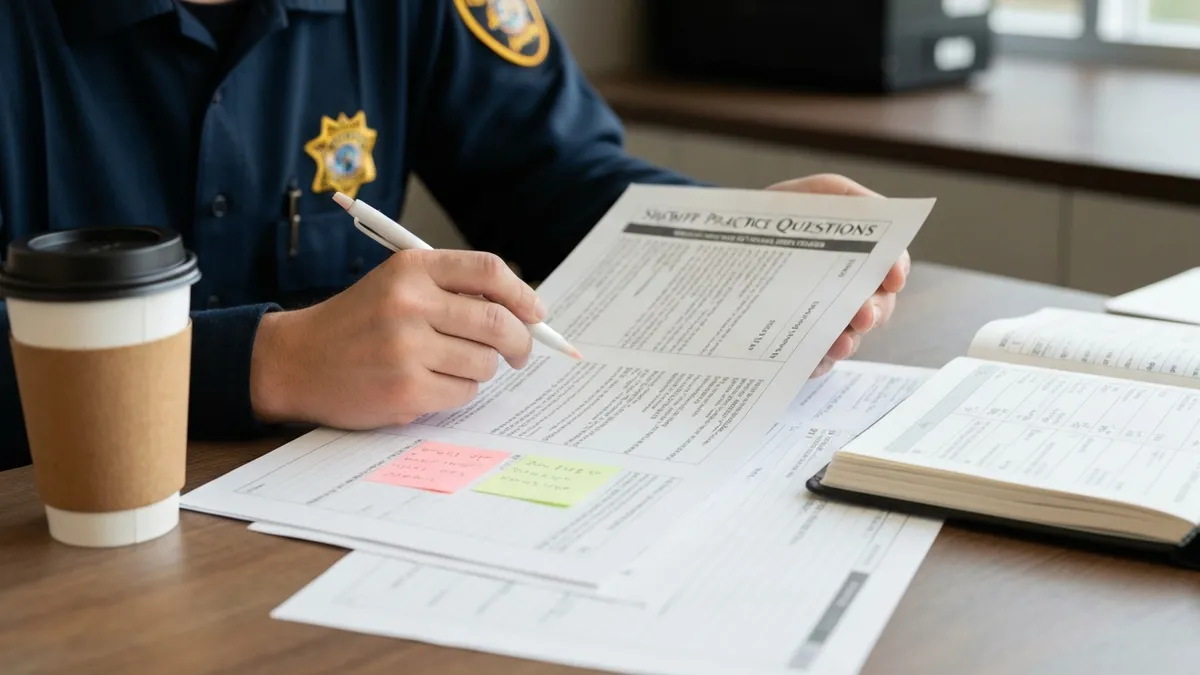
The written exam is one of the most consequential hurdles in the hiring process. Most sheriff's offices administer a standardized civil service test that covers reading comprehension, written communication, basic mathematics, situational judgment, and sometimes deductive reasoning. Candidates who prepare thoroughly for this exam consistently outperform those who rely solely on their general knowledge. Practice tests, study guides, and timed drills are all effective tools that can meaningfully improve your score and push your name higher on the eligibility list.
Throughout this article, you will find a detailed breakdown of deputy sheriff requirements by category, a comparison of the deputy versus sheriff role, salary data, hiring process steps, and practical advice to help you succeed every step of the way. Whether you are a first-time applicant or a lateral transfer from another agency, the information here will help you navigate the path to a rewarding career in county law enforcement with confidence and clarity.
Deputy Sheriff by the Numbers
Key Facts at a Glance
| Item | Value | Details |
|---|---|---|
| Typical Academy Length | 16–26 wks | Varies by state POST standards |
| Agencies Requiring College Credits | 60%+ | Some accept military service in lieu |
| Minimum Age (Most Counties) | 21 yrs | Some allow 18 for jailer roles |
Core Entry Requirements for Deputy Sheriff
Most counties require candidates to be at least 21 years old, though some allow 18 for civilian or jailer positions. U.S. citizenship or permanent legal residency is required. Some agencies accept non-citizen applicants who are eligible to obtain citizenship.
A high school diploma or GED is the universal baseline. Many departments now prefer or require some college education — typically 30 to 60 semester hours — and a bachelor's degree often accelerates advancement and starting pay.
Any felony conviction is an automatic disqualifier nationwide. Many agencies also disqualify candidates with domestic violence misdemeanors, DUI history within the past 5–10 years, or recent drug use. Honesty during the background check is essential.
Candidates must pass a standardized physical ability test (PAT) measuring push-ups, sit-ups, a timed 1.5-mile run, and sometimes an obstacle course. Standards are age- and gender-adjusted but demanding. Begin training at least 90 days before your test date.
A civil service exam covering reading comprehension, grammar, arithmetic, map reading, and situational judgment is required by virtually every agency. Scores determine your rank on an eligibility list, making thorough test prep a top priority.
Once you pass the initial screening tests and background investigation, most sheriff's offices require new hires to complete a state-certified law enforcement academy before they can work as sworn deputy sheriffs. The length of these academies varies widely — from as few as 16 weeks in some rural states to 26 weeks or longer in California, New York, and other jurisdictions with comprehensive POST (Peace Officer Standards and Training) requirements. During the academy, recruits study criminal law, constitutional law, firearms, defensive tactics, emergency vehicle operations, first aid, and report writing.
Not everyone entering a sheriff's office starts as a sworn deputy. Many agencies hire candidates into civilian support roles — dispatch, records, code enforcement — allowing them to gain familiarity with the organization before transitioning into a sworn position. Others begin as correctional officers in the county jail, a role that provides valuable experience managing incarcerated populations, de-escalating volatile situations, and working within a chain of command. Correctional experience can sometimes reduce the academy requirements for lateral candidates moving into patrol roles.
If you already hold a law enforcement certification from another state, many sheriff's offices offer a waiver or abbreviated academy for lateral transfers. The specific requirements depend on your state's reciprocity agreements and how recently you completed your original certification. In general, lateral transfers must still complete the local agency's field training program (FTO), which typically lasts 12 to 16 weeks and pairs new deputies with experienced officers who evaluate their performance in real patrol situations.
Field training is one of the most intense phases of the hiring process. Your Field Training Officer will assess everything from how you handle traffic stops to how you write your incident reports. Performance during FTO can make or break your career at a particular agency, so entering this phase with strong procedural knowledge and a coachable attitude is critical. Many candidates who stumble in FTO do so not because of skills gaps but because of poor communication or an inability to accept constructive criticism under stress.
After successfully completing the academy and FTO, new deputies typically serve a probationary period of 12 to 18 months during which they can be released from employment without the full due-process protections that apply to tenured officers. During this period, it is especially important to demonstrate reliability, sound judgment, and a commitment to the agency's values. Deputies who perform well during probation are usually assigned to their first permanent unit and begin the formal performance evaluation cycle that will drive their future promotions and assignments.
The Philadelphia Deputy Sheriff Recruit: Complete Hiring Process and Training Guide offers an excellent case study in how the multi-stage hiring process works in a large urban sheriff's office, including timelines and what evaluators look for at each stage. While every agency is different, the broad structure — application, written test, physical test, background, polygraph, medical, psychological, academy — is consistent across most U.S. counties, and preparing for each stage systematically is the best strategy for success.
Continuing education does not stop once you graduate from the academy. Most states require sworn deputies to complete a minimum number of training hours each year to maintain their certification — typically 24 to 40 hours annually. Topics covered in annual in-service training include use-of-force policy updates, implicit bias, mental health crisis intervention, and emerging legal developments. Deputies who pursue voluntary advanced training in areas such as criminal investigation, forensics, or community policing position themselves for promotion and specialized assignments.
Deputy Sheriff vs Sheriff vs Police Officer: Key Differences
A deputy sheriff is a sworn officer who works directly under the county sheriff's authority. Deputies handle patrol in unincorporated areas, serve civil process, manage county jails, provide court security, and assist other agencies when called upon. Because sheriff's offices are county-wide agencies, deputies often cover large geographic territories with fewer resources than urban police departments, requiring strong independent judgment and self-reliance on every shift.
The deputy's badge represents the broadest jurisdictional reach in local law enforcement — deputies can operate anywhere within their county, including inside city limits when mutual aid is needed. Career paths within a sheriff's office range from road patrol to detective bureaus, narcotics task forces, school resource officer programs, and administrative leadership. The diversity of available assignments makes the deputy sheriff role attractive to candidates who want career variety without changing employers.

Pros and Cons of a Deputy Sheriff Career
- +Broad jurisdiction covering the entire county, including unincorporated rural areas
- +Diverse assignment options: patrol, jail, courts, civil process, investigations, and more
- +No prior police experience required — entry-level positions widely available
- +Competitive salary with regular step increases, overtime, and shift differential pay
- +Strong pension and benefits packages common in most county sheriff's offices
- +Job stability backed by county government with civil service protections after probation
- −Rotating shifts, holidays, and weekends are mandatory for most patrol assignments
- −Exposure to traumatic events, violence, and high-stress situations on a regular basis
- −County budgets can limit equipment, staffing levels, and training opportunities
- −Political dynamics of an elected sheriff can affect policy and morale unpredictably
- −Jail assignments — common for new deputies — can be particularly demanding and stressful
- −Physical fitness standards and ongoing training requirements must be maintained throughout career
Deputy Sheriff Application Checklist
- ✓Confirm you meet the minimum age requirement (18 or 21) for the specific agency you are targeting.
- ✓Obtain your high school diploma, GED, or college transcripts and have certified copies ready.
- ✓Secure a valid state driver's license with a clean driving record for at least the past 3 years.
- ✓Begin a structured physical fitness training program at least 90 days before your PAT date.
- ✓Gather personal history documents: addresses, employers, references, and financial records for 10 years.
- ✓Start practicing with sheriff deputy exam prep materials covering math, reading, and situational judgment.
- ✓Disclose all prior contacts with law enforcement honestly — omissions are more damaging than the incidents themselves.
- ✓Obtain letters of recommendation from supervisors, coaches, or community leaders who know your character.
- ✓Complete any required college credits if the target agency specifies a minimum education threshold.
- ✓Schedule a pre-employment medical exam and ensure any chronic conditions are documented and treated.
Your Written Exam Score Determines Your Position on the Hiring List
In most county sheriff's offices, candidates are ranked strictly by their written exam score. A difference of just 3 to 5 percentage points can mean the difference between receiving a job offer this hiring cycle and waiting 12 to 24 months for the next one. Investing 4 to 8 weeks in focused test preparation is one of the highest-return activities any applicant can pursue before applying.
Deputy sheriff salary varies considerably across the United States depending on the county's size, cost of living, collective bargaining agreements, and state funding structures. According to the Bureau of Labor Statistics, the national median annual wage for all sheriff's officers and deputies was approximately $64,000 as of 2024. However, this median masks enormous variation: deputies in rural Midwest counties may earn $42,000 to $50,000 per year, while deputies in high-cost metropolitan areas like Los Angeles, San Francisco, or New York can earn well over $100,000 when base pay, overtime, and special assignment premiums are combined.
Understanding the full compensation picture requires looking beyond base salary. Most sheriff's office positions include employer-subsidized health insurance, dental and vision coverage, a defined-benefit pension plan, paid vacation and sick leave, and a uniform and equipment allowance. Many agencies also offer education incentive pay — an additional percentage added to base salary for associates, bachelor's, or graduate degrees. For candidates considering relocation, comparing total compensation packages rather than base salary alone is essential to making an informed decision.
If you want to compare sheriff deputy salary data for specific regions alongside other career information, it is worth noting that California consistently ranks among the highest-paying states for law enforcement generally, with many Southern California sheriff's offices offering starting salaries above $70,000 and top-step salaries exceeding $120,000 after five to seven years of service. Texas, Florida, and the Southeast tend to offer lower base salaries but lower cost of living as well, making direct comparisons complex without controlling for purchasing power.
Overtime is a significant component of actual take-home pay for most working deputies. Court appearances, mandatory holdovers when a shift partner calls in sick, and special event coverage all generate overtime at 1.5 times the regular hourly rate. Deputies who volunteer for specialized units — narcotics task forces, gang units, fugitive apprehension — often earn additional premium pay on top of their base rate. In many agencies, overtime income can add 15% to 30% to a deputy's annual earnings, making it an important factor in career financial planning.
Promotion opportunities directly affect long-term earning potential. The typical advancement ladder in a sheriff's office runs from deputy to corporal, sergeant, lieutenant, captain, and finally to division commander or undersheriff. Each promotion carries a salary increase of 5% to 15% and may bring additional benefits such as a vehicle take-home privilege or a clothing allowance. Promotion is usually competitive and requires passing a written examination, an oral board interview, and a review of performance evaluations — preparation strategies similar to those used for initial hiring.
The pension system is one of the most compelling long-term financial benefits of a deputy sheriff career. Most county law enforcement pensions vest after five years and allow retirement with full benefits after 20 to 25 years of service, often at 50% to 75% of final average salary — indexed for inflation. Combined with Social Security eligibility and potential post-retirement employment in private security or federal law enforcement, a deputy sheriff who completes a full career can expect solid financial security in retirement compared to the private-sector average.
For those specifically researching compensation in Los Angeles County — one of the nation's largest sheriff's departments — the la sheriff deputy salary data and broader career guide at PracticeTestGeeks offers detailed information about pay scales, step increases, and how the LASD exam process works. Los Angeles is instructive because it illustrates both the ceiling of deputy compensation in the U.S. and the competitive nature of the hiring process in a large, well-resourced agency that receives thousands of applications per hiring cycle.

Many applicants who pass the written exam, physical test, and oral board are ultimately disqualified during the background investigation — not for serious crimes, but for omissions, inconsistencies, or undisclosed social media content. Be completely transparent about your history, including minor incidents you think are irrelevant. Investigators will find them, and the cover-up is always treated as more serious than the original event.
Understanding the difference between a deputy sheriff's badge and the authority it confers is important for both aspiring candidates and citizens who interact with county law enforcement. A deputy sheriff badge identifies the officer as a duly sworn representative of the county sheriff's office, authorized to enforce state law, make arrests, carry firearms, and exercise police powers throughout the entire county. This authority is broader in geographic scope than a municipal officer's badge, which is constrained to city limits except in hot-pursuit situations.
The sheriff's office also holds specific statutory responsibilities that municipal police departments do not. In most states, the sheriff is the legal custodian of the county jail, responsible for housing pre-trial detainees, sentenced misdemeanants, and sometimes state prison inmates awaiting transfer. This means that a significant portion of deputy sheriff assignments are jail-based, particularly for new recruits who have not yet earned seniority. Jail duty, while demanding, builds crisis management skills, interpersonal communication abilities, and situational awareness that are invaluable on patrol.
Civil process service is another function that sets the sheriff's office apart. When courts issue summonses, subpoenas, eviction orders, restraining orders, or writs of execution, it is the sheriff's office that physically delivers and enforces those documents. Deputies assigned to civil process units work closely with the court system and must understand civil procedure law, deadlines, and the proper protocols for serving different types of legal documents. This work is less visible than patrol but equally important to the functioning of the justice system.
Court security is the third primary function unique to sheriff's offices in many states. Deputies assigned to courthouse security screen visitors, maintain order in courtrooms, transport inmates from the jail to court appearances, and protect judges, attorneys, witnesses, and jurors. The stakes in courthouse security are high — courtrooms have historically been sites of violence and attempted escapes — and deputies in this assignment must maintain constant situational awareness while projecting a calm, professional demeanor that keeps court proceedings running smoothly.
Community policing principles are increasingly central to how sheriff's offices operate, even in rural areas. Deputies who engage proactively with local businesses, schools, faith communities, and neighborhood groups build the trust necessary to receive crime tips, resolve disputes before they escalate, and reduce the fear of crime that affects residents' quality of life. The community policing philosophy does not replace enforcement — deputies still make arrests and serve warrants — but it frames enforcement within a broader relationship of mutual accountability between the agency and the public it serves.
For candidates preparing for the sheriff's deputy exam, understanding the legal and procedural frameworks that govern all of these functions — patrol, jail, civil process, court security, community policing — is essential. The written exam will test your knowledge of applicable laws and regulations, your ability to apply procedures to realistic scenarios, and your reasoning skills under time pressure. Reviewing the statutory authority of the sheriff in your specific state, along with state criminal code basics, will give you a meaningful advantage over candidates who study only generic test-prep materials.
The deputy sheriff association in many counties serves as the collective bargaining representative for working deputies, negotiating contracts that govern wages, benefits, working conditions, discipline procedures, and grievance processes. Joining or engaging with the association once hired can help new deputies understand their workplace rights, stay informed about contract developments, and build mentorship relationships with experienced colleagues. Most associations also offer legal defense funds that provide representation in use-of-force investigations or civil litigation — a benefit that has real practical value in today's law enforcement environment.
Strategic exam preparation is the single most controllable factor in whether you receive a job offer from a sheriff's office. While you cannot change your age, education level, or background history overnight, you can dramatically improve your written exam score in four to eight weeks of focused study. The key is to practice under realistic conditions — timed sections, no external references, the same format you will encounter on test day — rather than passively reviewing study guides without applying the material.
Start by identifying the specific exam used by your target agency. Many counties use commercially developed tests such as the National Police Officer Selection Test (POST), the PELLETB (used in California), or locally developed civil service exams. Each has a distinct format, section weighting, and timing structure. Downloading and studying the official candidate preparation bulletin — which most agencies publish alongside the job announcement — will tell you exactly what content to prioritize and how much time you will have per section.
Reading comprehension is consistently one of the highest-weighted sections on sheriff deputy written exams. Practice reading law enforcement-style passages — incident reports, policy excerpts, legislative summaries — and answering questions that require you to identify the main idea, draw inferences, or apply a rule to a specific scenario. Do not simply read the passages; practice active engagement by summarizing each paragraph in your own words before looking at the questions, which builds the deep processing that improves both speed and accuracy.
Mathematics on the law enforcement exam is not advanced algebra or calculus — it focuses on practical arithmetic, percentages, ratios, and simple data interpretation from tables and charts. However, candidates who have not used these skills recently can struggle under timed conditions. Work through at least 15 to 20 math problems per study session, focusing on identifying the fastest calculation method rather than the most thorough one, since exam time pressure rewards efficiency over exhaustive checking.
Situational judgment questions present realistic law enforcement scenarios and ask you to select the most appropriate response from four or five options. These questions assess values, priorities, and practical reasoning — not just knowledge. Study the agency's stated core values, code of conduct, and use-of-force policy before your exam, because the correct answers on situational judgment questions always align with those organizational standards. Candidates who have internalized the agency's values will answer these questions faster and more accurately than those guessing based on intuition alone.
Mock testing under authentic conditions is the most effective final preparation strategy. Set a timer, sit at a desk without distractions, and complete a full-length practice exam in a single sitting before your actual test date. After scoring yourself, conduct a mistake analysis — not just noting which answers were wrong, but understanding exactly why you made each error and what rule or strategy would have led to the correct answer. This systematic review accelerates improvement more than simply doing more practice questions without reflection.
In the days before your exam, prioritize sleep, nutrition, and light physical activity over last-minute cramming. Cognitive performance on reading comprehension and reasoning tasks is strongly affected by sleep quality, and candidates who arrive rested and calm consistently outperform those who stayed up late studying. Lay out your identification documents, confirmation email, and acceptable writing instruments the night before so that test-day logistics do not add unnecessary stress to an already high-stakes morning.
Sample Sheriff - Deputy Sheriff Exam Practice Questions
Try these questions from our free Sheriff - Deputy Sheriff Exam practice tests. The correct answer and an explanation follow each question.
The first responding officer to a crime scene has a primary responsibility to:
- A. Begin collecting all visible evidence immediately.
- B. Establish a perimeter and control access to the scene.
- C. Conduct interviews with all potential witnesses.
- D. Notify the press and provide a preliminary statement.
Answer: B. Establish a perimeter and control access to the scene.
The first officer's most critical duty upon arrival is to secure the scene. This involves establishing a perimeter and controlling access to prevent the destruction or contamination of potential evidence before the investigation can begin.
The 'automobile exception' to the Fourth Amendment's warrant requirement permits officers to search a vehicle without a warrant when:
- A. The driver is suspected of committing any criminal offense
- B. There is probable cause to believe the vehicle contains contraband or evidence of a crime
- C. The vehicle is parked on a public street or in a public lot
- D. The officer has reasonable suspicion about the driver's conduct
Answer: B. There is probable cause to believe the vehicle contains contraband or evidence of a crime
The automobile exception, rooted in Carroll v. United States (1925), allows warrantless vehicle searches when officers have probable cause to believe the vehicle contains evidence of a crime.
You are the first to arrive at a scene where a person has fallen from a ladder and is complaining of severe neck pain and tingling in their arms. They are conscious and breathing. What is your most important intervention?
- A. Help the person sit up to make them more comfortable.
- B. Manually stabilize the person's head and neck to prevent movement.
- C. Roll the person onto their side into the recovery position.
- D. Apply a cold pack to the back of their neck to reduce swelling.
Answer: B. Manually stabilize the person's head and neck to prevent movement.
The mechanism of injury (fall) and the patient's symptoms (neck pain, tingling) strongly suggest a potential spinal injury. To prevent further damage to the spinal cord, which could cause paralysis, the first responder's most critical action is to manually stabilize the head and neck in the position it was found.
Under which of the following circumstances is an officer justified in using deadly force?
- A. To stop a fleeing felon suspected of a non-violent property crime.
- B. When a subject is verbally threatening to harm the officer in the future.
- C. When a subject is armed with a deadly weapon and is threatening the officer or a third party.
- D. To subdue a subject who is actively resisting arrest but is unarmed.
Answer: C. When a subject is armed with a deadly weapon and is threatening the officer or a third party.
The use of deadly force is the highest level of force and is strictly governed. It is only justified when the officer reasonably believes the subject poses an imminent threat of death or serious bodily injury to the officer or another person. The threat must be immediate and severe.
Sheriff Questions and Answers
Ace the Sheriff (Deputy Sheriff Exam): Your Guide

What Happens When a Sheriff Comes to Evict You: A Complete Guide to the Eviction Process

Deputy vs Sheriff vs Officer: Key Differences Explained

How Does a Sheriff Serve Papers? Civil Process, Cost, and What to Expect

Philadelphia Deputy Sheriff Recruit: Complete Hiring Process & Training Guide
About the Author

Law Enforcement Trainer & Civil Service Exam Specialist
John Jay College of Criminal JusticeMarcus B. Thompson earned his Master of Arts in Criminal Justice from John Jay College of Criminal Justice and served 12 years as a law enforcement officer before transitioning to full-time academy instruction. He is a POST-certified instructor who has prepared candidates for police entrance exams, firefighter assessments, and civil service examinations across dozens of agencies.
Join the Discussion
Connect with other students preparing for this exam. Share tips, ask questions, and get advice from people who have been there.
View discussion (7 replies)