
Do Sheriffs Have Jurisdiction in Cities? A Complete Guide to Deputy Sheriff Authority Across County Lines
Do sheriffs have jurisdiction in cities? Learn how deputy sheriff authority 💯 works across county lines, city limits, and municipal boundaries in 2026 October.

One of the most commonly asked questions in law enforcement is do sheriffs have jurisdiction in cities. The answer surprises many civilians and aspiring deputy sheriff candidates alike. Unlike municipal police departments that serve specific city boundaries, a sheriff's office holds countywide authority that extends into every incorporated city, town, and unincorporated area within that county. Understanding how this jurisdictional reach works is essential for anyone pursuing a law enforcement career or preparing for the sheriff deputy written examination.
The relationship between a sheriff and deputy reflects a tradition rooted in English common law dating back centuries. When settlers established local governance across the American colonies, the office of the sheriff became one of the first elected positions in county government. Today, sheriffs remain uniquely powerful because they derive authority from state constitutions and county charters rather than city ordinances. This constitutional foundation gives the sheriff broader jurisdictional reach than most people realize across all municipal boundaries.
A deputy sheriff operates under the elected sheriff's authority and carries the same jurisdictional power throughout the entire county. This means deputy sheriffs can make arrests, conduct investigations, serve warrants, and perform traffic stops inside city limits just as easily as in rural unincorporated zones. While city police officers typically cannot enforce laws outside their boundaries without mutual aid agreements, a sheriff's deputy faces no such geographic limitation within the county lines.
Many aspiring officers confuse municipal police jurisdiction with county-level sheriff authority. City police departments are created by municipal charter and funded through city tax revenue, limiting their enforcement powers to the incorporated area they serve. In contrast, the sheriff's office receives funding from county government and answers directly to voters of the entire county. This broader mandate means deputy sheriffs regularly patrol areas that city police may overlook, including rural roads and unincorporated neighborhoods.
The practical implications become evident during major incidents. When a crime occurs near a city boundary, deputy sheriffs respond without waiting for jurisdictional approval from city police. During large-scale emergencies such as natural disasters or civil unrest, the sheriff's office often serves as the primary coordinating agency because it already possesses countywide authority. This seamless coverage ensures no area within the county lacks law enforcement protection regardless of municipal boundaries or city charter provisions.
Understanding sheriff jurisdiction also matters for career planning. Candidates who pass the deputy sheriff exam discover their daily duties span a much wider geographic area than city police officers typically cover. From serving civil process documents in suburban neighborhoods to conducting felony investigations in remote areas, deputy sheriffs enjoy remarkable variety in daily assignments. This diversity attracts candidates who prefer the challenge and autonomy of covering an entire county rather than a single municipality.
Sheriff Jurisdiction by the Numbers

Types of Sheriff Jurisdictional Authority
Deputy sheriffs exercise full criminal enforcement authority throughout the entire county, including all incorporated cities. They can make arrests, conduct traffic stops, investigate crimes, and execute search warrants without requiring permission from city police departments to operate within municipal boundaries.
The sheriff's office serves civil process documents including summons, subpoenas, eviction notices, and court orders throughout the county. This duty extends into every city and cannot be delegated to municipal police. Deputies regularly enter incorporated areas to serve legal papers at residences and businesses.
Sheriff's offices provide security at county courthouses, transport prisoners between facilities and courtrooms, and maintain order during trials and hearings. These judicial functions operate independently of city police jurisdiction and represent a unique sheriff responsibility not shared with municipal law enforcement agencies.
During declared emergencies such as natural disasters or civil disturbances, the sheriff assumes a primary coordination role across the entire county. This emergency authority allows deputies to direct operations within city limits and coordinate multi-agency responses without waiting for formal mutual aid activation.
When people ask whether deputy sheriffs can enforce laws inside city limits, the answer is unequivocally yes in nearly every state across the country. The sheriff's countywide jurisdiction is not diminished or suspended when a deputy crosses from an unincorporated area into an incorporated city. This principle has been upheld repeatedly by courts at both state and federal levels. In practical terms, a deputy sheriff driving through a city can initiate a traffic stop, respond to a distress call, or arrest a suspect just as any city officer would do.
The legal basis for this authority varies slightly from state to state, but the underlying principle remains consistent. In California, Penal Code Section 830.1 grants sheriff deputies full peace officer status throughout the county. Texas Government Code similarly recognizes the sheriff as the chief law enforcement officer of the county with authority that supersedes municipal boundaries. Florida Statute 30.07 explicitly states that the sheriff shall be the chief law enforcement officer of the county with no geographic exceptions carved out for cities.
High-profile incidents reinforce this jurisdictional reality in dramatic ways. When a pima county sheriff's deputy shot and killed an armed man inside city limits, the event demonstrated that sheriff authority extends into urban areas without question. Such incidents highlight why understanding jurisdictional boundaries is essential for law enforcement professionals and the communities they serve. Deputy sheriffs must know the extent of their legal authority before engaging in enforcement actions anywhere within the county.
Mutual aid agreements between city police departments and county sheriff's offices further clarify how these overlapping jurisdictions function in practice. Most counties maintain formal memorandums of understanding that outline which agency takes primary responsibility for specific areas or types of calls. In many jurisdictions, the sheriff's office handles unincorporated areas while city police cover incorporated zones for routine patrol. However, these agreements do not strip the sheriff of jurisdiction; they simply establish operational protocols for efficiency and resource management.
The concept of concurrent jurisdiction means that both city police and county sheriff deputies can legally enforce laws within city boundaries simultaneously. This creates a system of overlapping authority that benefits public safety significantly. When a city police department is overwhelmed during a major incident, sheriff deputies step in immediately without waiting for formal requests. Conversely, city police can assist the sheriff's office when county resources are stretched thin during large-scale operations or natural emergencies requiring all available personnel.
Understanding these jurisdictional nuances is especially important for candidates preparing for the deputy sheriff exam. Written tests frequently include questions about the scope of sheriff authority, mutual aid agreements, and the legal basis for countywide jurisdiction. Knowing specific statutes governing your state's sheriff jurisdiction helps you answer these questions confidently and accurately. Review your state's government code or revised statutes to identify exact provisions that define the sheriff's enforcement powers within municipal boundaries and across the county.
Sheriff Practice Test Questions
Prepare for the Sheriff - Deputy Sheriff Exam exam with our free practice test modules. Each quiz covers key topics to help you pass on your first try.
Sheriff Applicable Laws and Regulations
Sheriff Exam Questions covering Applicable Laws and Regulations. Master Sheriff Test concepts for certification prep.
Sheriff Basic Mathematics Application
Free Sheriff Practice Test featuring Basic Mathematics Application. Improve your Sheriff Exam score with mock test prep.
Sheriff Community Policing Principles
Sheriff Mock Exam on Community Policing Principles. Sheriff Study Guide questions to pass on your first try.
Sheriff Correctional Officer Practices
Sheriff Test Prep for Correctional Officer Practices. Practice Sheriff Quiz questions and boost your score.
Sheriff Criminal Investigation Procedures
Sheriff Questions and Answers on Criminal Investigation Procedures. Free Sheriff practice for exam readiness.
Sheriff Deductive and Inductive Reasoning
Sheriff Mock Test covering Deductive and Inductive Reasoning. Online Sheriff Test practice with instant feedback.
Sheriff Evidence Collection and Preservation
Free Sheriff Quiz on Evidence Collection and Preservation. Sheriff Exam prep questions with detailed explanations.
Sheriff First Aid and Emergency Response
Sheriff Practice Questions for First Aid and Emergency Response. Build confidence for your Sheriff certification exam.
Sheriff Observation and Memory Recall
Sheriff Test Online for Observation and Memory Recall. Free practice with instant results and feedback.
Sheriff Officer Duties and Responsibilities
Sheriff Study Material on Officer Duties and Responsibilities. Prepare effectively with real exam-style questions.
Sheriff Patrol Procedures and Techniques
Free Sheriff Test covering Patrol Procedures and Techniques. Practice and track your Sheriff exam readiness.
Sheriff Professional Ethics and Situationa...
Sheriff Exam Questions covering Professional Ethics and Situational Judgment. Master Sheriff Test concepts for certification prep.
Sheriff Reading Comprehension Skills
Free Sheriff Practice Test featuring Reading Comprehension Skills. Improve your Sheriff Exam score with mock test prep.
Sheriff Report Writing and Grammar
Sheriff Mock Exam on Report Writing and Grammar. Sheriff Study Guide questions to pass on your first try.
Sheriff Report Writing and Written Communi...
Sheriff Test Prep for Report Writing and Written Communication. Practice Sheriff Quiz questions and boost your score.
Sheriff Situational Judgment Scenarios
Sheriff Questions and Answers on Situational Judgment Scenarios. Free Sheriff practice for exam readiness.
Deputy vs Sheriff: Comparing Roles and Authority
The elected sheriff serves as the chief law enforcement officer of the entire county and holds a position established by the state constitution. Unlike police chiefs who are appointed and removed by city administrators, sheriffs answer directly to voters through regular elections. This electoral accountability gives sheriffs independence from political pressure that might otherwise compromise law enforcement integrity. The sheriff sets departmental policy, manages the budget, and determines enforcement priorities across every jurisdiction within county boundaries.
Because the sheriff holds constitutional authority, the position carries unique powers that no other local law enforcement leader possesses. The sheriff can deputize civilians during emergencies, exercise independent judgment without requiring approval from county commissioners, and maintain enforcement authority that cannot be overridden by municipal ordinances. This extraordinary independence makes the sheriff one of the most powerful elected officials at the county level and ensures that law enforcement decisions reflect voter preferences rather than political appointments.

Advantages and Challenges of Countywide Sheriff Authority in Cities
- +Provides seamless law enforcement coverage across the entire county without gaps between municipal borders
- +Enables rapid emergency response near city boundaries without jurisdictional delays or approval requirements
- +Creates backup coverage that enhances public safety when city police resources are stretched thin
- +Allows coordinated investigation of crimes that span multiple municipal jurisdictions within one county
- +Reduces opportunities for criminals to exploit enforcement gaps between adjacent city police boundaries
- +Ensures constitutional accountability through direct election of the sheriff by all county voters
- −Can create confusion about which agency holds primary responsibility for calls in overlapping areas
- −May lead to duplicated efforts and resource waste when multiple agencies respond to the same incident
- −Potential for jurisdictional friction between city police officers and county sheriff personnel on scene
- −Requires complex mutual aid agreements to manage overlapping authority effectively and avoid conflicts
- −Can result in inconsistent enforcement standards when different agencies patrol the same neighborhoods
- −May generate public confusion about which agency to contact for specific law enforcement concerns
What Is a Deputy Sheriff: Essential Jurisdiction Facts for Exam Preparation
- ✓Study your state constitution's provisions regarding the sheriff's office and countywide authority
- ✓Review specific state statutes that define deputy sheriff jurisdiction within incorporated municipalities
- ✓Memorize key court decisions that upheld sheriff enforcement authority inside city limits
- ✓Understand the difference between concurrent jurisdiction and exclusive jurisdiction on written exams
- ✓Learn how mutual aid agreements establish operational protocols between sheriff and city police agencies
- ✓Practice answering exam questions about jurisdictional boundaries and cross-agency enforcement authority
- ✓Research your target county's specific policies on deputy operations within incorporated cities
- ✓Review federal statutes including 42 U.S.C. Section 1983 that affect deputy sheriff liability
- ✓Familiarize yourself with fresh pursuit laws governing cross-boundary and cross-county enforcement actions
- ✓Study interagency communication protocols used during multi-agency emergency response scenarios
Sheriff Authority Cannot Be Diminished by City Ordinance
The most critical concept for exam candidates to understand is that no city ordinance, municipal charter, or local resolution can diminish the sheriff's constitutionally granted countywide jurisdiction. Courts have consistently ruled that because the sheriff derives authority from the state constitution, only a constitutional amendment or state legislation can alter that authority. This principle appears frequently on deputy sheriff written examinations and oral board interviews.
The legal foundations supporting sheriff jurisdiction within cities trace back to state constitutions enacted during the formation of American government. Most state constitutions explicitly designate the sheriff as a constitutional officer elected by county residents to serve as the chief law enforcement official. This constitutional status distinguishes the sheriff from police chiefs, who are typically appointed by city councils or mayors. Because the sheriff derives authority directly from the state constitution, no city ordinance can diminish that jurisdictional power or limit enforcement activities.
State statutes further codify the sheriff's countywide authority through detailed provisions outlining enforcement powers. In states like Ohio, the Revised Code grants the sheriff the duty to preserve peace throughout the county, which includes every city, village, and township within its borders. Georgia Code Section 15-16-10 grants sheriffs the power to execute all warrants and processes directed to them by any court. These statutory provisions leave no ambiguity about whether sheriff deputies can operate inside city boundaries throughout the state.
Court decisions at both state and federal levels have consistently upheld sheriff jurisdiction within incorporated cities across the country. When municipalities attempted to exclude sheriff deputies from operating within their boundaries, courts rejected these claims based on the constitutional status of the sheriff's office. The landmark principle is straightforward: a county officer with countywide jurisdiction cannot be barred from performing lawful duties anywhere within that county. Understanding deputy sheriff salary expectations alongside legal authority helps candidates prepare comprehensively for their careers ahead.
The Tenth Amendment to the United States Constitution reserves police powers to the states, and states have delegated portions of those powers to both counties and municipalities. This creates a layered system where multiple law enforcement agencies hold legitimate authority within the same geographic area simultaneously. Rather than creating conflicts, this overlapping jurisdiction provides redundancy that enhances public safety for all residents. If one agency cannot respond quickly to an emergency, another agency with concurrent jurisdiction steps in to fill the gap immediately.
Some jurisdictions have adopted home rule charters granting cities significant autonomy in governing internal affairs, including creation and management of their own police departments. However, even in home rule cities, the sheriff's constitutional authority typically remains fully intact and enforceable. Courts have generally held that home rule provisions allow cities to create their own law enforcement agencies without simultaneously eliminating the sheriff's pre-existing countywide jurisdiction. The two systems of authority coexist rather than compete for supremacy.
Federal law also intersects with sheriff jurisdiction in important ways that affect daily operations. Under 42 U.S.C. Section 1983, sheriff deputies acting under color of state law can be held liable for civil rights violations regardless of whether those violations occur inside or outside city limits. This federal accountability applies uniformly across the county and reinforces the principle that deputy sheriffs carry their full authority and corresponding legal responsibilities wherever they operate within the jurisdiction they serve.

While sheriffs hold countywide jurisdiction in most states, specific provisions vary significantly. Some states grant sheriffs broader powers than others, and a few states have unique exceptions for certain cities or counties with independent charters. Always research the exact statutes that apply in your state before making assumptions about jurisdictional authority. Incorrect assumptions about your legal authority can lead to serious legal consequences during your career.
Preparing for a career as a deputy sheriff requires understanding both the scope of the position and the specific requirements your county imposes on candidates. Most sheriff's offices require applicants to be at least twenty-one years of age, hold United States citizenship, possess a valid driver's license, and have no felony convictions on their record. Many agencies also require a minimum of sixty college credit hours, though some accept equivalent military or law enforcement experience in place of formal higher education credentials.
The written examination represents one of the most challenging steps in the hiring process for aspiring deputies. Questions typically cover reading comprehension, basic mathematics, situational judgment, and knowledge of applicable laws and regulations. Joining a deputy sheriff association provides valuable study resources and networking opportunities with current deputies who have successfully navigated the testing process. Many associations offer practice exams, study groups, and mentorship programs that give candidates a significant advantage during the competitive selection process.
Physical fitness testing is another critical component that candidates must prepare for well in advance of their application date. Most sheriff's offices administer a physical ability test that includes components such as a timed obstacle course, push-ups, sit-ups, and a cardiovascular endurance run. Standards vary by department, but candidates should aim to exceed minimum requirements rather than merely meeting them. Performing well on the physical test demonstrates dedication and readiness for the demanding nature of patrol work.
Background investigations for deputy sheriff candidates are among the most thorough in all of law enforcement. Investigators review your financial history, employment records, social media activity, driving record, and criminal history with extreme diligence. They interview neighbors, former employers, teachers, and personal references to build a complete picture of your character. Any attempt to deceive investigators or conceal disqualifying information results in immediate elimination from the process without exception or appeal.
The oral interview panel typically consists of command staff members who evaluate your communication skills, decision-making ability, and understanding of the deputy sheriff role in depth. Common interview questions focus on handling ethical dilemmas, community interactions, and use-of-force scenarios that reflect real-world situations. Candidates who demonstrate knowledge of sheriff jurisdiction, including the ability to explain why deputies have authority in cities, make strong impressions on interview panels consistently. Practice articulating your understanding of countywide jurisdiction clearly.
After receiving a conditional offer of employment, candidates must complete a police academy training program ranging from sixteen to twenty-six weeks depending on state requirements. Academy training covers defensive tactics, firearms proficiency, emergency vehicle operations, criminal law, constitutional law, report writing, and community relations. Graduates enter a field training program where experienced deputies mentor new officers through real-world scenarios across the county, including patrol assignments within city boundaries and remote rural areas.
Practical preparation for understanding and applying sheriff jurisdiction concepts begins with studying your state's specific legal framework in detail. Download your state's revised statutes or government code and identify every section that references the sheriff's office, deputy authority, and jurisdictional boundaries. Create a summary document highlighting key provisions and review it regularly until you can recall specific statute numbers and their core requirements without prompting. This detailed knowledge serves you during written exams and throughout your entire law enforcement career.
Building relationships with current deputy sheriffs provides invaluable insight into how jurisdictional authority works in everyday practice. Attend community meetings hosted by your local sheriff's office, participate in citizen academy programs, and volunteer for community policing initiatives whenever possible. These experiences allow you to observe how deputies interact with city police officers, navigate jurisdictional overlaps, and coordinate responses to cross-boundary incidents. Real-world observation adds depth to textbook knowledge and demonstrates genuine interest in the profession.
Practice exams are one of the most effective study tools available to deputy sheriff candidates preparing for the written test. Work through as many sample questions as possible, focusing particularly on scenarios involving jurisdictional authority, mutual aid agreements, and interagency cooperation protocols. Time yourself when taking practice tests to build comfort with the pace required during the actual examination day. Review every incorrect answer thoroughly and understand why the correct response is right rather than simply memorizing the answer key.
Physical preparation should begin at least six months before you plan to submit your application to the sheriff's office. Design a fitness regimen that addresses every component of the physical ability test administered by your target agency. Include cardiovascular endurance training, strength exercises, and agility drills in your weekly routine consistently. Track your progress against published standards and adjust training intensity as needed to exceed minimum requirements before test day arrives.
Understanding the financial aspects of a deputy sheriff career helps you make informed decisions about your professional future and family planning. Entry-level deputy sheriffs earn salaries that vary significantly based on geographic location, cost of living, and the size of the sheriff's office. Research specific compensation packages offered by your target agencies, including benefits such as health insurance, retirement pensions, overtime opportunities, and educational incentive pay. Many sheriff's offices offer competitive total compensation that rivals or exceeds municipal police department packages across the region.
Networking with other candidates preparing for the deputy sheriff exam creates a support system that improves everyone's chances of success during the process. Form study groups to discuss complex topics such as jurisdictional authority, constitutional law, and use-of-force standards together. Share practice test resources, compare study strategies, and hold each other accountable for maintaining consistent preparation schedules each week. Candidates who prepare collaboratively often outperform those who study in isolation because group discussions expose knowledge gaps that individual study overlooks.
Sheriff Questions and Answers
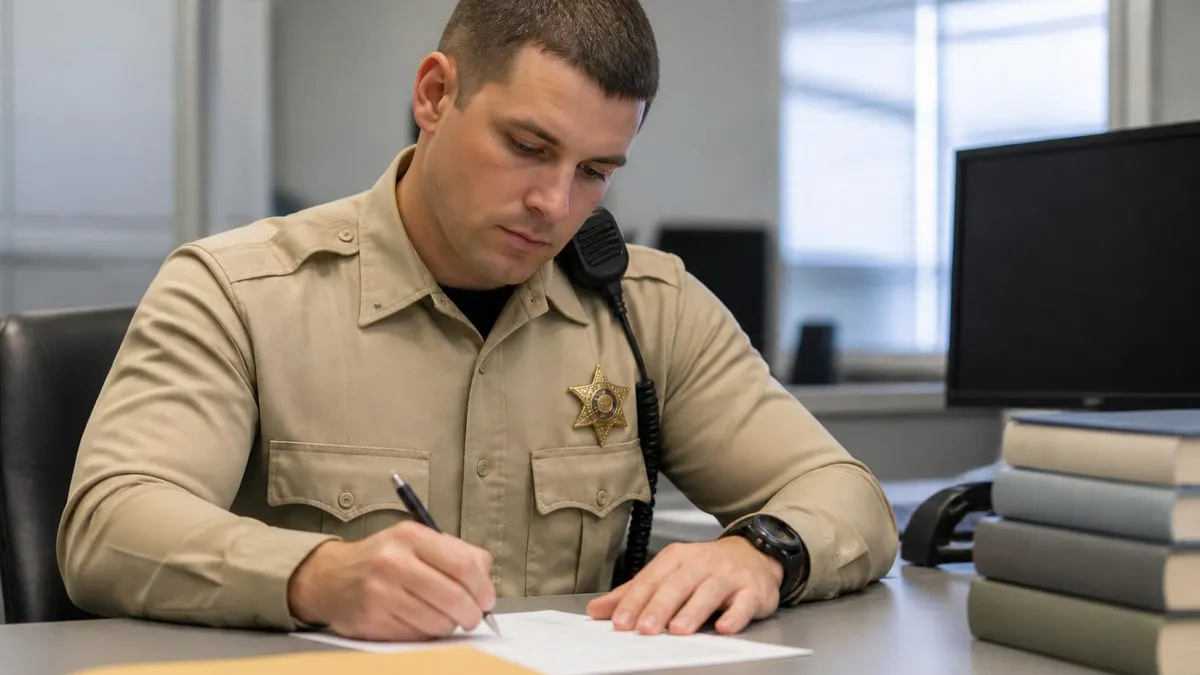
Deputy Sheriff Salary 2026: Real Pay Numbers by State, Rank, and Years of Service

How to Become a Deputy Sheriff: Requirements, Training, and Career Path 2026

Sheriff Deputy Exam: Complete Guide to the Written Test, Fitness, and Interview 2026
Sheriff Practice Test Video Answers

Duties of a Deputy Sheriff: Complete Guide to Daily Responsibilities, Patrol Work, and Court Functions in 2026
About the Author

Law Enforcement Trainer & Civil Service Exam Specialist
John Jay College of Criminal JusticeMarcus B. Thompson earned his Master of Arts in Criminal Justice from John Jay College of Criminal Justice and served 12 years as a law enforcement officer before transitioning to full-time academy instruction. He is a POST-certified instructor who has prepared candidates for police entrance exams, firefighter assessments, and civil service examinations across dozens of agencies.
Join the Discussion
Connect with other students preparing for this exam. Share tips, ask questions, and get advice from people who have been there.
View discussion (7 replies)