
ServSafe Food Handler Test: Complete Study Guide and Certification Prep Hub for 2026 October
Master the ServSafe food handler test with our complete prep hub: format, study schedule, practice questions, passing tips, and certification steps. ✏️
The ServSafe food handler test is the entry-level food safety certification that millions of restaurant workers, grocery clerks, school cafeteria staff, and catering employees need before stepping behind the counter. Unlike the more advanced manager exam, this assessment focuses on the day-to-day habits that prevent foodborne illness: proper handwashing, time and temperature controls, allergen awareness, and cross-contamination prevention. Most states and counties either require this credential outright or accept it as proof of training under local health department rules.
If you have arrived here while searching for the servsafe food handler test, you are likely either a new hire who needs the card within thirty days, a returning worker whose certificate has expired, or a manager assigning training to a team. This guide consolidates everything you need: exam format, scoring, study timeline, common pitfalls, and a focused review of every domain the test covers. By the time you finish reading, you will know exactly how to pass on the first attempt without wasting study hours.
The exam itself is shorter and gentler than ServSafe Manager, but the pass rate is not automatic. Test takers who skim the booklet and rely on workplace habits frequently fail the temperature math sections and confuse cleaning steps with sanitizing steps. We will walk through each weak spot with concrete examples, including the exact temperatures the FDA Food Code requires and the precise contact times approved sanitizers must remain on a surface. These are the questions that trip up real candidates.
Cost-wise, the food handler test is one of the most affordable professional credentials in the United States, typically ranging from fifteen to twenty-five dollars including the online course. Compare that to the hundred-plus dollars required for the manager certification, and you can see why employers often pay for it directly. A few states bundle the program with payroll onboarding, while others let employees pick their own approved provider. We will explain which states accept ServSafe specifically versus which require a state-administered alternative.
The format is also worker-friendly. You can take the entire course and exam from a laptop or even a smartphone, pause at any point, and resume later. There is no testing center to visit, no proctor watching over your shoulder, and no scheduling deadline. Most candidates finish the training in ninety minutes and pass the exam on the first attempt with a score of seventy-five percent or higher. That said, do not underestimate the questions about cooking temperatures and reportable illnesses, which appear on nearly every version of the test.
Throughout this hub you will find practice quizzes mapped to each major domain. Before diving in, review our overview of the broader ServSafe Test family so you understand where the handler credential fits among the manager, alcohol, and allergen certifications. Each program targets a different role in the foodservice operation, and choosing the right one for your job description saves both time and money.
The remainder of this guide is organized as a study sequence. Read it top to bottom for a complete prep walkthrough, or jump to the table of contents on the right and skip directly to the section most relevant to your situation. Whether you have a week to prepare or just an afternoon, the material below will get you ready to pass the servsafe food handler test confidently.
Free ServSafe Food Safety Test Study Tools
Interactive ServSafe Food Safety Test resources on PracticeTestGeeks, free to start:
- ServSafe Food Safety Test flashcards — review key terms and concepts card by card
- ServSafe Food Safety Test study guide — topic-by-topic overview of what the exam covers
- ServSafe Food Safety Test cheat sheet — one-page printable summary for last-minute review
ServSafe Food Handler Test by the Numbers
Key Facts at a Glance
| Item | Value | Details |
|---|---|---|
| Typical Completion Time | 60-90 min | course and exam |
| Minimum Passing Score | 75% | 30 of 40 questions |
| Certificate Validity | 3 years | in most jurisdictions |
| Multiple Choice Questions | 40 | untimed in most states |

ServSafe Food Handler Test Exam Format
| Section | Questions | Time | Weight | Notes |
|---|---|---|---|---|
| Basic Food Safety | 8 | 15 min | 20% | hygiene and personal habits |
| Personal Hygiene | 8 | 15 min | 20% | handwashing, illness reporting |
| Cross-Contamination & Allergens | 10 | 20 min | 25% | storage and prep separation |
| Time & Temperature | 8 | 20 min | 20% | cooking, holding, cooling |
| Cleaning & Sanitation | 6 | 20 min | 15% | three-compartment sink, chemicals |
| Total | 40 | 90 minutes | 100% |
The ServSafe food handler test is built around five domains, and each one maps to a real situation you will encounter on a shift. Understanding the weight of each domain helps you allocate study time efficiently. Cross-contamination and allergen control carries the most questions because mistakes in this area lead to the most lawsuits and hospitalizations. Time and temperature control comes second because it is the technical heart of food safety, requiring you to memorize specific numbers like 41°F for cold holding and 135°F for hot holding.
Basic food safety questions cover foundational concepts: what a foodborne illness is, who is most at risk, and why food workers play a critical public health role. Expect questions about the Big Six pathogens, including Norovirus, Hepatitis A, Salmonella Typhi, Shigella, E. coli, and Nontyphoidal Salmonella. The exam will ask which of these must be reported to your manager and which require exclusion from the workplace under FDA Food Code rules. Memorize the list and the symptoms that trigger reporting, especially vomiting, diarrhea, jaundice, and sore throat with fever.
Personal hygiene questions focus on handwashing technique, glove use, and dress code. The correct handwashing sequence has five steps: wet hands with warm water, apply soap, scrub for ten to fifteen seconds, rinse thoroughly, and dry with a single-use towel. The total process should take at least twenty seconds. Gloves do not replace handwashing; you must wash hands before putting on a new pair, and gloves must be changed when switching tasks, when they tear, or every four hours during continuous use, whichever comes first.
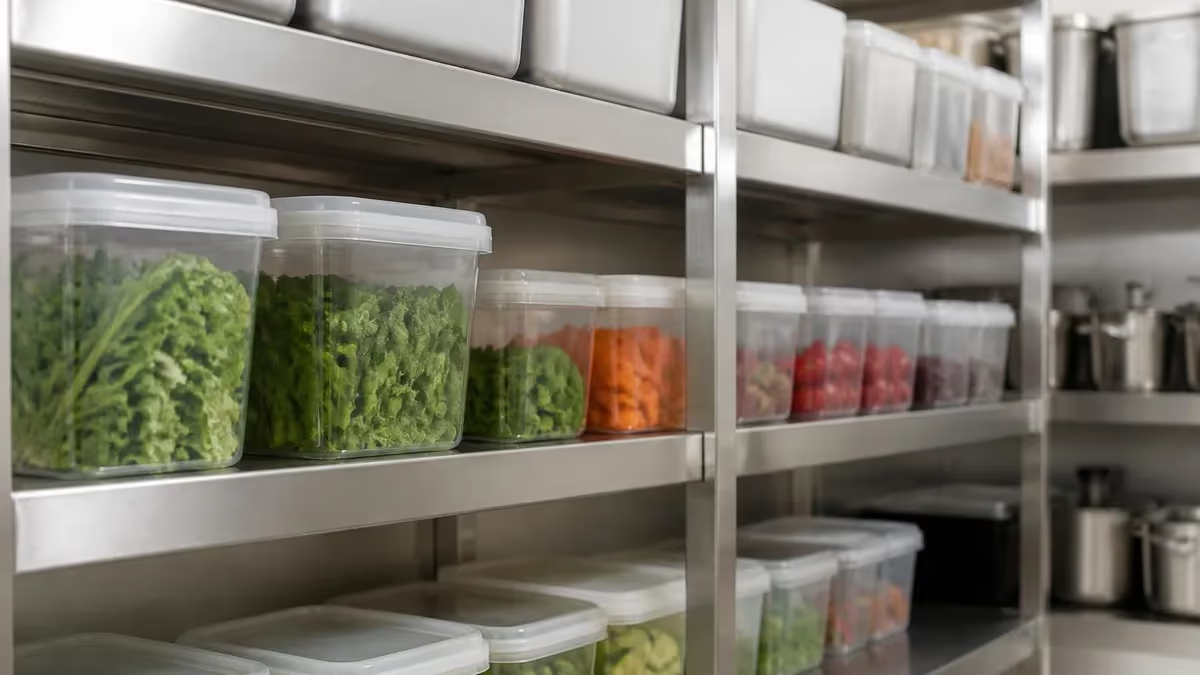
Cross-contamination is the largest domain because separating raw and ready-to-eat items happens constantly in a busy kitchen. The exam tests storage order in a walk-in cooler: ready-to-eat foods on top, then seafood, then whole cuts of beef and pork, then ground meats, with poultry on the bottom. This order reflects each food's minimum internal cooking temperature, so juices dripping down will not contaminate items cooked to lower temperatures. Expect at least two questions on this storage hierarchy alone.
Allergen questions are increasingly emphasized after recent updates to the Food Code. You must recognize the major allergens: milk, eggs, fish, shellfish, tree nuts, peanuts, wheat, soybeans, and now sesame, which was added to the federal list in 2023. The exam will test what to do when a guest reports an allergy, how to prevent cross-contact during prep, and which symptoms indicate anaphylaxis. If you want a deeper review before exam day, consult our guide on how to get your ServSafe certificate for the full enrollment workflow.
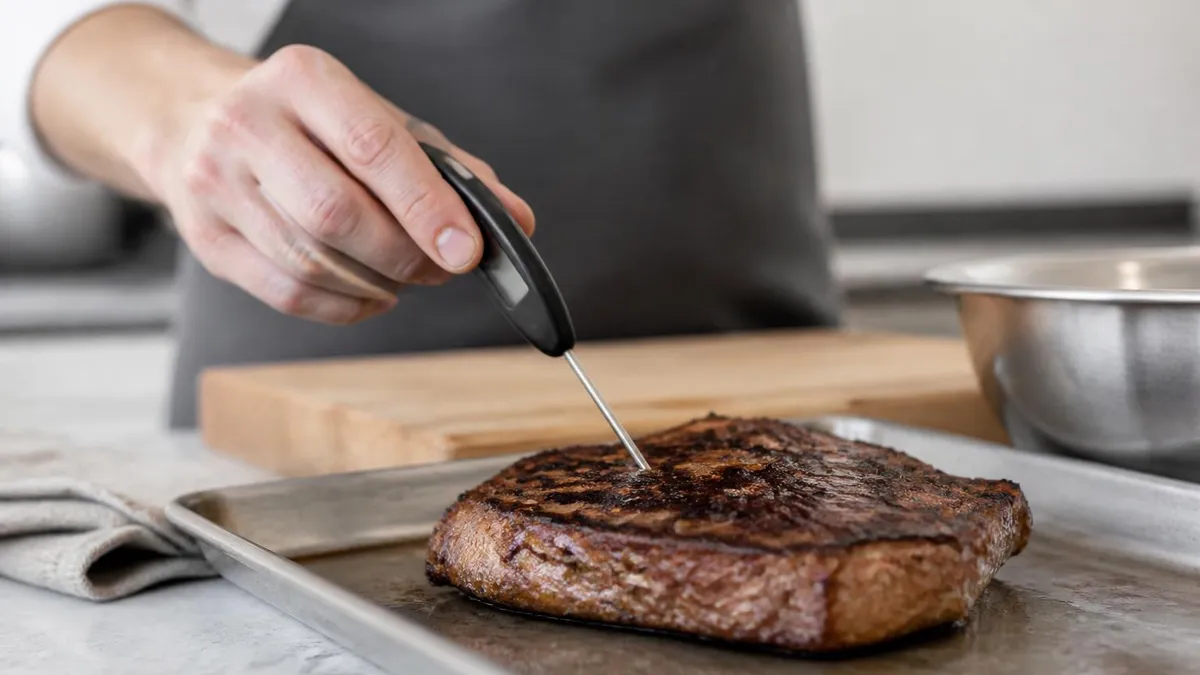
Time and temperature control questions require pure memorization, but the numbers are not arbitrary. They reflect decades of microbiological research on pathogen growth curves. The temperature danger zone runs from 41°F to 135°F, the range where bacteria multiply most rapidly. Food cannot remain in this zone for more than four cumulative hours total. Cooking temperatures vary by product: 165°F for poultry, stuffed items, and reheated leftovers; 155°F for ground meat and ratites; 145°F for whole cuts of beef, pork, and seafood; and 135°F for fruits, vegetables, and commercially processed ready-to-eat foods being held hot.
Cleaning and sanitation is the smallest section but contains tricky distinctions. Cleaning removes visible dirt and food residue; sanitizing reduces pathogens to safe levels on an already-clean surface. The two are not interchangeable. The three-compartment sink procedure runs in a fixed order: scrape, wash at 110°F minimum, rinse, sanitize with chemical or hot water at 171°F, then air dry. Towel drying is never acceptable because it reintroduces contamination.
ServSafe Practice Test Questions
Prepare for the ServSafe Food Safety Test Prep exam with our free practice test modules. Each quiz covers key topics to help you pass on your first try.
ServSafe Cleaning & Sanitization Procedures
ServSafe Exam Questions covering Cleaning & Sanitization Procedures. Master ServSafe Test concepts for certification prep.
ServSafe Cross-Contamination Prevention
Free ServSafe Practice Test featuring Cross-Contamination Prevention. Improve your ServSafe Exam score with mock test prep.
ServSafe Emergency Procedures & Crisis Man...
ServSafe Mock Exam on Emergency Procedures & Crisis Management. ServSafe Study Guide questions to pass on your first try.
ServSafe Food Allergen Management
ServSafe Test Prep for Food Allergen Management. Practice ServSafe Quiz questions and boost your score.
ServSafe Foodborne Illness & Prevention
ServSafe Questions and Answers on Foodborne Illness & Prevention. Free ServSafe practice for exam readiness.
ServSafe Food Preparation & Cooking Standards
ServSafe Mock Test covering Food Preparation & Cooking Standards. Online ServSafe Test practice with instant feedback.
ServSafe HACCP Principles & Implementation
Free ServSafe Quiz on HACCP Principles & Implementation. ServSafe Exam prep questions with detailed explanations.
ServSafe Personal Hygiene & Employee Health
ServSafe Practice Questions for Personal Hygiene & Employee Health. Build confidence for your ServSafe certification exam.
ServSafe Pest Control & Management
ServSafe Test Online for Pest Control & Management. Free practice with instant results and feedback.
ServSafe Receiving & Inspecting Food Deliv...
ServSafe Study Material on Receiving & Inspecting Food Deliveries. Prepare effectively with real exam-style questions.
ServSafe Regulatory Compliance & Health Codes
Free ServSafe Test covering Regulatory Compliance & Health Codes. Practice and track your ServSafe exam readiness.
ServSafe Facility Design & Equipment Maint...
ServSafe Exam Questions covering ServSafe Facility Design & Equipment Maintenance. Master ServSafe Test concepts for certification prep.
ServSafe Food Handler Certification & Trai...
Free ServSafe Practice Test featuring ServSafe Food Handler Certification & Training. Improve your ServSafe Exam score with mock test prep.
ServSafe Food Labeling & Date Marking
ServSafe Mock Exam on ServSafe Food Labeling & Date Marking. ServSafe Study Guide questions to pass on your first try.
Study Methods That Actually Work for the ServSafe Food Handler Test
The ServSafe Food Handler online course is roughly seventy pages of material delivered as interactive slides with embedded video clips. Read it once at normal pace without taking notes, just to get a feel for the scope. Then go back through a second time and make a one-page summary sheet with the key numbers: cooking temperatures, danger zone limits, handwashing duration, and allergen list. Most failures happen because candidates skim and never write anything down.
Active recall beats passive reading by a wide margin. After each section, close the booklet or browser tab and write down everything you remember on a blank page. Compare your notes to the source and circle gaps. Repeat this process for the temperature charts especially, because they are the most testable and the easiest to forget. Five minutes of active recall is worth thirty minutes of rereading.
ServSafe Food Handler vs Other Food Safety Credentials
- +Lowest cost of any nationally recognized food safety credential, typically under $25 total
- +Online format with no proctor or testing center required for most states
- +Recognized in nearly every state as meeting local health department training rules
- +Certificate valid for three years in most jurisdictions before renewal is needed
- +Course is self-paced and can be completed during a single ninety-minute session
- +Available in multiple languages including Spanish, Chinese, and Korean
- +Employer-friendly: bulk seats and corporate accounts cut per-employee cost
- −Not accepted as a substitute for the manager-level certification in any state
- −Some states like California, Texas, and Illinois require additional state-specific exams
- −Online proctoring is not available, which limits use in certain employer audit programs
- −Three-year expiration is shorter than some state cards that last five years
- −Course material is dense for ESL workers without bilingual support at their employer
- −Does not cover alcohol service, which requires a separate ServSafe Alcohol credential
Day-of-Test Checklist for the ServSafe Food Handler Test
- ✓Confirm your ServSafe account login and password the night before the exam
- ✓Find a quiet space with stable Wi-Fi and a charged laptop, tablet, or phone
- ✓Have a government-issued photo ID nearby in case your employer requires verification
- ✓Review the temperature chart one final time: 165, 155, 145, 135, 41
- ✓Re-read the Big Six pathogen list and the symptoms that trigger work exclusion
- ✓Memorize the five-step handwashing sequence and the twenty-second minimum
- ✓Run through the cooler storage order from top shelf to bottom shelf
- ✓Sleep at least seven hours the night before; fatigue causes careless errors
- ✓Drink water and eat a light meal before sitting down to start the exam
- ✓Read each question twice; never click an answer based on the first word you see

Watch for trick wording on temperature questions
Many test-takers lose points because they answer based on the cooking temperature alone without reading whether the question asks about cooking, holding, or reheating. Reheating leftovers requires reaching 165°F within two hours, regardless of the original cook temp. Holding hot food only requires 135°F. Memorize the verbs as carefully as the numbers, and you will pick up three to five easy points.
Even strong students make predictable mistakes on the ServSafe food handler test. The most common is rushing through the personal hygiene questions because they seem like common sense. They are not. The exam writers craft scenarios that sound reasonable but violate Food Code rules. For example, a question might ask whether a cook can taste a sauce with the same spoon used for stirring. The intuitive answer is no, but the exam wants the specific procedure: use a clean spoon for each taste, then drop it in the dishpan.
Another frequent error involves the difference between cleaning and sanitizing. Candidates assume that scrubbing a surface with soap is enough to make it safe. It is not. After cleaning, you must apply an approved sanitizer at the correct concentration and let it sit for the required contact time, typically thirty seconds for chlorine and one minute for quaternary ammonia. The exam will specifically ask which step comes first and how long each chemical needs to work. Skipping the contact time portion costs points every test cycle.
Cooling food is the third trap. The two-stage cooling rule requires food to drop from 135°F to 70°F within two hours, then from 70°F to 41°F or below within an additional four hours, for a total maximum of six hours. Many candidates remember only the six-hour total and miss questions that ask about the first stage specifically. Reviewers also frequently confuse the cooling rule with the four-hour rule for total time in the danger zone, which applies to food that has not been temperature-controlled at all.
Glove questions trip up many test-takers because the rules sound stricter than real-world practice. The Food Code requires hand-washing before putting on a new pair of gloves, not just at the start of a shift. Gloves must be discarded whenever you switch tasks, touch your face, sneeze, take out trash, or after four hours of continuous use. They are not a substitute for hand-washing under any circumstance. The exam will offer scenarios where a worker changes gloves without first washing, and the correct answer is always that this fails the rule.
Allergen questions have grown more nuanced since the FASTER Act added sesame as the ninth major allergen. Candidates who studied from older materials may miss this update entirely. The current list includes milk, eggs, fish, shellfish, tree nuts, peanuts, wheat, soybeans, and sesame. The exam may also ask about gluten-free preparation, even though gluten is not technically a Big Nine allergen. Reading the question carefully matters: "major food allergen" and "food intolerance" are different categories.
Finally, reportable illness questions are a sneaky source of failure. The Big Six pathogens must be reported to your manager whenever you suspect exposure, but the exam goes further. Workers showing symptoms of vomiting, diarrhea, jaundice, sore throat with fever, or an infected wound that cannot be properly covered must be excluded from food handling duties. Many candidates assume only the named pathogens require action, missing questions about symptomatic exclusion. Memorize both the pathogen list and the symptom triggers.
If you fail the first attempt, do not panic. Most providers allow a free retake within thirty days. Use the score report to identify which domains pulled you down, focus your study time there, and retake when you can score above ninety percent on practice tests. Failure on the first attempt is far less common than people assume, but a smart retake strategy turns a setback into a guaranteed pass.
California, Texas, Illinois, Arizona, and a handful of other states have additional state-approved food handler programs beyond ServSafe. In these jurisdictions, ServSafe may be accepted, may need a state addendum, or may not be accepted at all. Always confirm with your county or city health department before paying for the course, and verify that your employer's approved provider list includes ServSafe specifically.
Passing the ServSafe food handler test on the first attempt comes down to three things: studying the right material, practicing with realistic questions, and managing test-day pressure. The official ServSafe course covers everything that appears on the exam, so resist the temptation to use third-party study guides as your only resource. Supplementary materials are useful for practice questions, but the primary content should come from the official booklet or e-learning module to ensure you see the exact terminology the exam uses.
Timing-wise, give yourself at least three days to absorb the material rather than cramming the night before. Cognitive science shows that spaced repetition over multiple short sessions outperforms one long study marathon by a large margin. Spend forty-five minutes on day one reading and note-taking, another forty-five minutes on day two on practice questions, and a final thirty minutes on day three reviewing weak areas. Take the test on day four when the material is fresh but well consolidated.
If your certification is for a new job, you can typically register and complete the entire process within twenty-four hours of being hired. The certificate is delivered as a downloadable PDF immediately after passing, so you can email it to your employer the same day. If you need a physical card, ServSafe will mail it within seven to ten business days, but most employers accept the digital version for compliance purposes. Save a copy to your phone for inspections and audits.
For employers managing a team, ServSafe offers corporate accounts that let you assign training, monitor completion, and reissue certificates from a central dashboard. Bulk seat pricing typically saves five to ten dollars per employee compared to individual purchases. If you manage multiple locations, this consolidation makes audit prep dramatically easier because all records live in one place. Ask the ServSafe sales team for a quote if you need more than fifteen seats annually.
One question candidates frequently ask is whether the food handler certificate transfers across states. The answer is partial: ServSafe is recognized in most states, but the local health department always has final authority. Moving from Texas to Illinois, for instance, may require you to retake under Illinois rules even if your card has not expired. Check the destination state's food safety page before assuming your existing card is valid. For more details on validity rules, see our breakdown of how long ServSafe certification lasts across credentials and states.
Retake policy varies by state and provider, but ServSafe generally allows up to two retakes per purchase. After two failed attempts, you must re-enroll and pay again. The retake exam is drawn from the same question pool, but the specific questions you see may differ. Do not assume you can pass by memorizing missed items from the first attempt; the second exam will test the same concepts with different scenarios. Genuine understanding beats rote memorization on retakes.
Finally, view this certification as the first step rather than the final destination. Many food handlers go on to earn the ServSafe Manager certification, which opens shift lead and management roles in any state. Some pursue allergen-specific or alcohol-specific add-on credentials. The skills you build now form the foundation for every future food safety role, so invest the study time fully rather than treating the test as a checkbox to clear.
With your test date approaching, focus the final twenty-four hours on consolidation rather than new learning. Cramming new material the night before reliably backfires because short-term memory crowds out the concepts you have already absorbed. Instead, review your one-page summary sheet, take one final timed practice test, and identify any remaining gaps. If you score above eighty-five percent on the practice exam, you are ready. If you score below that, focus your last study session on the two weakest domains rather than re-reading the entire course.
Sleep matters more than people realize. Multiple studies on cognitive performance show that a single night of poor sleep reduces test scores by five to ten percent across all academic disciplines. The ServSafe food handler test is no exception. Go to bed at your normal time, avoid caffeine after early afternoon, and skip alcohol entirely the night before. A clear head will help you parse the trickier double-negative questions that appear on every version of the exam.
On the morning of the test, eat a real breakfast with protein and complex carbohydrates. Hunger and low blood sugar slow reaction time and impair judgment, both of which hurt your score. Avoid sugary energy drinks; the crash that follows can hit right in the middle of the exam. Drink water consistently and use the bathroom before starting, since most online proctoring rules do not allow breaks once the exam begins.
When the exam loads, read every question twice before answering. The ServSafe item writers frequently use words like "except," "not," and "least" that flip the meaning of a question. A quick first read often misses these qualifiers and leads to careless mistakes. After you select an answer, read the question once more and confirm the answer still makes sense in context. This three-pass approach adds maybe fifteen seconds per question but eliminates the most common source of wrong answers.
If you encounter a question you genuinely do not know, do not panic and do not stare at it for five minutes. Eliminate the obviously wrong choices, make your best guess, flag the question if your platform allows, and move on. You can return to flagged questions at the end if time permits. Spending too long on one item drains mental energy you will need for the rest of the exam, and there is no penalty for guessing, so a thoughtful guess is always better than a blank.
After you submit, the score appears within seconds. If you pass, download your certificate immediately and save it to multiple devices, including cloud storage. If you fail, do not delete your account or rage-quit the platform. Take a deep breath, request the retake, and plan a smarter study session for the weakest domain. Most retake passers credit their second-attempt success to a focused two-hour review session on the specific area that pulled their first score down.
Once certified, keep the digital card accessible in case a health inspector or new employer requests proof. Set a calendar reminder for thirty days before your three-year expiration so you have plenty of time to renew without lapsing. Food safety is a continuous practice, and the habits you build during this preparation will serve you throughout a foodservice career. Pass with confidence, and start putting the knowledge to work on your very next shift.
Sample ServSafe Food Safety Test Practice Questions
Try these questions from our free ServSafe Food Safety Test practice tests. The correct answer and an explanation follow each question.
A customer returns a plate of food they say is not cooked to their liking. What should a food handler do with the returned plate?
- A. Place it back on the line for recooking
- B. Discard it and prepare a new plate
- C. Reheat it to 165°F before returning it
- D. Store it in the refrigerator and reuse it later
Answer: B. Discard it and prepare a new plate
Food that has left the kitchen and been served to a customer must be discarded and a fresh plate prepared to avoid contamination.
A food handler rewrites an old date on a food label to extend its use. This is:
- A. Acceptable if the food still looks and smells fine
- B. A violation of food safety regulations
- C. Allowed only with manager approval
- D. Fine as long as the food is reheated before serving
Answer: B. A violation of food safety regulations
Altering or falsifying date labels is a food safety violation because it conceals critical shelf-life information.
A food handler notices that the ice in the salad bar has partially melted and some food items are sitting above the ice line. What should be done?
- A. Continue service as long as food looks fresh
- B. Add more ice and check the food temperature
- C. Move the food to a refrigerator immediately and discard if above 41°F
- D. Stir the food to redistribute cold air
Answer: C. Move the food to a refrigerator immediately and discard if above 41°F
Food that may have risen above 41°F must be temperature-checked, and any food in the danger zone for too long must be discarded.
How often must a food handler wash their hands when switching between handling raw meat and ready-to-eat foods?
- A. Every time before switching tasks
- B. Only once per shift
- C. Only if they visibly soiled
- D. Only when a manager observes them
Answer: A. Every time before switching tasks
Hands must be washed every time a food handler switches from handling raw meat to ready-to-eat foods to prevent cross-contamination.
ServSafe Questions and Answers


About the Author

Registered Sanitarian & Food Safety Certification Expert
Cornell University College of Agriculture and Life SciencesThomas Wright is a Registered Sanitarian and HACCP-certified food safety professional with a Bachelor of Science in Food Science from Cornell University. He has 17 years of experience in food safety auditing, regulatory compliance, and foodservice management training. Thomas prepares food industry professionals for ServSafe Manager, HACCP certification, and state food handler examinations.
Join the Discussion
Connect with other students preparing for this exam. Share tips, ask questions, and get advice from people who have been there.
View discussion (8 replies)