
SCRUM Practice Test PDF (Free Printable 2026 October)
Boost your Scrum exam score with practice questions and detailed answer explanations. Track progress with instant feedback. 💯
Free Scrum Practice Test PDF Download
Scrum is the most widely adopted agile framework in the world, and Scrum certifications — from PSM I (Professional Scrum Master) to CSM (Certified ScrumMaster) — are among the most sought-after credentials in project management and software development. This free Scrum practice test PDF delivers printable exam questions across every core Scrum topic: accountabilities, events, artifacts, empiricism, and the Scrum values. Download it, print it, and work through it anywhere — no internet required.
Every question in this PDF is written against the official Scrum Guide (2020 version), which is the authoritative reference for all Scrum.org and Scrum Alliance certification exams. Pair it with our interactive Scrum practice test for immediate feedback and full explanations on every answer.
Pro Tip: Focus your SCRUM study time on areas where you score lowest. Most exam questions test application of knowledge, not memorization.
What Scrum Certification Exams Cover
The 2020 Scrum Guide is lean — just 13 pages — but the exams test deep comprehension of every sentence. Questions frequently present scenarios requiring you to identify the correct Scrum accountability, the right event to address a problem, or how the empirical pillars apply. Here is a breakdown of the major topic areas.
Scrum Values and Empiricism
The five Scrum values — commitment, courage, focus, openness, and respect — are not decorative. Exam questions test whether you understand how these values enable the three pillars of empiricism: transparency, inspection, and adaptation. Scrum is founded on empirical process control, meaning decisions are made based on what is known and observed, not forecasts or plans. Questions will ask you to identify which pillar is violated when a team hides problems from stakeholders, or which value enables a Scrum Master to escalate an impediment.
Scrum Accountabilities
The 2020 Scrum Guide replaced "roles" with "accountabilities" — a distinction the PSM I exam tests directly. The Product Owner is accountable for the Product Backlog and maximizing the value of the product. The Scrum Master is accountable for the Scrum Team's effectiveness and for promoting and supporting Scrum as defined in the Scrum Guide. The Developers are accountable for the Sprint Backlog and creating a usable Increment every Sprint. No one else — not managers, not stakeholders — has authority over the Scrum Team's work during a Sprint.
Scrum Events and Time-Boxing
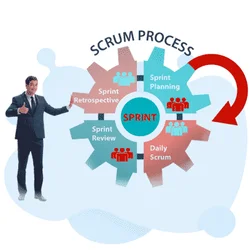
All five Scrum events are time-boxed. The Sprint itself is the container event — one month or less, never extended. Sprint Planning is time-boxed to 8 hours for a one-month Sprint. The Daily Scrum is 15 minutes, for the Developers only (the Scrum Master does not run it). Sprint Review is 4 hours for a one-month Sprint. Sprint Retrospective is 3 hours for a one-month Sprint and is the final event of the Sprint — it occurs before the next Sprint Planning. Knowing the exact time-boxes and who attends each event is heavily tested.
Artifacts and Commitments
The 2020 Scrum Guide added commitments to each artifact — one of the most-tested additions. The Product Backlog's commitment is the Product Goal (the long-term objective). The Sprint Backlog's commitment is the Sprint Goal (the single objective for the Sprint). The Increment's commitment is the Definition of Done (the quality standard every Increment must meet). The Definition of Done is created by the Developers unless the organization has an existing standard, in which case the Developers must comply with it as a minimum.
- ✓Read the 2020 Scrum Guide completely at least twice — every word is testable
- ✓Memorize all five Scrum values and be able to give an example of each in a team context
- ✓Know the three empirical pillars and how each event and artifact supports them
- ✓Study the three accountabilities: what each one is responsible for and what they are NOT
- ✓Memorize all five events, their time-boxes for a one-month Sprint, and who must attend each
- ✓Learn the three artifacts and their commitments: Product Goal, Sprint Goal, Definition of Done
- ✓Understand Product Backlog refinement — it is ongoing, not a formal event in the Scrum Guide
- ✓Study Sprint Planning two topics: why this Sprint is valuable (Sprint Goal) and what can be done (forecast)
- ✓Review the Scrum Master service responsibilities to the Product Owner, Developers, and organization
- ✓Take at least three full practice exams under timed conditions before your certification exam
Free Scrum Practice Tests Online
The printable PDF is a great study companion, but our interactive Scrum practice test platform adds features that printed materials simply cannot match. Get instant right/wrong feedback, read detailed answer explanations tied to specific Scrum Guide passages, and track your score by topic area so you know exactly where to focus. Many candidates use the PDF for their first review pass, then switch to online tests for timed simulation in the final week before their PSM I or CSM exam.
Sample SCRUM Practice Questions
Try these questions from our free SCRUM practice tests. The correct answer and an explanation follow each question.
Which of the following Scrum events is specifically designed for the Scrum Team to inspect itself and create a plan for improvements to be enacted during the next Sprint?
- A. The Sprint Review
- B. The Daily Scrum
- C. The Sprint Retrospective
- D. The Sprint Planning
Answer: C. The Sprint Retrospective
The purpose of the Sprint Retrospective is to plan ways to increase quality and effectiveness by inspecting how the last Sprint went regarding individuals, interactions, processes, tools, and the Definition of Done. The output is a plan for implementing improvements in the upcoming Sprint.
A Developer on the Scrum Team personally pledges to complete their assigned tasks, assists other team members who are falling behind, and actively works with the entire team to ensure the Sprint Goal is met. This dedication exemplifies which Scrum Value?
- A. Focus
- B. Respect
- C. Commitment
- D. Openness
Answer: C. Commitment
This behavior demonstrates Commitment. The Scrum Team commits to achieving its goals and to supporting each other. The developer is not just dedicated to their own work but is also committed to the team's collective success and the achievement of the Sprint Goal.
A Scrum Team is in the middle of a Sprint. A key stakeholder insists that a new, urgent feature must be added to the current Sprint Backlog immediately. According to Scrum accountabilities, how should this be handled?
- A. The Developers must add the new feature to the Sprint Backlog as requested by the stakeholder.
- B. The Scrum Master should add the item to the Sprint Backlog and adjust the Sprint Goal.
- C. The stakeholder should directly negotiate with the Developers to swap out an existing item.
- D. The stakeholder should discuss the new feature with the Product Owner, who will decide if and how to adjust the Product Backlog.
Answer: D. The stakeholder should discuss the new feature with the Product Owner, who will decide if and how to adjust the Product Backlog.
The Product Owner is accountable for managing the Product Backlog and its contents. Stakeholders who want to change the Product Backlog should do so by convincing the Product Owner. The Developers own the Sprint Backlog and should not be interrupted during the Sprint. The Product Owner can work with the Developers to see if the Sprint Goal is impacted and if there's an opportunity to include the new work, but the initial conversation must go through the Product Owner.
A Scrum Team demonstrates a new Increment to key stakeholders during the Sprint Review. The stakeholders are pleased but realize that market conditions have shifted, making a different set of features more valuable for the next Sprint. How is this feedback primarily used as an act of adaptation within the Scrum framework?
- A. The Scrum Master documents the feedback as an impediment to be removed.
- B. The Developers immediately begin working on the newly requested features.
- C. The Product Owner uses the input to revise and reorder the Product Backlog for the next Sprint.
- D. The Sprint Goal for the just-ended Sprint is retroactively changed to reflect the new market realities.
Answer: C. The Product Owner uses the input to revise and reorder the Product Backlog for the next Sprint.
The purpose of the Sprint Review is to inspect the outcome of the Sprint and determine future adaptations. Based on feedback from stakeholders, the Product Owner adapts the Product Backlog to maximize value, which provides valuable input for the next Sprint Planning.