

Reflexology Practice Test
Updated October 2026Facts verified Oct 31, 2026 against American Reflexology Certification Board
Sample Reflexology Practice Questions
Try these questions from our free Reflexology practice tests. The correct answer and an explanation follow each question.
The International Institute of Reflexology (IIR) was founded by which reflexology pioneer?
- A. Eunice Ingham
- B. Dwight Byers
- C. Hanne Marquardt
- D. Laura Norman
Answer: B. Dwight Byers
Dwight Byers, Eunice Ingham's nephew, founded the International Institute of Reflexology to carry on and teach her original method.
How does pressure application in hand reflexology generally compare to foot reflexology?
- A. Hands require deeper pressure because they have more muscle
- B. Hands are more sensitive, so lighter pressure is often used compared to feet
- C. Pressure is identical — no adjustment needed
- D. Hands require no technique, just rubbing
Answer: B. Hands are more sensitive, so lighter pressure is often used compared to feet
The hands are generally more sensitive than the feet and have less protective tissue, so slightly lighter, more precise pressure is typically used.
How does ear reflexology differ from foot reflexology in the way stimulation is applied?
- A. Ear reflexology uses only heat; foot reflexology uses only pressure
- B. Ear reflexology may use small seeds, pellets, needles, or light pressure on tiny points; foot reflexology uses thumb/finger walking across broader areas
- C. There is no difference in technique
- D. Ear reflexology is always performed by MDs only
Answer: B. Ear reflexology may use small seeds, pellets, needles, or light pressure on tiny points; foot reflexology uses thumb/finger walking across broader areas
Ear reflexology uses fine tools, seeds, pellets, or micro-needles on very small precise points, while foot reflexology uses broader thumb and finger walking techniques.
In hand reflexology, the dorsal (back) surface of the hand corresponds to which surface of the foot?
- A. Plantar surface
- B. Dorsal (top) surface of the foot
- C. Heel only
- D. Arch only
Answer: B. Dorsal (top) surface of the foot
The dorsal surface of the hand mirrors the dorsal (top) surface of the foot, with the same musculoskeletal and lymphatic reflex areas mapped to both.
The Reflexology has 150 questions and takes about 1.5 hours[1] (American Reflexology Certification Board, verified Oct 25, 2026).
- The ARCB reflexology certification examination consists of 150 questions.[1]
- Candidates have 90 minutes to complete the ARCB reflexology certification exam.[1]
- The ARCB reflexology exam is reported as PASS or FAIL against a criterion-referenced passing standard; no numeric cut score is published.[2]
- The ARCB Foot Reflexology exam application and examination fee is $500 USD.[3]
- Applying for both the ARCB Foot and Hand reflexology exams on one application costs $935 USD.[3]
- An ARCB Foot Reflexology exam retake costs $250 USD.[3]
- Per the 2026 ARCB Applicant Handbook, a candidate who fails must wait 30 days and may retake the exam up to three times.[2]
- ARCB candidates have 12 months from their application date to take the reflexology examination.[3]
- ARCB-certified reflexologists must submit 12 continuing education credits every other year from their original certification date.[4]
Numbers in brackets link to the official sources listed under Sources & last verified. Dates that have passed are removed automatically.
Reflexology Exam at a Glance
| Item | Detail | Source · Verified |
|---|---|---|
| Number of questions | 150 questions[1] | American Reflexology Certification Board · Oct 25, 2026 |
| Time limit | 90 minutes[1] | American Reflexology Certification Board · Oct 25, 2026 |
| Passing score | Pass/Fail (criterion-referenced)[2] | American Reflexology Certification Board · Oct 25, 2026 |
| Exam fee (Foot) | $500 application + exam fee[3] | American Reflexology Certification Board · Oct 25, 2026 |
| Exam fee (Foot and Hand) | $935 for both exams[3] | American Reflexology Certification Board · Oct 25, 2026 |
| Exam fee (Hand) | $500 application + exam fee[3] | American Reflexology Certification Board · Oct 25, 2026 |
| Retake fee (Foot) | $250 per retake[3] | American Reflexology Certification Board · Oct 25, 2026 |
| Retake policy | Wait 30 days; up to 3 retakes (per 2026 handbook)[2] | American Reflexology Certification Board · Oct 25, 2026 |
| Validity | 12 months from application to test[3] | American Reflexology Certification Board · Oct 25, 2026 |
| Renewal | 12 CEs every other year[4] | American Reflexology Certification Board · Oct 25, 2026 |
| Delivery | Prometric test center or remote online proctoring[2] | American Reflexology Certification Board · Oct 25, 2026 |
| Score release | Shown at the end of the exam[2] | American Reflexology Certification Board · Oct 25, 2026 |
| Testing window | Year-round[2] | American Reflexology Certification Board · Oct 25, 2026 |
What changed for Reflexology in 2026
- Oct 25, 2026: Number of questions changed to 150 questions (previously 150 multiple-choice questions).[1]
- Oct 25, 2026: Retake policy changed to Wait 30 days; up to 3 retakes (per 2026 handbook) (previously Wait 30 days; up to 3 retakes).[2]
- Oct 25, 2026: Renewal changed to 12 CEs every other year (previously 12 CEs every other year + annual dues ($75 active)).[4]
Free Reflexology Study Tools
Interactive Reflexology resources on PracticeTestGeeks, free to start:
- Reflexology Benefits 1 — 7 questions with answer explanations
- Reflexology flashcards — review key terms and concepts card by card
- Reflexology study guide — topic-by-topic overview of what the exam covers
- Reflexology cheat sheet — one-page printable summary for last-minute review
Reflexology Questions and Answers
Reflexology Question and Answers
- Complementary therapy principles and practices
- Understanding of pathologies, anatomy, and physiology
- Offer reflexology
- Health and Safety for Complementary Therapies and Hygiene
- Understanding of Rarer Pathologies for Complementary Therapies
- Business Procedures for Alternative Therapies
- Reflective Reflexology Practice
- Leaning forward while holding your first or middle finger, gradually release your head’s weight from the finger’s support.
- Press firmly and move your thumb in a circular motion.
- While massaging, take ten full breaths, then exhale.
- Make sure to wash your hands to prevent skin irritations or the spread of infections. ⇒Use massage oils or lotion for easier and smoother manipulation of the fingers and hands. ⇒Use constant pressure in a circular motion for 3 to 5 seconds before proceeding to another location. The body part or place you want to concentrate on can be found on the reflexology hand chart.
- Begin by stroking your thumb on your hand in broad circles, beginning in the middle and moving outward. Rub the thumb pad of your hand in a straight line from the knuckles to the wrist. This movement is meant to help you relax, so use little pressure.
- Grasp a finger and turn it counterclockwise at the joint. Do this with each finger. 4. Press the tips of each finger between your thumb and fingers to activate the pressure points on your hands. 5. Work counterclockwise circles from the base of each finger to the tip using your thumb and forefinger. 6. Starting at the palm and working your way down to the wrist, gently rub the finger pads, the back of the hand, and the palm of the hand. 7. To help your body rid itself of wastes and toxins, drink water after each hand reflexology session.
- Do some market research
- Create a client profile.
- Alternative medicine
- Pricing strategy
- Promote your company
- Purchase an established company
- Place the mat. Overlay your bed or any other flat surface you want to use with a folded towel. Make sure there is enough room around it to allow you to lay down comfortably and roll over without bumping against anything.
- Adding Warm Water Your body’s natural lubricant is warm water. It greatly helps massage and aids in easing pain and tense muscles. If you struggle with swelling, using warm water is a terrific approach to relieve unpleasant strain on aching muscles and joints.
- Immerse your hands and feet When you exit the shower or bath, pat your hands and feet dry rather than rubbing them. Each appendage should be covered with water before being placed on a towel.
- Wash Your Hands And Dry Them Before massaging, you should make sure your hands are clean and dry. As a result, step 4 involves washing off with soap and warm water before patting your hands dry with a towel. They won’t absorb oil correctly if they aren’t completely dry. This might result in an unpleasant and dangerous situation.
- The basic rubdown Once you’ve been familiar with your reflexology mat, begin with a simple rubdown. Spend at least one minute concentrating on each of these zones before shifting your attention to another portion of your body.
- Working on either side of the body, one side at a time One side at a time, you should work on each side of your body. When using these reflexology massage mats, keep in mind that you should only apply 20 to 30 pounds of pressure, since more than that can be harmful.
- Switch between the sides Make sure to massage each reflex point separately, depending on how many there are on your mat. You might need to turn your mat over and rub both sides.
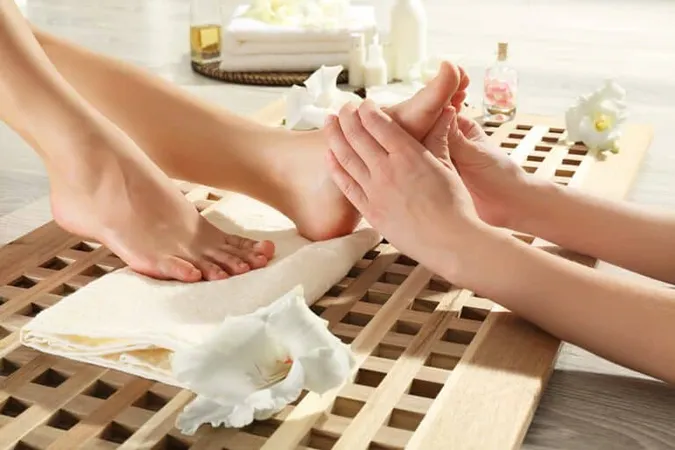
- Feet. Starting from the little toe, go from the thumb to the big toe. Put your thumb on one foot and move your entire hand along it, from little toe to big toe. Repeat many times while creating circles along each digit with a steady, soothing pressure. From the little toe to the big toe, switch feet and begin again.
- Work inwards with your feet. Beginning With The Little Toe, Move Outward From Heel To Heel Spend around two minutes working on each area of your foot. Apply little pressure to each area of your foot, working your way up to the heel, starting at the toes. For instance, place the thumb from either hand against your big toe.
- Finish by massaging your hands, working your way up each finger from pinky to thumb. Frequently simply go for it at this point and massage their entire hand all at once. However, you can also focus on each finger for a full minute, starting with the pinky. People are frequently astounded by how great they feel after receiving reflexology, especially after using a massage mat!
According to American Reflexology Certification Board, “The ARCB certification examination consists of 150 questions.”[1]
Reflexology content outline and where to practise each area
The content areas below are copied from the official Reflexology content outline published by American Reflexology Certification Board. The right-hand column shows which of our practice sets covers it.
| Official content area | Practice on this site |
|---|---|
| Anatomy & Biomechanics (FOOT or HAND)[2] | Reflexology Foot Anatomy and Zones Practise naming the bones, joints and muscles of the foot and how they move, then repeat for the hand if you sit that exam. |
| Critical Thinking[2] | Reflexology Client Assessment and Safety Work through scenario questions and decide what to do when a client's situation affects how or whether you should work. |
| Professional Business Practices[2] | Reflexology Professional Ethics and Practi... Practise questions on ethics, scope of practice, client records and professional boundaries. |
| Reflexes and Maps (FOOT or HAND)[2] | Reflexology Hand Reflexology Rehearse where each body area sits on the foot and hand map, and compare the hand map with the foot map. |
| Theory & Scientific Studies[2] | Reflexology History and Principles Learn the main models of how reflexology is explained and how to read research claims with care. |
Reflexology Practice Test Questions
Prepare for the Reflexology exam with our free practice test modules. Each quiz covers key topics to help you pass on your first try.
Reflexology Reflexologist Trainer
Reflexology Exam Questions covering Reflexologist Trainer. Master Reflexology Test concepts for certification prep.
Reflexology Benefits
Free Reflexology Practice Test featuring Benefits. Improve your Reflexology Exam score with mock test prep.
Reflexology Client Assessment and Safety
Reflexology Mock Exam on Client Assessment and Safety. Reflexology Study Guide questions to pass on your first try.
Reflexology Ear Reflexology and Auriculoth...
Reflexology Test Prep for Ear Reflexology and Auriculotherapy. Practice Reflexology Quiz questions and boost your score.
Reflexology Foot Anatomy and Zones
Reflexology Questions and Answers on Foot Anatomy and Zones. Free Reflexology practice for exam readiness.
Reflexology Hand Reflexology
Reflexology Mock Test covering Hand Reflexology. Online Reflexology Test practice with instant feedback.
Reflexology Professional Ethics and Practi...
Free Reflexology Quiz on Professional Ethics and Practice Standards. Reflexology Exam prep questions with detailed explanations.
Worked examples: how to reason through Reflexology questions
These are practice questions written for this site, not questions from the real exam. Each explanation shows why the right answer is right and why the others are wrong.
Example 1
Question: A trainer should teach that excessive pressure on a client most likely causes what?
- Faster healing
- Pain and guarding, reducing effectiveness
- Improved circulation only
- No effect at all
Answer: B. Pain and guarding, reducing effectiveness
Explanation:
The correct answer is pain and guarding, reducing effectiveness. When pressure goes past what a client can tolerate, the body tenses up to protect itself. That tension works against the relaxation that the session is meant to encourage, so the work becomes less effective, not more.
Faster healing is wrong because more force is not linked to better results. Improved circulation only is wrong because it ignores the discomfort and tension that excess pressure creates. No effect at all is wrong because pressure clearly changes how the client responds, and usually for the worse.
The rule to remember: pressure should be firm but comfortable, and you adjust it to the client's feedback, not to what you think should work.
Example 2
Question: Which model describes reflexology as a 'map' of the entire body reproduced on the feet?
- Segmental reflex model
- Holographic or somatotopic model
- Dermatome model
- Trigger point model
Answer: B. Holographic or somatotopic model
Explanation:
The correct answer is the holographic or somatotopic model. It proposes that the foot holds a miniature map of the whole body, with each organ and area placed at a specific spot. That is the idea behind a reflexology chart.
The segmental reflex model is wrong because it describes how nerves serve body segments, not a full body map on one part. The dermatome model is wrong because it maps skin areas to spinal nerves. The trigger point model is wrong because it deals with tight, tender spots in muscle, not a body-wide map.
The rule to remember: when a question says the whole body is reproduced in one small area, think holographic or somatotopic. Match each model name to what it actually describes.
Example 3
Question: The auriculotherapy body map is based on which anatomical concept?
- The ear represents a miniature hand
- The ear resembles an inverted fetus, with the earlobe corresponding to the head
- The ear maps only to the head and neck
- The ear has no consistent reflex map
Answer: B. The ear resembles an inverted fetus, with the earlobe corresponding to the head
Explanation:
The correct answer is that the ear resembles an inverted fetus, with the earlobe corresponding to the head. This is the basis of the auricular map used in auriculotherapy, where the lobe relates to the head and other ear regions relate to other body areas.
The ear representing a miniature hand is wrong because no such model is used for the ear map. The ear mapping only to the head and neck is wrong because the map covers the whole body. The ear having no consistent reflex map is wrong because auriculotherapy relies on a defined map.
The rule to remember: picture the ear as an upside-down body, head at the lobe, and place other regions from there.
How to use these practice tests
Start by reading the official content areas and the applicant handbook on the ARCB site, so you know what is tested and how the exam is run. Then take one of our topic sets cold, without notes, to find your weak areas.
Work on the weakest area first. For each missed question, read the explanation, then write the rule in your own words. Anatomy and the foot or hand map are best learned by drawing them from memory and checking against your course material, then returning to the matching practice set.
Give regular time to the less visual areas as well. Use the professional ethics set for business practices, the history and principles set for theory, and the client assessment and safety set for critical thinking and body systems. Scenario questions reward careful reading, so slow down on the wording and look for what the question actually asks.
In the last stretch, mix sets together and practise under a timer that matches the 90 minutes allowed for 150 questions. Afterwards, review every miss, including lucky guesses. Remember that our questions are for practice and are not copies of the real exam.
- ✓Review the content outline published by the specific certifying body you're pursuing (e.g. ARCB, RAA)
- ✓Take a diagnostic practice test to identify weak areas
- ✓Create a study schedule (4-8 weeks recommended)
- ✓Focus on your weakest domains first
- ✓Complete at least 3 full-length practice exams
- ✓Review all incorrect answers with detailed explanations
- ✓Take a final practice test 1 week before exam day

- +A recognized credential (from bodies like ARCB) can boost your resume and client trust
- +Demonstrates commitment to professional development
- +Can open doors to additional career opportunities
- +Structured study builds a solid foundation in reflex zones, anatomy, and safe technique
- −Exam preparation requires significant time investment
- −Certification fees, requirements, and required session hours vary by certifying body
- −May require continuing education to maintain
- −Not all employers or clients require formal certification
Pros and Cons at a Glance
| Pros | Cons |
|---|---|
| A recognized credential (from bodies like ARCB) can boost your resume and client trust | Exam preparation requires significant time investment |
| Demonstrates commitment to professional development | Certification fees, requirements, and required session hours vary by certifying body |
| Can open doors to additional career opportunities | May require continuing education to maintain |
| Structured study builds a solid foundation in reflex zones, anatomy, and safe technique | Not all employers or clients require formal certification |
Reflexology for Headaches
Sources & last verified
- American Reflexology Certification Board — number of questions, time limit (official source). “The ARCB certification examination consists of 150 questions.” Verified Oct 25, 2026.
- American Reflexology Certification Board — passing score, retake policy, delivery, score release (official source). “Examination results are reported as PASS or FAIL.” Verified Nov 1, 2026.
- American Reflexology Certification Board — exam fee, retake fee, validity (official source). “$500.00 (USD)” Verified Oct 25, 2026.
- American Reflexology Certification Board — renewal (official source). “ARCB Certificants are required to submit 12 CEs every OTHER year from the date they were originally certified.” Verified Oct 25, 2026.
How we verify: editorial & fact-checking policy. Report an error: contact us.
How this page was made: written with AI tools and published by Nathan Beja, founder of Practice Test Geeks, who is responsible for its content. Exam facts are checked against the official sources listed below. Not reviewed by a subject-matter expert. Editorial policy
Sources & references
Exam facts on this page (fees, format, dates, passing scores) are checked against these official sources; the date is our last check. Editorial policy
- arcb.net — Test delivery, passing score, retake policy, score release, test dates, renewal, exam format, time limit, fees, retake fee · verified Nov 2026