
PALS Certification Cost: Complete 2026 October Pricing Guide for Healthcare Professionals
How much does PALS certification cost in 2026 October? 💡 Compare AHA, online, and hospital-based course fees, renewal costs, and ways to save.

Understanding the full PALS certification cost before you enroll is one of the smartest moves you can make as a healthcare professional. Costs vary widely depending on whether you take an American Heart Association (AHA) instructor-led course, an online blended-learning option, a hospital-sponsored program, or a private training center. On average, first-time candidates in the United States spend between $150 and $350 for a complete PALS course, but the total investment can climb higher once you factor in study materials, skills-check fees, and renewal cycles.
The American Heart Association is the gold standard for PALS training, and most employers specifically require AHA-aligned certification. AHA courses are delivered through a network of authorized Training Centers, which means the instructor fee, facility cost, and materials bundle are set locally rather than by a fixed national price. That decentralized model is why you might pay $175 at a community hospital and $295 at a private simulation center in the same city, even though both programs teach exactly the same AHA curriculum.
Online blended-learning has changed the cost equation significantly over the past several years. In a blended model, you complete all cognitive content — algorithms, pharmacology, rhythm recognition — through a self-paced online module that typically costs $40–$85. You then attend a shorter, skills-only in-person session, sometimes called a HeartCode skills check, which runs $50–$120 at most sites. Together, that brings your all-in cost to roughly $90–$205, which is often meaningfully cheaper than a traditional two-day classroom course while still earning the same AHA PALS Provider Card.
Employer sponsorship is a major variable that the published price lists do not capture. Many hospitals, pediatric emergency departments, and intensive care units cover some or all of the PALS certification cost for staff who hold clinical roles that require the credential. If your employer offers tuition reimbursement or continuing education benefits, always check those programs first before paying out of pocket. Some organizations also run in-house PALS courses using on-staff AHA instructors, which can bring your personal cost to zero.
Renewal adds another layer to the total cost of maintaining your credential. PALS certification is valid for two years, and recertification courses — sometimes called PALS renewal or PALS refresher — are generally shorter and less expensive than the initial provider course. Expect to pay $100–$200 for a renewal session, depending on your training center and whether you use the blended-learning pathway. Over a ten-year career, a healthcare professional might spend $600–$1,500 maintaining their PALS credential, making it worthwhile to find reliable, lower-cost options from the start.
The pals certification cost is only one side of the preparation equation — you also need to arrive at your course ready to demonstrate competency in pediatric advanced life support algorithms, which is where targeted practice testing pays off. The written exam and skills stations both require genuine fluency with case-based scenarios, so combining a quality course with deliberate self-study dramatically increases your odds of passing on the first attempt and avoiding any retake fees.
This guide breaks down every pricing category you will encounter: initial certification, renewal, blended versus classroom, employer-covered options, and hidden fees that catch many candidates off guard. Whether you are a new nurse entering a pediatric ICU, a paramedic adding an advanced credential, or a physician assistant refreshing a lapsed card, the numbers and strategies in this article will help you plan your PALS budget accurately and confidently.
PALS Certification Cost by the Numbers
Key Facts at a Glance
| Item | Value | Details |
|---|---|---|
| Initial Course Cost | $150–$350 | National average range for first-time candidates |
| Renewal Course Cost | $100–$200 | 2-year renewal, blended or classroom |
| Certification Validity | 2 Years | AHA PALS Provider Card |

PALS Course Cost Breakdown by Provider Type
PALS renewal costs are consistently lower than initial certification fees, and understanding why helps you plan your two-year budget more effectively. The renewal course — officially called PALS Provider Renewal — assumes you already hold a valid or recently expired card and focuses on updates to AHA guidelines, case-based scenario practice, and a streamlined skills evaluation. Because the cognitive groundwork is already in place, the course compresses from a full two-day session to roughly four to six hours in the classroom, or as little as two to three hours for the in-person skills portion of a blended renewal pathway.
The typical renewal course fee through an AHA Training Center ranges from $100 to $175 for an instructor-led session and $75 to $150 for a blended-learning renewal pathway. The gap between initial and renewal costs largely reflects reduced instructor time, shorter facility use, and the fact that you already own the PALS Provider Manual from your first certification cycle. If your AHA guidelines edition is current, you do not need to purchase a new textbook for renewal, which saves an additional $35–$60 compared to first-time candidates.
One timing consideration that catches many clinicians off guard is the lapsed certification penalty. AHA allows you to take a renewal course if your card has expired within a reasonable window — typically within 30 days — but policies vary by Training Center. If your certification has been expired for more than 30 days, some centers require you to repeat the full initial provider course at the higher price. Setting a calendar reminder three to four months before your expiration date gives you enough time to find a convenient course without paying the full initial fee under time pressure.
The blended renewal pathway deserves special attention for busy clinicians. The online HeartCode PALS renewal module costs approximately $50–$70 and can be completed on your own schedule over several weeks. The skills check session, which you schedule separately at a participating Training Center, costs $60–$90 at most sites. That brings the all-in blended renewal cost to $110–$160, which represents meaningful savings compared to a traditional classroom renewal, and the asynchronous online portion means you are not forced to take a day off work to sit through didactic content you already know well from previous certification cycles.
Recertification frequency is worth factoring into your long-term career planning. A healthcare professional who maintains PALS certification continuously from age 30 to 65 will complete approximately 17–18 renewal cycles over that career. At an average renewal cost of $130, that represents roughly $2,200–$2,340 in renewal fees alone, not counting study materials or any retake fees. Automating a PALS renewal fund — even setting aside $10–$15 per month — makes the expense invisible while ensuring you are never caught scrambling for funds when your card is about to lapse.
Some healthcare professionals hold multiple advanced life support certifications simultaneously: ACLS for adult emergencies and PALS for pediatric cases is a very common pairing, particularly in emergency medicine, critical care, and flight nursing. Many AHA Training Centers offer bundle pricing for candidates who take PALS and ACLS renewal courses on consecutive days, with combined discounts of $30–$75 compared to booking them separately. If you need both credentials renewed in the same cycle year, bundling is almost always the better financial choice.
Finally, if you are employed at a hospital that is itself an AHA Training Center, ask your education department whether staff renewal fees are waived or internally billed at cost. Many large academic medical centers operate their own Training Centers primarily to credentialize staff, and internal courses are priced at cost or below — sometimes as low as $30–$50 for the skills-check session when the hospital already employs the instructor as a salaried employee.
Online vs. Classroom vs. Blended PALS Pricing Compared
Traditional instructor-led PALS classroom courses run six to eight hours on a single day or are split across two consecutive half-days. You pay one bundled fee — typically $150–$295 — that covers the instructor's time, facility rental, manikin use, AHA course materials, and your written exam. The advantage is immediate, structured feedback from a certified instructor in real time, which is especially valuable for clinicians who are new to pediatric emergency response or who learn best through supervised hands-on repetition.
The main financial downside of the classroom format is that you pay for the full experience even if you are highly experienced and need very little remediation. There is no discounted track for seasoned ICU nurses who have held PALS for fifteen years. Additionally, missing a classroom session due to schedule conflicts can mean waiting weeks for the next available date and potentially paying a rescheduling fee of $25–$50, adding hidden cost to an already fixed-price experience.

Is Paying for an AHA PALS Course Worth It?
- +Universally recognized by US hospitals, trauma centers, and accreditation bodies
- +Two-year validity period gives long credential shelf life relative to cost
- +Blended pathway reduces total cost to as low as $90 for experienced clinicians
- +Employer reimbursement programs often cover the full fee for qualifying staff
- +Skills stations build genuine hands-on competency, not just test-passing ability
- +AHA certification satisfies Joint Commission and CMS credentialing requirements
- −Initial course fee of $150–$350 is a significant out-of-pocket cost for students
- −Renewal required every two years adds ongoing lifetime cost to your career budget
- −Scheduling in-person skills checks can be difficult in rural or underserved areas
- −Non-refundable fees at most Training Centers if you cancel within 48 hours
- −Retake fees apply if you fail the written exam or skills station on the first attempt
- −Course prices vary widely with no national standard, making comparison shopping necessary
PALS Certification Cost Reduction Checklist
- ✓Ask your HR or education department if your employer sponsors PALS certification before paying out of pocket.
- ✓Compare prices from at least three AHA Training Centers in your area — rates legally vary.
- ✓Choose the blended HeartCode pathway instead of a full classroom course if you are renewing.
- ✓Check whether your hospital system has an internal Training Center that offers reduced staff rates.
- ✓Enroll in PALS and ACLS renewal on consecutive days to qualify for Training Center bundle discounts.
- ✓Renew your certification before it expires to avoid paying full initial-course fees for a lapsed card.
- ✓Look for group discount rates if three or more colleagues from your unit need certification at the same time.
- ✓Confirm your employer accepts the specific AHA course format (blended vs. classroom) before paying.
- ✓Ask about military, student, or first-responder discounts at private simulation and training centers.
- ✓Set a calendar reminder 90 days before your card expires to allow time for comparison shopping.
Blended Learning Can Cut Your PALS Cost by 40%
Switching from a traditional classroom PALS course to the AHA HeartCode blended pathway typically saves experienced clinicians $60–$150 per certification cycle. Over a 30-year career with 15 renewal cycles, that adds up to $900–$2,250 in savings — enough to fund a professional conference or continuing education program.
Understanding who actually pays for PALS certification in the US healthcare system reveals a more favorable financial picture than the sticker price suggests. A majority of employed nurses, respiratory therapists, paramedics, and physicians who hold PALS work in settings where the credential is required for their role, which legally and practically obligates many employers to fund or subsidize the training. Hospitals, in particular, have strong institutional incentives to ensure their staff maintain current credentials — a lapsed certification can trigger Joint Commission findings and create liability exposure that far outweighs the cost of a $200 PALS course.
Hospital-employed nurses are among the most likely to have their PALS certification fully covered by their employer. Most large hospital systems maintain continuing education funds — sometimes called CE funds, professional development stipends, or tuition assistance programs — that reimburse employees for certification costs incurred at outside Training Centers. The reimbursement cap varies widely: some systems offer $500–$2,000 per year for all continuing education combined, while others have a flat per-certification reimbursement of $150–$300. Reading the fine print of your employment contract and the hospital's HR policy manual is worthwhile before you assume you will pay out of pocket.
Travel nurses and contract clinicians face a more complicated reimbursement landscape. Staffing agencies vary significantly in their certification support policies. Some premium staffing agencies pay for PALS as a condition of placement, factoring the cost into their agency margin and requiring candidates to arrive credentialed before their first assignment. Others expect contractors to self-fund and self-schedule, treating the certification as a professional prerequisite rather than an employer obligation. Before accepting a travel nursing contract, ask the recruiter explicitly about certification cost coverage and get the answer in writing as part of your contract addendum.
First responders — paramedics, emergency medical technicians, and flight crew — often have PALS costs covered through municipal, county, or EMS agency budgets. Public safety agencies frequently have dedicated training budgets that fund required certifications, and some states require PALS as a condition of paramedic licensure, which triggers funding through state EMS training grants. If you work in a publicly funded EMS system, check with your training officer before spending personal funds on certification.
Self-employed clinicians and locum tenens physicians face the starkest out-of-pocket cost reality, but they also benefit from the most favorable tax treatment. For a self-employed healthcare professional, PALS certification costs are generally deductible as an ordinary and necessary business expense under IRS guidelines, provided the certification is required to maintain or improve skills in your current profession. Keeping receipts for course fees, textbooks, and study materials throughout the tax year makes it straightforward to deduct these costs at filing time, effectively reducing the real cost by your marginal tax rate.
Nursing and allied health students represent another category with unique cost considerations. Many nursing school programs that include a PALS requirement for clinical placement negotiate group rates with local Training Centers and pass those savings to students enrolled in the program. Student rates are not universally available, but asking your program director before searching for your own Training Center is always the right first step. Some programs include PALS course fees within their overall program tuition, meaning you may have already paid for the certification without realizing it.
Volunteer roles in pediatric emergency medicine — community paramedicine, school district EMS responders, and pediatric disaster response teams — often qualify for grant-funded or nonprofit-subsidized PALS courses. The American Red Cross, some state EMS foundations, and pediatric hospital foundations periodically offer scholarship slots in PALS courses for volunteers who serve underserved communities. Searching for these opportunities takes a modest amount of research, but a free PALS course is worth any amount of time spent finding it.

Before purchasing any PALS certification online, confirm with your employer's credentialing department that the specific provider is accepted. Most US hospitals and accreditation standards require an American Heart Association PALS Provider Card. Purchasing a non-AHA card to save $80–$120 upfront often means paying for a full AHA course anyway — at significantly higher total cost and with potential delays in onboarding or re-credentialing.
Budgeting for PALS certification over the arc of a healthcare career requires thinking beyond the immediate course fee and considering the full lifetime cost of maintaining an active credential. A nurse who earns her PALS certification at age 28 and maintains it continuously until retirement at 65 will complete the initial course once and the renewal course approximately 18 times, for a total of 19 course enrollments.
At an average blended-pathway cost of $130 per renewal and $225 for the initial course, the lifetime total comes to approximately $2,565 — a number that sounds large in aggregate but averages just $70 per year over a 37-year career.
Study materials are a separate but related line item that first-time candidates often underestimate. The AHA PALS Provider Manual — the official textbook for the course — costs approximately $32–$45 if purchased new directly from the AHA or a retailer.
Many Training Centers include the manual in their course fee, but it is worth confirming during enrollment because some centers require you to purchase it separately. The manual is updated periodically when AHA releases new guidelines (most recently in 2020, with updates expected on a rolling basis), so a used copy from a prior guidelines cycle may have outdated algorithm information.
Supplementary study resources add optional but often valuable cost to your certification budget. Practice question banks, algorithm reference cards, simulation apps, and video review courses from third-party providers range from free to $50 and can significantly improve your first-attempt pass rate.
Given that many Training Centers charge $30–$75 for a retake fee if you fail the written exam or a skills station, spending $20–$40 on quality practice materials is a cost-effective insurance policy. PracticeTestGeeks offers free PALS practice questions that mirror the format and difficulty of the actual AHA written exam, which means you can supplement your study at zero cost.
Retake fees deserve specific attention because they represent the single largest variable cost that candidates can control through preparation. If you fail the AHA PALS written exam on your first attempt, most Training Centers allow one immediate retake within the same session at no additional charge. However, if you fail the skills stations — the hands-on portion where instructors evaluate your performance in simulated pediatric emergencies — remediation may require scheduling a new session, which often carries a separate skills-check fee of $50–$100. Arriving well-prepared eliminates this risk entirely.
Long-term career planning should also account for the possibility of guidelines updates that may shorten the useful life of your existing study materials. When the AHA publishes major guideline revisions — as they do approximately every five years — the changes cascade through the PALS algorithm structure, drug doses, and energy recommendations. During a guidelines update year, expect Training Centers to require the new edition of the PALS Provider Manual, adding $35–$45 to your renewal cost in that cycle. Building a modest buffer into your annual CE budget covers these periodic step-ups without financial stress.
For healthcare administrators who manage credentialing for a clinical team, the aggregate PALS cost can be surprisingly large. A 20-person pediatric ICU team, each renewing every two years at $150 per renewal, represents $1,500 per year in certification costs — before accounting for the labor cost of clinicians attending the course during paid work hours. Negotiating a preferred-provider agreement with a local AHA Training Center, or establishing an in-house Training Center if your unit is large enough, can reduce the per-person cost by 30–50% and significantly reduce scheduling complexity.
The most financially sound approach for any clinician is to treat PALS certification as a recurring professional operating expense, plan for it explicitly in an annual budget, and actively pursue every available subsidy — employer coverage, tax deduction, group discount, or scholarship — before paying full retail price. The strategies in this guide, combined with disciplined exam preparation using resources like free practice questions, position you to earn and maintain PALS certification at the lowest realistic all-in cost throughout your career.
Getting the most value from your PALS certification investment starts well before you walk into the course room. Experienced clinicians and first-time candidates alike perform significantly better when they arrive with algorithm fluency already established through deliberate self-study. The written component of the AHA PALS Provider course tests your ability to recognize pediatric rhythms, select appropriate interventions, calculate weight-based drug doses, and sequence the steps of resuscitation algorithms under time pressure. Showing up without that foundational knowledge forces you into passive learning during a skills-intensive day that is designed for application, not initial acquisition.
The most effective preparation strategy combines three elements: reading the PALS Provider Manual at least two weeks in advance, working through practice questions daily in the week leading up to your course, and memorizing the core algorithms — cardiac arrest, bradycardia, tachycardia, and respiratory emergencies — to the point where you can walk through each branch point from memory without consulting a reference card. Candidates who complete this preparation consistently report greater confidence during skills stations, faster performance in timed scenario exercises, and lower anxiety on written exam day.
Algorithm memorization does not have to be passive. Active recall techniques — closing the book and drawing the algorithm from memory, then checking it against the official version — are far more effective than re-reading alone. Create a simple spaced-repetition schedule: attempt to draw each algorithm from memory on days one, three, seven, and fourteen before your course. By day fourteen, the decision trees should feel automatic. This approach takes approximately 30–45 minutes per day during the preparation window and costs nothing beyond the time invested.
Rhythm recognition is the second major cognitive skill tested in PALS and one where systematic practice pays enormous dividends. The AHA PALS written exam includes rhythm strips that require you to identify the underlying rhythm — sinus bradycardia, supraventricular tachycardia, ventricular fibrillation, pulseless electrical activity, and others — and then select the correct initial intervention. Working through practice questions that pair rhythm images with clinical scenarios is the most efficient way to build this recognition speed, because the exam tests interpretation in context, not rhythm identification in isolation.
Time management during the written exam itself is an underappreciated skill. The AHA PALS written exam contains 50 questions with a passing threshold of 84% correct (42 of 50). You typically have 60–90 minutes to complete the exam, which is generous if you are well prepared but can feel tight if you are uncertain about multiple questions and spend too long deliberating. Practice under timed conditions — not just answering questions but answering them at the pace of approximately one to two minutes per question — so that the exam-day time pressure does not catch you off guard.
Skills station performance is evaluated by your AHA instructor, who is looking for both technical accuracy and team leadership behaviors. Even if you are taking the PALS course individually rather than as part of a team training event, demonstrating closed-loop communication, clear assignment of roles, and calm systematic decision-making during the simulated scenarios earns you strong marks. Watching video demonstrations of high-performing PALS teams — which the AHA includes in the HeartCode online module — gives you a concrete model to emulate before you arrive at your skills station.
Finally, take care of the logistics that have nothing to do with medical knowledge but significantly affect exam-day performance. Get a full night of sleep before a classroom course, arrive 10–15 minutes early so you are not rushed during registration, eat a balanced meal beforehand, and bring a light snack if your course runs through lunch. Cognitive performance during scenario exercises and written exams is measurably lower when you are tired or hungry, and those performance dips can be the difference between passing on the first attempt and paying a retake fee you could have avoided entirely.
Sample PALS - Pediatric Advanced Life Support Practice Questions
Try these questions from our free PALS - Pediatric Advanced Life Support practice tests. The correct answer and an explanation follow each question.
In the PALS systematic approach, after the initial impression, the provider moves to the primary assessment. What does the 'E' in the ABCDE primary assessment stand for?
- A. Exposure and Environment
- B. Electrolytes and ECG
- C. Evaluation and Examination
- D. Edema and Extremities
Answer: A. Exposure and Environment
E stands for Exposure and Environment — exposing the patient to identify injuries, rashes, or environmental factors while preventing heat loss.
A 5-year-old child is in ventricular fibrillation. Two defibrillation attempts and 2 minutes of high-quality CPR have been performed. IV access is established. According to the PALS Cardiac Arrest Algorithm, which medication should be administered FIRST?
- A. Amiodarone
- B. Epinephrine
- C. Lidocaine
- D. Atropine
Answer: B. Epinephrine
In the PALS Cardiac Arrest Algorithm for a shockable rhythm (VF/pVT), epinephrine is the first drug to be administered after the second shock. It should be given every 3 to 5 minutes. Amiodarone or lidocaine are antiarrhythmics considered only after the third shock if the rhythm remains refractory. Atropine has no role in the management of VF/pVT.
During post-resuscitation care of a child with bradycardia, continuous epinephrine infusion is ordered. What rate range is used in PALS?
- A. 0.001–0.01 mcg/kg/min
- B. 0.01–1 mcg/kg/min
- C. 5–20 mcg/kg/min
- D. 1–10 mg/kg/hr
Answer: B. 0.01–1 mcg/kg/min
The PALS epinephrine infusion dose range for bradycardia and poor perfusion is 0.01–1 mcg/kg/min, titrated to effect.
Two healthcare providers are performing CPR on a 7-year-old child who does not have an advanced airway in place. To ensure high-quality CPR, what is the correct compression-to-ventilation ratio?
- A. 30 compressions to 2 ventilations
- B. 15 compressions to 2 ventilations
- C. 30 compressions to 1 ventilation
- D. Continuous compressions with 1 breath every 6 seconds
Answer: B. 15 compressions to 2 ventilations
For two-rescuer CPR in infants and children (up to the age of puberty), the recommended compression-to-ventilation ratio is 15:2. The 30:2 ratio is used for single-rescuer CPR for all ages. Continuous compressions are only performed once an advanced airway is in place.
Take the full PALS - Pediatric Advanced Life Support practice test
PALS Questions and Answers
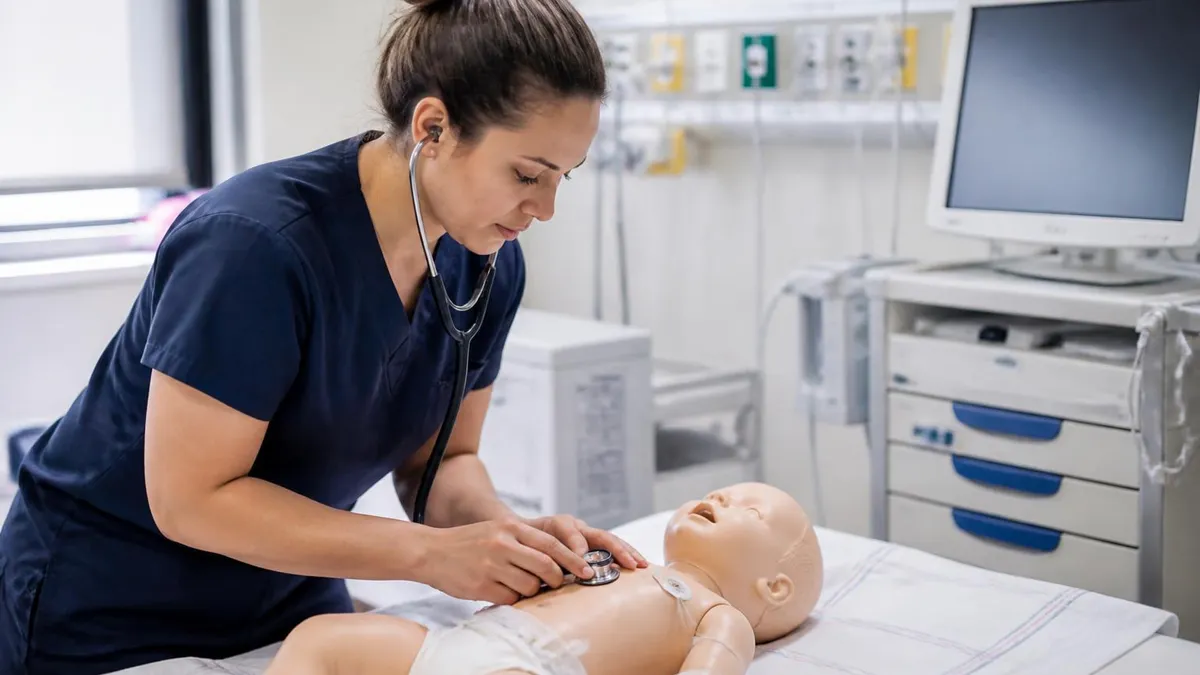
AHA Pediatric Advanced Life Support Algorithms: Complete 2026 Reference
PALS Practice Test PDF (Free Printable 2026)
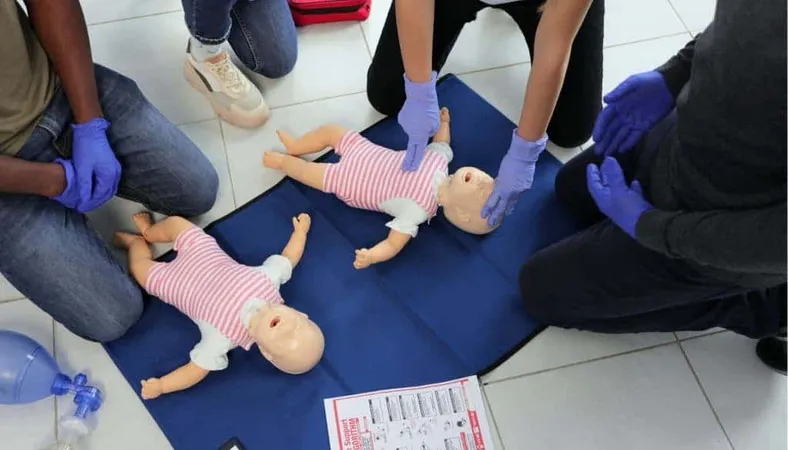
Pediatric Advanced Life Support Training Guide 2026
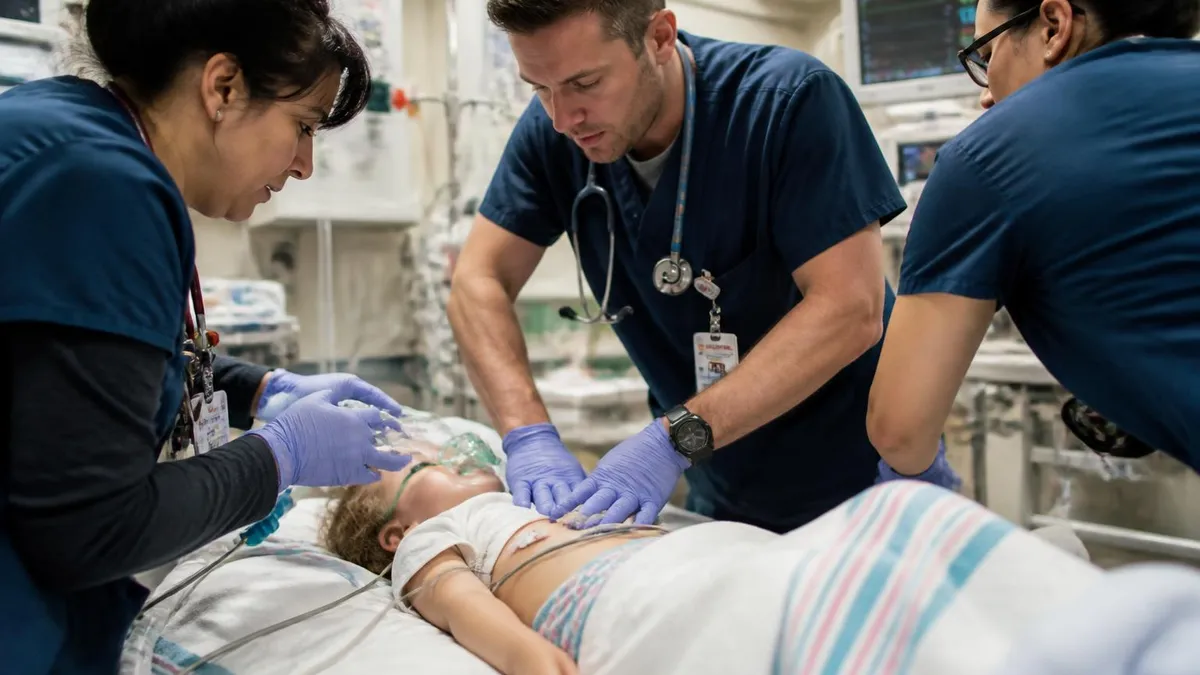
PALS Secondary Assessment: Complete Study Guide for Certification Prep

PALS Book & Study Guide: Complete Certification Prep Hub for 2026
About the Author

Registered Nurse & Healthcare Educator
Johns Hopkins University School of NursingDr. Sarah Mitchell is a board-certified registered nurse with over 15 years of clinical and academic experience. She completed her PhD in Nursing Science at Johns Hopkins University and has taught NCLEX preparation and clinical skills courses for nursing students across the United States. Her research focuses on evidence-based exam preparation strategies for healthcare certification candidates.
Join the Discussion
Connect with other students preparing for this exam. Share tips, ask questions, and get advice from people who have been there.
View discussion (8 replies)