
How Many CE Hours for PALS? Course Length, Credit Rules and Renewal Requirements
🎓 How many CE hours for PALS do you need? See initial vs renewal course hours, nursing board rules, CME credit, and how to track your 2-year card.

If you are a nurse, paramedic, respiratory therapist, or physician who treats children, the question of how many ce hours for pals comes up every renewal cycle. The honest answer is that it depends on the course format, the training provider, and the board that licenses you. A first-time American Heart Association provider course usually runs about 14 to 16 hours, while a renewal course typically takes 6 to 8 hours of seat time and skills practice.
Those numbers describe course length, which is not the same thing as continuing education credit. Many providers convert classroom time into contact hours or CE credits, and the amount awarded can differ from the clock hours you sat through. Some accredited courses award around 8 CE hours for a renewal, while longer initial courses may award 14 or more. Always read the credit statement on the course page before you pay, because that line decides what your employer or board will accept.
It also helps to separate two ideas that people often blur together. PALS certification is a card that proves you completed an approved course and passed both the written exam and the hands-on skills test. Continuing education is a licensing requirement set by your state board, specialty certifier, or hospital. The PALS card itself does not demand a set number of CE hours to stay valid, but the course you take to renew it can supply some of those hours.
Understanding this split saves money and prevents rejected paperwork. Imagine a pediatric ICU nurse in Texas who must complete 20 contact hours every two years. A single eight-hour PALS renewal that awards 8 contact hours covers 40 percent of that obligation, provided the provider is approved by a recognized accrediting body. If that same nurse picked a non-accredited course, the card would still be valid for work, yet zero hours would count toward the license.
This guide walks through every number you need. You will see typical hour counts for initial, renewal, and blended online plus skills courses, how nursing, EMS, and physician credit rules differ, and how to document everything. We also cover the mistakes that cost clinicians time, such as buying a course with no accredited credit. For a clinical refresher that pairs well with how many ce hours for pals planning, read our asystole and PEA walkthrough.
A quick word on timing: the two-year clock starts on the date you pass, and most card expiration dates fall at the end of that month. Booking a renewal six to eight weeks ahead leaves room for a rescheduled skills session. Training centers fill up fast near the end of quarters, so planning early protects you from a lapse. A lapsed card can force you into the longer initial course, which roughly doubles the time you must invest.
Throughout this article, every figure is labeled as typical rather than guaranteed, because providers set their own schedules within the AHA framework. Treat the numbers as planning ranges, then confirm exact hours and credit statements with your chosen training center, your employer's education department, and your licensing board before you register. That one confirmation step is the difference between earning useful credit and holding a card that satisfies work but not your license.
PALS CE Hours by the Numbers
Typical PALS Course Hours by Format
First-time students usually spend about 14 to 16 hours across lectures, case discussions, and skills stations. Some training centers split this over two days. Credit awarded often falls between 12 and 16 contact hours when the provider holds accreditation, though the exact figure is printed on the course listing.
Clinicians with a current or recently expired card typically complete 6 to 8 hours. The schedule is condensed, focusing on case scenarios, rhythm recognition, and team dynamics. Accredited renewals commonly award roughly 6 to 8 contact hours, which many nurses apply directly toward license renewal.
AHA HeartCode PALS lets you finish the cognitive portion online at your own pace, often in 4 to 6 hours, then attend an in-person skills session lasting 2 to 4 hours. Total time is similar to a renewal, but scheduling is far more flexible for shift workers.
After completing the online module, you must still prove hands-on competence with an AHA instructor. The skills session itself is brief, often two to four hours, and usually carries no extra CE credit because the credit is attached to the online portion that you finished first.
The most common source of confusion is the vocabulary. Course hours measure how long the class lasts. Contact hours measure instruction time that an accrediting body recognizes for licensing purposes. A continuing education unit, or CEU, equals ten contact hours, so a course awarding 0.8 CEUs delivers eight contact hours. Physicians see a different label, AMA PRA Category 1 Credit. When a course page says CE, check which of these units is actually being offered.
Accreditation matters more than the number itself. Nursing boards usually accept contact hours from providers approved by the American Nurses Credentialing Center or a state nurses association. Emergency medical services professionals often need credit approved by CAPCE, formerly known as CECBEMS. Physicians look for ACCME-accredited activities. A generous-looking 16-hour award from an unrecognized provider can be worth nothing, while a modest 6-hour award from an approved provider counts in full.
Another subtlety is that the AHA itself sets course content and card rules, but it does not control every CE listing. Training centers and affiliated education companies decide whether to pursue accreditation for their classes. That is why two renewal classes with the same agenda can show different credit amounts. One may award 8 hours, another 4, and a third none at all. Compare the credit statement, not just the course title, when you shop.
Partial credit rules also deserve attention. Some accredited courses require full attendance, completion of an evaluation form, and a passing result before releasing a certificate of contact hours. Miss the first hour of a renewal and a strict provider may award nothing, even if you pass the skills test. Read the attendance policy before class so you know whether arriving late or leaving early could erase your credit entirely.
Consider a worked example. A paramedic in Ohio needs continuing education to keep state recertification current. She registers for an eight-hour PALS renewal approved for EMS credit and receives eight hours of pediatric-specific education. Because many EMS systems require a set portion of hours in specific topics, the pediatric content may satisfy a required category that general lectures could not. This kind of category matching is why the type of credit can matter as much as the quantity.
Licenses also differ on whether certification courses may count at all. A few boards treat basic life support, ACLS, and PALS as mandatory competencies that do not count as elective CE, while others allow them in full. Some employers require the card regardless of whether the board credits it. If your state board publishes a list of acceptable activities, search it for resuscitation courses, or call the board's education desk and ask for the policy in writing.
Finally, keep in mind that retaking an identical course within the same renewal period rarely earns you double credit. Boards typically count each unique activity once per cycle. If you complete PALS in January of year one and a similar course again in October of year one, expect only one to count. Planning the year's education around different topics gives you more total hours than repeating the same content, so spread resuscitation courses across cycles.
How Many CE Hours for PALS by Profession
Nursing boards set their own totals, and PALS usually fills only part of the requirement. California asks registered nurses for 30 contact hours every two years, Florida requires 24, Texas requires 20, and Pennsylvania requires 30. An accredited eight-hour PALS renewal could therefore supply anywhere from roughly a quarter to nearly half of the total, depending on where you hold your license.
Specialty certifications add another layer. Pediatric nurses who maintain a credential through a certifying body may need a set number of hours in pediatric practice, and PALS fits that category naturally. Keep every certificate, note the accrediting body, and log the date. Before assuming a course counts, search your board's website for its accepted provider list, since policies change and exceptions exist.
Blended Online PALS vs In-Person Classroom: Which Earns the Better CE Value?
- +Blended courses let you complete the cognitive portion at your own pace around shift schedules
- +Classroom courses give more instructor feedback during mock codes and case discussions
- +Blended formats often cost less than a full day of instructor-led training
- +In-person renewals are easier to track because the entire block of hours is documented at once
- +Online modules can be repeated, which helps you master rhythm recognition before the skills test
- +Instructor-led classes build real team communication, which the exam scenarios reward
- −Blended courses require two separate steps, and missing the skills session leaves the card incomplete
- −Some employers or boards reject fully online courses with no hands-on component
- −Classroom courses can consume a full day, which is hard to arrange when staffing is tight
- −CE credit on blended courses may attach only to the online portion, so read the credit statement
- −Seats for in-person renewals can fill weeks in advance near expiration season
- −Self-paced modules can tempt you to rush, which weakens retention of dosing and algorithms
Checklist: Confirm How Many CE Hours for PALS Count Before You Register
- ✓Read your licensing board's current continuing education rules.
- ✓Write down the total hours required for your renewal cycle.
- ✓Check whether resuscitation courses count as elective CE.
- ✓Find the accrediting body named on the course page.
- ✓Compare the credit statement across at least three providers.
- ✓Confirm the attendance and evaluation rules for releasing credit.
- ✓Ask whether the hands-on skills session carries separate credit.
- ✓Verify the course is an official AHA provider class if your employer requires it.
- ✓Save the certificate and card images the day you receive them.
- ✓Log the date, hours, and provider in your CE tracker.
The card and the credit are two different things
A PALS card stays valid for two years whether or not your course awarded CE hours. The hours only matter if your board accepts the provider's accreditation, so verify the accrediting body before you pay.
Knowing what fills the hours helps you judge whether a listed number is realistic. A typical initial course begins with a short introduction, then moves into systematic pediatric assessment, including the pediatric assessment triangle covering appearance, work of breathing, and circulation to the skin. Students practice recognizing respiratory distress versus failure and compensated versus hypotensive shock. These early blocks usually consume two to three hours before any rhythm work begins.
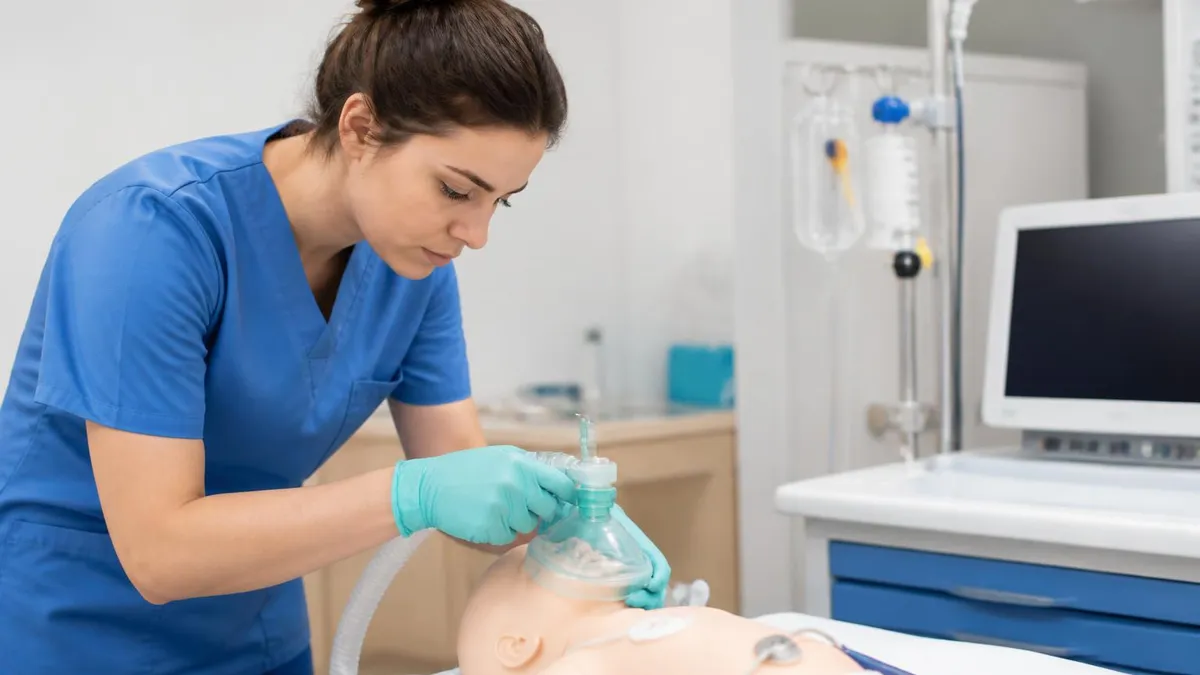
The next major block covers resuscitation fundamentals. Participants rehearse high-quality pediatric CPR, with compressions at 100 to 120 per minute, proper depth for infants and children, and minimal interruptions. They learn bag-mask ventilation, airway adjuncts, and when advanced airway placement is appropriate. This portion is heavily hands-on, with instructors watching technique at mannequin stations, so it takes longer than most people expect and is a major reason the course cannot be shortened safely.
Rhythm management follows. Learners study bradycardia, supraventricular tachycardia, ventricular tachycardia with a pulse, ventricular fibrillation, pulseless ventricular tachycardia, asystole, and pulseless electrical activity. Each rhythm has a decision path involving medication, cardioversion, or defibrillation. Dosing for epinephrine and amiodarone is based on weight, so students practice reading length-based tapes. Most courses dedicate three to four hours to this material because errors here carry the highest clinical risk.
Team dynamics are the quiet centerpiece. Instructors assign roles such as team leader, airway manager, compressor, and recorder, then run simulated cases while grading closed-loop communication. A leader who says give epinephrine 0.01 mg per kilogram and waits for the repeat-back earns marks, while vague orders do not. These case simulations commonly fill two to three hours and are the part students say they remember most clearly.
Testing closes the course. The written exam contains 50 multiple-choice questions and requires a score of 84 percent, which means you may miss no more than eight. Students who score below that line can usually remediate and retest, though policies differ by training center. Skills testing is separate and covers CPR for infants and children plus case-based competency. Passing both components earns the card, regardless of how many CE hours were awarded.
Renewal courses cover the same ground in compressed form, which explains the shorter hour count. Because learners are assumed to know the basics, instructors spend less time on anatomy and assessment fundamentals and more on case practice. A six-hour renewal is therefore not a lower-quality class; it simply trusts your baseline knowledge. If your skills feel rusty after a long gap, the longer initial course may serve you better, even when a renewal would be allowed.
Pre-course preparation counts too, though it rarely earns formal credit. Many programs ask students to review the provider manual, take a precourse self-assessment, and complete a rhythm identification quiz before arriving. Budget two to four hours for this work. Students who skip it often struggle with dosing during case simulations, which can stretch the day. Treating preparation as part of the total time investment gives a more honest picture of your real schedule.
A course with no in-person skills evaluation does not meet AHA requirements, and many hospitals and boards will reject it. Check that your chosen class includes a hands-on skills test with an authorized instructor before paying, or you may need to retake the entire course.
Renewal timing is the second half of the hours question. Your PALS card is valid for two years, and the expiration date is usually the last day of the month in which you passed. The AHA does not publish an official grace period, and many employers treat an expired card as invalid the next day. Schedule your renewal at least a month before the date, ideally earlier, so a cancelled class does not leave you uncertified.
If the card lapses, your options narrow. Some training centers still allow a renewal course for recently expired cards, while others require the full initial class. That decision belongs to the individual center and instructor, so call before assuming. The difference is real: a renewal runs about 6 to 8 hours, while starting over may take 14 or more. A missed deadline can therefore double your time commitment and cost.
Costs follow the same pattern. Renewal classes often range from roughly 100 to 250 dollars, and initial courses can run higher, commonly 175 to 350 dollars, depending on region and provider. Accredited CE credit sometimes adds a small fee for the certificate. Employers frequently reimburse the course, so ask your education department before paying out of pocket. Keep the receipt either way, since it documents the activity in case of a licensing audit.
Record keeping protects you. After every course, save a copy of your eCard or certificate, the CE completion certificate, and the course description showing the accrediting body. Store them in a cloud folder labeled by renewal cycle. Many boards audit a random sample of licensees, and you may have to produce documents years later. A clinician who cannot show proof of hours may have to repeat them, so a tidy folder is cheap insurance.
Digital tracking tools help too. Some state boards provide online portals where you can upload certificates, and several professional organizations offer free CE trackers that remind you when a card is about to expire. A simple spreadsheet works equally well if you update it immediately after each class. Include columns for course name, provider, accrediting body, hours awarded, date completed, and card expiration so one glance tells you where you stand.
Do not forget employer rules, which may be stricter than your board's. A children's hospital may require PALS for all emergency, ICU, and rapid response staff, with renewal required before the card expires rather than after. Some facilities pay for paid class time, others do not. Ask your manager whether class hours count as paid work, and whether the facility runs its own AHA training center, which often provides the easiest and cheapest path.
When you are choosing between providers, weigh convenience against credit value. A hospital-run renewal might be free but award no CE hours, while a commercial class might cost more yet deliver eight accredited hours that satisfy your board. Calculate the real cost per credit hour, including travel and unpaid time off. That small calculation often reveals that the cheaper option on paper costs more once the missing credit is replaced elsewhere.
Start your preparation by confirming your actual requirement rather than guessing. Open your licensing board's website, find the continuing education page, and write down the total hours, the cycle length, and any mandatory topics. Then check your employer's policy on PALS. Having those three facts in hand turns a vague worry about how many hours to earn into a concrete plan, and it keeps you from buying a longer or costlier class than you need.
Choose your format by looking at your calendar honestly. If you work rotating twelve-hour shifts, a blended course lets you finish the online portion in short sessions between shifts, then attend one skills block. If you learn best by doing, a full classroom renewal gives more instructor feedback. Whichever you pick, confirm that the skills session date fits before purchasing the online module, since the two are often sold and scheduled separately.
Study the content that trips people up most. Pediatric dosing by weight is the leading source of lost points, so practice using a length-based resuscitation tape and memorize core drugs: epinephrine 0.01 mg per kilogram, adenosine 0.1 mg per kilogram for the first dose, and amiodarone 5 mg per kilogram for refractory shockable rhythms. Drill the rhythm algorithms until you can sketch each from memory. Short daily practice sessions work better than a single cram the night before.
Practice with questions before class. Taking free practice tests exposes weak spots in bradycardia, tachycardia, airway, and cardiac arrest management while there is still time to fix them. Aim to score above 90 percent on practice sets before exam day, since the real passing line is 84 percent. When you miss a question, read the explanation and write one sentence describing the rule you forgot. This builds the recall you need under simulation pressure.
On class day, arrive early with your manual, your previous card if you have one, and a government ID. Eat beforehand, since skills stations are physically tiring. During case simulations, speak clearly, assign roles by name, and use closed-loop communication. Instructors score communication as heavily as technique, so narrate what you are doing. If you make a mistake, say so and correct it aloud; evaluators generally reward recovery rather than perfection.
After you pass, act on paperwork the same day. Download your eCard, save the CE certificate, and enter the hours in your tracker. Set two calendar reminders for your next renewal: one at twelve months out and one eight weeks before the expiration date. If your employer maintains a roster, email them the card so it is recorded. These five-minute tasks prevent most of the lapses and audit headaches that clinicians face later.
Finally, think of PALS hours as one piece of a larger education plan. Combine your resuscitation renewal with other required topics so you do not scramble in the final months of your license cycle. Spread learning across the two years, and use the PALS credit as an anchor rather than the entire plan. Clinicians who treat continuing education as an ongoing habit tend to feel more confident during real pediatric emergencies, which is the point of the training.
PALS Questions and Answers

PALS Asystole & PEA Algorithm: Initial Steps, Treatment Protocol & Practice Quiz

Renewing Your PALS Card: Online and AHA Recertification Guide

Pale Gray or Blue Colored Skin, Lips, or Nail Beds: PALS Symptom Recognition Guide

PALS VF/PVT Algorithm: What Are the Initial Steps and How to Master Them
Pediatric Advanced Life Support: The Complete 2026 Certification & Study Hub
Written and edited by Nathan Beja, founder of Practice Test Geeks, with AI assistance. Exam facts are checked against the official sources linked below. Editorial policy
Sources & references
Exam facts on this page (fees, format, dates, passing scores) are checked against these official sources; the date is our last check. Editorial policy
- cpr.heart.org — Renewal, score release, test delivery, passing score, score validity · verified Nov 2026
- elearning.heart.org — Eligibility · verified Nov 2026