
NOVA OTA Program: Complete Training Guide, Requirements & What to Expect
Everything about the nova ota program — admission, coursework, fieldwork & NBCOT prep. Your complete 2026 October training guide. 🎯

The nova ota program at Northern Virginia Community College (NOVA) is one of the most recognized pathways into occupational therapy assistant practice in the Mid-Atlantic region. Designed as an Associate of Applied Science degree, the program blends rigorous classroom instruction, laboratory skill-building, and supervised clinical fieldwork to prepare graduates for the national NBCOT certification examination. Students who complete the program are eligible to sit for the COTA exam and enter a profession that is growing faster than average, with a projected 18% job growth rate through 2032 according to the U.S. Bureau of Labor Statistics.
NOVA's OTA program attracts students from across Northern Virginia, Washington D.C., and Maryland, largely because of its affordable community college tuition structure, flexible scheduling options, and strong relationships with regional clinical placement sites. The program typically admits a cohort of 20–24 students per year into its competitive selection process. Admission is not automatic upon completing prerequisites — applicants must meet GPA thresholds, complete observation hours in an OTA setting, and demonstrate professional readiness through a structured application process that evaluates academic and personal qualifications alike.
Understanding what the nova ota program entails before you apply can make the difference between a smooth enrollment experience and a frustrating series of surprises. Many prospective students underestimate the time commitment involved in fieldwork rotations or the academic rigor of anatomy and kinesiology coursework. This guide walks you through every stage — from prerequisite planning to graduation and national board exam preparation — so you can enter the program fully informed and strategically prepared.
The occupational therapy field itself is grounded in the philosophy that meaningful, purposeful activity promotes health, well-being, and independence. As a COTA, you will work under the supervision of a licensed Occupational Therapist (OT) to deliver interventions targeting fine motor skills, activities of daily living, cognitive rehabilitation, sensory processing, and much more. NOVA's curriculum is designed to reflect this breadth, exposing students to pediatric, adult, geriatric, and mental health populations across varied clinical environments including hospitals, schools, skilled nursing facilities, and outpatient clinics.
NOVA holds programmatic accreditation through the Accreditation Council for Occupational Therapy Education (ACOTE), which is a non-negotiable credential for any OTA program worth attending. ACOTE accreditation ensures that the curriculum meets national standards, that faculty hold appropriate credentials, and that fieldwork experiences are structured to produce competent entry-level practitioners. Without graduating from an ACOTE-accredited program, you cannot sit for the NBCOT COTA exam, which means you cannot become a licensed occupational therapy assistant in any U.S. state.
Tuition at NOVA is significantly lower than at four-year universities offering similar health science programs. In-state students pay roughly $180–$200 per credit hour, making the full OTA program cost approximately $7,000–$10,000 in tuition alone, excluding fees, textbooks, and clinical supplies. This cost advantage, combined with NOVA's proximity to a dense network of healthcare employers in the greater D.C. metro area, gives graduates a powerful combination of affordability and career opportunity that is hard to replicate at private institutions or out-of-state programs.
Whether you are a recent high school graduate exploring allied health careers, a career-changer seeking a more meaningful profession, or a healthcare aide looking to formalize your clinical skills, the NOVA OTA program offers a structured, accredited, and nationally respected credential. The sections below cover every detail you need to evaluate whether this program fits your goals, how to maximize your application, and how to set yourself up for NBCOT success from day one of the program.
NOVA OTA Program by the Numbers

NOVA OTA Program: Step-by-Step Pathway
Complete Prerequisites
Complete Observation Hours
Submit Program Application
Complete OTA Core Coursework
Fieldwork Level I & II
NBCOT Exam & State Licensure
Admission to the NOVA OTA program is competitive and selective, which means meeting the minimum qualifications does not guarantee a seat in the cohort. NOVA uses a points-based ranking system to evaluate applicants, awarding credit for prerequisite GPA, science course grades, observation hours, and prior healthcare work experience. Students who earn A grades in Anatomy & Physiology consistently rank higher in the pool, making those two courses particularly critical investments of your academic effort before applying.
The prerequisite coursework that NOVA requires before admission includes Human Anatomy & Physiology I and II (with lab), Introduction to Psychology, English Composition I, and a college-level math course such as Quantitative Reasoning or higher. Some applicants also strengthen their candidacy by completing Introduction to Sociology and a Medical Terminology course, both of which appear in the OTA curriculum and are easier to absorb if encountered earlier. Strong performance in all science prerequisites signals to the admissions committee that you can handle the program's demanding life science content.
Observation hours are a non-negotiable component of the application and must be documented on an official form signed by the supervising OT or COTA. NOVA recommends observing in at least two distinct practice areas to demonstrate breadth of understanding. Many applicants complete hours in hospital acute care settings, outpatient orthopedic clinics, pediatric early intervention programs, or skilled nursing facilities. Volunteering or working as a rehab aide while completing your prerequisites allows you to accumulate observation hours organically while also building professional references and clinical vocabulary.
The personal statement is an often-overlooked but important piece of the application. Admissions reviewers are looking for evidence that you understand the scope of OTA practice — including the distinction between an OT and a COTA — and that you have reflected on why this career path aligns with your values and strengths. Statements that reference specific observations or patient interactions tend to be more compelling than generic declarations of a desire to help people. Proofread carefully, as writing quality reflects your professional communication skills, which are essential in clinical documentation.
Letters of reference should ideally come from licensed healthcare professionals who have observed you in a clinical or caregiving context, or from academic instructors who can speak to your ability to handle rigorous science coursework. Personal references from friends, family members, or employers in unrelated fields carry significantly less weight. If you are applying without prior healthcare experience, a science professor who knows your academic habits and work ethic is a strong choice for at least one of your reference letters.
Once admitted, students begin the OTA-specific curriculum in the fall semester. The program is designed as a lock-step sequence, meaning courses build directly on each other and must be completed in a specific order. Missing or failing a single course can delay your progression by an entire academic year, since courses are typically offered only once per year. This makes consistent academic performance and proactive communication with your academic advisor essential habits to develop from the very first semester of the program.
Applicants who are not admitted in their first attempt should not be discouraged. Many successful NOVA OTA graduates applied twice, using the intervening year to retake prerequisite courses for better grades, accumulate additional observation hours, or strengthen their personal statement. The admissions office provides feedback to unsuccessful applicants upon request, which can give you specific, actionable guidance for improving your competitiveness in the next cycle.
Fieldwork Training in the NOVA OTA Program
Level I fieldwork experiences are embedded throughout the didactic coursework at NOVA and are designed to introduce students to real clinical environments in a low-stakes, observational format. These experiences typically range from one to three days per clinical site and expose students to a variety of patient populations including pediatric, adult neurological, geriatric, and psychiatric clients. Students complete written reflections after each Level I experience to connect classroom theory with real-world practice.
During Level I, students are not expected to provide independent interventions but are encouraged to actively participate under close supervision. Common Level I placements include school-based therapy programs, outpatient hand therapy clinics, long-term care facilities, and inpatient psychiatric units. These exposures help students identify which practice areas excite them most and begin building the professional behaviors — punctuality, communication, clinical reasoning — that will be formally evaluated during Level II fieldwork.

Is the NOVA OTA Program Right for You?
- +ACOTE-accredited program ensuring NBCOT exam eligibility in all U.S. states
- +Affordable in-state tuition averaging $7,000–$10,000 for the full degree
- +Strong clinical network across the D.C. metro area with diverse fieldwork placements
- +Cohort-based learning model builds peer support and professional community
- +Proximity to high-demand healthcare employers in Northern Virginia and D.C.
- +Comprehensive curriculum covering pediatrics, geriatrics, mental health, and physical rehab
- −Highly competitive admission with limited seats (20–24 students per cohort)
- −Lock-step curriculum means one failed course can delay graduation by a full year
- −Level II fieldwork rotations require full-time availability for 32 total weeks
- −Students cannot arrange their own fieldwork placements, limiting geographic flexibility
- −Limited evening or weekend course options during the core OTA curriculum semesters
- −Application window is narrow; missing the deadline means waiting another full year
Pros and Cons at a Glance
| Pros | Cons |
|---|---|
| ACOTE-accredited program ensuring NBCOT exam eligibility in all U.S. states | Lock-step curriculum means one failed course can delay graduation by a full year |
| Strong clinical network across the D.C. metro area with diverse fieldwork placements | Students cannot arrange their own fieldwork placements, limiting geographic flexibility |
| Cohort-based learning model builds peer support and professional community | Limited evening or weekend course options during the core OTA curriculum semesters |
| Proximity to high-demand healthcare employers in Northern Virginia and D.C. | Application window is narrow; missing the deadline means waiting another full year |
NOVA OTA Application & Success Checklist
- ✓Complete Anatomy & Physiology I and II with a grade of B or better in each course
- ✓Finish Introduction to Psychology, English Composition I, and a college-level math course
- ✓Log at least 40 documented observation hours in an OT or COTA-supervised setting
- ✓Observe across at least two different practice settings (e.g., pediatric and geriatric)
- ✓Request official observation documentation signatures from your supervising OT or COTA
- ✓Secure two professional references from licensed healthcare providers or science faculty
- ✓Write a personal statement demonstrating knowledge of OTA scope of practice vs. OT
- ✓Submit your application during NOVA's official spring application window
- ✓Meet with a NOVA health science advisor to verify your prerequisite completion status
- ✓Begin NBCOT content review in the final semester to build familiarity with exam domains
ACOTE Accreditation Is Non-Negotiable
Graduating from an ACOTE-accredited OTA program is a federal and state requirement for NBCOT exam eligibility. NOVA's OTA program maintains this accreditation through rigorous self-study and periodic site visits. Before applying to any OTA program, verify its current accreditation status directly at the ACOTE website — never rely on program marketing materials alone, as accreditation can be placed on probation or withdrawn between print cycles.
Understanding the full cost of the NOVA OTA program is essential for financial planning before you apply. While tuition is the most visible expense, total program costs include mandatory fees, liability insurance, clinical supplies, uniform requirements, background check and drug screening fees, CPR certification, and the NBCOT application fee after graduation. Building a realistic budget that accounts for all of these expenses — not just tuition — prevents financial surprises mid-program when you have limited bandwidth to address them.
NOVA's in-state tuition rate for credit-bearing courses runs approximately $180–$200 per credit hour. The full OTA AAS degree typically requires 72–75 credit hours, though some credits are fulfilled by prerequisite courses completed before program admission. Assuming 40–50 remaining credit hours after prerequisites, in-state tuition costs range from approximately $7,200 to $10,000. Out-of-state students pay roughly double, making establishing Virginia residency before enrollment a financially significant consideration if you are relocating for the program.
Required fees beyond tuition include a student activity fee, technology fee, and health science program fee that varies by cohort year. Students also pay for liability insurance (typically $30–$50/year), CPR certification renewal, and clinical uniform costs. Many programs require a stethoscope, goniometer, and specific clinical assessment tools that can add $100–$200 to your first-semester supply budget. Textbooks range from $400–$800 per semester during the core curriculum, though used copies, library reserves, and digital rentals can reduce this substantially.
NOVA participates in federal Title IV financial aid programs, meaning eligible students can apply for Pell Grants, Subsidized and Unsubsidized Federal Direct Loans, and the Federal Work-Study program by completing the FAFSA. Many OTA students also qualify for Virginia state grants including the Commonwealth Award and the Two-Year College Academic Promise Scholarship if they maintain satisfactory academic progress. NOVA's financial aid office holds health science-specific information sessions each fall, and attending one early in your prerequisite phase helps you understand your award potential before making enrollment decisions.
External scholarships are an underutilized resource for OTA students. The American Occupational Therapy Foundation (AOTF) offers several scholarships specifically for COTA students enrolled in ACOTE-accredited programs, with awards ranging from $500 to $5,000. State OT associations, including the Virginia Occupational Therapy Association (VOTA), also offer scholarship opportunities that are less competitive than national awards because they are limited to Virginia residents. Applying to five or more scholarships each academic year meaningfully reduces the loan burden you carry into your first years of employment.
The NBCOT examination itself carries an application fee of approximately $585 for first-time candidates. This fee covers the initial three-hour examination and the official score report that Virginia's DHPE requires for licensure processing. If you do not pass on the first attempt, retake fees apply, which is one of the strongest financial incentives to invest in structured exam preparation before your first attempt. The Virginia state OTA licensure application carries an additional fee of approximately $130–$140, so budget roughly $700–$750 in post-graduation fees before you receive your license and can begin billing under your own credentials.
Students who work as rehab aides or therapy technicians during their prerequisite phase or during program summers report that this experience not only builds clinical competence but also provides income that offsets educational costs. Some regional employers in Northern Virginia — particularly large hospital systems and therapy staffing agencies — offer tuition reimbursement or loan forgiveness for employees who complete health science degrees and commit to a defined period of post-graduation employment. Investigating employer-sponsored education benefits before accepting a rehab aide position can add thousands of dollars in hidden value to your employment arrangement.

NOVA's OTA program accepts applications only once per year, typically during a six-to-eight-week window in early spring for fall semester admission. Missing this deadline by even one day means waiting a full calendar year to reapply. Set a calendar reminder at least three months before the anticipated opening date and verify the exact dates each year on NOVA's health science admissions page, since deadlines can shift by one to two weeks between academic years.
Career outcomes for NOVA OTA graduates are strong, driven by strong employer demand across the greater Washington D.C. metropolitan area and Northern Virginia's concentration of hospitals, rehabilitation centers, school systems, and outpatient clinics. The U.S. Bureau of Labor Statistics reports a median annual wage of approximately $64,250 for occupational therapy assistants nationally, with the Washington-Arlington-Alexandria metro area consistently ranking above the national median due to cost of living adjustments and high demand from large healthcare systems like INOVA Health System, MedStar Health, and the Veterans Affairs Medical Center network.
Entry-level COTAs in Northern Virginia typically start at $50,000–$58,000 annually, with wages rising to $70,000–$80,000 after five or more years of specialized experience. Specialty practice areas including hand therapy, pediatric early intervention, and acute care neurological rehabilitation often command premium compensation. COTAs who obtain additional certifications — such as the Low Vision Certification (CLVT) or Assistive Technology Professional (ATP) credential — can further differentiate themselves and negotiate higher compensation packages at specialty clinics and assistive technology vendors.
The school-based employment sector is particularly active in Northern Virginia, where Fairfax County Public Schools, Arlington Public Schools, and Prince William County Schools all employ COTAs to support students with disabilities under IDEA mandates. School-based positions typically offer a ten-month contract with summers off, predictable hours, excellent benefits, and strong job security. Some school districts also offer loan forgiveness programs for health professionals who commit to working in high-need Title I schools, which can substantially accelerate debt repayment for NOVA OTA graduates carrying federal student loans.
Travel therapy is another career pathway available to NOVA graduates willing to work on temporary contracts in locations across the United States. Travel COTA contracts typically pay $1,400–$2,000 or more per week, often including free furnished housing and stipends for meals and incidentals.
Many new graduates travel for one to three years to pay off student loans aggressively before returning to the D.C. metro area or settling in another preferred location. Staffing agencies that specialize in travel therapy — including Supplemental Health Care, AMN Healthcare, and Fusion Medical Staffing — actively recruit from NOVA and other ACOTE-accredited programs in the Mid-Atlantic region.
Entrepreneurship is an increasingly viable path for experienced COTAs. Some COTAs with several years of clinical experience open private practice services as independent contractors, providing therapy in home health, early intervention, school consulting, or wellness program design. Virginia law permits COTAs to practice under general supervision after demonstrating competency, which gives experienced practitioners meaningful clinical autonomy. Building a referral network, obtaining professional liability insurance, and understanding billing for occupational therapy services are the foundational skills for this transition.
NOVA alumni consistently report strong professional community ties through the Virginia Occupational Therapy Association (VOTA) and the American Occupational Therapy Association (AOTA). AOTA membership provides access to continuing education, the OT Practice magazine, specialty interest sections, and national advocacy resources. Maintaining AOTA membership throughout your career keeps you connected to evolving evidence-based practice standards and ensures you receive timely information about regulatory changes that may affect your licensure or scope of practice in Virginia and nationally.
Continuing education is a licensure requirement in Virginia, with COTAs needing to complete 24 contact hours of approved professional development per two-year renewal cycle. NOVA itself offers some continuing education programming through its workforce development division, and regional OT conferences like the VOTA Annual Conference provide concentrated learning opportunities. Planning your continuing education proactively — rather than scrambling in the weeks before your license renewal deadline — keeps your clinical knowledge current and demonstrates the professional commitment that distinguishes high-performing COTAs from those who treat CE as an afterthought.
Preparing strategically for the NBCOT COTA examination while completing your final semester at NOVA is one of the most important things you can do for your career launch. The exam tests four core domains: Gathering and Interpreting Information (26%), Formulating and Implementing a Plan (44%), Managing and Monitoring Services (20%), and Professional Responsibilities (10%). Knowing the weight of each domain helps you allocate study time proportionally, with heaviest emphasis on intervention planning and implementation because it represents nearly half the total score.
The most effective NBCOT study plans start eight to ten weeks before your scheduled exam date and combine active recall practice with content review. Passive reading of textbooks is the least efficient study method for a clinical exam like NBCOT, where application-level questions dominate. Instead, work through large question banks — targeting 50–100 practice questions per day — and review every incorrect answer carefully to understand the clinical reasoning behind the correct response. TherapyEd's COTA Examination Review and Practice Guide and the NBCOT's own Study Pack are the two most consistently recommended resources by first-time passers.
Simulation exams taken under realistic conditions — timed, on a computer, in a quiet environment — are especially valuable in the final two weeks before your test date. Taking two or three full 170-question simulated exams helps your brain adapt to the cognitive stamina required for three hours of concentrated clinical reasoning. Many students who struggle on the actual exam report practicing under comfortable, untimed conditions that did not replicate the pressure of the real test environment. Discipline in your practice conditions pays dividends on exam day.
Mental health and physical wellness during your NBCOT preparation period are factors that disproportionately affect performance and are often underestimated by driven, high-achieving students. Sleep is when memory consolidation occurs, making seven to nine hours per night non-negotiable during study periods, not a reward for finishing a chapter. Regular aerobic exercise has been shown in research studies to improve memory retention, reduce anxiety, and improve sustained attention — all of which directly support better exam performance. Building thirty minutes of movement into your daily routine during the prep period is a high-use investment of time.
Study groups with fellow NOVA OTA graduates can amplify individual preparation, particularly for content areas where different cohort members have different clinical strengths from their fieldwork placements. A classmate who completed a pediatric rotation may have stronger sensory integration knowledge, while another who rotated through acute care may excel at physical dysfunction content. Peer teaching — explaining a concept clearly to someone else — is one of the most effective ways to solidify your own understanding, and study groups create natural opportunities for this.
After passing NBCOT, your next step is applying for your Virginia OTA license through the Virginia Department of Health Professions (VDHP). The application requires your NBCOT certification number, official transcripts, verification of your Level II fieldwork completion, a background check, and the state application fee. Processing times vary but typically run two to four weeks. During this waiting period, you can work as an OTA trainee under close supervision in Virginia while your license application is pending, which allows you to begin generating income immediately after NBCOT certification rather than waiting idle for the state license to arrive.
Networking actively during your final semester and fieldwork rotations is the single most effective career strategy available to NOVA OTA students. Many positions are filled through informal referrals before they are ever posted on job boards. Attending VOTA student events, following up professionally with your Level II fieldwork supervisors, and connecting with alumni on LinkedIn all expand the professional web that will surface opportunities when you are ready to accept your first position. Supervisors who were impressed by your clinical performance during fieldwork are often your strongest advocates and may proactively reach out to you before you even begin applying.
Sample Occupational Therapy Assistant Test Practice Questions
Try these questions from our free Occupational Therapy Assistant Test practice tests. The correct answer and an explanation follow each question.
When integrating caregiver training into a treatment plan for a client with advanced Parkinson's disease, what should the OTA emphasize?
- A. Safe assistance techniques for transfers and ADLs to prevent caregiver and client injury
- B. Complete independence for the client in all ADLs regardless of safety
- C. Reducing the caregiver's involvement to promote client autonomy only
- D. Delegating all caregiver training to a home health aide
Answer: A. Safe assistance techniques for transfers and ADLs to prevent caregiver and client injury
Caregiver training in safe assistance techniques is essential to prevent falls and injury as Parkinson's disease progresses.
An OTA notices a client's performance has plateaued and goals are no longer being met. What is the MOST appropriate next step?
- A. Continue the current plan and wait for spontaneous improvement
- B. Independently revise the treatment goals
- C. Communicate findings to the supervising OT for re-evaluation and plan modification
- D. Discharge the client due to lack of progress
Answer: C. Communicate findings to the supervising OT for re-evaluation and plan modification
When progress plateaus, the OTA must communicate this to the supervising OT, who has the authority to reassess and modify the plan of care.
What role does collaboration play in pediatric ot for Occupational Therapy Assistant Test professionals?
- A. It slows down work unnecessarily
- B. It enhances outcomes through diverse perspectives and shared expertise
- C. It is only needed in emergencies
- D. It reduces individual accountability
Answer: B. It enhances outcomes through diverse perspectives and shared expertise
Collaboration leverages diverse perspectives and combined expertise to achieve better outcomes than any individual could alone.
A school-based OTA is asked to address handwriting with a 2nd grader. Which handwriting program is evidence-based and commonly used by OTAs?
- A. Handwriting Without Tears (HWT)
- B. The Orton-Gillingham Method
- C. Applied Behavioral Analysis (ABA)
- D. Social Thinking Curriculum
Answer: A. Handwriting Without Tears (HWT)
Handwriting Without Tears is a widely used, evidence-based handwriting curriculum developed by OT Jan Olsen that addresses letter formation and legibility.
Take the full Occupational Therapy Assistant Test practice test
OTA Questions and Answers

OTA Certification Requirements: Complete Guide to Becoming a Licensed Occupational Therapy Assistant
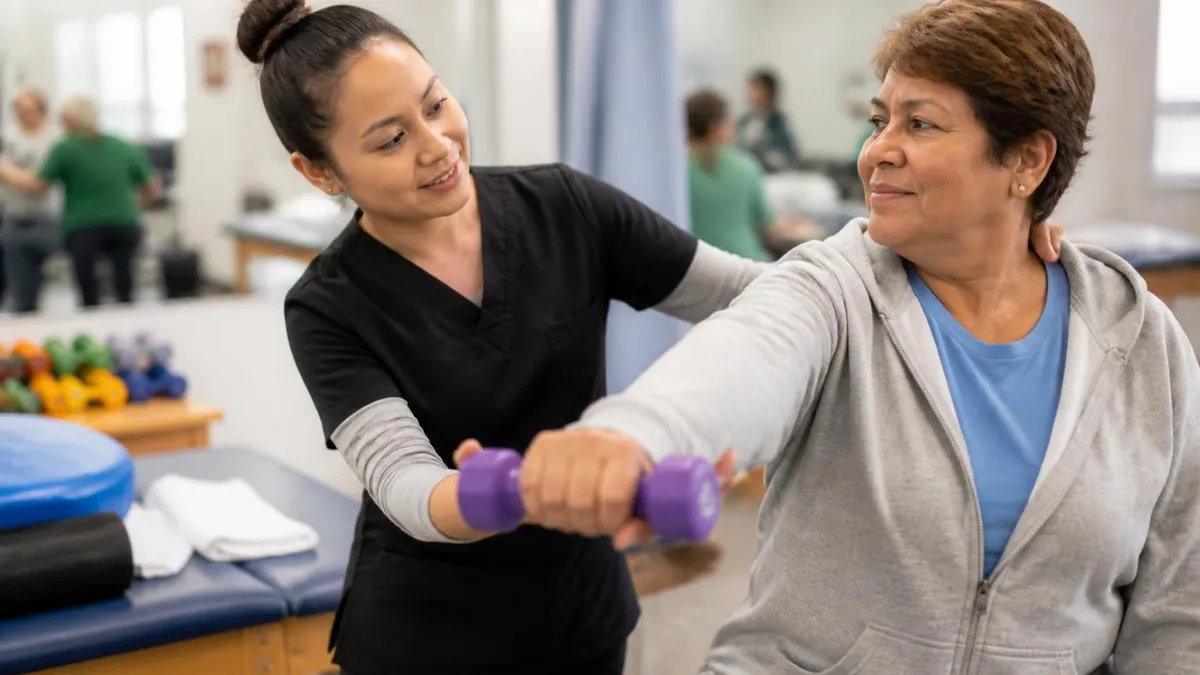
OTA Program: Complete Training Guide, Requirements & Career Path

Occupational Therapy Assistant (OTA): Role, Training & Career Guide

Pediatric Occupational Therapy Assistant: Training, Requirements & Career Guide
Pediatric Occupational Therapy Assistant Jobs: Complete Career Guide for 2026
About the Author

Physical Therapist & Allied Health Licensing Exam Expert
University of Pittsburgh School of Health and Rehabilitation SciencesDr. Michelle Park holds a Doctor of Physical Therapy and a PhD in Physical Therapy from the University of Pittsburgh, a top-ranked PT program in the nation. With 13 years of orthopedic and neurological rehabilitation experience, she coaches physical therapy and occupational therapy graduates through the NPTE, NBCOT, and state allied health licensing board examinations.
Join the Discussion
Connect with other students preparing for this exam. Share tips, ask questions, and get advice from people who have been there.
View discussion (8 replies)