
OSHA Violation Lookup: How to Search Inspections, Citations & Penalties (2026 September Guide)
OSHA violation lookup made simple. Learn how to search inspection records, citations, penalties and an employer's safety history using free public databases. 🧠
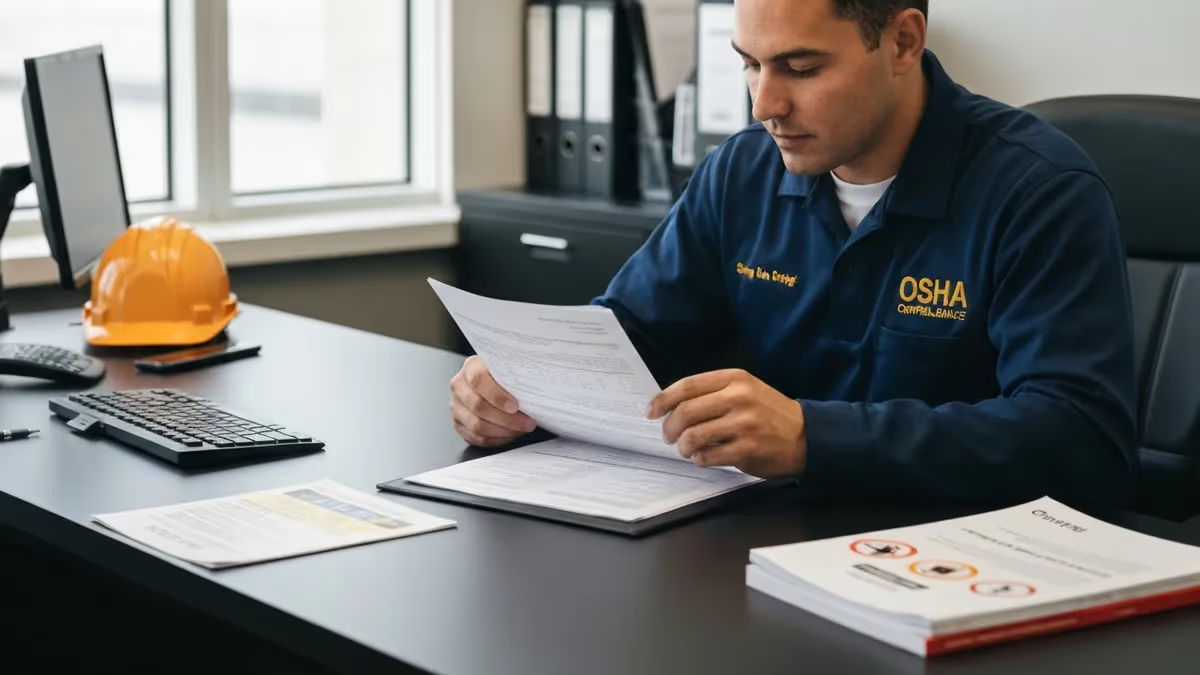
An osha violation lookup lets anyone search the public record of workplace safety inspections, citations, and penalties that the Occupational Safety and Health Administration has issued against an employer. Whether you are a job seeker vetting a potential employer, a contractor screening a subcontractor, a journalist researching a story, or a safety manager benchmarking your own company, these searches pull from a federal database that is free, open, and surprisingly detailed. You do not need a login, a subscription, or a lawyer to read it.
Most people are surprised to learn just how much information OSHA publishes. Every inspection generates a record that includes the date, the establishment name, the violations cited, the specific standard numbers, the severity classification, the proposed penalty, and the eventual settlement amount. Some records even include the narrative of what an inspector observed. Because workplace safety is a matter of public interest, this transparency is intentional. Knowing how to read it turns a wall of bureaucratic codes into a clear picture of how seriously a company takes worker safety.
The primary tool is the Establishment Search on OSHA's official website, but it is not the only one. The Department of Labor's enforcement portal, the Severe Injury Reports database, and several third-party aggregators each offer a slightly different window into the same underlying data. Throughout this guide we will walk through each source, explain what the codes mean, and show you how to interpret a company's history fairly rather than jumping to conclusions from a single old citation buried in the archive.
Understanding violations also means understanding the standards behind them. A citation under 1926.501 for fall protection means something very different from a recordkeeping paperwork error. The dollar amount of a penalty tells only part of the story; the classification — whether a violation is labeled serious, willful, repeat, or other-than-serious — often reveals far more about the underlying risk and the employer's intent. We will decode all of these terms so the numbers stop being intimidating and start being useful to you.
This guide is written for a United States audience and reflects the federal OSHA system as it operates in 2026. If you work in one of the 22 states that run their own OSHA-approved state plans, your data may live in a separate state portal, and we cover that wrinkle too. By the end, you will be able to run a thorough search, read the results like a professional, and know exactly what each number and code is telling you about real workplace conditions on the ground.
If safety research is part of your job, pairing a violation search with foundational knowledge pays dividends. Reviewing topics like the osha violation lookup resources alongside standard texts helps you connect a citation number to the actual hazard it describes. The more fluent you become in the standards, the faster a raw inspection record turns into actionable insight you can use to protect workers or make a smarter hiring decision when the stakes are high.
OSHA Enforcement by the Numbers
Where to Search OSHA Violation Records
The official tool at osha.gov lets you search by company name and state. It returns every inspection, the violations cited, standards referenced, and penalty amounts for that establishment going back decades.
The Department of Labor's enforcement database aggregates OSHA data with wage and other Labor agency records, useful for a fuller compliance picture of a single employer across multiple federal programs.
A separate OSHA database tracking work-related amputations, hospitalizations, and loss-of-eye events that employers must report within 24 hours. It reveals serious incidents even without a formal citation.
States like California, Oregon, and Washington run their own OSHA-approved programs. Their inspection data often lives on a state agency site rather than the federal database, so check both sources.
Sites that repackage federal data add filters, charts, and trend views. They are convenient but always verify a critical finding against the official OSHA source before relying on it.
The fastest way to begin an osha violation lookup is the official Establishment Search hosted on osha.gov. From the agency's enforcement data page you choose the Establishment Search option, type the company name, optionally narrow by state, and set a date range. The system is forgiving with partial names, so searching a parent brand often surfaces dozens of related locations. Each result row links to a detailed inspection page packed with the specific information you actually need to evaluate safety performance.
One important quirk is that OSHA indexes records by the exact establishment name on file at inspection time, not by the corporate brand you know. A national restaurant chain might appear under a franchisee's LLC, a regional operating company, or a slightly misspelled variation. Because of this, a single search rarely captures everything. Smart researchers try several name variations, search adjacent ZIP codes, and cross-reference results against the Severe Injury Reports database to make sure no significant incident slips through the cracks unnoticed.
The Department of Labor's broader enforcement portal is worth a visit when you want context beyond a single agency. It pulls together OSHA citations alongside Wage and Hour Division findings, Mine Safety records, and other Labor enforcement actions tied to the same employer. A company with a clean OSHA record but repeated wage violations tells a different story than one with no findings at all. This wider lens helps you judge whether a safety lapse was an isolated event or part of a broader pattern of cutting corners.
For employers researching their own footprint, these same tools double as a compliance mirror. Pulling your establishment history before an auditor or insurance underwriter does it for you removes nasty surprises. Many safety managers run a quarterly self-lookup to confirm that abated violations show the correct status and that no clerical error has left an old citation appearing open. If you are building an internal program, our guidance on osha violation lookup approaches pairs naturally with a routine self-audit habit you can sustain.
State plan states deserve special attention because their data may be invisible on the federal site. If a company operates in California, the relevant inspections live in the Cal/OSHA system; Michigan, Oregon, North Carolina, and roughly twenty others maintain comparable portals. A federal-only search of a West Coast manufacturer could return almost nothing while a state portal reveals an extensive citation history. Always confirm which jurisdiction governs the worksite before concluding that a clean federal result means a clean record overall for that employer.
Finally, remember that the absence of records is not proof of safety. Many small employers have simply never been inspected, since OSHA prioritizes high-hazard industries, programmed inspections, complaints, and incidents. A blank result means no inspection on file, not necessarily a flawless safety culture. Treat an empty record as a starting question rather than a final answer, and weigh it alongside industry risk, company size, and any voluntary safety certifications the employer may hold and publicly advertise to customers.
Understanding an OSHA Violation Lookup Result
Every record opens with a header showing the inspection number, the establishment name and address, the date opened, and the inspection type. Types include programmed, complaint, referral, accident, and follow-up. Knowing the trigger matters: a complaint-driven inspection means a worker raised a concern, while an accident inspection means something already went wrong on the job before OSHA ever arrived.
The header also lists the scope — complete or partial — and the union status of the workplace. A complete-scope inspection examined the entire operation, so its findings carry more weight than a partial look at one machine. Reading the header first frames everything that follows and prevents you from misjudging the seriousness of the citations listed below it on the page.
Is the Official OSHA Database Enough on Its Own?
- +Completely free with no account or subscription required
- +Authoritative source straight from the federal agency
- +Includes specific standard numbers and penalty amounts
- +Covers decades of historical inspection records
- +Links related inspections to reveal repeat patterns
- +Updated as new inspections close and settle
- −Misses state plan data in 22 states
- −Indexed by establishment name, so searches can be incomplete
- −No inspection record does not prove a workplace is safe
- −Interface feels dated and codes need decoding
- −Settlement context is not always fully explained
- −Small or never-inspected employers may show nothing at all
Your OSHA Violation Lookup Checklist
- ✓Open the official Establishment Search on osha.gov
- ✓Try the parent brand and several name variations
- ✓Search adjacent ZIP codes and the full state
- ✓Confirm whether a state plan covers the worksite
- ✓Check the Severe Injury Reports database separately
- ✓Note each inspection type and scope in the header
- ✓Record the standard number cited for every violation
- ✓Compare initial penalties against final settlement amounts
- ✓Look for related-activity history showing repeat hazards
- ✓Verify any critical finding against the official source
Severity classification beats penalty dollars every time
When evaluating a record, the violation classification — serious, willful, repeat, or other-than-serious — reveals more than the dollar figure. A modest penalty on a willful violation signals an employer who knew of a hazard and ignored it, which is far worse than a large fine on a single serious item that was promptly corrected and verified abated.
Decoding penalties and codes is where most newcomers stumble, so it pays to slow down here. OSHA classifies every citation into one of several categories, and that label drives both the penalty range and the legal seriousness. An other-than-serious violation involves a condition that probably would not cause death or serious harm; it may carry a small penalty or none at all. A serious violation means a substantial probability of death or serious physical harm exists, and in 2026 it can reach roughly $16,550 per item.
Willful violations sit at the top of the scale. A willful citation means the employer either knew the conduct violated the law or showed plain indifference to worker safety. These can reach about $165,514 per violation and may even trigger criminal referral if a death resulted. A repeat violation arises when an employer is cited for a substantially similar hazard within five years of a prior final citation, and it carries the same elevated maximum as a willful item. Spotting these labels instantly sharpens your read of any record.
The standard numbers themselves form a logical map once you learn the structure. General industry rules live in 29 CFR Part 1910, construction rules in Part 1926, maritime in Parts 1915 through 1919, and agriculture in Part 1928. A citation reading 1926.501 points to construction fall protection, the most frequently cited standard year after year. A 1910.1200 citation flags hazard communication. You do not need to memorize them all; you simply look up the number on OSHA's standards index to learn exactly what physical requirement was violated.
Penalty amounts on paper rarely match what an employer finally pays, and that gap is normal rather than suspicious. During an informal settlement conference, OSHA may reduce penalties in exchange for prompt abatement, recognition of a good-faith safety program, the employer's small size, or a clean inspection history. A citation that started at $12,000 and settled at $4,500 with verified correction is not a sign of weak enforcement; it reflects the system working as designed to encourage fast, real-world hazard fixes on the floor.
Abatement status is the next code to watch. Each violation shows whether the hazard has been corrected, verified, or remains open. An open item may still be contested before the Occupational Safety and Health Review Commission, an independent body that hears employer appeals. Contested citations are not final, so a record showing an open willful violation under review should be read with that caveat in mind. Always check the current status rather than assuming the initial citation tells the whole story about the situation.
Finally, learn to read the inspection type code because it frames everything. Programmed inspections are routine and target high-hazard industries. Unprogrammed inspections respond to complaints, referrals, accidents, or fatalities. A record dominated by accident-type inspections suggests a workplace where incidents keep happening, while a single programmed inspection with minor findings is far less alarming. Combining classification, standard number, penalty history, abatement status, and inspection type gives you a complete, fair, and genuinely useful interpretation of any employer's safety record.
A violation listed in the database may still be under appeal before the independent Review Commission. Do not treat an open or contested item as a settled fact. Check the current abatement and contest status, because penalties and even the violation itself can be reduced, affirmed, or vacated during the appeals process.
Using OSHA data responsibly matters as much as finding it, because these records describe real people and real consequences. The information is public for a reason: transparency pushes employers toward safer conditions. But raw citations can mislead if read without context. A company with twelve inspections might simply be enormous, operating thousands of sites, while a competitor with zero records might just be small enough to have flown under the agency's radar. Volume alone never equals danger, and silence never equals safety in this system.
Fairness requires weighing the age of a record. A serious citation from 2009 that was promptly abated says very little about a company's current culture, especially if leadership, ownership, and procedures have all changed since. By contrast, a cluster of recent violations within the last two or three years deserves real scrutiny. When you present findings to a hiring manager, a client, or a reporter, lead with the recent pattern and the classification, not the largest dollar figure you happened to spot in the archive.
Context from the broader industry also sharpens interpretation. Construction, manufacturing, warehousing, and agriculture inherently carry more hazard exposure than an accounting office, so they draw more inspections and citations simply by operating in dangerous environments. Comparing a roofing contractor to an insurance firm on raw violation count is meaningless. The honest comparison is against peers in the same sector, where you can judge whether an employer is leading, lagging, or roughly average for the risks its workers face daily on the job.
If you are a job seeker, a violation lookup is one signal among many, not a verdict. Pair it with reviews, interviews, and direct questions about the company's safety committee, training cadence, and incident reporting. Asking a prospective employer how they responded to a past citation often reveals more than the citation itself. A company that owns a mistake, fixes it, and explains the corrective action is frequently safer than one with a spotless paper record and a defensive attitude toward safety questions.
Employers reading their own data should treat every finding as a roadmap rather than a scarlet letter. The standard cited points directly to a control you can strengthen, and the abatement record proves to underwriters and clients that you act on problems. Building this discipline into a broader program and learning how to earn the right credentials reinforces the same habits across a whole team. Strong programs treat enforcement data as feedback rather than something to hide from outside parties who ask questions.
Above all, verify before you publish or decide. Third-party aggregators are convenient, but data entry lags, name mismatches, and stale records creep in. When a finding will influence a hiring choice, a contract award, or a published article, click through to the official OSHA establishment page and confirm the inspection number, the classification, and the current status directly from the source. That one extra step protects you from amplifying an error and keeps your conclusions grounded in the authoritative federal record rather than a secondhand copy.
With the fundamentals in place, a few practical habits will make every future lookup faster and more reliable. Start by bookmarking the official OSHA enforcement data page and the Severe Injury Reports portal so you never waste time hunting for the right URL. Keep a simple template noting the establishment name, inspection number, date, classification, standard cited, and final penalty for each finding. This small record-keeping discipline lets you compare employers side by side and spot patterns that a one-off glance would miss entirely over time.
When a company name returns nothing, do not give up after one attempt. Drop suffixes like Inc, LLC, and Corp, try the doing-business-as name, and search by city when the brand is ambiguous. Franchises and staffing arrangements frequently hide records under an operating entity you would never guess. If the worksite sits in a state plan state, pivot immediately to that state's portal, because the federal database simply will not hold those inspections no matter how cleverly you phrase the query you submit.
Build the habit of reading the standard number before reacting to the penalty. Looking up 1910.212 or 1926.451 on the standards index takes thirty seconds and instantly tells you whether the hazard was machine guarding or scaffolding. This converts an abstract citation into a concrete picture of what an inspector actually saw on the floor. Over time you will recognize the most-cited standards on sight, and your interpretation speed will rival that of a seasoned compliance professional reviewing the same record.
For those studying toward a safety role, treating these searches as study material accelerates your learning dramatically. Pull real inspection records, identify the cited standard, and quiz yourself on what the requirement says and how the hazard should have been controlled. This active approach beats passive reading and mirrors the scenario-based questions you will face on certification exams. Connecting live enforcement data to the underlying rules builds the kind of durable understanding that sticks long after a cram session would fade away.
Set a recurring reminder if you monitor specific employers, whether you are a union representative, a procurement officer, or a safety consultant tracking clients. OSHA data updates as inspections close and settlements finalize, so a record you checked six months ago may now show new findings or a resolved appeal. A simple quarterly re-check keeps your picture current and ensures you are never caught flat-footed by a development that has been sitting in the public record for weeks while you assumed nothing had changed.
Finally, treat the entire process as part of a larger safety mindset rather than a one-time errand. The same fluency that lets you read a citation also helps you anticipate hazards, ask sharper interview questions, and advocate for stronger controls. Whether you are protecting your own crew, vetting a partner, or preparing for a credential, the ability to run a thorough, fair, and well-interpreted lookup is a genuinely valuable skill. Practice it deliberately, verify against the official source, and let the data inform decisions rather than dictate snap judgments you might regret.
OSHA Questions and Answers

OSHA Lightning Safety: Standards, Rules & Outdoor Worker Protection Guide for 2026

OSHA 510 Online Course: Construction Safety Training Requirements, Format, and Best Providers

Is OSHA a Government Agency? The Federal Body Behind US Workplace Safety

OSHA Compliance Without the Headache: Checklist, Consulting, and a 10-Step Action Plan

How to Get OSHA Certified: Complete 2026 Guide to Training, Cards & Compliance
About the Author

Certified Safety Professional & OSHA Compliance Expert
Indiana University of Pennsylvania Safety SciencesDr. William Foster holds a PhD in Safety Science from Indiana University of Pennsylvania and is a Certified Safety Professional (CSP) and Certified Hazardous Materials Manager. With 20 years of occupational health and safety management experience across construction, manufacturing, and chemical industries, he coaches safety professionals through OSHA certification, CSP, CHST, and safety management licensing programs.
Join the Discussion
Connect with other students preparing for this exam. Share tips, ask questions, and get advice from people who have been there.
View discussion (8 replies)