
OSHA Toeboard Requirements: Complete Guide to Fall Protection and Elevated Surface Safety
Master OSHA toeboard requirements for elevated surfaces, scaffolds & floors. Heights, materials, installation rules & compliance tips. ✅
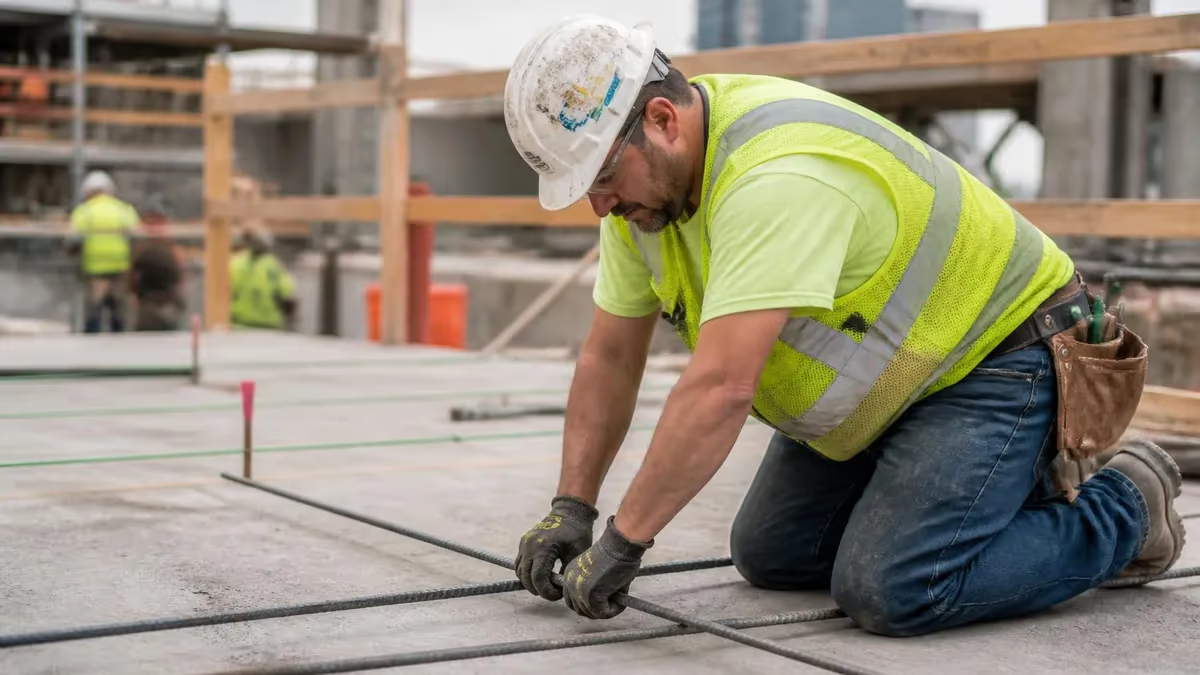
Understanding osha toeboard requirements is essential for any worker or safety officer responsible for maintaining compliant workplaces at elevation. Toeboards are physical barriers installed at the edges of elevated surfaces — platforms, scaffolds, runways, ramps, and floor openings — to prevent tools, materials, and debris from rolling or sliding off and striking workers below. OSHA's standards treat toeboards as a critical component of a layered fall-protection and falling-object-protection system, meaning they work alongside guardrails and safety nets rather than replacing them.
The core regulation governing toeboards in general industry is found in 29 CFR 1910.23, which covers walking-working surfaces and elevated platforms. For construction worksites, 29 CFR 1926.502 and the scaffold-specific rules in 29 CFR 1926.451 apply. Although the language across these standards differs slightly, the underlying intent is identical: keep objects from becoming projectiles that injure workers on lower levels. OSHA compliance officers routinely cite toeboard violations during inspections, and the penalties can range from a few hundred dollars for other-than-serious violations to over $15,000 for willful or repeated infractions as of the most recent penalty adjustments.
The minimum height requirement for a toeboard is 3.5 inches (measured from the top of the toeboard to the floor or platform surface). This seemingly small barrier is engineered to stop the vast majority of hand tools, fasteners, bricks, and similar objects that might otherwise travel over the edge during normal work activity. OSHA specifies that a toeboard must be solid or have openings no larger than one inch in any direction, ensuring that small items like screws, bolts, and nails cannot slip through gaps and fall onto personnel below.
Material selection for toeboards is another area where compliance officers pay close attention. OSHA allows wood, metal, or other solid materials, but whatever is used must be capable of withstanding the forces of normal work activity without bending, splintering, or dislodging. Lumber toeboards should be free of large knots, splits, or decay. Metal versions — typically angle iron or formed steel — must be securely fastened to prevent movement when bumped by foot traffic or rolling equipment. Plastic and composite materials are increasingly common in modern construction and must meet equivalent strength standards.
Many workers confuse toeboards with the bottom rail of a standard guardrail system. They serve different purposes. A guardrail mid-rail is designed to stop a person from falling; a toeboard is specifically designed to stop objects. OSHA generally requires both on any open-sided platform or floor that is four feet or more above a lower level in general industry (six feet in construction). Relying on only one of these systems while omitting the other creates a compliance gap that inspectors will flag and that can lead to serious injuries when objects strike workers on lower floors.
Scaffolding adds another dimension of toeboard complexity. Under 29 CFR 1926.451(h), toeboards on scaffolds must be a minimum of 3.5 inches high and must be secured to prevent displacement. For scaffolds where the height above the lower level exceeds ten feet, OSHA may require a paneled or screened enclosure above the toeboard to provide complete object-retention protection. This is particularly important on scaffolds adjacent to public walkways, roadways, or areas where other trades are working at ground level simultaneously.
This guide walks through every major aspect of OSHA's toeboard requirements: the regulatory framework, measurement standards, material specifications, installation best practices, common violations, and the practical steps you need to take to keep your worksite compliant. Whether you are preparing for an OSHA 10 or OSHA 30 certification exam, managing a construction crew, or auditing a manufacturing facility, the information below will give you a thorough and actionable foundation.
OSHA Toeboard Requirements by the Numbers

OSHA Regulatory Framework for Toeboards
The primary standard for walking-working surfaces in general industry. Covers open-sided floors, platforms, and runways four feet or more above an adjacent floor or ground level. Specifies minimum toeboard height, material integrity, and permitted opening sizes for all fixed elevated work surfaces.
OSHA's fall protection standard for construction environments. Requires toeboards on scaffolds and elevated surfaces six feet or more above lower levels. Works in concert with guardrail systems, personal fall arrest systems, and safety net requirements for comprehensive worker protection.
Dedicated scaffolding rules that require toeboards at least 3.5 inches high on all scaffold platforms. Scaffolds over ten feet in height adjacent to areas where workers below may be exposed to falling-object hazards require additional overhead protection beyond the standard toeboard.
Establishes employer responsibility to provide fall and falling-object protection. Toeboard requirements are triggered when workers on lower levels could be struck by falling materials. Covers holes, skylights, hatchways, and all open floor and platform edges in general industry facilities.
The dimensional requirements for toeboards sound simple — at least 3.5 inches tall, openings no larger than one inch — but applying those specs in the field requires attention to detail that many employers underestimate. The 3.5-inch measurement is taken from the top of the toeboard down to the walking surface, not from the bottom of any gap.
If a toeboard is installed but sits even a quarter inch above the floor, that gap beneath the board must be added to the effective height calculation. In practice, this means toeboards must be installed flush with the walking surface, or the actual exposed height above the gap may fall below the 3.5-inch minimum.
Attachment and fastening methods receive specific OSHA scrutiny because a toeboard that shifts or falls out of place provides no protection at all. Toeboards should be attached with nails, screws, bolts, or purpose-built clamps rated for the load, and they must be fastened at intervals sufficient to prevent sagging or bowing between attachment points. On wooden platforms, the toeboard is typically nailed to upright planks or framing members every 8 to 12 inches along its length. Metal toeboards on scaffolding are usually secured with wire ties or scaffold clamps approved for the specific scaffold system being used.
Color coding and visibility are not explicitly required by OSHA for toeboards, but many safety programs use high-visibility yellow paint or reflective tape to make toeboards easier to see in low-light environments such as basements, tunnels, and night-shift operations. This is a best-practice approach that goes beyond minimum compliance and helps prevent accidental displacement by workers who might not notice a standard wood or gray-metal toeboard in poor lighting conditions. Safety managers who implement visibility improvements typically see fewer toeboard-related incidents and faster pre-shift inspection times.
Temporary versus permanent toeboards operate under slightly different expectations. Permanent installations — such as mezzanine edges in warehouses or elevated production platforms — must meet full 29 CFR 1910.23 requirements and should be incorporated into the original design of the platform. Temporary toeboards used during construction phases or for short-duration tasks still must meet the 3.5-inch height requirement, but they may use lighter attachment methods appropriate to the duration of the work. However, OSHA does not create a reduced-compliance tier for temporary installations; the standard applies regardless of how long the elevated surface will be in use.
Wire mesh and expanded metal are sometimes used as toeboard materials, especially in environments where solid panels would obstruct airflow, create weight problems, or block visibility of machinery at floor level. OSHA permits these materials as long as the mesh or expanded metal openings do not exceed one inch in any dimension. A standard quarter-inch hardware cloth, for example, fully complies. A 1.5-inch chain-link mesh does not comply because the openings exceed the one-inch limit. When specifying mesh toeboards, always verify the opening dimensions on the product specification sheet rather than estimating by eye.
Toeboards are not required in every situation involving elevation. OSHA carves out specific exemptions. For example, a platform used only for maintenance access and equipped with a solid guardrail system that itself prevents objects from rolling over the edge may not require a separate toeboard if the bottom rail of the guardrail system is within 3.5 inches of the floor surface.
Similarly, areas where access is prevented and no material storage or work activity takes place at the platform edge may qualify for a variance. However, employers should document the basis for any exemption and consult with a qualified safety professional before omitting toeboards from an elevated surface.
Understanding how toeboards interact with floor holes and wall openings is equally important. OSHA requires toeboards around floor holes — openings 12 inches or more in their least dimension through which a person could fall — whenever those holes are not covered. The toeboard prevents tools and materials from rolling into the hole and striking workers below or bouncing unpredictably on lower levels. Standard floor-hole covers are preferred, but when covers are removed for maintenance or installation work, temporary toeboards and guardrails must immediately be erected to provide equivalent protection for the duration of the opening.
Toeboard Requirements by Work Environment
In general industry settings — manufacturing plants, warehouses, and industrial facilities — OSHA's 29 CFR 1910.23 requires toeboards on all open-sided platforms, runways, and floors four feet or more above a lower level. The toeboard must be at least 3.5 inches high, secured against displacement, and have no openings larger than one inch. Permanent platforms such as mezzanines, loading docks, and machinery maintenance decks all fall under this standard, and compliance must be verified during initial construction and during any subsequent modification to the elevated surface.
Employers in general industry are also responsible for providing toeboards around floor holes and wall openings through which objects could fall and strike workers below. Inventory shelving that extends to elevated pick levels, assembly-line catwalks, and overhead conveyor maintenance platforms are all common locations where toeboard violations are discovered during OSHA inspections. A documented walking-working surface inspection program that includes toeboard verification at each elevated location is considered best practice and helps demonstrate good-faith compliance to inspectors.
Toeboards: Benefits and Limitations in Workplace Safety
- +Prevent tools, fasteners, and debris from falling off elevated edges and striking workers below
- +Required by OSHA under multiple standards, so compliance also reduces legal and financial liability
- +Low-cost safety solution compared to the cost of a single falling-object injury or fatality
- +Easy to install on most platform types using standard lumber, metal angle, or purpose-built systems
- +Durable and low-maintenance when made from metal; typically last the life of the platform
- +Visible physical barrier that reminds workers not to store materials at the platform edge
- −Toeboards alone cannot stop large or heavy objects that could topple a 3.5-inch barrier on impact
- −Wooden toeboards deteriorate over time and must be regularly inspected for rot, splits, and nail pull-out
- −Workers frequently remove toeboards to pass materials and may fail to reinstall them correctly
- −Solid toeboards can obstruct airflow on platforms in hot environments, creating heat-stress concerns
- −Do not protect against falling-person hazards — guardrails and personal fall arrest systems are also needed
- −Mesh and expanded metal toeboards require dimensional verification to confirm openings are within the one-inch limit
OSHA Toeboard Compliance Checklist
- ✓Verify toeboard height is at least 3.5 inches measured from the top of the board to the walking surface with no gap beneath.
- ✓Confirm there are no openings in the toeboard larger than one inch in any direction.
- ✓Check that the toeboard is securely fastened and cannot be displaced by foot traffic, rolling equipment, or normal work activity.
- ✓Inspect wooden toeboards for rot, large knots, splits, or loose fasteners that could cause structural failure.
- ✓Confirm metal toeboards are free of significant corrosion, sharp edges, and loose clamps or bolts.
- ✓Verify toeboards are installed on all open sides and ends of elevated platforms, not just the most exposed edge.
- ✓Check that toeboards are in place around floor holes and openings whenever covers have been removed.
- ✓Inspect scaffold toeboards before each shift and after any event that could have caused displacement or damage.
- ✓Confirm that toeboards on scaffolds adjacent to public or high-traffic areas are supplemented with screening or solid paneling where required.
- ✓Document all toeboard inspections in writing, including the date, inspector name, locations checked, and any corrective actions taken.
The 3.5-Inch Rule Is a Minimum, Not a Target
OSHA's 3.5-inch minimum toeboard height was established to stop the majority of common hand tools and materials. Many safety engineers recommend installing toeboards at 4 to 6 inches wherever the work involves round objects — pipes, conduit, cylinders — that can more easily overcome a lower barrier. Exceeding the minimum is always permissible and significantly reduces both hazard exposure and OSHA citation risk.
Common OSHA toeboard violations fall into a handful of recurring patterns that compliance officers see on worksites across every industry sector. The most frequent citation involves toeboards that are present but have been displaced, loosened, or damaged since the last inspection and were not corrected before work resumed. A toeboard that sits at an angle, has a visible gap beneath it, or is only attached at one end provides minimal real-world protection while technically appearing to be in place. Inspectors look closely at the quality of attachment rather than simply confirming that a board exists at the platform edge.
The second most common violation category involves missing toeboards at locations that workers have come to treat as permanent access points. When a toeboard is routinely removed so workers can slide materials between levels, the path of least resistance becomes leaving it off permanently.
This pattern is especially common on mezzanine edges adjacent to freight elevators, on scaffolding platforms where materials are hoisted from below, and on loading dock edges where pallets are moved frequently. The solution is typically a hinged or removable toeboard section that can be easily opened for material transfer and then secured closed again — OSHA allows these designs as long as the closure mechanism keeps the toeboard firmly in place during work operations.
Toeboards on wire-managed floors pose a different challenge. Electrical conduit, pneumatic lines, and data cables that pass through a platform edge make it difficult to install a continuous solid toeboard without gaps. Many contractors simply leave sections of the toeboard out rather than engineering a solution.
OSHA's answer to this problem is that openings for pipe, conduit, or other items passing through the toeboard are acceptable as long as the opening is as small as practicable — ideally no more than one inch larger in any dimension than the item passing through it. Brush grommets, foam fill, or purpose-built cable pass-through panels can achieve this while maintaining code compliance.
Penalty structures for toeboard violations reflect the seriousness OSHA assigns to falling-object hazards. An other-than-serious violation — where a hazard exists but the most likely outcome is not death or serious physical harm — currently carries a maximum penalty of $15,625 per violation. A serious violation, where the hazard could cause death or serious physical harm and the employer knew or should have known about it, carries the same maximum but is more aggressively pursued.
Willful violations — where the employer intentionally disregarded the standard or showed plain indifference to worker safety — can reach $156,259 per violation. Repeat violations, defined as a substantially similar violation cited within the previous five years, carry the same $156,259 ceiling.
OSHA's General Duty Clause (Section 5(a)(1) of the OSH Act) provides another enforcement avenue even when a specific toeboard standard does not perfectly match a given worksite condition. If OSHA can demonstrate that a recognized hazard exists that is causing or is likely to cause death or serious physical harm, and that feasible means to abate the hazard exist, the agency can cite an employer under the General Duty Clause regardless of whether a specific toeboard rule technically applies.
This means that the absence of an explicit standard for a particular elevated surface type does not insulate an employer from citation if workers below are exposed to falling-object hazards.
Documentation is an often-overlooked element of toeboard compliance. Employers who maintain written inspection records, corrective action logs, and training records for workers who install and inspect toeboards are in a significantly stronger position during OSHA inspections than those who rely on informal visual checks. Written records demonstrate that the employer has an active, functioning safety program rather than simply reacting to violations after they are discovered. Many safety management systems now include digital inspection apps that generate timestamped records with photographs, making documentation quick and defensible.
Training requirements intersect with toeboard compliance in important ways. OSHA requires that workers who work on or adjacent to elevated surfaces understand the hazards associated with those surfaces, including the risk of falling objects. Workers who install, inspect, or modify toeboards should receive specific training on the dimensional requirements, acceptable materials, fastening methods, and the circumstances under which toeboards must be replaced rather than repaired. This training should be documented and repeated whenever there is reason to believe a worker does not understand the requirements or when changes in work conditions create new falling-object hazards.

OSHA strictly prohibits removing toeboards — even temporarily — unless equivalent falling-object protection is immediately provided. When toeboards must be removed for material transfer or maintenance, erect barricades below the open edge, restrict access to the area beneath, and post a qualified person as a spotter. Failure to provide interim protection is a citable violation even if the toeboard was removed for only a few minutes.
Preparing for an OSHA inspection that may cover toeboard compliance requires a proactive rather than reactive mindset. The single most effective step an employer can take is to conduct a thorough self-inspection of all elevated surfaces before an OSHA compliance officer arrives. Walk every platform, scaffold, mezzanine edge, and elevated runway in the facility.
Measure toeboard heights, check attachment points, test for lateral stability, and look for gaps beneath the board. Document what you find and correct deficiencies immediately. A written record of self-inspection and corrective action is one of the strongest indicators of a good-faith compliance program, which OSHA considers when calculating penalty amounts.
Engaging workers in the inspection process pays dividends that management-only inspections cannot. Frontline workers know which toeboards get moved regularly, which ones have been damaged by forklifts or material drops, and which locations have never had toeboards even though they should. A peer-observation program — where workers are trained to identify and report toeboard deficiencies to their supervisor without fear of retaliation — creates a continuous monitoring capability that no periodic management inspection can replicate. OSHA's VPP (Voluntary Protection Programs) and SHARP programs both emphasize worker involvement in safety programs as a cornerstone of effective compliance.
Selecting the right toeboard system for a given application involves matching material properties to the work environment. In chemical plants and wastewater treatment facilities where corrosion is a constant threat, stainless steel or high-density polyethylene (HDPE) toeboards outlast wood or standard carbon steel by years and require far less maintenance.
In food processing environments where hygiene is paramount, smooth stainless or anodized aluminum toeboards are preferred because they can be cleaned without harboring bacteria in wood grain or paint imperfections. In high-temperature environments near furnaces or ovens, metal toeboards are safer than wood, which can dry out and crack when exposed to radiant heat over time.
Reviewing your toeboard program after any near-miss or incident involving a falling object is mandatory both from a legal standpoint and from a continuous improvement perspective. OSHA's incident investigation requirements under 29 CFR 1904 do not specifically mandate a toeboard review after a falling-object incident, but a thorough root-cause analysis will almost always surface toeboard deficiencies as contributing factors in object-fall incidents.
Use post-incident reviews to update inspection checklists, retrain relevant workers, and engineer permanent solutions rather than temporary fixes. Recurring falling-object incidents at the same location are a clear signal that the toeboard design itself needs to be re-engineered rather than simply repaired in place.
Many employers find that participating in OSHA's free consultation services is an excellent way to identify toeboard and other compliance gaps before a formal enforcement inspection. OSHA's On-Site Consultation Program, available in every state through partnerships with state agencies, provides free, confidential safety and health advice to small and medium-sized businesses.
Consultants identify hazards, explain regulatory requirements, and recommend corrective actions without issuing citations or penalties. Employers who implement all recommended corrections and achieve a certain level of safety excellence may qualify for OSHA's Safety and Health Achievement Recognition Program (SHARP), which confers formal recognition and certain exemptions from programmed inspections.
Recordkeeping for toeboard-related incidents must align with OSHA's injury and illness recording requirements under 29 CFR 1904. Any work-related injury caused by a falling object — including those that could have been prevented by a proper toeboard — must be recorded on the OSHA 300 log if it results in days away from work, restricted work, job transfer, loss of consciousness, medical treatment beyond first aid, or diagnosis of a significant injury by a healthcare professional.
Identifying toeboard failures in incident records creates an analytical data trail that safety professionals can use to prioritize future capital investments in fall and falling-object protection systems.
Finally, staying current with OSHA rulemaking is an ongoing responsibility for safety professionals. OSHA periodically updates its walking-working surface standards, scaffold standards, and fall-protection rules through the formal rulemaking process. The 2016 update to Subpart D (Walking-Working Surfaces) in general industry significantly modernized the language around toeboards and related requirements. Future rulemaking could further adjust specifications, especially as new materials and prefabricated toeboard systems enter the market. Subscribing to OSHA's mailing list, reviewing the Federal Register regularly, and participating in industry safety associations are all effective ways to stay ahead of regulatory changes that could affect your compliance program.
Practical toeboard compliance on active worksites comes down to a few core habits that safety leaders must build into daily operations. The most important is the pre-shift walkthrough. Before any work begins at elevation, a competent person — defined by OSHA as someone capable of identifying existing and predictable hazards and who has the authority to take corrective measures — must inspect all toeboards on platforms and scaffolds that will be used that day.
This walkthrough should be quick but thorough: check height, check attachment, check for damage, and verify that no toeboards were displaced during the previous shift's cleanup or material-handling operations.
Standardizing toeboard materials and fastening systems across a jobsite or facility reduces the cognitive load on workers and inspectors alike. When every toeboard is made from the same pressure-treated 2x4 stock and secured with the same stainless-steel duplex nails at 12-inch intervals, workers can quickly recognize non-compliant installations and inspectors can efficiently verify compliance without evaluating each installation individually. Material standardization also simplifies procurement, ensures replacement boards are always available on-site, and reduces the temptation to use whatever scrap lumber is at hand when a toeboard needs to be replaced in a hurry.
Contractor management is a critical but often neglected dimension of toeboard compliance for general contractors and facility owners. When subcontractors work on elevated platforms within your facility or on your construction project, their toeboard installations become your liability as well as theirs under OSHA's multi-employer worksite doctrine.
The controlling employer — typically the general contractor or the host employer — has a duty to ensure that all employers on the site comply with OSHA standards that protect any worker on the site, not just their own employees. Pre-mobilization safety meetings, written subcontractor safety requirements, and regular joint inspections are all effective tools for managing this shared compliance responsibility.
Integrating toeboard requirements into your facility's change-management process prevents compliance gaps from opening during modification projects. Any time an elevated platform is extended, reconfigured, or has its edge profile changed, the toeboard installation must be re-evaluated to ensure it still meets OSHA requirements for the new configuration.
Management of change procedures — common in process safety contexts — should explicitly include a toeboard and fall-protection review as a mandatory step before any modified elevated surface is returned to service. Skipping this step is how facilities end up with compliant platforms that become non-compliant after a renovation without anyone noticing until an inspection or incident occurs.
Training new workers on toeboard requirements should be incorporated into onboarding rather than treated as a stand-alone topic. When workers understand from their first day that toeboards are a non-negotiable safety requirement — not an optional feature that gets skipped when time is short — they are far more likely to maintain and replace them correctly throughout their careers.
Use real-world examples during training: show photographs of falling-object injuries, share OSHA case studies, and demonstrate proper installation techniques rather than just reading the regulation aloud. Hands-on installation practice, where new workers actually measure, cut, and secure a toeboard under supervision, produces far better long-term compliance than classroom-only training.
Budgeting for toeboard maintenance should be a line item in any facility's or project's safety budget rather than an afterthought pulled from contingency funds. Toeboards wear out, get damaged by forklifts and pallet jacks, and need replacement as part of normal operations. Facilities that budget predictably for this maintenance are less likely to defer repairs and more likely to use quality materials rather than makeshift alternatives.
A modest annual toeboard materials budget — even a few hundred dollars for a small facility — is trivially small compared to the cost of a single OSHA citation, a workers' compensation claim for a falling-object injury, or the legal liability associated with a fatality caused by a preventable object-fall incident.
The relationship between toeboard compliance and overall safety culture is perhaps the most important practical point of all. Toeboards are simple, inexpensive, and easy to install correctly. A worksite where toeboards are consistently maintained and replaced sends a clear signal to workers, inspectors, and visitors that leadership takes safety seriously at every level of detail.
Conversely, a worksite with damaged, missing, or non-compliant toeboards signals that safety is treated as optional when it becomes inconvenient. Building a culture where every worker treats toeboard maintenance as a personal responsibility — not just the safety officer's job — is the single most durable way to achieve and sustain full compliance with OSHA's toeboard requirements over the long term.
OSHA Questions and Answers

OSHA Approved Safety Glasses: Complete 2026 Guide to ANSI Z87.1 Eye Protection Standards, Selection, and Workplace Compliance

OSHA Lightning Safety: Standards, Rules & Outdoor Worker Protection Guide for 2026
Is OSHA a Government Agency? The Federal Body Behind US Workplace Safety

OSHA 10 Test Answers: Complete Study Guide & Practice Questions for 2026

How Many Modules Are in OSHA 30? Complete Course Structure Breakdown for 2026
About the Author

Certified Safety Professional & OSHA Compliance Expert
Indiana University of Pennsylvania Safety SciencesDr. William Foster holds a PhD in Safety Science from Indiana University of Pennsylvania and is a Certified Safety Professional (CSP) and Certified Hazardous Materials Manager. With 20 years of occupational health and safety management experience across construction, manufacturing, and chemical industries, he coaches safety professionals through OSHA certification, CSP, CHST, and safety management licensing programs.
Join the Discussion
Connect with other students preparing for this exam. Share tips, ask questions, and get advice from people who have been there.
View discussion (8 replies)