
OSHA Required Posters: Complete Guide to Workplace Posting Requirements and Compliance
Learn which OSHA required posters every US employer must display, where to post them, and how to avoid costly fines. 📋 Complete 2026 October compliance guide.
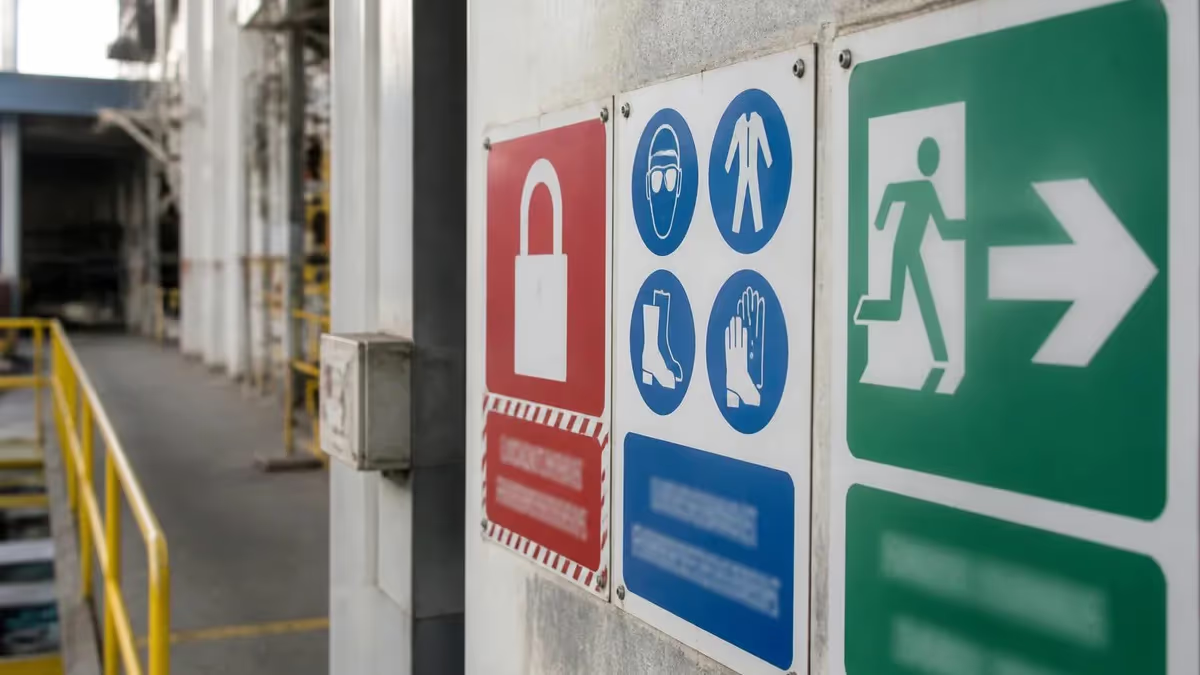
Understanding osha required posters is one of the most fundamental compliance obligations every US employer must meet, regardless of industry size or sector. The Occupational Safety and Health Administration mandates that certain informational notices be prominently displayed in workplaces so employees know their rights, understand available protections, and know how to report unsafe conditions. Failure to post these required notices can result in federal citations and financial penalties that range from hundreds to thousands of dollars per violation.
The centerpiece of federal workplace posting requirements is the OSHA Job Safety and Health: It's the Law poster. This notice informs workers of their right to a safe workplace, their ability to report hazards without fear of retaliation, and the process for filing complaints with OSHA. Every employer covered under the Occupational Safety and Health Act of 1970 must display this poster in a conspicuous location where all employees can read it — typically a break room, main entrance, or common hallway. The current version of this poster was updated in 2015, and outdated versions are not considered compliant.
Beyond the primary OSHA safety poster, employers may also be required to display several other federal workplace notices depending on their size, industry, and workforce composition. These include notices from the Equal Employment Opportunity Commission, the Department of Labor's Wage and Hour Division, the Family and Medical Leave Act poster, and others. The specific combination of posters required depends on factors such as the number of employees, whether federal contracts are involved, and the nature of the business operations being conducted.
Many employers are surprised to learn that OSHA required posters must be displayed in every language spoken by a significant portion of the workforce. If a substantial number of employees are not proficient in English, the employer must provide translated versions of the required posters in the workers' native languages. OSHA provides free translations of the Job Safety and Health poster in numerous languages including Spanish, Chinese, Vietnamese, Korean, Portuguese, and many others, all available through the OSHA website at no cost to the employer.
State-plan states add another layer of complexity to workplace posting requirements. Twenty-two states and two territories operate their own OSHA-approved occupational safety programs, and these jurisdictions often have additional or different posting requirements beyond what federal OSHA mandates. For example, California, New York, Michigan, and North Carolina all have state-specific safety posters that employers operating within those borders must display in addition to the federal notices. Employers with multi-state operations must carefully track which posters apply in each jurisdiction where they have employees.
The consequences of non-compliance with OSHA posting requirements extend beyond financial penalties. When an OSHA compliance officer visits a worksite — whether in response to a complaint, following an incident, or as part of a programmed inspection — one of the first things they verify is whether required posters are properly displayed. A missing or outdated poster can signal to the inspector that the employer may not be taking other compliance obligations seriously, potentially triggering a more thorough review of the entire operation and increasing the likelihood of discovering additional violations.
For crane operators and construction employers specifically, OSHA posting compliance is particularly important because these industries are subject to heightened regulatory scrutiny. OSHA's cranes and derricks standard (29 CFR 1926 Subpart CC) imposes rigorous safety requirements, and compliance officers inspecting construction sites are trained to look for multiple categories of violations simultaneously. Maintaining proper poster displays demonstrates a culture of compliance that can influence how inspectors approach their overall assessment of a jobsite, making it an important element of any comprehensive workplace safety program.
OSHA Required Posters by the Numbers

Core Federal Posters Every Employer Must Display
The foundational federal requirement. Every employer covered by the OSH Act must display this poster informing workers of their rights to a safe workplace, hazard reporting, and OSHA complaint procedures. Available free from OSHA.gov.
Required for employers with 15 or more employees. Informs workers about federal laws prohibiting discrimination based on race, color, religion, sex, national origin, age, disability, and genetic information in employment.
Required for most employers. Covers federal minimum wage, overtime pay rules, child labor provisions, and employee rights under the FLSA. Must be displayed where all employees can easily read it during their workday.
Required for employers with 50 or more employees. Details employee rights to unpaid, job-protected leave for qualifying family or medical reasons, including eligibility requirements and the employer notification process.
Required for most private employers. Prohibits most employers from using lie detector tests for pre-employment screening or during employment, with limited exceptions for certain security service and pharmaceutical industries.
Knowing which posters to display is only half the compliance equation — understanding exactly where and how to display them is equally critical for avoiding OSHA citations. The fundamental rule is that required posters must be conspicuous, meaning employees can readily see and read them during the normal course of their workday. A poster tucked behind a door, placed in a storage closet, or mounted at a height that makes it difficult to read does not satisfy the visibility requirement, even if the poster itself is technically present on the premises.
The ideal locations for workplace posting compliance are high-traffic common areas where employees regularly spend time. Break rooms and lunchrooms are among the most popular choices because virtually all workers pass through them at some point during their shift. Main entrance lobbies, near time clocks, and in hallways adjacent to restrooms are also effective placements. For construction sites and other outdoor or non-traditional workplaces, a prominently positioned job trailer, tool shed, or designated posting board near the site entrance typically satisfies the requirement, provided it is accessible to all workers.
Size matters when it comes to federal workplace posters. OSHA and other federal agencies typically specify minimum poster dimensions to ensure readability, and employers should verify that any poster they obtain meets the official size specifications. Using a printout from a low-quality source that produces a smaller-than-required image, or displaying a poster with faded ink that makes text difficult to read, can constitute non-compliance even when the employer has made a good-faith effort to post required notices. Obtaining official posters directly from the relevant federal agencies is the safest approach.
For employers with multiple worksites or facilities, each physical location where employees report to work typically requires its own set of required posters. A company with a corporate office, a warehouse, and three retail locations must maintain compliant poster displays at all five locations. Remote workers and teleworkers present a newer compliance challenge: while OSHA has not issued definitive guidance requiring posters in home offices, employers should consider providing electronic access to required notices through their company intranet, employee handbook, or onboarding portal to ensure all workers receive the required information.
Laminating required workplace posters is a widely accepted practice that helps preserve them against wear, moisture, and damage — particularly on construction sites and in industrial environments. However, any lamination must not obscure text or alter the poster's appearance in a way that makes information harder to read. Similarly, employers may display posters in protective frames or behind plexiglass, provided visibility is not compromised. The key test is whether a typical employee, standing at a normal reading distance, can clearly read all text on the poster without difficulty.
Digital display screens and electronic posting boards raise interesting questions under current OSHA regulations. While some federal agencies have begun allowing or even encouraging electronic posting as a supplement to physical displays, OSHA's core regulations still require physical poster displays for the Job Safety and Health notice in most circumstances. Employers who want to use digital signage should consult current OSHA guidance and consider maintaining physical postings as well to avoid any ambiguity about compliance. Electronic postings alone are generally not sufficient to replace physical displays under existing rules.
When conducting internal compliance audits, designate a specific person or team responsible for verifying that all required posters are displayed correctly at each worksite. Create a posting checklist that includes the name of each required poster, the date it was last verified, and notes about its specific location within the facility. Schedule quarterly walk-throughs to check that posters remain visible and undamaged, and immediately replace any that have been removed, covered, or become illegible. Maintaining documentation of these audits can be invaluable if an OSHA inspector ever questions your posting compliance history.
OSHA Poster Requirements by Employer Type
Construction employers face some of the most rigorous OSHA posting requirements in any industry. In addition to the standard federal posters, construction sites must often display notices related to specific OSHA standards such as the cranes and derricks rule, fall protection requirements, and hazard communication standards. On federally funded construction projects, additional notices required under the Davis-Bacon Act, the Contract Work Hours and Safety Standards Act, and other federal contracting laws may also apply, increasing the total number of required postings significantly.
For multi-employer construction sites where subcontractors work alongside the general contractor, each employer typically bears responsibility for ensuring their own workers have access to required posting information. However, the general contractor often maintains a central posting board near the site entrance that all workers on the project can access. Best practice is for the general contractor to post all federal and state-required notices prominently and to verify that subcontractors are meeting their independent posting obligations as part of regular site safety inspections and pre-work safety briefings.

Benefits and Challenges of Maintaining OSHA Poster Compliance
- +Demonstrates genuine commitment to worker safety and rights awareness
- +Avoids OSHA citations that can reach $16,131 per serious violation
- +Builds employee trust by ensuring workers know their legal protections
- +Reduces risk of worker complaints driven by not knowing their rights
- +Signals a culture of compliance that can positively influence OSHA inspections
- +Free posters from OSHA and DOL mean zero cost for basic compliance
- −Multi-state employers must track different requirements in each jurisdiction
- −Poster updates require ongoing monitoring and replacement when new versions release
- −Remote and hybrid workforces create ambiguity about electronic posting sufficiency
- −Construction and outdoor sites present physical challenges for proper poster display
- −Non-English-speaking workforce requirements increase administrative complexity
- −Federal contractor posting requirements add significant additional compliance burden
Pros and Cons at a Glance
| Pros | Cons |
|---|---|
| Demonstrates genuine commitment to worker safety and rights awareness | Multi-state employers must track different requirements in each jurisdiction |
| Builds employee trust by ensuring workers know their legal protections | Poster updates require ongoing monitoring and replacement when new versions release |
| Reduces risk of worker complaints driven by not knowing their rights | Remote and hybrid workforces create ambiguity about electronic posting sufficiency |
| Signals a culture of compliance that can positively influence OSHA inspections | Construction and outdoor sites present physical challenges for proper poster display |
| Free posters from OSHA and DOL mean zero cost for basic compliance | Non-English-speaking workforce requirements increase administrative complexity |
OSHA Poster Compliance Checklist for Employers
- ✓Display the current 2015 version of the OSHA Job Safety and Health: It's the Law poster at every worksite.
- ✓Verify that all posters are posted in conspicuous locations visible to all employees during normal work activities.
- ✓Obtain and display translated poster versions in any language spoken by a significant portion of your workforce.
- ✓Check whether your state operates an OSHA state plan and obtain any additional state-required safety posters.
- ✓If you have 15 or more employees, display the current EEOC Know Your Rights poster at all locations.
- ✓If you have 50 or more employees, display the Family and Medical Leave Act poster prominently.
- ✓Verify all posters are current — check OSHA.gov and DOL.gov quarterly for updated versions.
- ✓Replace any poster that is damaged, defaced, faded, or otherwise difficult to read immediately.
- ✓Document all posting locations and maintain a log of the last date each poster was verified at each location.
- ✓If you hold federal contracts, consult with legal counsel to identify all additional contractor-specific posting requirements.
All Required OSHA Posters Are Free
Many employers pay third-party vendors for workplace poster compliance services when in fact all federally required OSHA posters are available at absolutely no cost directly from OSHA.gov and the Department of Labor's website. While paid all-in-one poster services can be convenient for tracking updates across multiple federal and state requirements, they are entirely optional. Download official posters directly from federal agencies to ensure you always have the authentic, current version.
OSHA's enforcement of posting requirements operates through a straightforward but potentially costly citation system. When an OSHA compliance officer discovers that a required poster is missing or non-compliant during a worksite inspection, the agency can issue an other-than-serious citation with a penalty of up to $16,131 per violation as of 2024. While this category of violation is considered less severe than imminent danger or willful violations, employers with multiple worksites who are missing required posters at each location can quickly accumulate substantial total penalties that create real financial hardship for small and mid-sized businesses.
The enforcement process begins when an OSHA compliance safety and health officer (CSHO) arrives at a worksite, whether in response to a complaint, following a workplace injury, or as part of a planned inspection. One of the officer's first tasks is typically to walk through the facility and note whether required posters are displayed.
Employers are not entitled to advance notice of most OSHA inspections, meaning you cannot simply put up posters when an inspector calls ahead — the posters must be in place at all times. Attempting to post required notices after an inspector arrives on site does not cure a non-compliance finding for that inspection.
Retaliation protections connected to OSHA posting requirements deserve special attention. The Job Safety and Health poster specifically notifies employees that they have the right to report unsafe conditions and request OSHA inspections without fear of retaliation.
When employers fail to display this poster, workers may not be aware of these protections, which OSHA views as a particularly serious form of non-compliance because it can chill workers from exercising their rights. Section 11(c) of the OSH Act prohibits retaliation against workers who file complaints, participate in inspections, or exercise other rights under the Act, and employers must not interfere with these protections.
State plan states may impose different — and sometimes higher — penalties for posting violations than the federal schedule. California's Division of Occupational Safety and Health (Cal/OSHA), for example, has its own penalty structure and compliance requirements that may differ from federal OSHA in both the types of posters required and the penalties for non-display. Employers operating in state plan jurisdictions should contact their state OSHA office directly to obtain the complete list of state-required posters and understand the specific enforcement approach used in that state, as assuming federal and state requirements are identical can lead to inadvertent violations.
Settlement and penalty reduction programs give employers some options for mitigating posting violation penalties. OSHA typically offers penalty reductions of up to 80 percent for small employers (those with 10 or fewer employees), up to 60 percent for medium-sized employers with 11 to 25 employees, and additional reductions for employers with strong safety records and those who promptly correct identified deficiencies. Employers who contest OSHA citations and demonstrate good faith efforts toward compliance may negotiate further reductions through the informal conference process, which is available before an employer formally contests a citation.
The interplay between posting violations and other OSHA standards matters for construction employers in particular. When an OSHA inspector finds a missing poster at a construction site, this often triggers more intensive scrutiny of other compliance areas, including crane operator certification, fall protection systems, personal protective equipment programs, and hazard communication standards. A single poster violation can thus serve as the entry point for a comprehensive inspection that uncovers much more serious and costly violations. This domino effect makes poster compliance a genuinely high-use activity from a risk management perspective for construction employers.
Employers seeking to strengthen their overall posting compliance program should consider subscribing to a reliable update service or setting calendar reminders to check for poster updates at the beginning of each calendar year. OSHA and other federal agencies periodically update required posters to reflect changes in law, new contact information, or policy revisions, and using outdated poster versions is a common compliance pitfall. Creating a simple internal calendar event to visit OSHA.gov, DOL.gov, and relevant state agency websites each January to verify that current poster versions are displayed takes only a few minutes and can prevent costly citations.

Using an older version of the OSHA Job Safety and Health poster — even one that was previously compliant — does not satisfy current posting requirements. OSHA updated the mandatory poster in 2015, and older versions displaying different contact information or outdated rights language are considered non-compliant. Always verify you are displaying the most current version by downloading directly from OSHA.gov, and replace outdated posters immediately to avoid citations during inspections.
Keeping your OSHA required posters current is an ongoing responsibility, not a one-time task, and building a systematic approach to poster maintenance is essential for sustained compliance. Federal agencies update required workplace posters more frequently than most employers realize — changes in minimum wage rates, new or amended laws, updated agency contact information, and policy revisions all trigger poster updates that employers are required to implement within a reasonable timeframe after the new versions become available. Relying on a poster that was compliant when you put it up years ago is not a defense against a current violation.
The Department of Labor's free Poster Advisor tool at dol.gov is one of the most valuable compliance resources available to employers and is often underutilized. By answering a short series of questions about your business — including your industry, number of employees, whether you hold federal contracts, and your state of operation — you receive a customized list of all federal posters you are required to display. The tool also provides direct links to download official, print-ready PDF versions of each required poster, making it simple to obtain authentic materials at no cost without relying on third-party vendors.
For multi-location employers, centralizing poster compliance management is highly recommended. Designate a compliance coordinator at either the corporate or regional level who is responsible for monitoring poster update announcements from OSHA, DOL, EEOC, and other relevant agencies, and for communicating required changes to each location in a timely manner. Create a standardized posting kit for each new facility opening that includes all required federal posters plus state-specific notices for the applicable jurisdiction, so new locations are compliant from their first day of operation rather than scrambling to achieve compliance after the fact.
Technology can play a helpful role in managing ongoing poster compliance. Several human resources and compliance management software platforms include features that track federal and state poster requirements and alert administrators when updated versions are released. While these services typically involve a subscription fee, they can provide significant value for employers with operations in multiple states who face the challenge of tracking posting requirements across numerous jurisdictions simultaneously. For smaller employers with operations in a single state, the free government resources are typically sufficient to maintain compliance without additional investment.
Annual compliance audits should always include a dedicated section on workplace posting compliance. During these audits, physically visit each worksite location and verify that every required poster is displayed in a visible location, is the current official version, is in readable condition, and is available in all required languages. Document your findings in writing, including photographs of each posting location, and retain these records for at least three years. This documentation creates a compliance trail that can demonstrate good faith effort if any posting issues are identified during a subsequent OSHA inspection, potentially supporting penalty reduction negotiations.
Training your supervisors and managers on workplace posting requirements is another layer of compliance that many employers overlook. Front-line managers who understand why specific posters are required, what information they communicate to workers, and what to do when a poster becomes damaged or needs replacement are far more effective than relying solely on a centralized compliance function to catch problems. Include poster compliance basics in supervisor training programs and onboarding materials so that all members of your management team are equipped to maintain the visible workplace presence of required notices.
When employees ask about the information displayed on OSHA required posters, treat these conversations as compliance opportunities rather than interruptions. An employee who asks about their rights to request an OSHA inspection or report a safety concern without retaliation is exercising exactly the kind of informed engagement that these posters are designed to encourage. Having knowledgeable supervisors who can explain the information on required posters reinforces the message that the company takes worker rights seriously and is not simply posting notices as a paperwork formality, which in turn contributes to a genuinely safer and more engaged workplace culture.
Practical day-to-day management of OSHA posting compliance requires simple, durable systems that your team will actually use. The single most effective practice is to designate one person at each worksite as the posting compliance owner — someone who knows exactly which posters are required, where they are displayed, and what to do when one needs to be replaced. This ownership model prevents the all-too-common scenario where everyone assumes someone else is handling poster compliance and the task falls through the cracks during busy operational periods when other priorities compete for attention.
Creating a physical or digital posting binder is a practical tool for multi-site employers. This binder contains a copy of every required poster for each location along with notes about the version date, where each poster is displayed in that facility, and when it was last verified.
A simple spreadsheet tracking the poster name, current version date, display location, and last verification date provides immediate visibility into your compliance status across all sites and makes it easy to identify any location that may be overdue for a poster update or compliance check. This organized approach also impresses OSHA inspectors who appreciate employers who take compliance documentation seriously.
When new employees are onboarded, explicitly direct them to the location of required workplace posters as part of the standard orientation process. This practice serves two purposes: it ensures that all workers are actually aware of where to find required postings, and it reinforces the employer's commitment to transparent communication about worker rights.
Some employers include a brief overview of the information on key posters — particularly the OSHA Job Safety and Health poster — as part of new hire safety training, which helps workers understand their rights and the company's safety reporting procedures from their very first day on the job.
Construction foremen and site superintendents play a crucial role in maintaining poster compliance at active jobsites where conditions change frequently. As work progresses and job trailers, equipment staging areas, and worker gathering points shift around the site, the designated poster display location may become less accessible or conspicuous. Conducting a brief posting visibility check as part of weekly site safety meetings ensures that required notices remain visible and accessible even as site conditions evolve. This simple habit takes less than five minutes but provides meaningful protection against the kind of inadvertent non-compliance that results from gradual changes to site layout.
Obtaining OSHA required posters is straightforward and completely free through official channels. Visit OSHA.gov and navigate to the posters section to download print-ready PDF files of all required federal workplace notices. For the highest quality output, print posters on a color laser printer using heavyweight paper or cardstock, or take the PDF files to a professional print shop for large-format printing that enhances visibility and durability.
Laminating printed posters significantly extends their usable life, particularly in environments with exposure to moisture, dust, or physical contact. Remember to replace laminated posters when updated versions become available rather than assuming the laminated version is acceptable indefinitely.
Connecting your posting compliance program to your broader OSHA compliance strategy creates compounding benefits for workplace safety management. Employers who maintain rigorous poster compliance tend to also maintain stronger safety training programs, more thorough hazard assessments, and better-documented safety procedures — because the organizational discipline required for effective poster management reflects the same attention to detail that drives compliance excellence in other areas. For crane operators and construction employers preparing for OSHA certifications and inspections, this integrated approach to compliance creates a foundation of regulatory confidence that extends well beyond any single requirement.
Finally, remember that OSHA required posters are not just a regulatory checkbox — they represent a genuine communication tool that connects workers to the rights and protections the law affords them. Treating poster compliance as a meaningful element of your safety culture, rather than a bureaucratic obligation to minimize, signals to your workforce that you respect their rights and take your legal obligations seriously. This attitude, reflected in how visibly and accessibly you display required notices, contributes to the kind of trust between employers and workers that underlies genuinely safe and productive workplaces across every industry that OSHA regulates.
Sample OSHA - OSHA Certified Crane Operator Practice Questions
Try these questions from our free OSHA - OSHA Certified Crane Operator practice tests. The correct answer and an explanation follow each question.
What is the most critical safety requirement in code compliance?
- A. Speed of completion
- B. Following all applicable safety regulations and wearing required PPE
- C. Cost minimization
- D. Working alone to avoid delays
Answer: B. Following all applicable safety regulations and wearing required PPE
Safety regulations and proper PPE use are the most critical requirements in code compliance to prevent injury and ensure compliance.
What code compliance requirement applies to environmental standards?
- A. Codes are guidelines, not requirements
- B. All work must comply with applicable local, state, and national codes
- C. Code compliance only matters for commercial projects
- D. Follow codes only when inspectors are present
Answer: B. All work must comply with applicable local, state, and national codes
Code compliance is mandatory for all work, ensuring safety, quality, and legal adherence.
What code compliance requirement applies to safety procedures?
- A. Codes are guidelines, not requirements
- B. All work must comply with applicable local, state, and national codes
- C. Code compliance only matters for commercial projects
- D. Follow codes only when inspectors are present
Answer: B. All work must comply with applicable local, state, and national codes
Code compliance is mandatory for all work, ensuring safety, quality, and legal adherence.
What code compliance requirement applies to equipment operation?
- A. Codes are guidelines, not requirements
- B. All work must comply with applicable local, state, and national codes
- C. Code compliance only matters for commercial projects
- D. Follow codes only when inspectors are present
Answer: B. All work must comply with applicable local, state, and national codes
Code compliance is mandatory for all work, ensuring safety, quality, and legal adherence.
Take the full OSHA - OSHA Certified Crane Operator practice test
OSHA Questions and Answers

How Long Does an OSHA 10 Card Last? Complete Guide to Validity, Renewal, and What Happens When It Expires

360 Training OSHA 10: Complete Guide to Online OSHA 10-Hour Construction and General Industry Certification Courses

In the OSHA Bloodborne Pathogens Standard, OPIM Stands For: Complete Guide to Other Potentially Infectious Materials

OSHA (OSHA Certified Crane Operator) Test Guide

OSHA Flammable Cabinet Rules: Complete Guide to Storage Requirements, Compliance, and Workplace Safety
About the Author

Certified Safety Professional & OSHA Compliance Expert
Indiana University of Pennsylvania Safety SciencesDr. William Foster holds a PhD in Safety Science from Indiana University of Pennsylvania and is a Certified Safety Professional (CSP) and Certified Hazardous Materials Manager. With 20 years of occupational health and safety management experience across construction, manufacturing, and chemical industries, he coaches safety professionals through OSHA certification, CSP, CHST, and safety management licensing programs.
Join the Discussion
Connect with other students preparing for this exam. Share tips, ask questions, and get advice from people who have been there.
View discussion (8 replies)