
OSHA Health and Safety: Complete 2026 October Guide to Workplace Standards, Rights, and Compliance
Master OSHA health and safety rules in 2026 October. Learn worker rights, employer duties, hazard standards & how to stay compliant. ✅ Free practice tests included.
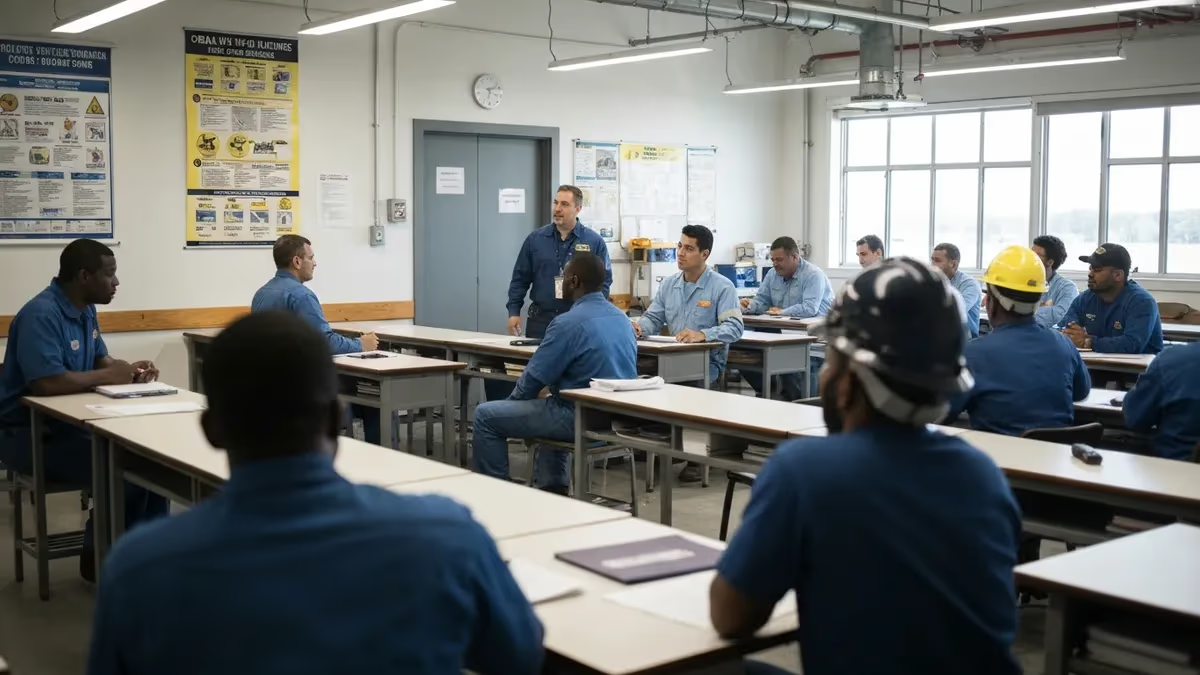
Understanding osha health and safety is essential for every worker and employer in the United States. The Occupational Safety and Health Administration — commonly known as OSHA — was established in 1970 under the Occupational Safety and Health Act, signed into law by President Richard Nixon. Since its founding, OSHA has dramatically reduced workplace fatalities, injuries, and illnesses across virtually every industry sector in the country. Whether you work in construction, manufacturing, healthcare, or an office environment, OSHA regulations directly affect your daily work life and the protections available to you.
OSHA's core mission is straightforward: ensure that American workers have safe and healthful working conditions. To accomplish this goal, the agency sets and enforces standards, provides training and education, and establishes partnerships with employers and workers. The agency covers approximately 130 million workers at more than 8 million worksites across the United States. Its reach extends from small family-owned businesses to multinational corporations operating on American soil, making it one of the most broadly impactful federal agencies in existence today.
The significance of OSHA cannot be overstated when examined through the lens of historical data. Before OSHA's creation, roughly 14,000 workers died on the job each year in the United States. Today, that number has fallen to fewer than 5,500 annually — a reduction of more than 60 percent over five decades, even as the workforce has more than doubled in size. Occupational illness rates have similarly declined. These outcomes represent millions of lives protected, families kept whole, and economic costs avoided through consistent regulatory enforcement and safety culture development.
For workers, OSHA health and safety protections include the right to a workplace free from recognized hazards, the right to receive training in a language they understand, the right to review records of work-related injuries and illnesses, and the right to file a complaint with OSHA if they believe unsafe or unhealthful conditions exist. Critically, workers also have the right to refuse work they reasonably believe poses an imminent danger to their health or safety, without fear of retaliation from their employer.
Employers, meanwhile, carry substantial obligations under OSHA law. They must provide a workplace free from serious recognized hazards, comply with all applicable OSHA standards, keep accurate records of all work-related injuries and illnesses, notify OSHA within specified timeframes of workplace fatalities and catastrophes, and provide workers with required training in OSHA standards. Employers must also display the official OSHA poster in a prominent location where employees can see it, informing them of their rights and responsibilities.
OSHA operates through a combination of federal oversight and state-plan programs. Twenty-two states and two territories operate their own OSHA-approved occupational safety and health programs covering private-sector workers. An additional six states and one territory operate plans covering only state and local government employees. These state plans must be at least as effective as the federal OSHA program, and many states have adopted standards that go beyond the federal minimums. Understanding whether your state operates under federal OSHA or a state plan matters, because the complaint and enforcement processes may differ slightly between jurisdictions.
This comprehensive guide breaks down everything you need to know about OSHA health and safety — from the core standards that affect most workplaces, to workers' rights, inspection procedures, common violations, and how to use free practice tests to prepare for OSHA certification exams. Whether you are a worker seeking to understand your rights, a supervisor aiming for compliance, or someone studying for an OSHA certification, the information in this guide will provide you with a thorough foundation for workplace safety knowledge in 2026.
OSHA Health and Safety by the Numbers

Core OSHA Standards Every Worker Should Know
Covers the broadest range of workplaces including factories, warehouses, retail facilities, and offices. Key topics include machine guarding, electrical safety, lockout/tagout, personal protective equipment, and hazard communication. These standards apply to any employer not covered by a more specific industry standard.
Specifically addresses construction worksites, the sector with the highest rate of fatal injuries. Subpart M (Fall Protection), Subpart P (Excavations), and Subpart Q (Concrete) are among the most frequently cited sections. Scaffolding, ladders, and electrical hazards are primary concerns in construction OSHA enforcement.
Requires employers to maintain Safety Data Sheets (SDS) for all hazardous chemicals in the workplace, label containers properly, and train workers on chemical hazards. Aligned with the Globally Harmonized System (GHS), this standard ensures that chemical hazard information is standardized and universally understood across industries.
Mandates that employers provide respirators when engineering controls cannot adequately control airborne contaminants. Requires a written respiratory protection program, medical evaluations for respirator users, proper fit testing, and worker training. The standard distinguishes between mandatory use and voluntary use scenarios.
Employers with 10 or more employees in non-exempt industries must record work-related injuries and illnesses on OSHA Forms 300, 300A, and 301. These records must be posted annually from February 1 through April 30. Electronic submission to OSHA is required for employers with 100 or more employees in high-hazard industries.
Worker rights under OSHA are far more extensive than many employees realize, and understanding these protections is fundamental to maintaining a safe and respectful workplace environment. Section 11(c) of the Occupational Safety and Health Act specifically prohibits employers from retaliating against workers who exercise their OSHA rights. This means that an employer cannot fire, demote, transfer, reduce pay, reduce hours, or otherwise discriminate against a worker because that worker filed a complaint, participated in an OSHA inspection, or reported a work-related injury or illness. Retaliation complaints must be filed with OSHA within 30 days of the alleged retaliatory action.
One of the most powerful rights workers possess is the right to request a confidential OSHA inspection. If you believe your workplace has a serious hazard or that your employer is violating OSHA standards, you can submit a complaint either online, by phone, by fax, or by mail. Workers also have the right to have a representative — such as a union steward — accompany the OSHA compliance officer during a workplace inspection. During the walk-around, workers can point out hazards and provide relevant information to the inspector without fear of employer retribution.
The right to receive safety training is another cornerstone of OSHA worker protections. OSHA requires that training be provided in a language and vocabulary that workers understand, which is particularly important in workplaces with non-English-speaking employees. Training requirements vary by standard but generally must cover the hazards present in the workplace, the methods workers can use to protect themselves, and the procedures to follow in emergency situations. Employers cannot charge workers for OSHA-required training and must pay workers for time spent in mandatory training sessions.
Employers carry equally significant duties under OSHA law, beginning with the General Duty Clause. Section 5(a)(1) of the OSH Act, known as the General Duty Clause, requires every employer to provide a workplace free from recognized hazards that are causing or are likely to cause death or serious physical harm. The General Duty Clause acts as a catch-all provision, allowing OSHA to cite employers for hazards not specifically covered by a written standard. This means employers cannot use the absence of a specific rule as an excuse for ignoring a known dangerous condition.
Employers must also establish and maintain effective hazard prevention and control programs. OSHA's Recommended Practices for Safety and Health Programs emphasize a hierarchy of controls: elimination of the hazard altogether is the most effective approach, followed by substitution of a less hazardous material or process, engineering controls that physically separate workers from hazards, administrative controls that change how work is performed, and finally personal protective equipment (PPE) as the last line of defense. PPE should never be the primary strategy for protecting workers when higher-order controls are feasible.
Recordkeeping and reporting duties represent another critical employer responsibility. When a worker dies from a work-related incident, the employer must report the fatality to OSHA within 8 hours. If a worker suffers an in-patient hospitalization, amputation, or loss of an eye as the result of a work-related incident, the employer has 24 hours to report. These reports can be made by calling OSHA's national hotline at 1-800-321-OSHA or by calling the nearest OSHA Area Office. Failure to report timely can result in significant additional penalties on top of any underlying citations.
Understanding the interplay between employer duties and worker rights creates a more cooperative and safer workplace. When workers know their rights and employers fulfill their obligations, the overall culture of safety improves. OSHA has repeatedly found that workplaces with strong safety cultures — where workers feel comfortable raising concerns without fear of punishment and where management genuinely prioritizes safety — have significantly lower rates of injuries, illnesses, and fatalities than workplaces where safety is treated as a compliance checkbox rather than a core value.
OSHA Health and Safety Hazard Categories Explained
Physical hazards are among the most common and dangerous threats in American workplaces, encompassing falls, struck-by incidents, caught-in/between accidents, and electrocution — the so-called "Fatal Four" in construction. Falls alone account for more than one-third of all construction fatalities each year. OSHA's fall protection standard requires guardrails, safety nets, or personal fall arrest systems at heights of 6 feet in construction and 4 feet in general industry environments.
Other significant physical hazards include excessive noise levels that can cause permanent hearing damage, extreme temperatures leading to heat stress or hypothermia, vibration from tools and machinery, ergonomic stressors from repetitive motions or awkward postures, and radiation exposure in certain industrial and medical settings. OSHA's Permissible Exposure Limits (PELs) establish maximum allowable concentrations for noise and other physical agents. Employers must monitor exposure levels, implement engineering controls, and provide audiometric testing programs for workers exposed to hazardous noise above action levels of 85 decibels as an 8-hour time-weighted average.
OSHA Compliance: Benefits vs. Challenges for Employers
- +Dramatically reduces workplace injuries, illnesses, and fatalities, protecting your workforce
- +Lowers workers' compensation costs and insurance premiums over the long term
- +Reduces risk of costly OSHA citations, civil litigation, and regulatory fines
- +Improves employee morale, retention, and productivity through demonstrated safety commitment
- +Enhances company reputation with clients, contractors, and potential employees
- +Positions the business favorably for government contracts that require OSHA compliance documentation
- −Initial compliance investments in PPE, engineering controls, and training can be substantial
- −Recordkeeping and reporting requirements consume significant administrative time and resources
- −Keeping up with evolving standards, new rules, and regulatory updates requires ongoing effort
- −Enforcement inspections can be disruptive to business operations and production schedules
- −State plan requirements in some jurisdictions exceed federal standards, creating additional burdens
- −Small businesses often lack dedicated safety staff to manage compliance comprehensively
Pros and Cons at a Glance
| Pros | Cons |
|---|---|
| Dramatically reduces workplace injuries, illnesses, and fatalities, protecting your workforce | Initial compliance investments in PPE, engineering controls, and training can be substantial |
| Lowers workers' compensation costs and insurance premiums over the long term | Recordkeeping and reporting requirements consume significant administrative time and resources |
| Reduces risk of costly OSHA citations, civil litigation, and regulatory fines | Keeping up with evolving standards, new rules, and regulatory updates requires ongoing effort |
| Improves employee morale, retention, and productivity through demonstrated safety commitment | Enforcement inspections can be disruptive to business operations and production schedules |
| Enhances company reputation with clients, contractors, and potential employees | State plan requirements in some jurisdictions exceed federal standards, creating additional burdens |
| Positions the business favorably for government contracts that require OSHA compliance documentation | Small businesses often lack dedicated safety staff to manage compliance comprehensively |
OSHA Workplace Safety Compliance Checklist
- ✓Post the official OSHA "Job Safety and Health — It's the Law" poster in a visible location accessible to all employees.
- ✓Conduct a comprehensive workplace hazard assessment and document all identified risks in writing.
- ✓Develop a written Hazard Communication (HazCom) program and maintain current Safety Data Sheets for all chemicals.
- ✓Implement a Lockout/Tagout (LOTO) procedure for all machinery requiring energy isolation during servicing.
- ✓Establish and document a written emergency action plan covering evacuation routes, assembly points, and employee responsibilities.
- ✓Provide required PPE at no cost to workers and train employees on proper selection, use, care, and storage.
- ✓Record all work-related injuries and illnesses on OSHA Form 300 and post the Form 300A summary from February 1 to April 30 annually.
- ✓Report worker fatalities to OSHA within 8 hours and hospitalizations, amputations, or eye loss within 24 hours.
- ✓Conduct regular safety training in a language and vocabulary each worker understands, and document all training completed.
- ✓Perform periodic workplace safety inspections and promptly correct identified hazards, documenting corrective actions taken.
The General Duty Clause Is OSHA's Most Powerful Enforcement Tool
Even if no specific OSHA standard covers a hazard in your workplace, employers can still be cited under Section 5(a)(1) — the General Duty Clause — if the hazard is recognized, likely to cause death or serious harm, and a feasible means of abatement exists. This provision means that saying "there is no rule about this" is never a complete legal defense against an OSHA citation.
OSHA conducts workplace inspections through its Compliance Safety and Health Officers (CSHOs), who are trained industrial hygienists and safety professionals. Inspections are prioritized according to a set hierarchy established to direct enforcement resources where they are most needed. Imminent danger situations — where there is reasonable certainty that a hazard exists that could cause death or serious physical harm immediately — receive the highest priority and may result in immediate inspection. Severe injuries and illnesses, such as fatalities or hospitalizations, are the second-highest priority. Worker complaints and referrals from other government agencies represent the third tier of priority.
Programmed inspections round out OSHA's enforcement approach. These are planned inspections of high-hazard industries or employers with historically poor safety records, conducted as part of national or local emphasis programs. The Site-Specific Targeting (SST) program directs inspections to establishments with high rates of days away from work, restricted work activity, and job transfers based on data submitted through OSHA's injury and illness recordkeeping system. Being selected for an SST inspection signals that your establishment's injury data stands out compared to industry peers.
When an OSHA inspector arrives at your workplace, employers have specific rights and responsibilities. The inspector will present credentials and explain the reason for the visit. Employers may request that the inspector obtain a warrant before entering if the visit is a programmed inspection, though this approach can sometimes escalate tensions with the agency. For unprogrammed inspections based on complaints or referrals, courts have generally held that warrantless inspections are permissible when the employer consents. Legal counsel should always be consulted if there is uncertainty about how to handle an OSHA inspection.
The inspection itself consists of three phases: the opening conference, the walk-around inspection, and the closing conference. During the opening conference, the CSHO explains the scope and purpose of the inspection. The walk-around involves a physical examination of the worksite, review of injury and illness records, and interviews with management and workers. Workers have the right to speak privately with the CSHO. During the closing conference, the inspector discusses any apparent violations found, but does not issue citations on the spot. Citations and proposed penalties are mailed to the employer within six months of the inspection.
OSHA citations classify violations into several categories based on severity and employer knowledge. A "Serious" violation exists when there is substantial probability that death or serious physical harm could result, and the employer knew or should have known about the hazard. Serious violations carry penalties up to $15,625 per violation as of 2026. "Willful" violations — where an employer intentionally and knowingly disregards OSHA requirements — carry penalties between $11,162 and $156,259 per violation. Repeat violations can result in penalties up to $156,259 per instance. "Other-than-Serious" violations, while still requiring correction, carry lower penalties.
Employers who receive citations have 15 working days to notify OSHA if they intend to contest the findings. The contest initiates a process before the Occupational Safety and Health Review Commission (OSHRC), an independent federal agency that adjudicates OSHA enforcement actions.
Employers can also enter into informal settlement agreements with OSHA to reduce penalties in exchange for expedited abatement and other corrective actions. Many first-time citations for smaller employers result in penalty reductions through this informal process, and OSHA typically offers small businesses (those with 25 or fewer employees) a penalty reduction of 60 percent on top of any other adjustments.
The most frequently cited OSHA standards provide a useful roadmap for where employers should concentrate their compliance efforts. Year after year, the top violations in general industry include hazard communication failures, respiratory protection deficiencies, and lockout/tagout program inadequacies. In construction, fall protection, scaffolding, ladders, eye and face protection, and powered industrial trucks consistently top the citation lists. Understanding the most-cited standards and proactively addressing those hazards before an inspector arrives is arguably the most practical compliance strategy available to employers of any size or industry sector.

If you believe your employer retaliated against you for exercising your OSHA rights — including filing a complaint, reporting an injury, or refusing unsafe work — you must file a retaliation complaint with OSHA within 30 days of the adverse action. Missing this deadline typically results in dismissal of the complaint regardless of its merits, so act quickly and contact your nearest OSHA Area Office or call 1-800-321-OSHA as soon as possible.
OSHA offers a wide range of training and certification programs designed to build safety competency at every level of the workforce, from entry-level workers to experienced safety professionals. The OSHA Outreach Training Program is the most widely recognized pathway to OSHA certification for workers in construction and general industry. Delivered by OSHA-authorized trainers, the program consists of two primary course levels: the 10-hour course designed for entry-level workers and the 30-hour course intended for supervisors and workers with greater safety responsibilities. Upon completion, participants receive a Department of Labor (DOL) wallet card confirming their training.
The OSHA 10-hour course introduces participants to OSHA's role and the rights of workers under the OSH Act, and covers the major hazards most commonly encountered in the relevant industry sector. For construction workers, topics include fall protection, electrical safety, struck-by hazards, caught-in/between hazards, scaffolding, and personal protective equipment. For general industry workers, the curriculum emphasizes walking and working surfaces, exit routes, fire protection, electrical safety, machine guarding, and hazardous materials. The 10-hour training typically takes place over two days and is available in both classroom and online formats authorized by OSHA.
The OSHA 30-hour course provides more in-depth coverage of workplace hazards and is designed for individuals who have some responsibility for worker safety. In construction, the 30-hour course covers the full range of construction hazards in considerably more detail than the 10-hour version, including specific attention to topics like confined spaces, cranes and rigging, demolition, and steel erection. In general industry, additional coverage includes ergonomics, industrial hygiene, safety management systems, and OSHA's recordkeeping and reporting requirements. Completion of the 30-hour course is often a contractual requirement on larger construction projects and is commonly required by union contracts and government agencies.
Beyond the Outreach Training Program, OSHA supports education through its network of OSHA Training Institute (OTI) Education Centers. These nonprofit organizations across the country offer a broad curriculum of safety and health courses, many of which are approved for continuing education units. Topics range from confined space entry and hazardous waste operations to industrial hygiene fundamentals and construction safety management. Some OTI courses are prerequisites for OSHA's more advanced credentials, including the OSHA 500 and 510 courses that authorize individuals to deliver the 10- and 30-hour Outreach programs themselves.
The National Institute for Occupational Safety and Health (NIOSH) works alongside OSHA to advance workplace safety through research and educational activities. While OSHA sets and enforces standards, NIOSH conducts the scientific research needed to develop new knowledge in the field of occupational safety and health. NIOSH recommendations often serve as the foundation for new or updated OSHA standards, and the two agencies coordinate closely on emerging health threats such as new chemical exposures, pandemic response, and the occupational health implications of new technologies and work practices.
For workers and employers interested in proactive safety improvements rather than just regulatory compliance, OSHA offers several consultation and cooperative program options. OSHA's On-Site Consultation Program provides free, confidential occupational safety and health advice to small and medium-sized businesses in all industries.
Consultants — employed by state agencies under agreements with OSHA — help employers identify workplace hazards, suggest corrective measures, and improve safety management systems. These visits are completely separate from enforcement activity; no citations are issued and no penalties are proposed. Employers who demonstrate exemplary safety programs through consultation may qualify for OSHA's Safety and Health Achievement Recognition Program (SHARP).
The OSHA Voluntary Protection Programs (VPP) represent the agency's highest recognition for employers and workers who have implemented effective safety and health management systems and maintain injury and illness rates below national averages. VPP participants are exempt from routine programmed inspections while maintaining their VPP status, and they serve as models for other employers seeking to improve their safety performance. Earning VPP Star status — the highest designation — signals to employees, customers, contractors, and regulators that a workplace has achieved genuine excellence in occupational safety and health management, going well beyond the minimum requirements of regulatory compliance.
Preparing effectively for OSHA certification exams requires a combination of understanding the regulatory framework, memorizing key standards and thresholds, and applying that knowledge to realistic workplace scenarios. One of the most common mistakes test-takers make is focusing exclusively on memorizing rules without understanding the reasoning behind them. OSHA standards are built on logical foundations rooted in hazard analysis and risk reduction principles. When you understand why a standard exists — what injury or illness it is designed to prevent — the specific requirements become far easier to remember and apply correctly on both the exam and the job.
Start your study plan by familiarizing yourself with OSHA's organizational structure. The agency divides its standards primarily by industry sector: general industry (29 CFR Part 1910), construction (29 CFR Part 1926), maritime (29 CFR Parts 1915–1919), and agriculture (29 CFR Part 1928). For most certification candidates, the general industry and construction standards are the primary focus.
Within those sections, certain subparts are disproportionately represented on certification exams. For general industry, pay particular attention to Subparts D (Walking-Working Surfaces), E (Emergency Action Plans), H (Hazardous Materials), I (Personal Protective Equipment), J (General Environmental Controls), O (Machinery), Q (Welding), and Z (Toxic and Hazardous Substances).
Practice tests are among the most valuable tools available for exam preparation. Taking timed practice tests under realistic conditions allows you to identify weak areas, get comfortable with the question format, and build the stamina needed for longer exams. Review every incorrect answer carefully — not just to learn the right answer, but to understand why your initial reasoning was flawed. Pattern recognition is a powerful learning tool; many exam questions test the same concepts repeatedly in slightly different ways, and working through large question banks helps you recognize those patterns and respond confidently under pressure.
Numerical thresholds and specific values appear frequently on OSHA exams and should be memorized rather than estimated. Key values to know include: the permissible noise exposure limit of 90 dBA as an 8-hour time-weighted average; the action level for noise at 85 dBA; fall protection trigger heights of 6 feet (construction) and 4 feet (general industry); the oxygen-deficient atmosphere threshold of less than 19.5 percent oxygen; the emergency egress lighting requirement of at least 1 foot-candle; and the maximum forklift load capacity must not exceed the rated capacity on the nameplate.
These values appear across multiple standards and are common exam topics precisely because they represent critical thresholds that directly affect worker safety decisions in the field.
Time management during OSHA certification exams is a skill that improves with deliberate practice. Many candidates spend too long on difficult questions and run out of time on easier ones near the end. A practical strategy is to move through the exam at a consistent pace, flagging questions you are uncertain about for review and answering all questions you are confident about first.
Since most OSHA certification exams do not penalize for wrong answers, it is always better to make your best educated guess on flagged questions rather than leaving them blank. Use process of elimination aggressively — ruling out clearly incorrect options often narrows a four-option question to a 50/50 choice even when you do not know the precise answer.
Group study and peer learning can dramatically accelerate exam preparation. Discussing complex OSHA standards with colleagues who have different workplace backgrounds often reveals applications and nuances you would not discover studying alone. Someone with manufacturing experience may understand machine guarding standards more intuitively, while someone from construction can explain fall protection scenarios more vividly. If formal study groups are not available, participating in online OSHA safety forums or reviewing OSHA's own free training resources — including eTool publications and QuickCards — provides an excellent supplement to commercial study materials.
Finally, give yourself adequate time to prepare rather than trying to cram immediately before the exam. Most OSHA certification candidates who score well report studying consistently over several weeks rather than intensively for a few days. Building in review sessions at regular intervals leverages the research-backed principle of spaced repetition, which significantly improves long-term retention compared to massed practice. Use the free practice tests available throughout this guide to benchmark your progress, identify remaining gaps, and build the confidence that comes from knowing you have genuinely mastered the material rather than simply hoping for the best on exam day.
Sample OSHA Safety Certificate Practice Questions
Try these questions from our free OSHA Safety Certificate practice tests. The correct answer and an explanation follow each question.
In a workplace where no specific OSHA standard exists for a particular hazard, what provision of the OSH Act requires employers to provide a workplace free from recognized hazards that are causing or are likely to cause death or serious physical harm?
- A. The Whistleblower Protection Program
- B. The General Duty Clause (Section 5(a)(1))
- C. The Personal Protective Equipment (PPE) Standard
- D. The Hazard Communication Standard
Answer: B. The General Duty Clause (Section 5(a)(1))
The General Duty Clause, Section 5(a)(1) of the OSH Act, is a catch-all provision that requires employers to protect employees from serious, recognized hazards even when there is no specific OSHA standard addressing that hazard.
Which agency enforces workplace safety standards in the United States?
- A. FDA
- B. OSHA
- C. FAA
- D. IRS
Answer: B. OSHA
OSHA (Occupational Safety and Health Administration) enforces workplace safety standards.
Who has the right to request an OSHA inspection of a workplace?
- A. Only the employer
- B. Only federal judges
- C. Employees or their representatives
- D. Only insurance companies
Answer: C. Employees or their representatives
Employees or their representatives can file a complaint requesting an OSHA inspection.
Which OSHA standard governs the Hazard Communication of chemicals, sometimes called 'Right to Know'?
- A. The HazCom Standard (29 CFR 1910.1200)
- B. The Family Medical Leave Act
- C. The Clean Air Act
- D. The ADA
Answer: A. The HazCom Standard (29 CFR 1910.1200)
The Hazard Communication Standard (29 CFR 1910.1200) ensures workers know chemical hazards.
OSHA Questions and Answers

OSHA Approved Safety Glasses: Complete 2026 Guide to ANSI Z87.1 Eye Protection Standards, Selection, and Workplace Compliance

OSHA Lightning Safety: Standards, Rules & Outdoor Worker Protection Guide for 2026

OSHA 10 Hour General Industry: Complete 2026 Guide to Training, Topics, Costs, and DOL Card

Is OSHA a Government Agency? The Federal Body Behind US Workplace Safety

How to Get OSHA Certified: Complete 2026 Guide to Training, Cards & Compliance
About the Author

Certified Safety Professional & OSHA Compliance Expert
Indiana University of Pennsylvania Safety SciencesDr. William Foster holds a PhD in Safety Science from Indiana University of Pennsylvania and is a Certified Safety Professional (CSP) and Certified Hazardous Materials Manager. With 20 years of occupational health and safety management experience across construction, manufacturing, and chemical industries, he coaches safety professionals through OSHA certification, CSP, CHST, and safety management licensing programs.
Join the Discussion
Connect with other students preparing for this exam. Share tips, ask questions, and get advice from people who have been there.
View discussion (8 replies)