
Is OSHA Federal? Understanding the Agency Behind US Workplace Safety
Is OSHA federal? ✅ Learn how OSHA works, its authority, history, and why it matters for every US worker and employer.
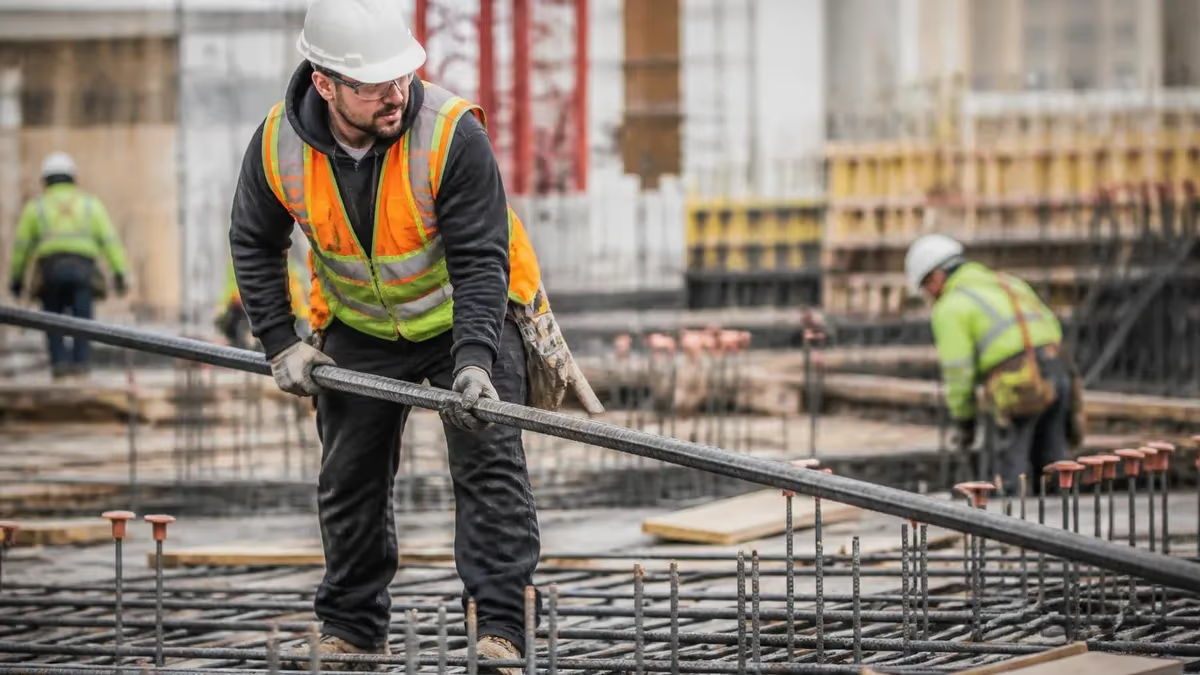
Is OSHA federal? The short answer is yes — the Occupational Safety and Health Administration is a federal agency operating under the United States Department of Labor. Created by Congress through the Occupational Safety and Health Act of 1970, OSHA was established to ensure that American workers have safe and healthful working conditions. Its federal status gives it the authority to set and enforce workplace safety standards across nearly every private-sector industry in the country, making it one of the most consequential regulatory bodies in the US labor landscape.
Understanding OSHA's federal identity is critical for workers, employers, and safety professionals alike. Because OSHA is a federal agency, its standards carry the force of federal law. Employers who violate OSHA regulations face federal citations, penalties, and — in the most serious cases — criminal prosecution. This is not a voluntary program or a set of suggestions. OSHA's rules are binding legal requirements, and compliance is not optional for covered employers. The agency's federal mandate means its reach extends from construction sites in rural Montana to warehouses in downtown Chicago.
The agency's mission, as stated in the OSH Act, is to prevent work-related injuries, illnesses, and deaths by issuing and enforcing standards and providing training, outreach, education, and compliance assistance. OSHA covers approximately 9 million workplaces and over 100 million workers across the United States. With a relatively modest workforce of around 2,100 inspectors, the agency relies heavily on employer compliance, worker reporting, and programmatic partnerships to carry out its mandate at this scale.
OSHA operates through a network of ten regional offices and dozens of area offices spread across the country. This decentralized structure allows the agency to respond to local workplace hazards while still operating under unified federal standards. Regional administrators oversee enforcement activities, compliance assistance programs, and partnerships with state-plan agencies. Workers can contact their nearest OSHA area office to file complaints, request inspections, or seek guidance on specific regulatory questions without fear of employer retaliation.
A key feature of OSHA's federal structure is the State Plan program. Under Section 18 of the OSH Act, states may apply to operate their own occupational safety and health programs in place of federal OSHA, provided those programs are at least as effective as the federal agency. Twenty-two states currently run state plans covering private-sector workers, while several additional states have plans covering only public employees. These state agencies must meet federal benchmarks and are monitored by OSHA to ensure effectiveness and consistency.
For workers preparing for an OSHA safety certification or seeking to understand workplace rights, knowing that OSHA is a federal body clarifies why its standards apply uniformly regardless of which state you work in — unless your state operates an approved state plan. Even then, state-plan standards must equal or exceed federal OSHA requirements. You can explore osha agency info and equipment requirements to see how federal standards translate into specific protective gear requirements on the job.
OSHA's federal character also means that its budget, leadership, and strategic priorities are influenced by the federal government's broader policy direction. The agency's administrator is a presidential appointee confirmed by the Senate, and its annual appropriations are determined by Congress. This political dimension shapes OSHA's enforcement posture, rulemaking pace, and outreach priorities from one administration to the next, making the agency's history a reflection of evolving federal attitudes toward labor protection and business regulation.
OSHA by the Numbers

How OSHA's Federal Authority Is Organized
OSHA sits within the US Department of Labor and is headed by an Assistant Secretary of Labor for Occupational Safety and Health. This administrator reports directly to the Secretary of Labor and is responsible for setting the agency's enforcement and rulemaking agenda.
OSHA divides its national operations into ten geographic regions, each headed by a Regional Administrator. These offices coordinate enforcement activities, compliance assistance programs, and relationships with State Plan agencies in their territories.
Approximately 2,100 federal compliance officers work out of area offices nationwide. These inspectors conduct workplace inspections, investigate complaints and accidents, issue citations, and provide compliance assistance to employers and workers.
Twenty-two states run OSHA-approved state plans covering private-sector workers. These agencies operate independently but must maintain standards at least as protective as federal OSHA and are subject to ongoing federal monitoring and evaluation.
The OSHA Training Institute (OTI) and its Education Centers nationwide deliver training to compliance officers, employers, and workers. OTI courses form the backbone of the OSHA 10-hour and 30-hour outreach training programs.
OSHA was born out of a national crisis in workplace safety. Throughout the 1960s, American workers faced alarming rates of on-the-job injuries, illnesses, and deaths. In 1970 alone, an estimated 14,000 workers were killed on the job each year, and millions more suffered disabling injuries or occupational diseases. Congress responded with the Occupational Safety and Health Act, which President Richard Nixon signed into law on December 29, 1970. The Act created three distinct entities: OSHA itself, the National Institute for Occupational Safety and Health (NIOSH), and the Occupational Safety and Health Review Commission (OSHRC).
NIOSH, housed within the Centers for Disease Control and Prevention, conducts research into workplace hazards and recommends new standards. OSHRC is an independent quasi-judicial body that handles appeals when employers contest OSHA citations. This division of functions — enforcement by OSHA, research by NIOSH, and adjudication by OSHRC — reflects a deliberate federal design intended to balance regulatory power with due process protections for employers. Understanding these three bodies helps clarify why OSHA focuses on inspections and enforcement rather than research or legal proceedings.
The first OSHA standards were adopted in 1971, largely by incorporating existing national consensus standards from bodies like the American National Standards Institute (ANSI) and the National Fire Protection Association (NFPA). This approach allowed the agency to establish a broad baseline of protection quickly, though it also locked in some standards that critics later argued were outdated. The rulemaking process for new or revised OSHA standards is lengthy, involving notice and comment periods, hearings, and legal challenges, which is why some OSHA rules remain decades old.
During the 1970s and 1980s, OSHA issued major standards addressing hazards like asbestos, lead, cotton dust, benzene, and noise. These rulemakings were frequently contested in federal courts by industry groups, leading to landmark Supreme Court decisions that shaped the legal framework for occupational safety regulation. The 1980 benzene case (Industrial Union Department v. American Petroleum Institute) established that OSHA must demonstrate a significant risk to workers before issuing a new standard — a requirement that continues to influence the agency's rulemaking approach today.
The 1990s brought significant expansions of OSHA's reach, including the bloodborne pathogens standard of 1991, which addressed HIV and hepatitis B risks for healthcare workers, and the process safety management standard for facilities handling highly hazardous chemicals. The agency also launched the Voluntary Protection Programs (VPP) in the 1980s, recognizing employers with exemplary safety records and encouraging a cooperative approach to workplace safety that complemented its enforcement activities.
In the 2000s and 2010s, OSHA focused increasingly on major industries with persistent hazard profiles — construction, healthcare, agriculture, and oil and gas. The agency's regulatory agenda has also expanded to address emerging hazards such as heat illness, musculoskeletal disorders, and workplace violence. Rulemaking on these topics has proceeded at varying speeds depending on the administration in power, reflecting the political dimension of a federal regulatory agency whose priorities shift with changes in executive leadership.
Today, OSHA continues to evolve in response to new workplace realities, including the rise of remote work, the gig economy, and new chemical and biological hazards. The COVID-19 pandemic prompted OSHA to issue an emergency temporary standard for healthcare settings and a broader guidance for all employers — actions that underscored the agency's continued relevance as a federal protector of worker health. Staying informed about osha agency info helps workers and employers understand how these evolving standards affect their specific workplaces and compliance obligations.
What OSHA Regulates: Key Coverage Areas
Federal OSHA covers most private-sector employers and their workers across virtually every major industry, including construction, manufacturing, healthcare, agriculture, maritime, and retail. Public-sector employees in states without an approved State Plan are not covered by federal OSHA, though many states extend protections to government workers through their own programs. Self-employed individuals and family farms that do not employ outside workers are also exempt from federal OSHA coverage.
The agency uses industry-specific standards for particularly hazardous sectors. Construction falls under 29 CFR Part 1926, maritime work under Parts 1915–1919, and agriculture under Part 1928. General industry — encompassing everything from warehouses to hospitals to offices — is governed by 29 CFR Part 1910. When no specific standard applies to a recognized hazard, the General Duty Clause of the OSH Act allows OSHA to cite employers who expose workers to serious, recognized hazards they could feasibly correct.
Federal vs. State OSHA: What's the Difference for Workers?
- +Federal OSHA sets a uniform national baseline ensuring no state can weaken protections below federal minimums
- +Federal enforcement is available in all 28 states and territories without approved State Plans
- +Federal OSHA standards benefit from extensive national research, stakeholder input, and legal review
- +Workers in states under federal jurisdiction can file complaints directly with federal compliance officers
- +Federal OSHA provides free On-Site Consultation services to small businesses nationwide
- +Federal standards like HazCom and lockout/tagout apply consistently across multi-state employers
- −Federal rulemaking is slow, often taking years or even decades to finalize new standards
- −Federal OSHA does not cover public-sector employees in most states without a State Plan
- −With roughly 2,100 inspectors for 9 million worksites, federal enforcement capacity is limited
- −Political changes in administration can significantly shift OSHA's enforcement priorities and rulemaking agenda
- −Federal OSHA penalties, while recently increased, remain lower than those in some aggressive state-plan states
- −Federal OSHA has less flexibility to tailor standards to regional or industry-specific conditions compared to state plans
Pros and Cons at a Glance
| Pros | Cons |
|---|---|
| Federal OSHA sets a uniform national baseline ensuring no state can weaken protections below federal minimums | Federal rulemaking is slow, often taking years or even decades to finalize new standards |
| Federal OSHA standards benefit from extensive national research, stakeholder input, and legal review | Federal OSHA does not cover public-sector employees in most states without a State Plan |
| Workers in states under federal jurisdiction can file complaints directly with federal compliance officers | Political changes in administration can significantly shift OSHA's enforcement priorities and rulemaking agenda |
| Federal OSHA provides free On-Site Consultation services to small businesses nationwide | Federal OSHA penalties, while recently increased, remain lower than those in some aggressive state-plan states |
| Federal standards like HazCom and lockout/tagout apply consistently across multi-state employers | Federal OSHA has less flexibility to tailor standards to regional or industry-specific conditions compared to state plans |
Worker Rights Under Federal OSHA: Know Your Protections
- ✓Request an OSHA inspection of your workplace at any time without disclosing your identity to your employer.
- ✓Receive information and training about workplace hazards in a language and vocabulary you can understand.
- ✓Review copies of the OSHA standards, rules, and regulations that apply to your workplace.
- ✓Access your own medical records and exposure records maintained by your employer.
- ✓Participate in OSHA inspections by talking privately with the compliance officer.
- ✓Contest the timeline OSHA gives your employer to fix identified hazards.
- ✓File a complaint with OSHA if you believe your employer has retaliated against you for exercising safety rights.
- ✓Refuse to perform work you reasonably believe poses imminent danger of death or serious injury.
- ✓Report a work-related injury or illness to OSHA without fear of employer retaliation.
- ✓Receive a copy of the injury and illness log (OSHA 300) that your employer is required to maintain.
Federal OSHA Standards Override Weaker State Laws
Because OSHA is a federal agency, its standards preempt any state law that provides less protection to workers. States can only adopt laws that are at least as effective as federal OSHA standards — never weaker. This federal floor ensures that no state legislature or governor can strip workers of fundamental safety protections by passing business-friendly deregulation that falls below the federal baseline established by the OSH Act of 1970.
OSHA's enforcement system is built around workplace inspections conducted by compliance safety and health officers (CSHOs). Inspections are prioritized in a specific order established by agency policy: imminent danger situations come first, followed by severe injuries and fatalities, then worker complaints, referrals from other agencies, targeted inspections in high-hazard industries, and finally follow-up inspections to verify that previously cited violations have been corrected. This priority order means that not every workplace is inspected regularly — the agency focuses its limited resources on the situations most likely to involve serious harm.
When an OSHA inspector arrives at a worksite, the inspection typically proceeds in four stages. The opening conference allows the inspector to explain the purpose and scope of the inspection to the employer and, separately, to worker representatives. The walkaround involves physically examining the workplace, observing conditions, reviewing records, and interviewing workers and supervisors. The closing conference presents preliminary findings to the employer and workers. Finally, if violations are found, OSHA issues citations specifying the violated standards, proposed penalties, and deadlines for correcting each hazard — a process that typically occurs within six months of the inspection.
OSHA classifies violations according to severity. Other-than-serious violations are those with a direct relationship to job safety and health but unlikely to cause death or serious physical harm. Serious violations are those where there is substantial probability that death or serious physical harm could result. Willful violations occur when an employer intentionally disregards OSHA requirements or shows plain indifference to worker safety. Repeated violations are cited when an employer has been cited for substantially similar conditions within the previous five years. Failure-to-abate violations arise when an employer does not correct a previously cited violation by the required deadline.
Penalty amounts are adjusted annually for inflation and reflect violation classification, employer size, good faith efforts, and inspection history. As of 2024, the maximum penalty for serious and other-than-serious violations is $15,625 per violation. Willful and repeated violations can reach $156,259 per violation.
For egregious cases — where an employer willfully and repeatedly exposes many workers to the same serious hazard — OSHA may cite each instance of exposure as a separate violation, potentially generating millions of dollars in total penalties. These large penalty structures are intended to create meaningful deterrence for large corporations that might otherwise treat fines as a cost of doing business.
Employers have the right to contest any citation, proposed penalty, or abatement deadline within fifteen working days of receiving the citation. Contested cases are heard by OSHRC administrative law judges, whose decisions can be appealed to the full Commission and ultimately to the federal courts of appeals. This multi-layered adjudication process reflects OSHA's status as a federal regulatory agency subject to the full machinery of administrative law, including procedural due process protections that would not exist in a purely voluntary safety program.
OSHA also uses strategic enforcement tools beyond individual inspections. The Severe Violator Enforcement Program (SVEP) subjects employers with a pattern of willful or repeated violations to mandatory follow-up inspections and enhanced settlement terms. National Emphasis Programs (NEPs) direct heightened inspection activity toward specific high-hazard industries or substances. Local Emphasis Programs (LEPs) allow regional and area offices to address hazards that are particularly prevalent in their geographic areas, ensuring that local conditions influence enforcement priorities.
Fatality and catastrophe investigations represent OSHA's most visible enforcement activities. Employers must report any work-related fatality to OSHA within eight hours, and any in-patient hospitalization, amputation, or loss of an eye within twenty-four hours. These reports trigger OSHA investigations that can result in significant citations, public press releases, and — in cases involving willful violations that cause worker deaths — referrals to the Department of Justice for criminal prosecution.
Criminal penalties under the OSH Act are relatively modest (up to six months in prison for willful violations causing death), but they represent the federal government's ultimate enforcement tool for the most egregious workplace safety failures.

Section 11(c) of the OSH Act prohibits employers from retaliating against workers who exercise their OSHA rights — including filing complaints, participating in inspections, or reporting injuries. Workers who believe they have been retaliated against must file a complaint with OSHA within thirty days of the adverse action. OSHA investigates these complaints and can seek reinstatement, back pay, and other remedies in federal court. Never let fear of retaliation stop you from reporting a genuine safety hazard.
Obtaining an OSHA certification — whether the widely recognized 10-hour or 30-hour outreach training card — demonstrates a worker's foundational knowledge of federal workplace safety standards and practices. These programs are delivered by OSHA-authorized trainers through the OSHA Training Institute Education Center network and through authorized private trainers. The 10-hour program is designed for entry-level workers and covers basic hazard recognition and avoidance. The 30-hour program targets supervisors and workers with safety responsibilities, covering OSHA standards in greater depth across more topic areas.
It is important to understand that OSHA outreach training cards are not licenses, permits, or certifications in the formal regulatory sense — OSHA itself does not issue professional certifications. However, many states, localities, and employers require workers to hold a current OSHA 10 or 30 card as a condition of employment or site access, particularly in construction. New York, Massachusetts, Missouri, Nevada, and several other states have enacted laws requiring construction workers to complete OSHA 10-hour training. Some large general contractors on major projects require OSHA 30 cards for supervisory personnel regardless of legal requirements.
Beyond the outreach training program, OSHA recognizes several pathways for workers and safety professionals to deepen their compliance knowledge. OSHA's Susan Harwood Training Grant Program funds nonprofit organizations to develop and deliver training to workers in high-hazard industries. The National Safety Council, ASSE (now the American Society of Safety Professionals), and numerous community colleges offer courses aligned with OSHA standards. These programs complement outreach training by providing industry-specific technical knowledge that goes beyond the general awareness level of OSHA 10 and 30.
For safety professionals pursuing advanced credentials, the Board of Certified Safety Professionals (BCSP) offers the Certified Safety Professional (CSP) designation, which requires a bachelor's degree, documented safety experience, and passing a comprehensive examination. The CSP is widely regarded as the gold standard credential in occupational safety and health. OSHA compliance officers themselves must complete extensive agency training, including courses at the OSHA Training Institute in Reston, Virginia, and maintain ongoing professional development throughout their careers.
Employers have compliance assistance resources available beyond training programs. OSHA's website provides free access to all standards, letters of interpretation, compliance directives, and guidance documents. The agency's free On-Site Consultation Program, operated by state agencies with federal funding, offers small businesses confidential hazard assessments with no citation risk. OSHA's Alliance and Strategic Partnership programs allow industry groups, unions, and professional associations to work collaboratively with the agency on training, outreach, and hazard-prevention initiatives outside of the traditional enforcement relationship.
Preparing for an OSHA compliance inspection — or for an OSHA certification examination — requires understanding how federal standards are structured, how inspections are conducted, and what rights both workers and employers have throughout the process. Practice questions that mirror the content and format of OSHA knowledge assessments are one of the most effective preparation tools available. Whether you are a new worker learning about hazard communication requirements or an experienced safety officer reviewing confined space entry procedures, structured practice builds the retention and application skills needed for real-world compliance.
The connection between understanding OSHA's federal authority and achieving certification success is direct: the more clearly you grasp why OSHA has the power it does, how its standards are developed, and what happens when they are violated, the better equipped you are to answer both knowledge-based and scenario-based questions on any OSHA-related assessment. Comprehensive resources covering osha agency info and specific equipment standards help bridge the gap between regulatory theory and practical workplace application, giving test-takers the complete picture they need to succeed.
Building a solid OSHA knowledge base starts with understanding the foundational structure of the OSH Act and the agency it created. Workers preparing for OSHA certification exams should focus first on the four rights workers have under OSHA: the right to a safe workplace, the right to know about hazards, the right to speak up without retaliation, and the right to take action to address unsafe conditions. These core rights underpin nearly every other aspect of OSHA law and appear repeatedly in both training programs and practice examinations.
Next, develop a clear understanding of how OSHA standards are organized. The Code of Federal Regulations Title 29 is where all OSHA standards live. Part 1910 covers general industry, Part 1926 covers construction, Part 1915 covers shipyard employment, and Part 1928 covers agriculture. Within each part, standards are organized by topic — for example, 29 CFR 1910.134 covers respiratory protection, 1910.147 covers lockout/tagout for the control of hazardous energy, and 1910.1200 covers hazard communication. Knowing which part and subpart governs your industry helps you quickly locate relevant requirements when preparing for inspections or answering compliance questions.
Pay particular attention to OSHA's recordkeeping requirements, which apply to most employers with ten or more employees. The OSHA 300 Log of Work-Related Injuries and Illnesses, the OSHA 301 Incident Report, and the OSHA 300A Annual Summary are central to the recordkeeping system. Employers must post the OSHA 300A summary in a visible workplace location from February 1 through April 30 each year. Certain low-hazard industries are partially exempt from routine recordkeeping, but all covered employers must report fatalities and severe injuries regardless of their recordkeeping exemption status.
Familiarize yourself with the hierarchy of controls, which OSHA inspectors and courts use to evaluate the reasonableness of an employer's hazard abatement efforts. The hierarchy runs from elimination (physically removing the hazard) and substitution (replacing it with something less dangerous) through engineering controls (isolating people from the hazard), administrative controls (changing how or when people work), and finally personal protective equipment (PPE). OSHA consistently expects employers to use higher-order controls whenever feasible, reserving PPE as the last line of defense rather than the primary protection strategy.
Understand the General Duty Clause (Section 5(a)(1) of the OSH Act) and how OSHA uses it. When a recognized hazard exists but no specific OSHA standard addresses it, the General Duty Clause allows the agency to cite an employer who fails to address the hazard.
Four elements must be proven for a General Duty Clause citation: the hazard must be recognized by the employer or the industry, it must be likely to cause death or serious physical harm, the employer must have failed to address it, and a feasible means of abatement must exist. Heat illness in outdoor workers and workplace violence in healthcare settings are two areas where OSHA has relied heavily on the General Duty Clause in recent years.
Practice applying OSHA concepts to realistic scenarios rather than just memorizing rule text. OSHA exam questions and inspector reasoning both require applying regulatory principles to specific workplace situations. Ask yourself: Who is covered here? What standard applies? What would a reasonable inspector expect to see? What are the worker's rights in this situation? This applied thinking is what separates workers who truly understand OSHA from those who have only skimmed the surface of the regulations.
Finally, use every available resource — official OSHA publications, authorized training programs, and quality practice tests — to reinforce your learning. OSHA publishes free QuickCards, eTool guidance, and compliance guidance documents on its website that present complex standards in accessible formats. Combining these official resources with structured practice questions gives you both the conceptual foundation and the test-taking experience needed to demonstrate OSHA knowledge confidently, whether on a certification exam, in a job interview, or in an actual workplace compliance situation.
Sample OSHA Safety Certificate Practice Questions
Try these questions from our free OSHA Safety Certificate practice tests. The correct answer and an explanation follow each question.
Which agency enforces workplace safety standards in the United States?
- A. FDA
- B. OSHA
- C. FAA
- D. IRS
Answer: B. OSHA
OSHA (Occupational Safety and Health Administration) enforces workplace safety standards.
Under which federal law was OSHA created?
- A. The Fair Labor Standards Act
- B. The Occupational Safety and Health Act of 1970
- C. The National Labor Relations Act
- D. The Social Security Act
Answer: B. The Occupational Safety and Health Act of 1970
OSHA was established by the Occupational Safety and Health Act of 1970.
According to OSHA's Hazard Communication Standard (HCS), which of the following is a primary responsibility of an employer who maintains hazardous chemicals in the workplace?
- A. To personally conduct the hazard classification of every chemical imported.
- B. To develop and implement a written hazard communication program.
- C. To create the Safety Data Sheets (SDSs) for each chemical from scratch.
- D. To relabel all shipped containers with their own company-specific labels.
Answer: B. To develop and implement a written hazard communication program.
OSHA's HCS at 29 CFR 1910.1200(e) explicitly requires employers to develop, implement, and maintain at the workplace a written hazard communication program. This program must detail how the employer will meet the requirements for labels, safety data sheets, and employee training. Chemical manufacturers/importers are responsible for classification and creating SDSs. Employers must maintain labels on shipped containers but are not required to relabel them unless the original is defaced.
What does the acronym PPE stand for in workplace safety?
- A. Personal Protective Equipment
- B. Professional Protection Enforcement
- C. Primary Prevention Evaluation
- D. Physical Protection Engagement
Answer: A. Personal Protective Equipment
PPE stands for Personal Protective Equipment, which includes items like gloves, hard hats, safety glasses, and respirators.
OSHA Questions and Answers

OSHA Approved Safety Glasses: Complete 2026 Guide to ANSI Z87.1 Eye Protection Standards, Selection, and Workplace Compliance

OSHA Lightning Safety: Standards, Rules & Outdoor Worker Protection Guide for 2026

OSHA 10 Hour General Industry: Complete 2026 Guide to Training, Topics, Costs, and DOL Card

Is OSHA a Government Agency? The Federal Body Behind US Workplace Safety

How to Get OSHA Certified: Complete 2026 Guide to Training, Cards & Compliance
About the Author

Certified Safety Professional & OSHA Compliance Expert
Indiana University of Pennsylvania Safety SciencesDr. William Foster holds a PhD in Safety Science from Indiana University of Pennsylvania and is a Certified Safety Professional (CSP) and Certified Hazardous Materials Manager. With 20 years of occupational health and safety management experience across construction, manufacturing, and chemical industries, he coaches safety professionals through OSHA certification, CSP, CHST, and safety management licensing programs.
Join the Discussion
Connect with other students preparing for this exam. Share tips, ask questions, and get advice from people who have been there.
View discussion (8 replies)