
OSHA 30 Discount Code: How to Save Money on Your OSHA 30 Training in 2026 September
Find every legit osha 30 discount code for 2026 September. Compare providers, group rates, and employer reimbursement tips to cut your training cost. 💡
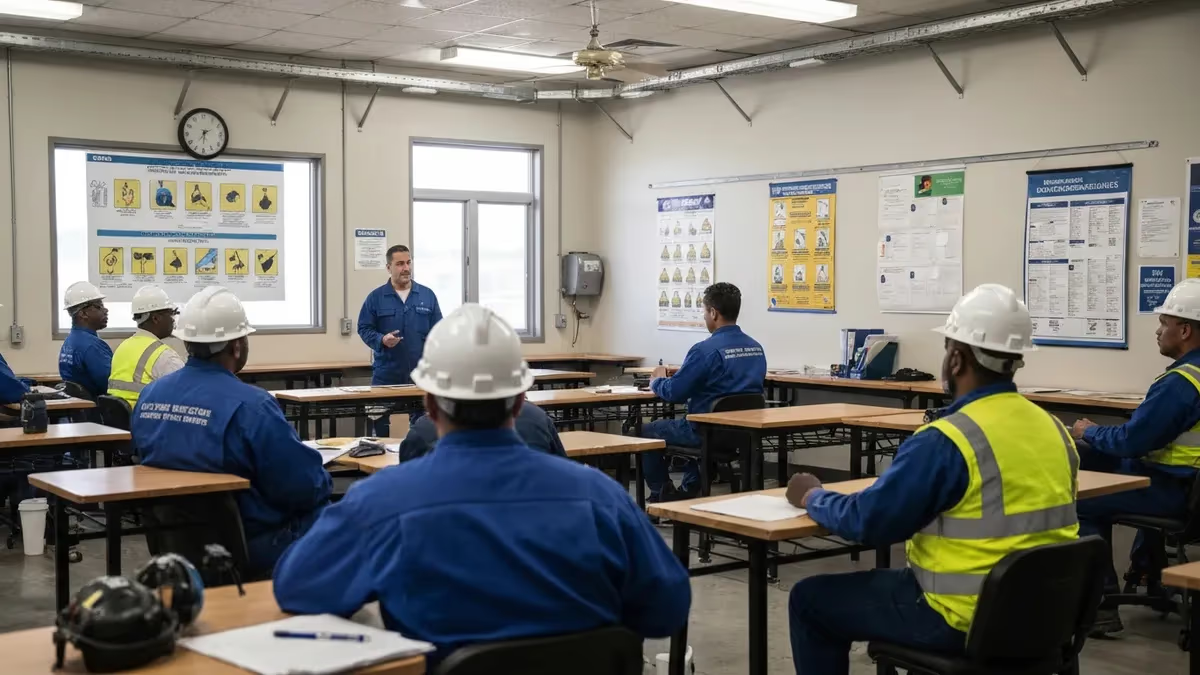
Finding a valid OSHA 30 discount code can meaningfully reduce what you pay for one of the most respected construction and general industry safety credentials in the United States. The OSHA 30-Hour Outreach Training Program typically runs between $179 and $299 depending on the provider, the delivery format, and any promotions currently active.
That price point puts it within reach for most workers, but when employers are training entire crews or individuals are paying out of pocket, every dollar saved matters. This guide breaks down exactly where discounts exist, how to qualify for them, and which providers consistently offer the best pricing.
The OSHA 30 course covers hazard recognition, fall protection, electrical safety, personal protective equipment, and dozens of other topics required by the Department of Labor's Outreach Training Program. Completing it earns you a DOL wallet card that many general contractors and project owners require before you ever set foot on a job site.
Because demand for the credential is high, a competitive market has developed among Authorized Outreach Trainers, and that competition works in your favor when it comes to pricing. Knowing how to compare providers intelligently is half the battle when you are hunting for a osha 30 discount that is actually legitimate.
Online OSHA 30 training has made the comparison-shopping process much easier than it used to be. A decade ago, your only option was a classroom course offered by a local trainer, and you had almost no use on price. Today, major online platforms publish their rates publicly, run seasonal promotions, and offer group pricing tiers that can cut the per-seat cost dramatically. The challenge is sorting the genuinely authorized providers from operators who sell certificates without actually delivering the required 30 hours of OSHA-approved content, which is both a compliance risk and a potential legal liability.
Employer-sponsored training is one of the most overlooked pathways to a discount. Many contractors budget for OSHA training as a standard line item, and employees who ask are often surprised to find that their company will cover part or all of the cost. Some union apprenticeship programs include OSHA 30 training as part of their curriculum at no additional charge to members. State-run workforce development grants in states like New York, California, Texas, and Ohio also subsidize OSHA training for workers in high-hazard industries, effectively delivering the course for free or at sharply reduced cost to qualifying individuals.
Promotional codes distributed through industry associations are another reliable source of savings. Organizations like the Associated General Contractors of America, the National Roofing Contractors Association, and various state building trades councils have negotiated member pricing with online OSHA training vendors. If you belong to any of these groups, checking your member portal or calling the association office before purchasing can unlock discounts of 10 to 30 percent that are not advertised to the general public. The same logic applies to alumni associations at community colleges and technical schools that partner with training providers.
Timing your purchase around major promotional events can also produce real savings. Several online OSHA training providers run sales aligned with National Safety Month in June, Labor Day weekend, and the end of the calendar year when construction budgets reset.
These sales are not always announced far in advance, but following providers on social media or subscribing to their email lists can alert you when a promotion goes live. Some providers also offer a first-time-buyer discount that applies automatically at checkout when you register a new account, so it is worth checking whether you have ever purchased from a given platform before.
Understanding what a legitimate discount looks like helps you avoid scams. A real OSHA 30 discount code reduces the price of a course delivered by a trainer authorized under OSHA's Outreach Training Program. It does not promise a card without coursework, a faster completion time than 30 hours, or a backdated certificate. Any offer that sounds too good to be true almost certainly is, and presenting a fraudulent card to an employer can result in termination, fines, and in some jurisdictions, criminal liability. Stick to recognized platforms and verify authorization status on OSHA's official website before purchasing.
OSHA 30 Training by the Numbers
Key Facts at a Glance
| Item | Value | Details |
|---|---|---|
| Typical OSHA 30 Course Cost | $179–$299 | Online providers, 2026 pricing |
| Required Training Duration | 30 Hours | Minimum per DOL rules |
| DOL Card Validity Period | 5 Years | Before refresher recommended |

Main Sources of OSHA 30 Discounts
Seasonal sales and newsletter-exclusive codes from authorized online providers can reduce the list price by 10 to 25 percent. Subscribe to provider email lists and follow social media accounts to catch time-limited offers before they expire.
Most major platforms offer tiered pricing that drops the per-seat cost when an employer or training coordinator buys five or more seats at once. Purchasing 10 or more seats typically unlocks the deepest available discount from any provider.
Many construction and industrial employers reimburse OSHA training costs in full. Ask your HR department or superintendent before paying out of pocket — budgets for OSHA cards are common and often go unclaimed by employees who never ask.
Several states fund OSHA training through workforce development programs. New York's OSHA Training Institute grant, for example, has historically covered the full cost for qualifying workers. Contact your state labor department to check current availability.
Union apprenticeship programs frequently include OSHA 30 at no additional cost. Industry associations like the AGC and NRCA negotiate member rates with training vendors that are significantly below retail pricing available to the general public.
Comparing OSHA 30 providers is the most straightforward way to ensure you pay a fair price without relying on a promotional code that may or may not be active when you need to enroll. The online training market is competitive, and the spread between the highest and lowest prices for essentially the same DOL-authorized 30-hour course can be more than $100. That gap exists because some providers invest heavily in course quality, customer support, and interface design, while others operate lean platforms with minimal overhead and pass the savings to buyers.
The largest authorized online providers in the United States include 360training, OSHA Education Center, and MySafetySign, among others. Each publishes base prices on its website, and most have a checkout flow that accepts promotional codes. Comparing their current list prices before searching for a discount code tells you which platform offers the best starting point. A 20 percent discount off a $299 course costs more than buying a $200 course at full price, so the math matters and the base price is your most important variable.
Course quality differences between providers are real but often less significant than they appear. All authorized providers must deliver the same core content mandated by OSHA's Outreach Training Program standards. The differences show up in how that content is presented — video length, quiz frequency, mobile compatibility, and whether a live instructor is available for questions. For most workers, an affordable self-paced online course delivers everything needed to earn the DOL card and develop genuine hazard-recognition skills. Paying a premium for a more polished platform is a personal choice, not a compliance requirement.
Completion time rules are another factor to understand when comparing providers. OSHA's regulations require that the 30-hour course be completed over a minimum of two days when delivered in person, but online courses have more flexible pacing rules — typically allowing completion over a period ranging from 30 days to 180 days depending on the platform. If you need your card urgently for a job that starts soon, check the provider's stated completion timeline and DOL card processing time before purchasing, regardless of what discount code is available.
Customer reviews provide useful signal about which providers actually deliver what they advertise. Look specifically for reviews that mention the DOL card arrival time, the responsiveness of customer support, and whether the course content was genuinely educational versus a mechanical click-through exercise. Platforms with strong reviews in those categories tend to be worth a small premium over bare-bones competitors. Reading a dozen recent reviews on Google or Trustpilot takes five minutes and can save you real frustration if you pick a provider that takes three months to deliver your wallet card.
Payment options and refund policies are worth reviewing before finalizing your purchase. Most reputable providers offer a full refund within 24 to 72 hours of purchase if you have not yet started the course. Some offer credit toward other courses rather than a cash refund after the course has begun. Understanding the policy before you buy protects you if your employment situation changes, if you discover the platform does not work well on your device, or if a better discount emerges from a different provider shortly after you enroll.
Bundle deals that package the OSHA 30 with the OSHA 10 or with other certifications like First Aid/CPR or a Competent Person course represent a different category of savings worth considering. If you know you will need multiple credentials in the next year, buying them together often costs significantly less than purchasing each separately. Some providers offer bundled packages at a fixed price that works out to 30 to 40 percent below the combined individual prices, making the bundle a better deal than any single-course discount code you are likely to find.
OSHA 30 Discount Strategies by Buyer Type
If you are paying for OSHA 30 training out of your own pocket, your best strategy is to combine a base-price comparison across two or three authorized providers with an active promotional code search. Start by checking whether the provider offers a new-account discount at checkout registration, as many platforms apply a 10 to 15 percent first-purchase reduction automatically. Then search for the provider name plus the word coupon in your browser to surface any active codes published on deal-aggregator sites or the provider's own promotions page.
Timing also works in your favor as an individual buyer. Providers frequently run short sales during National Safety Month in June, around Labor Day, and during the holiday period in November and December. If your training timeline is flexible by even a few weeks, waiting for one of these windows can save $30 to $60 on a typical online course. Signing up for a provider's email list at least a month before you plan to enroll gives you enough lead time to catch a promotion and still complete the 30-hour course before your job-site deadline.
Is Hunting for an OSHA 30 Discount Code Worth Your Time?
- +Legitimate codes can save $30–$75 on a single course purchase with minimal search effort
- +Group pricing from employers can cut per-seat cost by up to 30 percent for crew training
- +State grants can cover 100 percent of training costs for qualifying workers
- +New-account discounts are often automatic and require no code at all
- +Seasonal sales run predictably, making it easy to time a purchase for savings
- +Bundle deals combining multiple certifications deliver the best overall value per credential
- −Many discount codes found online are expired, fake, or tied to unauthorized providers
- −Chasing a coupon can delay enrollment and push your job-site start date
- −Cheapest providers may have slower DOL card delivery times of 4 to 8 weeks
- −Grant applications require paperwork and processing time that may not fit urgent timelines
- −Group discount savings only appear when buying five or more seats simultaneously
- −Some promotional codes are provider-specific and require switching platforms mid-research
OSHA 30 Discount Checklist — Steps Before You Buy
- ✓Confirm the provider is an OSHA-authorized Outreach Training Program trainer before comparing prices.
- ✓Check the provider's current base price on its official website and note it for comparison.
- ✓Search for a first-time-buyer or new-account discount at the checkout registration step.
- ✓Search the provider name plus the word coupon in your browser to find active promotional codes.
- ✓Ask your employer's HR or safety department whether the company reimburses OSHA 30 training.
- ✓Contact your union hall or trade association to ask about negotiated member pricing.
- ✓Check your state labor department's website for workforce development grants covering OSHA training.
- ✓Subscribe to two or three provider email lists at least 30 days before your planned enrollment date.
- ✓Compare the DOL card delivery timeline — not just price — because delays can affect job-site start dates.
- ✓Read recent customer reviews specifically for card delivery time and customer support responsiveness before finalizing your choice.
The Best OSHA 30 Deals Run in June and November
National Safety Month in June and the holiday promotional period in late November consistently produce the deepest discounts from authorized online OSHA training providers. Workers with flexible enrollment timelines who plan purchases around these windows regularly save $40 to $75 compared to buying at a random time of year. Set a calendar reminder and join provider email lists at least four weeks before your target enrollment date to make sure you catch the promotion before seats or codes sell out.
Avoiding scams is the most important aspect of the OSHA 30 discount search that most guides underemphasize. The demand for affordable safety training has created a market for fraudulent providers who sell certificates, completion cards, or even fake DOL wallet cards without delivering any actual training. These operations advertise heavily using search ads and social media, often targeting workers who search for the lowest possible price. The consequences of presenting a fraudulent OSHA card to an employer or on a public construction project can range from immediate termination to federal fines under 29 CFR Part 1926 or Part 1910.
The single most reliable fraud prevention tool available to you is OSHA's official list of Authorized Outreach Training Program trainers and training sponsors. This list is maintained on OSHA's website and is updated regularly. Any provider not appearing on that list is not authorized to issue DOL wallet cards, regardless of what their website claims. Before purchasing from any provider you have not used before, spend 60 seconds verifying their authorization status. This one step eliminates the vast majority of fraudulent operators from consideration.
Red flags that indicate a fraudulent or non-compliant OSHA training provider include promises to complete the 30-hour course in significantly less than 30 hours, guarantees of a card before you begin the course, prices dramatically below the market range of $150 to $299, and an absence of any information about the trainer's OSHA authorization credentials. Legitimate providers cannot legally issue a DOL card for a course completed in fewer hours than required, and none of them guarantee a passing outcome before training begins because the course is educational, not merely transactional.
Social media discount advertisements for OSHA training deserve particular scrutiny. Some legitimate providers run paid social campaigns with genuine promotional codes, but fraudulent operators also use the same channels to reach workers who are unfamiliar with the market. When you see an OSHA training ad on a social platform, do not click through to purchase directly. Instead, note the provider's name, search for them independently, verify their authorization status on OSHA's official site, and then navigate to their website directly to check whether the advertised discount is real and what the actual terms are.
Email phishing campaigns impersonating well-known OSHA training providers have also been reported. These emails mimic the branding of legitimate companies and offer discount codes that link to lookalike websites designed to collect payment information without delivering any training. Verify the sender's email domain carefully — a legitimate provider's communication will come from their actual domain, not a slight variation of it. When in doubt, go directly to the provider's known website rather than clicking email links.
Workers who have already purchased from a fraudulent provider do have some recourse. Credit card chargebacks for services not delivered are available for up to 120 days after purchase with most card issuers. Reporting the fraudulent provider to OSHA's national office and to the Federal Trade Commission creates a paper trail that helps protect other workers. Some state attorneys general have active consumer protection units that pursue OSHA training fraud, particularly when the fraud targets workers in high-risk industries like construction and utilities where the safety card requirement is strictly enforced by general contractors and project owners.
The long-term professional cost of a fraudulent card far exceeds any short-term savings from a too-good-to-be-true discount. General contractors and large project owners increasingly verify OSHA card validity through DOL's online verification system, and a card that fails verification can disqualify you from the project and damage your professional reputation in a trade community that tends to be close-knit. Paying the standard market price for a legitimate course from an authorized provider is the only approach that delivers actual protection both for your career and for your physical safety on the job site.

OSHA does not directly license or endorse any particular online training vendor. Only trainers who have completed OSHA's Outreach Training Program and are sponsored by an OSHA-authorized Training Institute Education Center (OTIEC) may issue official DOL wallet cards. Before using any discount code or purchasing from a provider you have not vetted, confirm their authorization status on OSHA's official trainer search tool. An unauthorized provider's card has no legal standing and could cost you your job or expose your employer to compliance liability.
Maximizing the value you receive from your OSHA 30 investment goes well beyond finding the lowest price at checkout. The 30-hour course covers an extensive range of workplace hazard topics, and workers who engage with the material seriously rather than clicking through as quickly as possible develop genuinely better hazard recognition skills that protect their lives and the lives of their coworkers. Understanding the depth of what the course teaches also helps you appreciate why authorized training costs what it does and why the cheapest possible option is not always the smartest choice.
Planning your study time realistically before you begin the course helps you complete it without rushing. Online OSHA 30 courses allow you to pause and resume, but most platforms require you to complete the course within 30 to 180 days of enrollment, depending on their specific terms. Workers who enroll and then forget about the course until their job-site deadline looms often end up cramming, which produces less genuine learning and more stress. Blocking two to three hours per week over four to five weeks gives you time to absorb the material at a comfortable pace.
Taking notes during the course, even simple ones about topics you find unfamiliar, pays dividends when you are actually on the job site. The OSHA 30 covers topics including scaffolding, struck-by hazards, caught-in and caught-between hazards, electrical safety, fall protection systems, hazard communication, and emergency action plans. Many of these topics have specific numerical thresholds and procedural requirements that are worth memorizing. Workers who retain this information perform better during contractor safety orientations, are more confident asking questions when they observe unsafe conditions, and are better positioned for supervisory and safety roles.
Pairing the online course with free practice quizzes on platforms like PracticeTestGeeks helps reinforce your knowledge of the specific regulations and numerical standards that appear most frequently in OSHA compliance situations. The OSHA 30 does not have a formal final exam with a pass/fail threshold, but the DOL's course evaluation elements do require you to demonstrate understanding of the covered topics. Practice questions help you identify areas where your knowledge is shaky before those gaps show up in a high-stakes situation on a real job site.
After completing your OSHA 30, keep digital copies of your completion certificate in addition to carrying the physical DOL wallet card. Some employers require you to upload documentation to a contractor management system like ISNetworld, Avetta, or Veriforce as part of your pre-qualification process. Having a clear digital copy ready saves time when you are setting up your compliance profile on those platforms. Store the digital copy in cloud storage that you can access from your phone, because you may need to produce documentation quickly when you are already on site.
Budgeting for a refresher or supplemental training every three to five years is a smart career investment even though your DOL card does not technically expire. OSHA updates its standards periodically, and the hazards present in construction and general industry workplaces evolve as new equipment, materials, and work methods are introduced. Workers who stay current with OSHA guidance are more valuable to safety-conscious employers and are better protected against the specific hazards that cause the roughly 1,000 construction fatalities that occur in the United States each year.
Connecting your OSHA 30 credential with additional certifications creates a professional profile that commands higher wages and more desirable assignments. Many workers who complete the OSHA 30 go on to pursue the OSHA 500 or OSHA 502 Outreach Trainer courses, which allow them to teach the OSHA 10 and OSHA 30 courses themselves.
Others add competent person designations in fall protection, scaffolding, excavation, or confined space, each of which addresses a specific high-hazard area covered in the OSHA 30 curriculum. These stacked credentials produce long-term earnings increases that far exceed the original cost of the 30-hour course, making the initial investment look modest regardless of whether you found a discount code at checkout.
Once you have completed your OSHA 30 training and received your DOL wallet card, the practical value of that credential extends well beyond the job site eligibility it provides. Construction workers with the OSHA 30 card consistently report that their understanding of workplace hazards increases their confidence when interacting with safety officers, project managers, and general contractors. They know the language of compliance, they understand what a Job Hazard Analysis is supposed to accomplish, and they can engage meaningfully in toolbox talks rather than simply listening passively. That depth of engagement is visible to supervisors and contributes to career advancement.
The OSHA 30 also matters in the context of incident investigations. When a near-miss or recordable incident occurs on a job site, workers who understand OSHA's incident causation framework and recordkeeping requirements can provide more useful witness accounts and are better positioned to participate constructively in corrective action meetings. Some employers specifically seek out OSHA 30 holders when staffing safety committee positions, and in many jurisdictions, serving on a joint labor-management safety committee is a paid committee assignment in addition to regular duties.
For workers considering a transition into safety management as a career path, the OSHA 30 is typically described as the foundational credential that signals serious interest in the field. Safety managers and EHS coordinators in construction and general industry consistently earn above-average wages — median annual earnings for occupational health and safety specialists exceed $78,000 according to Bureau of Labor Statistics data — and the pathway from journeyperson worker to safety role typically runs through the OSHA 30, the OSHA 500 or 510, and eventually the Certified Safety Professional credential from the Board of Certified Safety Professionals.
Participating in safety leadership at your current employer while you hold the OSHA 30 is one of the most effective ways to build the practical experience that safety management roles require. Volunteering to lead toolbox talks, assist with job hazard analysis development, conduct informal safety walks, or support new employee orientations demonstrates initiative and builds the kind of hands-on safety knowledge that academic credentials alone cannot provide. Employers in safety-conscious industries notice and reward this engagement, often with preferential consideration for openings in safety coordinator and safety manager roles.
The value of the OSHA 30 is also increasingly recognized internationally. While the DOL wallet card is a US-specific credential, major multinational construction and energy companies operating globally recognize OSHA certification as a signal of safety competency. Workers who hold the OSHA 30 alongside internationally recognized credentials like NEBOSH or IOSH certifications are particularly competitive for assignments on large international projects where diverse safety systems and documentation requirements must be navigated simultaneously.
Keeping your knowledge current between formal training cycles is easier than it used to be. OSHA publishes guidance documents, compliance assistance resources, and industry-specific safety and health topics on its official website, all available at no cost. Following OSHA's social media channels and subscribing to its QuickTakes newsletter keeps you informed about regulatory updates, new enforcement priorities, and emerging hazard guidance between formal training events. Workers who stay informed about the regulatory environment are better prepared to identify when their employer's practices have fallen behind current requirements and to raise those concerns constructively through appropriate channels.
Ultimately, the best OSHA 30 discount is one that reduces your out-of-pocket cost without compromising the quality of the training or the legitimacy of the credential you earn. The time you invest in researching authorized providers, comparing prices, checking for group or employer reimbursement options, and vetting any promotional code against OSHA's official trainer database is time well spent. The credential you earn opens doors, protects your livelihood, and may one day protect your life. Making sure it is genuine is always worth the extra effort.
OSHA Questions and Answers

OSHA Approved Safety Glasses: Complete 2026 Guide to ANSI Z87.1 Eye Protection Standards, Selection, and Workplace Compliance

OSHA Lightning Safety: Standards, Rules & Outdoor Worker Protection Guide for 2026

OSHA 10 Hour General Industry: Complete 2026 Guide to Training, Topics, Costs, and DOL Card

Is OSHA a Government Agency? The Federal Body Behind US Workplace Safety

How to Get OSHA Certified: Complete 2026 Guide to Training, Cards & Compliance
About the Author

Certified Safety Professional & OSHA Compliance Expert
Indiana University of Pennsylvania Safety SciencesDr. William Foster holds a PhD in Safety Science from Indiana University of Pennsylvania and is a Certified Safety Professional (CSP) and Certified Hazardous Materials Manager. With 20 years of occupational health and safety management experience across construction, manufacturing, and chemical industries, he coaches safety professionals through OSHA certification, CSP, CHST, and safety management licensing programs.
Join the Discussion
Connect with other students preparing for this exam. Share tips, ask questions, and get advice from people who have been there.
View discussion (8 replies)