
Chicago Nurse Practitioners: NP Jobs Near Me — Complete 2026 October Guide to Finding the Right Role
Chicago nurse practitioners: discover where to find NP jobs near you, salary benchmarks, top employers, and how to land your next role in 2026 October. 🎯
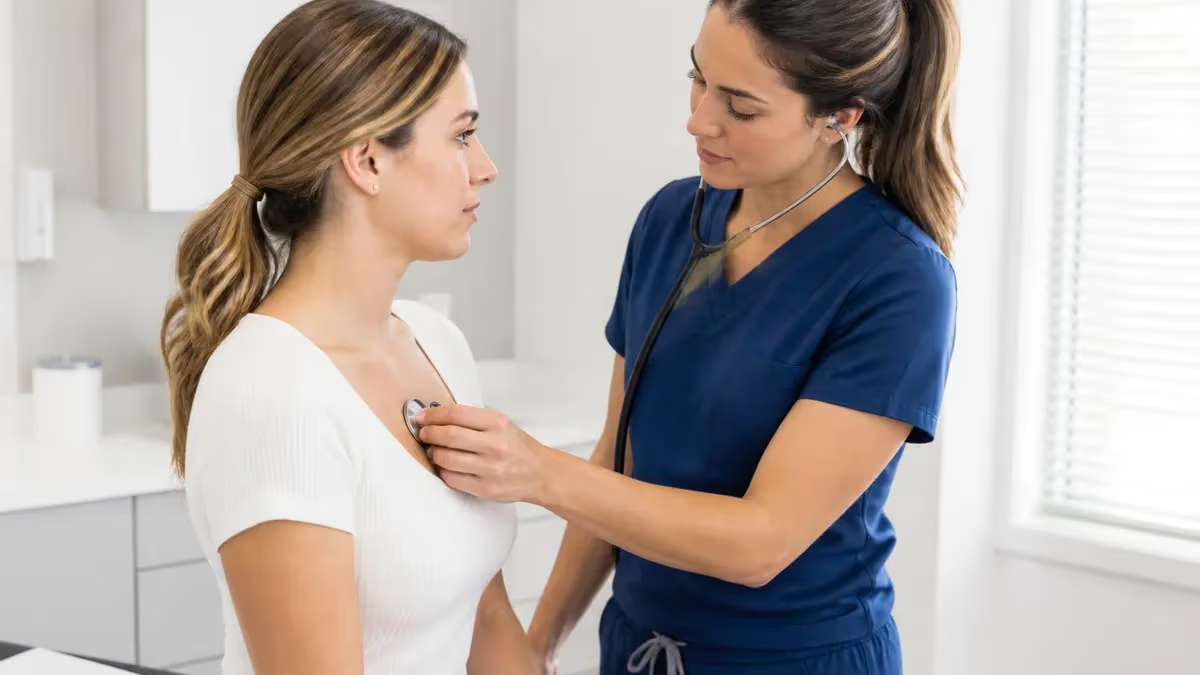
Chicago nurse practitioners occupy one of the most dynamic job markets in the Midwest, and if you are searching for NP jobs near you, the Windy City offers a uniquely deep bench of employers, specialties, and patient populations. From the academic powerhouses lining the Magnificent Mile to community health centers on the South Side, the demand for skilled NPs in Chicago has climbed every year since 2019, and 2026 projections show no sign of cooling. This guide breaks down where the jobs are and how to land one.
Whether you are a new graduate finishing your MSN or an experienced clinician relocating from another state, understanding the local landscape matters. Chicago has more than 35 hospitals, hundreds of urgent care locations, and a growing telehealth sector that hires NPs to serve patients across all 50 states from a Chicago base. The metro area also includes Cook, DuPage, Lake, Will, and Kane counties, expanding the realistic commute radius for any NP willing to drive 30 to 45 minutes outside the Loop.
For NPs searching jobs near me, the most important factor is matching your specialty to the right employer type. Family nurse practitioners thrive in primary care clinics and FQHCs. Acute care NPs find their best opportunities at Northwestern Memorial, Rush, and the University of Chicago Medicine. Psychiatric mental health NPs are in extraordinary demand thanks to ongoing behavioral health shortages, while pediatric NPs anchor pediatric specialty groups at Lurie Children's and across the suburbs.
Salary expectations in Chicago run higher than the Illinois state average, driven by cost of living adjustments and union representation at several major systems. The median NP salary in metro Chicago hovers around $128,000 in 2026, with senior clinicians and specialty NPs commonly clearing $150,000 when bonuses, productivity pay, and retention incentives are included. Read our Nurse Practitioner Jobs by State: Florida, Texas, California, and Beyond — A Complete 2026 Guide for cross-state comparisons.
Beyond pay, Chicago offers exceptional professional development. The city is home to three NP programs ranked in the U.S. News top 50 — Rush, UIC, and Loyola — meaning continuing education, preceptor opportunities, and research collaborations are unusually accessible. Many employers will pay for certifications, fellowships, and DNP coursework as part of retention packages, and the Illinois Society for male nurse practitioner vs physician assistant hosts monthly networking events that consistently generate referrals to unposted roles.
This article walks you through the entire process: where to search, which employers hire most aggressively, salary negotiation strategies, what hiring managers look for in 2026, and how to interview successfully in a market where the best jobs receive 80 to 120 applications within 48 hours of posting. We will cover florida nurse practitioner scope of practice credentialing timelines, telehealth options, and the practical realities of working as an NP in one of America's most diverse healthcare ecosystems.
If you are serious about finding the right NP role in Chicago this year, treat this guide as a workbook. Bookmark the employer list, screen-shot the salary ranges, and use the checklists as you build your application strategy. The Chicago NP job market rewards preparation and decisive action, and the candidates who land the strongest offers are almost always the ones who applied within a week of completing their state license and credentialing paperwork.
Chicago NP Job Market by the Numbers (2026)

Top Chicago NP Employers Hiring in 2026
Eleven-hospital system with strong inpatient and ambulatory NP roles. Known for structured onboarding, tuition assistance, and competitive base pay across 200+ outpatient clinics throughout the Chicago metro area.
Academic medical center with heavy investment in NP-led care models. Offers fellowship pathways for new grads in critical care, hospital medicine, and cardiology, plus generous DNP tuition coverage.
Major South Side employer with high acuity and research-rich roles. Pays at the top of market for AGACNPs and PMHNPs and offers shift differentials that often add $12,000 to $18,000 annually.
Largest Illinois health system after the 2022 Atrium merger. Hires heavily across primary care, urgent care, and specialty clinics in suburbs like Oak Lawn, Park Ridge, and Naperville with predictable schedules.
Mission-driven employers with loan repayment via NHSC. Roles serve underserved populations across Stroger Hospital, Provident, and dozens of community health centers — strong fit for FNPs seeking diverse patient panels.
Salary expectations are the first thing every NP candidate wants to verify, and Chicago compensation runs meaningfully above national medians thanks to cost of living, union density, and the concentration of academic medical centers. Base salaries for full-time NPs in the metro area typically fall between $115,000 and $148,000 in 2026, with the spread driven by specialty, years of experience, employer type, and whether the role is inpatient or outpatient. Senior PMHNPs and acute care NPs frequently command higher numbers.
Productivity-based compensation has become more common in Chicago primary care and specialty groups, with RVU thresholds layered on top of base pay. A common structure is a $125,000 base with bonuses kicking in once an NP exceeds 4,200 to 4,500 work RVUs annually. Top performers in cardiology, dermatology, and gastroenterology routinely earn $30,000 to $60,000 above their base through these structures, although new graduates should be cautious about productivity-only contracts until they understand realistic patient volumes.
Sign-on bonuses returned in force during 2024 and remain strong heading into 2026. Expect $10,000 to $25,000 sign-ons for primary care roles, with critical-need specialties like psych, hospitalist NP, and palliative care offering $30,000 to $50,000 packages tied to two or three-year retention agreements. Read the clawback language carefully — many require full repayment if you leave even a single day before the commitment ends, and a few systems pro-rate gradually starting in year two.
Benefits often add $25,000 to $40,000 of value beyond cash compensation. Most Chicago systems offer 403(b) or 401(k) matching between 4% and 6%, four to six weeks of paid time off, full malpractice coverage including tail, and continuing education stipends of $2,500 to $5,000 per year. Family-friendly benefits including parental leave, fertility coverage, and on-site childcare are increasingly common at the larger academic systems, which is meaningful for early and mid-career NPs balancing growing families.
Geographic micro-variations matter more than candidates expect. NPs working in the Loop or River North often see slightly higher base pay than identical roles in suburban Naperville, but the suburban roles frequently offer free parking worth $4,000 annually, lower patient acuity, and shorter commutes. Hyde Park and the South Side typically pay competitive base salaries plus loan repayment for federally qualified health center positions, and downstate satellite locations sometimes pay rural premiums that surprise candidates.
When you compare offers, normalize them to total annual compensation including base, bonus, benefits value, time off, and retirement match. Two offers with identical $130,000 base pay can differ by $20,000 in real value once you account for these inputs. Many candidates also overlook scheduled cost-of-living adjustments, automatic step increases tied to tenure, and the difference between W-2 employee status and 1099 contractor arrangements at urgent care chains, which carry their own tax implications.
Finally, consider family nurse practitioner programs if you are still choosing a specialty path — FNPs have the broadest employment options in Chicago, and the salary floor is higher than many candidates assume. Whatever your specialty, document every conversation and request offer details in writing before you resign your current position, because verbal commitments do not survive HR audits in large health systems.
NP Practice Test Questions
Prepare for the NP - Nurse Practitioner exam with our free practice test modules. Each quiz covers key topics to help you pass on your first try.
NP Adult-Gerontology Acute Care Nurse Prac...
NP Exam Questions covering Adult-Gerontology Acute Care Nurse Practitioner. Master NP Test concepts for certification prep.
NP Family Nurse Practitioner
Free NP Practice Test featuring Family Nurse Practitioner. Improve your NP Exam score with mock test prep.
NP Pediatric Nurse Practitioner
NP Mock Exam on Pediatric Nurse Practitioner. NP Study Guide questions to pass on your first try.
NP Case Studies & Practical Application
NP Test Prep for Case Studies & Practical Application. Practice NP Quiz questions and boost your score.
NP Communication & Stakeholder Relations
NP Questions and Answers on Communication & Stakeholder Relations. Free NP practice for exam readiness.
NP Diagnosis & Clinical Decision-Making
NP Mock Test covering NP Diagnosis & Clinical Decision-Making. Online NP Test practice with instant feedback.
NP Patient Education & Health Promotion
Free NP Quiz on NP Patient Education & Health Promotion. NP Exam prep questions with detailed explanations.
NP Pharmacology & Prescribing
NP Practice Questions for NP Pharmacology & Prescribing. Build confidence for your NP certification exam.
NP Professional Standards & Competencies
NP Test Online for Professional Standards & Competencies. Free practice with instant results and feedback.
NP Quality Control & Assurance
NP Study Material on Quality Control & Assurance. Prepare effectively with real exam-style questions.
NP Regulatory Frameworks & Compliance
Free NP Test covering Regulatory Frameworks & Compliance. Practice and track your NP exam readiness.
NP Research & Evidence-Based Practice
NP Exam Questions covering Research & Evidence-Based Practice. Master NP Test concepts for certification prep.
Where to Search NP Jobs Near Me in Chicago
Indeed, LinkedIn, and Health eCareers carry the majority of active Chicago NP postings, but they are also the most saturated. Set up alerts using specific specialty terms like AGACNP, PMHNP, or FNP rather than generic NP searches, and filter by distance to capture suburban roles. The best applicants apply within 48 hours of a posting going live, and recruiters consistently report that the first ten résumés receive disproportionate attention.
Specialty boards add meaningful coverage that general sites miss. PracticeMatch, NP Now, and AANP CareerLink frequently list roles before they appear on Indeed, and ENP Network is strong for emergency-focused candidates. Chicago Medicine Career Pages, posted directly on hospital websites, often skip the major aggregators entirely and reach applicants two to three weeks earlier — bookmark the careers page of every system you would consider working for.

Working as a Chicago Nurse Practitioner: Pros and Cons
- +Competitive metro salaries averaging $128,000 with strong benefits
- +Deep employer market with 35+ hospitals and hundreds of clinics
- +Access to top-ranked academic medical centers and fellowships
- +Diverse patient populations supporting clinical skill development
- +Strong professional networks through ISAPN and AANP Illinois chapter
- +Strong public transit and walkable neighborhoods reduce commute stress
- +Loan repayment opportunities at FQHCs and Cook County Health
- −High cost of living, especially in North Side neighborhoods
- −Illinois remains a reduced-practice authority state in 2026
- −Winter weather adds commute challenges from November to March
- −Competition is fierce — popular roles get 80+ applications in 48 hours
- −Some health systems require non-compete agreements within metro radius
- −State income tax of 4.95% plus Cook County property tax pressures
- −Credentialing timelines run 60-90 days, slowing start dates
Pros and Cons at a Glance
| Pros | Cons |
|---|---|
| Access to top-ranked academic medical centers and fellowships | High cost of living, especially in North Side neighborhoods |
| Diverse patient populations supporting clinical skill development | Winter weather adds commute challenges from November to March |
| Strong professional networks through ISAPN and AANP Illinois chapter | Some health systems require non-compete agreements within metro radius |
Chicago NP Job Application Checklist
- ✓Verify your Illinois APRN license is active or initiate application 90 days before your target start date
- ✓Update your CV to two pages with quantified outcomes and Chicago-relevant clinical experience
- ✓Build a LinkedIn profile that highlights specialty certifications, fellowships, and patient population expertise
- ✓Set up daily job alerts on Indeed, LinkedIn, Health eCareers, and at least three hospital career pages
- ✓Compile three professional references including at least one preceptor or supervising physician
- ✓Draft a cover letter template that you customize per application within 15 minutes
- ✓Request copies of every certification, transcript, and licensure document for credentialing packets
- ✓Practice common NP interview questions and prepare two clinical case examples to share verbally
- ✓Research salary benchmarks for your specialty using MGMA, AANP, and Glassdoor for negotiation prep
- ✓Confirm malpractice coverage details, especially whether tail insurance is included in any offer you accept
Apply Within 48 Hours of Posting
Chicago NP job postings receive the majority of qualified applications within the first two business days. Recruiters typically build their interview shortlist from the first 15 to 25 applicants, regardless of how long the posting remains open. Set up real-time alerts and prepare materials in advance so you can submit a fully tailored application within hours, not days.
Interview success in Chicago NP roles comes down to clinical specificity, cultural fit, and demonstrating that you understand the patient population you will serve. Hiring managers consistently report that the strongest candidates open with a 60 to 90 second professional summary that names their specialty certification, total clinical hours, two or three signature patient populations, and one concrete outcome they are proud of. Generic answers about teamwork and passion lose ground to candidates who quantify their clinical experience.
Expect a multi-round process at any major Chicago system. The typical sequence is a 30-minute phone screen with a recruiter, a 45-60 minute virtual interview with the hiring manager, an in-person panel including at least two NPs and one physician, and a final conversation with the medical director or department chief. The full cycle runs three to five weeks, although urgent specialty needs can compress to a week when the system has approved expedited hiring authority for that role.
Behavioral questions dominate the interview content. Be ready to describe how you handled a deteriorating patient, navigated disagreement with a physician, advocated for an underserved patient, and managed a near-miss or actual adverse event. The STAR framework — Situation, Task, Action, Result — works well, but only if your Result includes specific data: time to intervention, length of stay reduction, patient satisfaction improvement, or another measurable outcome. Vague resolutions land flat with experienced panels.
Clinical scenarios are increasingly part of NP interviews in Chicago. Hospitalist and acute care roles often present a case vignette with deteriorating vital signs and ask you to walk through your differential, immediate interventions, and consult triggers. PMHNP candidates frequently receive safety assessment scenarios involving suicidality or psychosis. Practice these out loud with a colleague or mentor — a written answer reads completely differently than a verbal explanation under interview pressure, and pacing matters as much as content.
Cultural fit questions reveal a lot about an organization. Ask about staffing ratios, how the team handles overflow days, the relationship between NPs and physicians, who covers your patients during PTO, and how performance reviews work. Strong answers from the employer side include concrete numbers, named NP leaders, and references to recent team wins. Vague or defensive answers should raise concerns — turnover in clinic environments often correlates with leadership styles that resist transparency about workload and support structures.
Negotiation in Chicago favors candidates who have multiple offers, document everything, and ask politely but firmly for what they want. The most successful negotiation framework anchors on total compensation, not base salary alone. Most large systems have a defined salary band for each NP role, but they can move on sign-on bonus, CE allowance, PTO accrual rate, scheduled raises, and tuition reimbursement caps. Private practice and specialty groups have meaningfully more flexibility on base pay and productivity formulas.
Always wait for a written offer before resigning your current position. Even well-intentioned verbal commitments fall through when HR runs final approvals or budget cycles change. Read the contract carefully for non-compete radius, weekend and call expectations, malpractice details including tail, and any clawback language tied to bonuses. If anything seems unclear, request a 24 to 48 hour review window and consider having a healthcare contract attorney review the agreement — a $400 attorney review often catches issues worth tens of thousands of dollars over a multi-year commitment.

Illinois enforces reasonable non-compete agreements for healthcare professionals. Some Chicago employers include 10 to 25-mile radius restrictions lasting 12 to 24 months after termination. Negotiate the radius, duration, and definition of competing employment before signing, and ensure exceptions exist for academic appointments and locum work outside the metro area.
Telehealth has fundamentally reshaped what NP jobs near me actually means in Chicago. By 2026, roughly 28 percent of NP postings in the metro area include some virtual component, ranging from fully remote roles serving multi-state patient panels to hybrid models that mix in-person and video visits. This shift creates genuine flexibility for NPs balancing childcare, continuing education, or commute distance from suburban homes — but it also raises new clinical and licensing considerations worth understanding before accepting an offer.
Pure telehealth employers based in or hiring through Chicago include Teladoc, Hims, Talkiatry, Brightside, and a growing list of niche platforms focused on weight management, menopause, dermatology, and chronic disease. Compensation models vary widely — some pay per visit at $25 to $45 per consult, others offer base salaries between $110,000 and $135,000 with productivity expectations. Read the patient volume requirements carefully, because expectations of 30 to 40 visits per shift create burnout risks even from a home office.
Multi-state licensure matters enormously for telehealth NPs. The Nurse Licensure Compact covers RN licensure across 41 states, but the APRN Compact for nurse practitioners is still in early adoption with only a handful of states active in 2026. This means most telehealth roles require NPs to maintain individual state licenses for every state where they see patients. Employers vary in whether they reimburse the licensing costs and time, which can add up quickly when each state license costs $150 to $400 and takes 60 to 120 days to process.
Hybrid roles offer some of the best work-life balance in Chicago healthcare. A common configuration is three days in-clinic and two days remote, allowing NPs to maintain in-person continuity with chronic patients while reducing commute time. Several Northwestern Medicine and Advocate outpatient practices have adopted this model permanently, and patient satisfaction scores have remained stable or improved compared to fully in-person care. For NPs caring for young children or elderly parents, hybrid scheduling can be a deciding factor between similar offers.
Compare specialty options across the country in our Nurse Practitioner Specialties: Complete 2026 Guide to Every NP Track if you are exploring whether to pivot specialties before your next role. Some Chicago NPs use telehealth as a bridge — taking a remote per-diem position in a new specialty while completing post-graduate certificate coursework, then transitioning to a full-time clinic role once they have built case experience and a portfolio of letters of recommendation from supervising physicians.
Tax implications of remote NP work surprise many candidates. If you live in Chicago but provide care to patients in Wisconsin or Indiana, you may owe taxes in both states unless reciprocity agreements apply. Engage a CPA familiar with multi-state professional licensure if you plan to work for a national telehealth company, because the difference between proper structuring and accidental over-withholding can exceed $5,000 per year for higher-earning NPs working across three or more states from their Chicago home base.
Finally, evaluate the technology stack before accepting any telehealth role. Reliable platforms include Doxy.me, Amwell, and proprietary systems at major health networks, but smaller startups sometimes operate on platforms that drop calls, struggle with audio quality, or lack proper integration with prescription monitoring programs. A 15-minute platform demo before signing the contract can reveal whether the company has invested in the infrastructure required for safe, efficient clinical work.
Practical preparation in the final weeks before your Chicago NP job search makes the difference between three weeks and three months of searching. Start by auditing your digital presence. Recruiters will Google your name within minutes of opening your application, and a clean LinkedIn profile with current certifications, a professional photo, and recent activity demonstrating clinical engagement signals that you take your career seriously. Remove or privatize personal social media content that does not align with your professional image.
Build a credentialing portfolio before you start applying. Scan your nursing diploma, MSN or DNP transcript, ANCC or AANP certification, BLS, ACLS, PALS as applicable, immunization records, OSHA training certificates, every state license you hold, and your DEA registration. Save them in a clearly labeled cloud folder so you can email any document to a credentialing specialist within an hour of request. Slow document retrieval is the most common cause of delayed start dates in Chicago NP hires.
Network deliberately in the four to six weeks before submitting applications. Attend at least one Illinois Society for male nurse practitioner vs physician assistant Nursing event, message five to ten Chicago NPs in your specialty through LinkedIn, and reach out to former classmates who landed roles at your target employers. Most Chicago NP job offers come either through formal applications or through a colleague's referral — the candidates who land their preferred roles fastest typically have both pipelines running simultaneously rather than relying on only one channel.
Practice your salary negotiation script out loud. Saying numbers in your head is completely different from saying them to a recruiter over the phone. Rehearse phrases like "Based on my specialty experience and the role requirements, I was hoping we could land closer to $138,000 base with a $20,000 sign-on" until they feel natural. Confidence in delivery matters as much as the actual number — hiring managers respect candidates who articulate their value clearly without aggression or apology.
Prepare two questions for every interview round that demonstrate you have researched the organization and care about the role. Strong examples include asking about NP-physician collaboration models, productivity expectations during the first 90 days, mentorship structures for new hires, how the team handles overflow patient volume, and what the previous person in this role moved on to do. Weak questions like "What are your benefits?" or "How much vacation do I get?" should wait until after an offer is extended.
Plan your first 90 days in advance. Even before you accept an offer, sketch out how you will introduce yourself to colleagues, set up your patient panel, identify your clinical mentors, and establish a productivity rhythm. New NPs who arrive on day one with a structured plan tend to integrate faster, build referral relationships earlier, and reach independent productivity targets two to three months sooner than peers who treat the first quarter as orientation only. Your future performance reviews start the moment you walk through the door.
Finally, take care of yourself during the search. Job hunting is psychologically demanding, especially when desirable roles require multiple interviews and references. Block dedicated application hours rather than letting the search bleed into every evening. Celebrate small wins like phone screens and informational interviews even when offers remain weeks away. Chicago has thousands of NP roles opening every year, and the right one for your specialty, schedule, and salary expectations is out there — disciplined effort and patience will find it.
Sample NP - Nurse Practitioner Practice Questions
Try these questions from our free NP - Nurse Practitioner practice tests. The correct answer and an explanation follow each question.
A 22-year-old woman presents with sudden-onset right lower quadrant pain that began periumbilically and migrated, anorexia, and a fever of 38.4°C. WBC is 14,200/μL with a left shift. Which physical exam finding most supports the diagnosis of acute appendicitis?
- A. Murphy's sign — inspiratory arrest with RUQ palpation
- B. Rovsing's sign — RLQ pain with LLQ palpation
- C. Cullen's sign — periumbilical ecchymosis
- D. Grey Turner's sign — flank ecchymosis
Answer: B. Rovsing's sign — RLQ pain with LLQ palpation
Rovsing's sign is positive when palpation of the left lower quadrant produces pain in the right lower quadrant, suggesting peritoneal irritation at the appendix.
Which clinical finding best differentiates cardiogenic shock from distributive (septic) shock?
- A. Elevated lactate
- B. Warm extremities with bounding pulses
- C. Cool clammy skin with elevated SVR and low CO
- D. Fever and leukocytosis
Answer: C. Cool clammy skin with elevated SVR and low CO
Cardiogenic shock is characterized by cool, clammy skin with elevated systemic vascular resistance and low cardiac output, unlike septic shock which presents with warm skin and low SVR.
A 10-year-old with known sickle cell disease presents with severe headache and right-sided weakness. What is the immediate priority?
- A. Morphine for pain crisis management
- B. Exchange transfusion and neuroimaging
- C. High-dose hydroxyurea
- D. IV fluids and supplemental oxygen only
Answer: B. Exchange transfusion and neuroimaging
Acute stroke in sickle cell disease requires emergent exchange transfusion to rapidly reduce HbS percentage and neuroimaging to confirm the diagnosis and guide care.
Which finding on a knee examination is most consistent with an anterior cruciate ligament (ACL) tear?
- A. Positive McMurray test
- B. Positive Lachman test with loss of firm endpoint
- C. Positive patellar apprehension test
- D. Positive valgus stress test at 30 degrees
Answer: B. Positive Lachman test with loss of firm endpoint
The Lachman test, which demonstrates anterior tibial translation without a firm endpoint, is the most sensitive physical examination test for ACL injury.
NP Questions and Answers

Nurse Practitioner Jobs by State: Florida, Texas, California, and Beyond — A Complete 2026 Guide

Nurse Practitioner Day: Honoring NPs and Celebrating the Profession in 2026
Nurse Practitioner Specialties: Complete 2026 Guide to Every NP Track

Family Nurse Practitioner: Role, Salary & How to Become One

Nurse Practitioner Degree: Complete Guide to NP Education Path
About the Author

Registered Nurse & Healthcare Educator
Johns Hopkins University School of NursingDr. Sarah Mitchell is a board-certified registered nurse with over 15 years of clinical and academic experience. She completed her PhD in Nursing Science at Johns Hopkins University and has taught NCLEX preparation and clinical skills courses for nursing students across the United States. Her research focuses on evidence-based exam preparation strategies for healthcare certification candidates.