
Best Nurse Practitioner Schools: How to Choose the Right NP Program in 2026 September
📝 Find the best nurse practitioner schools for your career goals. Compare accreditation, specialties, costs, and what makes top NP programs stand out in 2026 September.
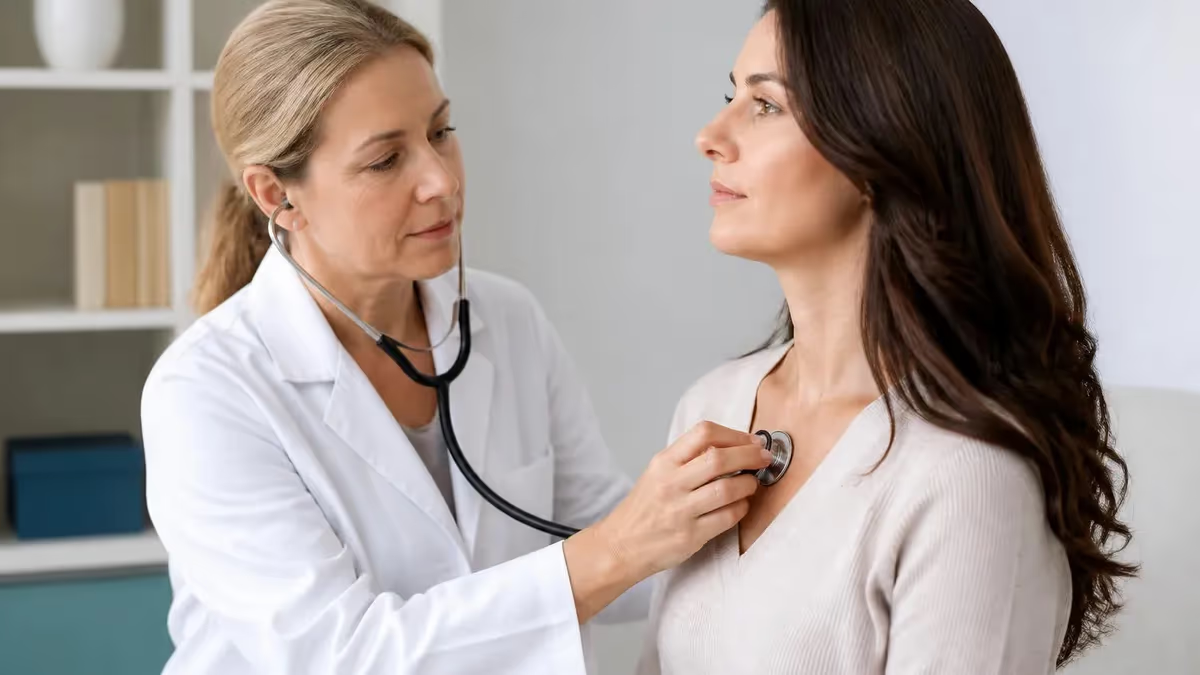
Choosing among the best nurse practitioner schools is one of the most consequential decisions you will make on your path to becoming an NP. The program you select shapes the clinical hours you accumulate, the certifications you can pursue, and the salary you command the moment you pass your boards. With more than 400 accredited NP programs operating across the United States today, the landscape can feel overwhelming — but a clear framework makes the decision far more manageable than it appears at first glance.
Nurse practitioner programs vary enormously in format, cost, clinical placement support, and specialty tracks. Some universities embed students in affiliated hospital systems from day one, while others rely on students to secure their own clinical sites. Some programs run entirely online with weekend intensives, whereas traditional campus-based schools require weekly on-site attendance. Understanding what each model demands of you — and what it gives back — is the first step toward identifying which program actually fits your life and your career ambitions.
Accreditation is the non-negotiable baseline. Every NP program you seriously consider must hold accreditation from either the Commission on Collegiate Nursing Education (CCNE) or the Accreditation Commission for Education in Nursing (ACEN). Without one of these stamps of approval, your degree may not qualify you to sit for national certification exams, and many state licensing boards will reject your application outright. Always verify accreditation status directly on the CCNE or ACEN website before investing a single dollar in applications.
Beyond accreditation, faculty credentials matter enormously. Programs staffed by board-certified NPs who maintain active clinical practices bring real-world currency to their teaching. Look at faculty CVs on program websites and check whether instructors hold advanced practice experience in the specialty you want to pursue. A pharmacology professor who has prescribed medications as an FNP for fifteen years teaches that subject very differently from someone whose experience is purely academic.
Clinical placement support has become a major differentiator among NP programs over the past decade. Students at programs with robust preceptor networks report spending less time scrambling to find placements and more time developing clinical competency. Ask admissions offices point-blank: does the program guarantee clinical placements, or is that the student's responsibility? The answer tells you a great deal about how the institution values your success versus its enrollment numbers.
Pass rates on national certification exams — the ANCC or AANP exams depending on your specialty — are published annually and should factor heavily into your evaluation. Top programs routinely post first-time pass rates above 90 percent. A program hovering near the national average of around 80 percent may still be worth considering, but you should ask what board preparation resources it provides, whether it runs dedicated NCLEX-style practice testing, and how it tracks student readiness before the exam date arrives.
Cost is real, and it deserves an honest look. Tuition for NP programs ranges from roughly $18,000 at in-state public universities to over $80,000 at private institutions. Factor in fees, textbooks, clinical equipment, and lost income if you reduce clinical hours during school. Many students finance graduate nursing education through federal loans, employer tuition assistance, or HRSA scholarships targeting primary care specialties. Mapping your projected total investment against expected NP salary in your target region is not pessimism — it is prudent financial planning that positions you to thrive after graduation rather than struggle under debt.
NP Education by the Numbers
Types of NP Programs Available Today
The most common pathway for registered nurses with a BSN. Typically two to three years full-time, these programs lead to a Master of Science in Nursing with a population focus and qualify graduates to sit for national certification exams.
Doctor of Nursing Practice programs are increasingly preferred by employers and required by some states. A BSN-to-DNP track takes three to four years and culminates in a practice-change capstone project alongside full clinical training.
Designed for nurses who already hold an MSN in a non-NP specialty. Certificate programs add the clinical hours and didactic coursework needed to earn a second population focus certification, often completed in 12 to 18 months.
Fully asynchronous coursework paired with intensive on-campus lab weekends and locally arranged clinical placements. These programs offer maximum scheduling flexibility for working RNs while maintaining hands-on simulation requirements.
Understanding accreditation standards and admission requirements is essential before you spend time preparing an application. Every credible NP program in the United States must be accredited by either the CCNE or the ACEN. These bodies evaluate curriculum rigor, faculty qualifications, clinical hour requirements, student outcomes, and ongoing quality improvement processes. When a program loses accreditation or is placed on probation — which does happen — enrolled students face serious consequences including inability to sit for boards. Verify accreditation status at ccneaccreditation.org or acenursing.org, not on the program's own marketing pages.
Admission requirements across NP programs follow a broadly consistent pattern, though specific thresholds vary. Nearly all programs require an active, unencumbered RN license in your state of residence. Most MSN programs want a minimum of one to two years of clinical experience as an RN, with preference given to applicants who have experience in settings related to their intended specialty. An FNP applicant who spent three years in a busy emergency department or outpatient primary care clinic will have a stronger application than one with exclusively ICU experience, simply because ambulatory care translates more directly to family practice NP work.
GPA expectations tend to cluster around a 3.0 minimum undergraduate science GPA, though competitive programs at major research universities often see incoming cohorts averaging 3.4 or higher. If your undergrad GPA fell short, completing graduate-level science courses and earning strong grades can rehabilitate your transcript. Many programs look at science prerequisites — pathophysiology, pharmacology, health assessment — separately from your overall GPA because these courses predict performance in NP didactics more reliably than introductory humanities coursework.
Letters of recommendation carry more weight in NP admissions than many applicants realize. Admission committees prefer letters from supervising physicians or NPs who can speak to your clinical judgment and patient interaction skills rather than purely academic references. A letter from a collaborating physician who has watched you triage a complex patient panel for two years is far more compelling than three letters from nursing faculty who knew you as a student four years ago. Choose recommenders strategically, give them specific talking points, and provide your resume and personal statement so they can write with precision.
The personal statement is your opportunity to articulate why you are choosing a specific population focus and why this particular program is the right fit. Generic statements that could apply to any school are immediately recognizable to experienced readers. Reference specific faculty research, clinical partnership sites, or curriculum features that align with your goals. If you want to practice in rural primary care, name the program's rural health track or its federally qualified health center partnerships. Specificity signals genuine research and genuine commitment.
GRE requirements have largely disappeared from NP admissions over the past five years. A majority of accredited programs have made the GRE optional or eliminated it entirely, recognizing that RN clinical experience and science GPA predict NP success more reliably than standardized aptitude testing. If a program you are considering still requires the GRE, weigh whether that requirement reflects a genuinely selective culture or simply an outdated policy that has not been reviewed recently — and prepare accordingly if you choose to apply.
International applicants and nurses educated outside the United States face additional hurdles. NCLEX equivalency, English proficiency testing, and credential evaluation through services like CGFNS are typically required before admission. Some states also impose additional endorsement steps before an internationally educated NP can obtain licensure. If your nursing education occurred outside the U.S., begin the credential evaluation process at least a year before your target program start date to avoid delays that could postpone your enrollment by an entire academic cycle.
NP Practice Test Questions
Prepare for the NP - Nurse Practitioner exam with our free practice test modules. Each quiz covers key topics to help you pass on your first try.
NP Adult-Gerontology Acute Care Nurse Prac...
NP Exam Questions covering Adult-Gerontology Acute Care Nurse Practitioner. Master NP Test concepts for certification prep.
NP Family Nurse Practitioner
Free NP Practice Test featuring Family Nurse Practitioner. Improve your NP Exam score with mock test prep.
NP Pediatric Nurse Practitioner
NP Mock Exam on Pediatric Nurse Practitioner. NP Study Guide questions to pass on your first try.
NP Case Studies & Practical Application
NP Test Prep for Case Studies & Practical Application. Practice NP Quiz questions and boost your score.
NP Communication & Stakeholder Relations
NP Questions and Answers on Communication & Stakeholder Relations. Free NP practice for exam readiness.
NP Diagnosis & Clinical Decision-Making
NP Mock Test covering NP Diagnosis & Clinical Decision-Making. Online NP Test practice with instant feedback.
NP Patient Education & Health Promotion
Free NP Quiz on NP Patient Education & Health Promotion. NP Exam prep questions with detailed explanations.
NP Pharmacology & Prescribing
NP Practice Questions for NP Pharmacology & Prescribing. Build confidence for your NP certification exam.
NP Professional Standards & Competencies
NP Test Online for Professional Standards & Competencies. Free practice with instant results and feedback.
NP Quality Control & Assurance
NP Study Material on Quality Control & Assurance. Prepare effectively with real exam-style questions.
NP Regulatory Frameworks & Compliance
Free NP Test covering Regulatory Frameworks & Compliance. Practice and track your NP exam readiness.
NP Research & Evidence-Based Practice
NP Exam Questions covering Research & Evidence-Based Practice. Master NP Test concepts for certification prep.
NP Specialty Tracks: Which Path Fits Your Goals?
The Family Nurse Practitioner track is by far the most popular specialty in the country, accounting for more than 70 percent of all NP students enrolled in accredited programs. FNPs are trained to manage patients across the entire lifespan — from newborn wellness exams through geriatric chronic disease management — making them the most versatile and widely employable NP specialty. Primary care clinics, urgent care centers, rural health networks, and federally qualified health centers all actively recruit FNPs, and the Bureau of Labor Statistics projects 40 percent growth in NP employment through 2033.
FNP programs typically require 500 to 700 supervised clinical hours distributed across diverse patient populations, including pediatrics, reproductive health, adult primary care, and geriatrics. Students should look for programs with clinical partnerships that guarantee exposure to all required populations rather than concentrating placements in a single age group. A well-rounded FNP clinical experience that includes at least 80 to 100 pediatric hours and meaningful geriatric exposure will make you a stronger candidate for positions that demand true lifespan competency.

Public vs. Private NP Programs: What's the Real Difference?
- +Public university tuition is significantly lower for in-state residents, often saving $30,000 to $50,000 over program length
- +Large public research universities offer access to affiliated academic medical centers for elite clinical placements
- +Public programs frequently receive state and federal grant funding that supports student scholarship opportunities
- +Strong alumni networks at established state flagship universities span decades and multiple NP specialties
- +Public programs often have larger cohorts, creating broader peer learning communities and study group options
- +Regional reputation of a state flagship NP program often carries significant weight with local healthcare employers
- −Public programs are often more competitive to enter due to in-state preference policies and limited seat counts
- −Bureaucratic processes at large public universities can slow advising, registration, and financial aid responses
- −Some public programs have not updated curricula as quickly as nimble private institutions in response to DNP trends
- −Geographic constraints mean public program clinical placements may cluster in one region rather than your target practice area
- −Large cohort sizes at public universities can reduce individualized faculty attention during didactic phases
- −Public programs may have longer waitlists for coveted clinical sites due to volume of students needing placements simultaneously
NP School Application Checklist: 10 Steps Before You Submit
- ✓Verify the program holds current CCNE or ACEN accreditation directly on the accrediting body's official website.
- ✓Confirm your RN license is active, unencumbered, and eligible for compact state privileges if the program is in another state.
- ✓Request official transcripts from all undergraduate and graduate institutions you have attended.
- ✓Line up two to three recommenders who can speak to your clinical judgment, ideally supervising physicians or NPs.
- ✓Write a targeted personal statement that names specific faculty, clinical partnerships, or curriculum features of each program.
- ✓Calculate total program cost including tuition, fees, clinical equipment, background checks, and drug screening expenses.
- ✓Research clinical placement policies — confirm whether the program arranges placements or requires you to self-arrange.
- ✓Check program first-time board pass rates on the ANCC or AANP websites for the most recent available year.
- ✓Explore federal HRSA scholarship and loan repayment programs for primary care NP students before completing FAFSA.
- ✓Review state licensure requirements for your intended practice state to ensure the program satisfies all clinical hour mandates.
Board Pass Rate Is the Single Most Predictive Quality Metric
Among all the data points you can gather about an NP program — faculty credentials, tuition, rankings, student reviews — first-time board pass rate is the most direct measure of whether the program actually prepares graduates for clinical practice. Anything consistently above 90 percent signals strong curriculum alignment with board competencies. Request specialty-specific pass rate data, not just an aggregate figure, to ensure your population focus is well represented.
Cost is one of the most emotionally charged and practically important factors in choosing an NP program, yet many applicants approach it with less rigor than they apply to evaluating curriculum or faculty credentials. The full cost of an NP education extends well beyond published tuition rates. Mandatory fees, simulation lab access charges, background check and drug screening costs, clinical uniform requirements, professional liability insurance, travel to clinical sites, and lost income from reduced work hours can add 20 to 30 percent to the sticker price you see on an admissions webpage. Build a comprehensive budget before you compare programs.
In-state tuition at public universities remains the gold standard for cost-conscious NP students. Programs at state flagships like the University of North Carolina, Ohio State University, and the University of Washington have long offered strong clinical training at a fraction of the cost charged by private institutions.
The trade-off is occasionally more competitive admissions and sometimes less flexible scheduling — but for students who can attend a local public program, the financial advantage is often decisive. A $25,000 public MSN and a $75,000 private MSN can deliver comparable clinical training if both programs are CCNE-accredited and post strong board pass rates.
HRSA scholarship and loan repayment programs represent one of the most underutilized financial resources available to NP students. The National Health Service Corps (NHSC) Scholarship Program covers tuition, fees, and a living stipend in exchange for service in a Health Professional Shortage Area after graduation. The NHSC Loan Repayment Program offers up to $50,000 in loan repayment for two years of service. For students open to practicing in rural or underserved communities — which is also where NP employment opportunities are often most abundant — these programs can dramatically alter the financial calculus of NP education.
Employer tuition assistance is another avenue that many working RNs fail to fully exploit. Large health systems increasingly offer tuition reimbursement of $5,000 to $15,000 per year for employees pursuing advanced practice degrees, recognizing that growing their own NPs reduces recruitment costs and improves staff retention. Some health systems have developed formal partnerships with specific NP programs, streamlining the tuition assistance process and sometimes guaranteeing clinical placement at system-affiliated sites. If you work for a large employer, speak with your HR department before applying anywhere — the right employer partnership can dramatically reduce out-of-pocket costs.
Federal student loans for graduate nursing education come with more favorable terms than many applicants expect. Graduate PLUS loans cover the full cost of attendance minus other financial aid and carry fixed interest rates set annually by Congress.
Income-Driven Repayment plans cap monthly payments at a percentage of discretionary income, and Public Service Loan Forgiveness (PSLF) eliminates remaining federal loan balances after 120 qualifying monthly payments for NPs who work for nonprofit or government employers. Given that most NPs eventually work for hospital systems or public health agencies, PSLF is a realistic pathway — not a long shot — and should factor into how you structure borrowing.
Return on investment calculations for NP education are generally favorable compared to most other graduate professional degrees. An NP earning $120,000 annually who borrowed $60,000 for graduate education will recoup that investment in roughly three years at a modest repayment pace.
Specialty and geography shift the math significantly: a PMHNP in a rural NHSC-eligible community may repay loans through service while earning $135,000 or more, whereas an FNP in an oversaturated urban market may face more moderate starting salaries and higher competition. Research average NP salaries in your specific target region using BLS occupational employment data or surveys from the American Association of Nurse Practitioners.
Scholarship opportunities specific to nursing graduate education include foundation awards from the American Nurses Foundation, the Nurses Educational Funds, and numerous state-level nursing associations. These awards typically range from $2,500 to $10,000 and require an application essay. They are not lottery tickets — they reward students who articulate clear, compelling career goals and can demonstrate financial need. Apply broadly, apply early, and keep a spreadsheet of deadlines. Cumulative scholarship income of $15,000 to $25,000 over a two-year program is achievable for diligent applicants and meaningfully reduces total borrowing.

Not all NP programs satisfy every state's licensure requirements. Some states mandate specific minimum clinical hour counts, require pharmacology coursework to be completed in-person, or impose additional supervised practice hours before granting full practice authority. If you plan to practice in a state different from where your NP program is located, verify that your program's curriculum meets that state's Board of Nursing requirements before accepting admission — not after graduation.
The debate between online and on-campus NP programs has intensified as hybrid delivery has become the norm rather than the exception. Very few programs today are entirely in-person, and very few are entirely asynchronous. The real question is not online versus on-campus but rather how much flexibility does a given program actually offer, and does that flexibility come at the cost of educational quality or clinical preparation? The honest answer is nuanced: the format is less important than the specific program's implementation of it.
Online NP programs offered by established, CCNE-accredited universities have produced thousands of highly competent NPs over the past fifteen years. The key to online program success is self-discipline and proactive engagement. Students who thrive in online NP programs tend to be organized self-starters who schedule study time the way they schedule clinical shifts — with firm boundaries and consistent follow-through. Students who rely on the physical classroom environment to stay accountable often struggle in asynchronous formats and should consider whether a hybrid program with required on-site sessions would serve them better.
Simulation lab requirements are where many online programs require in-person attendance, and this is appropriate. Skills like advanced physical assessment, procedural competency, and clinical reasoning under observation cannot be fully developed through video-based content alone. Programs that host weekend or week-long simulation intensives several times per year provide meaningful hands-on training while preserving weekday flexibility for working nurses. Evaluate simulation lab quality by asking specifically about faculty-to-student ratios during intensives, the technology available (high-fidelity manikins, standardized patients), and how simulation hours count toward total clinical requirements.
Geographic flexibility is the primary genuine advantage of online NP programs. A nurse in rural Montana or suburban Louisiana who cannot relocate for graduate school gains access to nationally recognized programs without uprooting her family or leaving her current RN position. This access has meaningfully expanded the NP pipeline in regions facing severe provider shortages.
The tradeoff is that online students in remote areas often face the steepest challenges arranging clinical placements, particularly if the program does not provide placement assistance. Research this explicitly: does the program have established preceptor relationships in your area, or will you be making cold calls to local NPs hoping someone will agree to supervise you?
On-campus programs offer different advantages that matter significantly for certain students and career goals. Direct, real-time interaction with faculty and peers builds the kind of collegial relationships that fuel career development for decades. On-campus students often have easier access to career services, faculty mentorship, and the university's affiliated clinical sites. For students who are newer to advanced practice or who want intensive preparation for a highly procedural specialty like AGACNP, the structured environment and immediate faculty access of an on-campus program may represent a genuine educational advantage worth the reduced scheduling flexibility.
Program reputation among regional employers is worth researching directly rather than through rankings. Call the nurse practitioner supervisor at a hospital you want to work at and ask where their NPs trained. Ask attending physicians in your specialty area which NP programs they respect and why.
This ground-level intelligence often differs markedly from published rankings, which typically weight research output and peer reputation surveys more heavily than the practical quality of clinical training. A mid-tier program with a 25-year track record of placing graduates in your target hospital system may be worth more to your career than a prestigious name with limited regional presence.
Ultimately, the best NP program is the one you will actually finish — with strong board preparation, adequate clinical hours in your intended specialty, and a cost structure that doesn't compromise your financial future. Use every data point available: accreditation status, board pass rates, clinical placement policies, faculty credentials, total cost, and employer reputation. Visit campuses or attend virtual information sessions. Talk to current students and recent graduates, not just admissions staff. The program that earns your tuition dollars should be able to answer every hard question you bring to it with transparency and specificity.
Once you have selected and enrolled in an NP program, the work of becoming a competent, board-ready clinician begins in earnest. The transition from RN to advanced practice student is cognitively demanding in ways that many students underestimate, particularly in the first semester when pharmacology and advanced pathophysiology hit simultaneously. Building strong study habits from the first week of the program — not two months before boards — is the single most consistent piece of advice offered by NPs who passed their certification exams on the first attempt.
Active learning strategies outperform passive reading for the volume and complexity of NP content. Concept mapping disease processes, completing practice questions after every lecture module, and teaching material to study partners are all evidence-based approaches that build the kind of retrievable clinical knowledge the ANCC and AANP exams test. Students who rely primarily on reading and re-reading notes tend to recognize information during study but struggle to recall it under timed exam pressure. Train for the test format from the beginning, not just in the final weeks before your exam date.
Clinical hours are where NP competence is actually forged, and maximizing the quality of those hours is within your control even when you cannot control where you are placed. Arrive to every preceptor shift with a focused learning goal. If this week's goal is mastering the heart failure management protocol, tell your preceptor at the start of shift and actively seek relevant patients. Keep a clinical journal documenting complex patients, unexpected diagnoses, and prescribing decisions that surprised you. Reflective practice accelerates skill development and builds the kind of nuanced clinical reasoning that oral boards and viva examinations test directly.
Board preparation should begin no later than six months before your intended exam date. For the ANCC Family NP exam or the AANP FNP exam, the content blueprints published by each organization are your master guide. Both exams test heavily in chronic disease management, pharmacology, health promotion, and clinical decision-making across the lifespan. Supplement your program's board prep content with a commercial question bank that allows you to track performance by category and identify weak areas early enough to address them systematically rather than cramming ineffectively in the final weeks.
Preceptor relationships are among the most valuable professional assets you will build during NP school, and cultivating them intentionally pays career dividends for years. Preceptors who observe your clinical skills, professional judgment, and work ethic firsthand are in a unique position to recommend you for positions, collaborate with you after graduation, and serve as professional references. Treat every clinical shift as a professional audition, not just a requirement to log. Send handwritten thank-you notes at the end of preceptorships. Stay in touch. These relationships form the foundation of your professional network in ways that classroom acquaintances typically do not.
Self-care during NP school is not optional — it is a clinical competency. Nurses who enter NP programs already carrying compassion fatigue or burnout from bedside roles frequently find that the added academic demands of graduate school push them toward crisis if they do not proactively protect their recovery time, sleep, and social connections.
Programs that offer counseling services, peer support groups, or wellness programming are worth seeking out precisely because they recognize this reality. An NP student who is mentally well performs better in clinical rotations, retains didactic content more efficiently, and presents with more emotional bandwidth during patient interactions.
Finally, engage with the professional NP community throughout your training, not just after graduation. Student membership in the American Association of Nurse Practitioners costs a fraction of full membership and provides access to clinical resources, policy updates, and networking events.
Attending state NP association conferences as a student is free or deeply discounted at most organizations and connects you with practicing NPs who can advise on specialty selection, job markets, and continuing education. The NP profession is an active, evolving community, and entering it as a student rather than waiting until you pass your boards gives you a substantial head start in building the professional identity and relationships that sustain a long NP career.
NP Questions and Answers

Nurse Practitioner Day: Honoring NPs and Celebrating the Profession in 2026
Psychiatric Mental Health Nurse Practitioner Guide
What Do Nurse Practitioners Do? Daily Scope, Settings, and Specialties

Family Nurse Practitioner: Role, Salary & How to Become One

SOAP Note Example for Nurse Practitioner — Complete Guide (2026)
About the Author

Registered Nurse & Healthcare Educator
Johns Hopkins University School of NursingDr. Sarah Mitchell is a board-certified registered nurse with over 15 years of clinical and academic experience. She completed her PhD in Nursing Science at Johns Hopkins University and has taught NCLEX preparation and clinical skills courses for nursing students across the United States. Her research focuses on evidence-based exam preparation strategies for healthcare certification candidates.