
Who Is a Notary Public? The Complete Guide to Roles, Requirements, and Finding One
Learn what is a notary public, what they do, how to find a free notary near you, and how to become one. Complete US guide with exam prep tips. 🎓

Understanding what is a notary public is essential for anyone navigating legal documents, real estate transactions, financial agreements, or immigration paperwork. A notary public is a state-commissioned official authorized to serve as an impartial witness during the signing of important documents, verify the identity of signers, administer oaths, and affix an official notary public seal or stamp to authenticate those documents. Their role exists to deter fraud and ensure that parties entering into legal agreements are doing so willingly and knowingly.
The office of the notary traces its roots back to ancient Rome, where scribes called notarii recorded legal transactions and official proceedings. In the United States today, there are approximately 4.4 million commissioned notaries public serving across all 50 states, the District of Columbia, and U.S. territories. Each state sets its own rules for who can become a notary, what acts they may perform, and how their commission is maintained — which means the scope of a notary's authority can vary significantly depending on where you live.
Many people first encounter a notary public when buying a home, signing a power of attorney, or completing government forms. Banks, law offices, shipping stores like UPS, and public libraries commonly employ or host notaries. If you have ever asked about notary public florida services, you already understand how important local access is — convenience and cost are top concerns for everyday consumers who need a document notarized quickly and affordably.
Beyond witnessing signatures, notaries in some states are authorized to perform additional duties. In Louisiana and certain other states with civil law traditions, notaries hold broader powers and may draft legal instruments. In many Western states, notaries may also act as closing agents for real estate transactions. The phrase notario publico is frequently used in Spanish-speaking communities across the U.S., but it is critically important to understand that an American notary public is not the same as a notario in Latin American countries, where that title denotes a licensed attorney with extensive legal authority.
For immigrants and Spanish-speaking individuals, this distinction is especially significant. Fraudulent practitioners sometimes market themselves as notario publico attorneys in the United States, charging large fees for legal advice they are not licensed to provide. Knowing the actual limits of a U.S. notary's authority helps consumers protect themselves from costly scams. A notary public in America cannot give legal advice, represent clients in court, or prepare legal documents unless they are also a licensed attorney.
Whether you are trying to locate a free public notary near me, studying for your state's notary exam, or simply trying to understand what happens when a notary stamps your document, this guide covers everything you need to know. We will walk through the notary's duties, how stamps and seals work, the process for becoming commissioned, where to find free notary services, and how to prepare for the notary public exam if you decide to pursue this career or side income opportunity.
The demand for notary services in the United States has grown steadily, especially with the rise of remote and mobile notary options following the COVID-19 pandemic. Remote online notarization (RON) is now legal in more than 40 states, allowing signers and notaries to connect via secure video platforms. This evolution has made notary services more accessible than ever while also raising new questions about security, identity verification, and legal validity — topics that any prospective notary or informed consumer should understand thoroughly.
Notary Public in the U.S. by the Numbers

Core Duties and Powers of a Notary Public
A notary's primary job is to be present when a signer executes an important document, confirming the person appeared before them, presented valid ID, and signed willingly without duress or coercion.
Notaries must confirm who is signing using government-issued photo identification such as a driver's license or passport. Some states allow credible witnesses or personal knowledge as alternatives to photo ID.
Notaries can administer verbal oaths or affirmations for affidavits, jurats, and depositions, making the signer legally responsible for the truthfulness of any statements made under that oath.
In many states, notaries may certify that a photocopy is a true and accurate reproduction of an original document — useful for diplomas, licenses, and personal records that institutions require as authentic.
Every notarization requires a written certificate — either an acknowledgment or jurat — that the notary signs and seals. This certificate is the legal record proving the notarial act occurred.
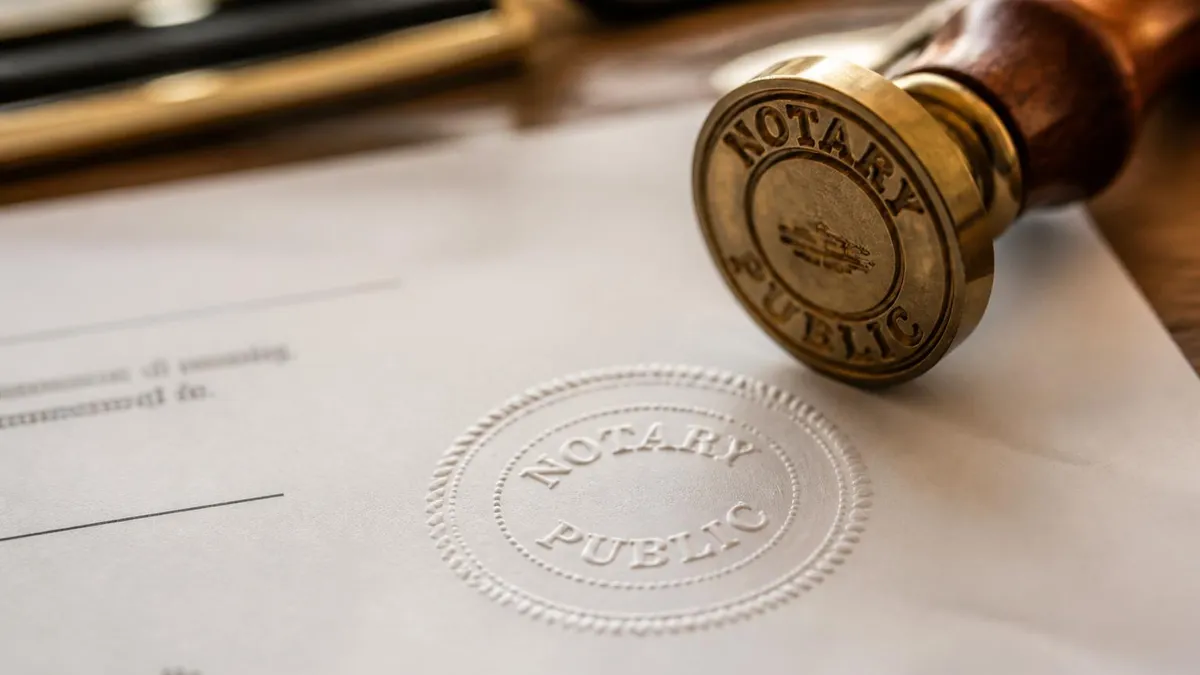
One of the most recognizable tools associated with a notary public is the notary public stamp or notary public seal. These two terms are often used interchangeably, but they refer to slightly different tools. A notary public stamp is an ink-based device — either a pre-inked rectangular stamp or a traditional rubber stamp — that imprints the notary's name, commission number, commission expiration date, and the state of commission directly onto the paper. This impression is immediately visible and is the most common form of notarial mark used across the United States today.
A notary public seal, by contrast, traditionally refers to an embossed seal — a raised impression created by a metal crimping device pressed into the paper. Embossed seals create a tactile, three-dimensional impression without ink. While embossed seals were once the standard in many states, most jurisdictions now accept or even require ink stamps because embossed impressions do not always reproduce clearly in photocopies or scanned documents — a practical concern in an increasingly digital world.
The information required on a notary public stamp and seal varies by state but typically includes: the notary's full legal name as commissioned, the words 'Notary Public,' the name of the state, the commission number assigned by the state, and the commission expiration date. Some states also require the county of residence or a decorative border. Using a stamp with incorrect or outdated information can invalidate a notarization and expose the notary to liability. If you want a complete breakdown of notary public stamp and seal requirements, state-by-state resources are available to help you choose the right tools.
Beyond the physical stamp or seal, notaries are also required to maintain a notary journal or log in most states. This record book contains details of every notarial act performed: the date, the type of document, the type of notarization, the signer's name and address, the form of identification used, and the signer's signature in the journal itself. The journal serves as a vital record if a notarization is ever challenged in court or if fraud is alleged. Some states mandate that notaries retain their journals for a minimum number of years after their commission expires.
For remote online notarization (RON), the tools are digital but the requirements are equivalent. RON platforms create an audio-visual recording of the entire notarization session, which serves as the electronic equivalent of the journal entry. The notary applies a digital stamp and electronic signature to the document, which is then tamper-sealed using cryptographic technology. This electronic notarization is legally valid in states that have enacted RON statutes, and the resulting documents are increasingly accepted by courts, government agencies, and financial institutions nationwide.
The role of the notary public stamp and seal in preventing fraud cannot be overstated. Because these tools are tied to a specific commissioned individual and expire on a fixed date, they create a verifiable chain of authenticity. When a lender receives a mortgage document with a valid notary stamp, they can cross-reference the commission number with state records to confirm the notary was active on the date of signing. This verification step is a critical anti-fraud measure in real estate, estate planning, and commercial transactions.
Consumers should also know that a notarized document is not automatically a legal document — it is a certified document. Notarization confirms the identity of the signer and the voluntary nature of the signing, but it does not mean the document's contents are accurate, fair, or legally enforceable. For example, a notarized contract that violates consumer protection laws is still unenforceable. Notarization is a procedural safeguard, not a legal guarantee of the underlying agreement's validity or fairness. Understanding this distinction protects both consumers and aspiring notaries from misunderstanding the scope of the office.
Types of Notarization: What Each One Means
An acknowledgment is the most common type of notarization in the United States. The signer appears before the notary and acknowledges that they signed the document voluntarily and that the signature on the document is genuinely theirs. Critically, the signer does not need to sign in front of the notary — they may have signed the document earlier, as long as they personally appear and confirm the signature. Acknowledgments are used for deeds, mortgages, powers of attorney, and contracts.
The notary completes an acknowledgment certificate that includes the date, the signer's name, and a statement confirming the signer appeared and acknowledged their signature. This certificate is attached to or printed directly on the document, then signed and stamped by the notary. Acknowledgments are particularly important in real estate closings, where lenders and title companies require certified confirmation that the borrower knowingly executed the loan documents.

Pros and Cons of Becoming a Notary Public
- +Low startup cost — most states charge under $200 for the full application and supplies
- +Flexible income stream — notaries can set their own schedules and charge per-notarization fees
- +High demand — millions of documents require notarization in the U.S. every year
- +Mobile notary option allows you to travel to clients and earn premium fees for convenience
- +Resume booster — adds a recognized professional credential useful in legal, financial, and real estate careers
- +Remote online notarization (RON) expands your market beyond local geography to the entire state
- −State fee caps limit per-notarization earnings — many states cap fees at $5–$15 per act
- −Liability risk — errors in notarization can expose you to lawsuits and bond claims
- −Continuing education requirements add time and cost in states that mandate renewal training
- −Strict rules leave little room for error — missing information on a certificate can invalidate the entire act
- −Notary commissions do not transfer across state lines — you must reapply if you move
- −Fraud and impostor risks — notaries must guard their stamp carefully to prevent misuse
How to Find a Free Notary Near You: 10 Best Sources
- ✓Visit your bank or credit union branch — Bank of America, Wells Fargo, Chase, and most banks offer free notary services to account holders.
- ✓Check your public library — many branches offer free or low-cost notary appointments through <a href='/notary/notary-public-classes'>free notary public library near me</a> programs.
- ✓Contact your employer's HR department — large companies often have an in-house notary available to employees at no charge.
- ✓Visit a UPS Store or FedEx Office location — both chains offer walk-in notary services, typically for a small fee.
- ✓Search the American Society of Notaries online directory at asnnotary.org for commissioned notaries in your ZIP code.
- ✓Use NotaryCafe.com or Notary.net to find mobile notaries who can travel to your home or office.
- ✓Contact a real estate title company — title companies often notarize documents for clients as a courtesy service.
- ✓Check AAA (American Automobile Association) — many AAA offices provide free notary services to members.
- ✓Search your county courthouse or city hall — government offices often have notaries available to the public.
- ✓Download the Notarize or Notary.com app to access remote online notarization 24/7 from your smartphone or computer.
Notario Publico ≠ U.S. Notary Public — Know the Difference
In Latin American legal systems, a notario publico is a highly trained attorney with authority to draft legal documents and provide legal advice. In the United States, a notary public holds no such legal authority. Fraudulent immigration consultants sometimes pose as notarios to charge immigrants for legal services they cannot legally provide, which can result in deportation, visa denials, and thousands of dollars in losses. Always consult a licensed immigration attorney for immigration legal matters, not a notary.
Learning how to become a notary public is a straightforward process, but the specific requirements differ from state to state. In general, the pathway involves meeting basic eligibility requirements, completing any mandatory education or training, passing an exam if required by your state, submitting an application and fee to the appropriate state authority, purchasing a surety bond, taking an oath of office, and finally obtaining your notary stamp and journal. Understanding each of these steps helps you plan your timeline and budget accurately.
The basic eligibility requirements to become a notary public are relatively universal across states: you must be at least 18 years old, a legal resident of the state in which you are applying (some states also accept regular employment within the state as a qualifying basis), able to read and write in English, and free of felony convictions or convictions for crimes of moral turpitude. Some states require U.S. citizenship, while others accept lawful permanent residency. A few states also require that applicants have no prior notary commission revocations on their record.
Many states require prospective notaries to complete a state-approved training course before submitting their application. California, for example, requires a three-hour approved notary education course and mandates that applicants pass a state-proctored exam with a score of at least 70%. Florida requires applicants to complete a three-hour education course approved by the Florida Department of State.
Texas does not currently require a course or exam, making it one of the more accessible states in which to become a notary. If you want detailed guidance on how can i become a notary public in california, a step-by-step state-specific resource can save you significant time and confusion.
The notary public exam, where required, tests applicants on state-specific laws and procedures, the notary's scope of authority and limitations, proper completion of notarial certificates, identification requirements, record-keeping obligations, and prohibited acts. Questions often focus on scenario-based situations: What should you do if the signer cannot speak English? What happens if the signer appears incapacitated? How do you handle a document that is missing a notarial certificate? Passing this exam is essential before your application will be processed.
Once your application is approved by the state, you will typically be directed to take an official oath of office — often before a county clerk or another commissioned official. This oath is a solemn promise to faithfully execute the duties of the notary public office. After the oath, you will receive your commission certificate, which you should keep in a safe place along with a copy of your bond and E&O insurance documentation. Your commission has a fixed expiration date, and you must renew it before that date if you wish to continue practicing.
The cost of becoming a notary varies by state but typically includes: a state application fee ($10–$120), a surety bond ($50–$100 for a 4-year term, though bond amounts range from $500 to $25,000 depending on the state), a training course if required ($30–$80), exam fees if applicable ($20–$40), and your notary supplies — stamp, seal, and journal ($30–$80). Total startup costs typically range between $100 and $350, making it one of the more affordable professional credentials available to working adults.
After your initial commission, you may choose to expand your practice by becoming a certified signing agent. Signing agents specialize in mortgage and real estate documents and typically earn $75–$200 per loan signing appointment. This specialization requires additional training through organizations like the National Notary Association (NNA) and a background check required by lenders and title companies. The notary public exam is your first step; signing agent certification is an advanced credential that unlocks higher-paying opportunities in the growing real estate and mortgage industry.

Using an expired notary commission — even accidentally — can invalidate every document you notarized after the expiration date and expose you to liability claims. Set a calendar reminder at least 90 days before your commission expires to begin the renewal process. Most states allow or require you to complete renewal training and reapply before your current commission ends to avoid any gap in authority.
Preparing for the notary public exam requires a focused study strategy that covers both the broad principles of notarial law and your specific state's statutes. While some states do not require an exam, the states that do — including California, New York, and others — have rigorous testing standards. Candidates who underestimate the exam often fail on their first attempt, wasting both time and the application fee. A structured study plan, combined with consistent practice testing, is the most effective way to pass on your first try.
The notary public exam typically covers five broad domains: general notary knowledge (roles, limitations, and legal foundations), notarial acts and certificates (acknowledgments, jurats, copy certifications), identification requirements and signer qualifications, journal and record-keeping requirements, and prohibited acts and ethics. Each of these domains carries significant weight on the exam, and candidates should allocate study time proportionally. Many examinees report that questions about prohibited acts and signer qualifications are among the most challenging because they require careful reading of scenario-based prompts.
One of the most effective study tools available is a dedicated notary public exam practice test. Answering realistic multiple-choice questions helps you identify knowledge gaps, build test-taking confidence, and familiarize yourself with the format and phrasing of actual exam questions. Rather than simply re-reading your state's notary handbook repeatedly, active recall through practice testing has been shown in cognitive science research to significantly improve long-term retention and exam performance compared to passive review methods alone.
When using practice tests, pay close attention to the explanations provided for both correct and incorrect answers. Understanding why an answer is right or wrong is far more valuable than simply memorizing which letter to choose. For example, if a practice question asks whether a notary may notarize a document for a family member, the answer in most states is technically permitted but strongly discouraged — because the notary's impartiality could be questioned. Nuances like this appear frequently on actual exams and require genuine comprehension rather than rote memorization.
Beyond practice tests, consider supplementing your study with your state's official notary handbook, which is typically available as a free PDF from the secretary of state's office. Cross-reference handbook content with your practice test results to identify which sections you need to revisit. Many candidates also benefit from taking notes in their own words, creating flashcards for key definitions (acknowledgment, jurat, surety bond, credible witness), and reviewing real-world scenarios where notaries have faced disciplinary action for specific violations.
Time management during the actual exam is important. Most state notary exams are not long — typically 30 to 45 questions completed within 45 to 90 minutes — but anxiety can cause candidates to overthink straightforward questions. Practice answering questions under timed conditions during your preparation period so that the pacing feels natural on exam day. If you encounter a question you are unsure about, flag it and move on; return to flagged questions after completing the rest of the exam with your remaining time.
For candidates who want a comprehensive, structured approach to exam preparation, a 30-day study plan that breaks down the entire handbook into daily reading assignments paired with daily practice quizzes is a highly effective framework. This approach ensures complete coverage of all tested material without last-minute cramming. Combined with state-specific resources and expert practice questions, it gives first-time exam takers the confidence and knowledge needed to succeed on exam day and begin their notary career on the right foot.
Once you have passed the notary public exam and received your commission, the real work of building a notary practice begins. Whether you plan to notarize documents as a side hustle, as part of your primary job, or as a full-time mobile notary business, success depends on understanding your market, setting appropriate fees, and maintaining impeccable accuracy in every notarization you perform. Even experienced notaries occasionally face unusual situations that require careful judgment and, sometimes, a call to your state's notary regulatory office for guidance.
Marketing yourself as a notary public has never been easier. Free and low-cost listings on platforms like Notary Rotary, NotaryCafe, and Snapdocs can generate a steady stream of clients without significant advertising spend. Mobile notaries who serve hospitals, nursing homes, correctional facilities, and law offices often develop loyal referral networks that provide consistent income without heavy marketing. Joining your state's notary association also connects you with continuing education opportunities, legislative updates, and peer support that can be invaluable as state laws evolve.
Customer service is a differentiator in the notary business. Being punctual, professional, and patient — especially with elderly clients or those signing documents during stressful life events like medical crises or estate settlements — builds a reputation that generates repeat business and word-of-mouth referrals. Always bring extra supplies to appointments: a spare ink pad, additional journal pages, and copies of your commission certificate in case a client or institution requests them. Small preparation details like these distinguish reliable professional notaries from casual practitioners.
Continuing education is increasingly important in the notary profession, particularly as remote online notarization technology evolves rapidly and state laws change to keep pace. Several states now require notaries to complete continuing education courses before renewing their commissions, and even in states that do not require it, staying current with regulatory updates protects you from inadvertently using outdated procedures. Subscribing to the National Notary Association's newsletter or your state association's updates is a low-effort way to stay informed about changes that affect your practice.
Errors and omissions insurance (E&O) is a critical but often overlooked protection for practicing notaries. While your surety bond protects the public if you cause financial harm, it does not protect you personally — the bonding company can seek reimbursement from you after paying a claim. E&O insurance covers your legal defense costs and damages up to the policy limit if you are sued for a notarial error, even if the error was unintentional. Policies typically cost $50–$100 per year and are widely regarded as essential for any notary handling mortgage documents, estate planning instruments, or other high-stakes paperwork.
For those who plan to specialize in loan document signings, becoming a certified notary signing agent (NSA) is a logical next step after obtaining your basic commission. The National Notary Association and similar organizations offer NSA certification programs that include training on mortgage document packages, title company expectations, closing procedures, and background screening. Lenders and title companies typically require NSA certification and a clear background check before assigning loan signings, so completing these steps promptly after your notary commission arrives will help you access the most lucrative segment of the notary market faster.
Finally, never underestimate the importance of maintaining your journal meticulously. Every notarial act should be recorded contemporaneously — meaning at the time it occurs, not later from memory. Your journal is your legal protection if a signer ever claims they did not appear before you, that you forged their signature, or that you failed to verify their identity.
Courts and investigators treat notary journals as authoritative records, and a complete, accurate journal can be the difference between a dismissed claim and a costly legal battle. Treat your notary journal with the same care you give to any other critical business document.
Notary Public Questions and Answers
What Is a Notary Public Office? Everything You Need to Know

Mobile Notary Public Near Me: How to Find, Book, and Use One in 2026

Notary Public Classes: Complete 2026 Guide to Training, Certification, and Exam Prep

30-Day Notary Public Exam Study Plan — Pass on Your First Try

Notary Public License: What It Is, How to Get One, and Everything You Need to Know
About the Author

Notary Public Law Expert & State Notary Exam Specialist
Georgetown University Law CenterAttorney Sarah Williams is a licensed attorney and National Notary Association (NNA) certified notary with a Juris Doctor from Georgetown University Law Center. She has 13 years of experience in notarial law, document authentication, and real estate closings. Sarah coaches candidates through state notary public examinations, notary signing agent certification, and loan signing agent training programs.