
Notary Public for Real Estate: What Every Buyer, Seller, and Agent Needs to Know
What is a notary public for real estate? Learn roles, stamp rules, costs & where to find free notary services near you. ✅ Full 2026 September guide.
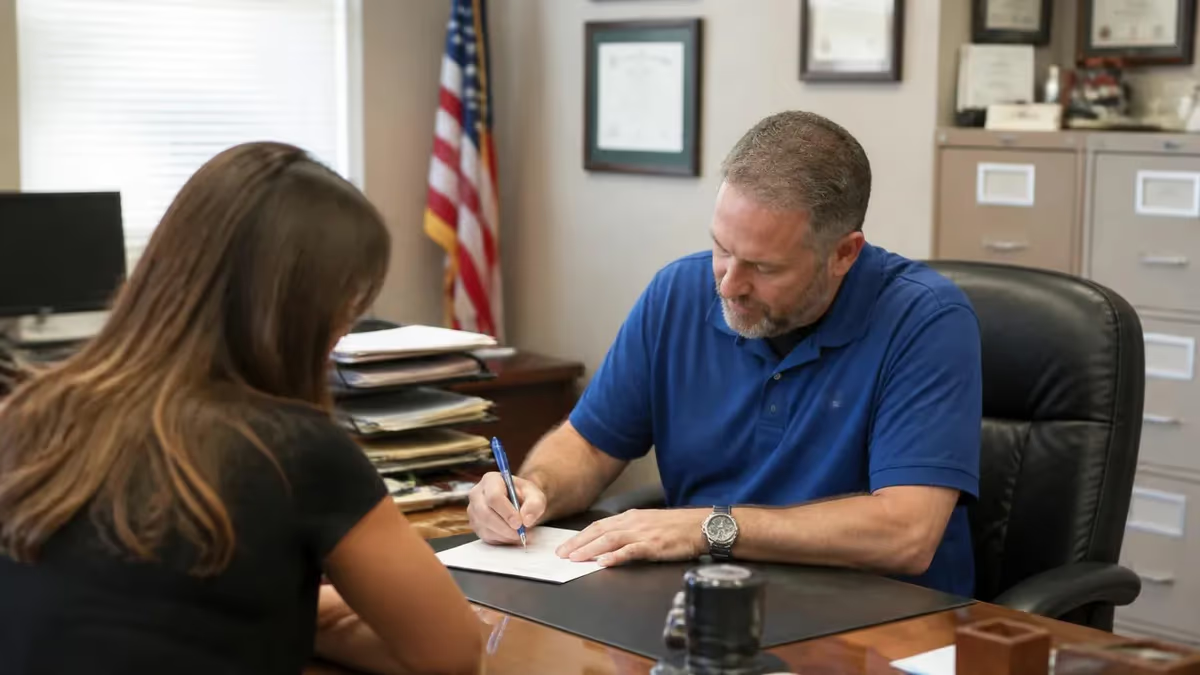
Understanding what is a notary public for real estate is essential for anyone involved in a property transaction — whether you are buying your first home, refinancing an existing mortgage, or handling a deed transfer between family members. A notary public is a state-commissioned official authorized to witness the signing of important documents, verify the identities of all signers, and affix an official notary public stamp or notary public seal to confirm the authenticity of those signatures. In real estate, this role is not optional — it is legally required in virtually every US state.
Real estate closings involve a stack of binding legal documents: the deed, mortgage agreement, promissory note, title affidavits, and various disclosure forms. Each of these must be signed in the presence of a notary to be legally recordable with the county recorder's office. Without proper notarization, a deed cannot be filed, a lien cannot be released, and a title cannot transfer cleanly. This is why understanding the notary's role can save buyers and sellers from costly delays at the closing table.
Many people confuse the American notary public with the Latin American notario publico, a highly trained legal professional akin to an attorney. In the United States, the notary public role is more administrative — notaries verify identity and witness signatures but do not provide legal advice. If you need guidance on contract terms or title issues, you'll need a real estate attorney, not just a notary. Understanding this distinction protects consumers from overpaying for services or, worse, relying on a notary for legal counsel they are not authorized to provide.
The notary public stamp is one of the most recognizable elements of any real estate closing package. It typically includes the notary's name, commission number, state of commission, and commission expiration date. Some states require an embossed seal in addition to the ink stamp. When a lender or title company reviews closing documents, the stamp is the first thing they check — an expired commission date or missing seal can cause the entire closing to be rejected and rescheduled, delaying funding by days or even weeks.
Finding a qualified notary for real estate closings has never been easier. Options range from free notary public services at Bank of America branches and credit unions to mobile signing agents who travel to your home, hospital, or office. If cost is a concern, searching for a public notary near me free will surface libraries, UPS stores, AAA offices, and community banks that offer complimentary notarization for basic documents. For complex closings with multiple signers, a certified signing agent with escrow experience is the better choice.
The notary public exam is the gateway credential for anyone who wants to serve in this role professionally. Most states require prospective notaries to pass a written test covering document types, proper identification procedures, journal-keeping requirements, and ethical obligations. Exam difficulty varies by state — California and New York have among the most rigorous requirements, while some states only require an application and background check. Regardless of your state, thorough preparation is the single most reliable predictor of first-attempt success.
This guide covers everything you need to know about the notary public's role in real estate transactions: the types of documents that require notarization, how to find notary services near you, what a notary legally can and cannot do, and how aspiring notaries can prepare for and pass their state exam. Whether you are a consumer, a real estate agent, or someone exploring notary as a career, the sections below will give you a thorough, accurate foundation to work from.
Notary Public in Real Estate: Key Numbers

Types of Real Estate Documents That Require Notarization
The primary document transferring property ownership from seller to buyer. Every state requires this to be signed before a notary and recorded with the county. An improperly notarized deed can cloud the title for decades, making the property difficult or impossible to sell later.
Lenders require notarized mortgage documents before releasing loan funds. The deed of trust — used in about 30 states — creates a lien on the property. If the notarization is defective, the lender's security interest may be unenforceable, exposing both lender and borrower to serious risk.
The legal promise to repay the loan, often requiring notarization at the lender's discretion. While not all states mandate notarization of the note itself, most title companies require it as a best practice to prevent later disputes about whether the borrower's signature is genuine.
Title affidavits, affidavits of heirship, and seller's affidavits of no liens are routinely notarized at closing. These sworn statements carry legal weight only when signed before a commissioned notary who has verified the affiant's identity and administered the oath required by state law.
When a buyer or seller cannot attend closing in person, a durable power of attorney authorizes an agent to sign on their behalf. Real estate POAs must be notarized — and in many states also witnessed — to be accepted by title companies, lenders, and county recorders.
Knowing how to find a qualified notary for real estate purposes is a practical skill that can save you hours of frustration on closing day. The most common starting point for many Americans is their bank. Notary public in Bank of America, Chase, Wells Fargo, and most regional credit unions is a complimentary service for account holders. Simply call ahead, confirm a commissioned notary is on duty, and bring valid government-issued photo identification. Banks typically limit free notarization to members and may have restrictions on the number of signatures per visit.
For those who need flexibility, a mobile notary public is one of the most convenient solutions available. Mobile signing agents travel to your location — home, hospital, office, or coffee shop — at a scheduled time. They are especially popular for real estate closings where one or both parties cannot travel to a title company office. Most mobile notaries charge a travel fee on top of the per-signature fee, but the convenience often outweighs the cost, particularly for elderly signers, individuals with disabilities, or closings that happen outside business hours.
Remote online notarization (RON) has expanded rapidly since 2020 and is now legal in more than 40 states. RON allows signers and notaries to complete the entire notarization process over a secure video platform. The notary verifies identity using knowledge-based authentication questions and credential analysis technology, then applies a digital notary public seal to electronically signed documents. For real estate, lenders and title companies must also accept RON-notarized documents, so confirm acceptance before scheduling a remote session.
Free notary services are more widely available than most people realize. Public libraries in major cities often staff a notary during business hours. Shipping centers like UPS Store locations offer notarization for a small fee — typically $5 to $15 per signature. AAA offices frequently provide free notarizations for members. Many employers also have a commissioned notary on staff who can assist employees at no charge. When searching online, filtering by "free notary public near me" or "free public notary near me" will surface these community resources.
When selecting a notary for a real estate transaction, verify that their commission is active and not expired. Ask to see their commission certificate or check your state's online notary database. Confirm that they carry errors and omissions (E&O) insurance — most professional signing agents carry $25,000 to $100,000 in coverage, which protects both the notary and the parties they serve if a mistake causes financial harm. A notary who is also a certified loan signing agent (CLSA) through organizations like the National Notary Association (NNA) has completed additional training specific to mortgage closings.
Title companies and real estate attorneys often have staff notaries who handle in-house closings. These notaries are familiar with the specific document packages used by major lenders and understand the sequencing and initialing requirements that prevent documents from being rejected at recording. If your closing is through a title company, ask whether they include notarization in their closing fee — most do, making it unnecessary to arrange a separate notary appointment.
Geographic availability varies significantly. In rural areas or smaller towns, finding a qualified notary who is available on short notice can be challenging. In these cases, county clerks, court offices, and tax assessor offices often have commissioned notaries on staff who can assist the public. Calling ahead and explaining the nature of the document (real estate deed vs. simple affidavit) helps the office staff prepare and ensures the right personnel are available when you arrive.
Notary Public Stamp, Seal & Identity Verification in Real Estate
The notary public stamp is the physical or digital mark that gives a notarized document its legal validity. Every state specifies exactly what information must appear on the stamp: the notary's full legal name, the state of commission, the commission expiration date, and usually a commission number or identifying code. Some states also require the county in which the notary was commissioned. Using an expired stamp — even by a single day — renders the notarization defective and may require the entire document to be re-signed.
For real estate documents, the placement of the notary public stamp matters. It must appear on the same page as the notary's signature and the notarial certificate language (the "acknowledged before me" or "subscribed and sworn" clause). If the stamp bleeds over text or is unclear when photocopied, county recorders may reject the document. Many professional signing agents use both an ink stamp and an embossed seal — the embossed impression provides a tamper-evident layer that is visible even on copies made after the original is recorded.

Using a Notary Public for Real Estate: Benefits and Drawbacks
- +Provides legally required authentication that enables deed recording at the county office
- +Deters fraud by requiring in-person identity verification before documents are signed
- +Creates an official notary journal record that can be subpoenaed if a signature is disputed later
- +Mobile and remote online notaries eliminate the need for all parties to travel to a single location
- +Free or low-cost services at banks, libraries, and credit unions make notarization accessible to all income levels
- +Certified loan signing agents understand mortgage document packages, reducing errors and re-signing delays
- −Scheduling conflicts or last-minute cancellations by a notary can delay real estate closings
- −An expired commission or incorrect stamp can invalidate the entire notarization, requiring costly re-signing
- −Mobile notary travel fees can add $50–$200 to closing costs in rural or after-hours situations
- −Remote online notarization is not yet accepted by all lenders or recognized in all states for real estate
- −Notaries cannot provide legal advice, so errors in document content go undetected unless an attorney also reviews
- −Some states impose per-signature fee caps as low as $5–$10, making it hard to find available notaries in high-demand periods
Real Estate Notary Closing Checklist: 10 Steps for a Smooth Signing
- ✓Confirm the notary's commission is active and not expired before the appointment.
- ✓Bring at least one government-issued photo ID with a current, non-expired date.
- ✓If signing on behalf of another party, bring the original, notarized Power of Attorney document.
- ✓Review all documents for blank fields before the signing — no notary should notarize a document with unfilled blanks.
- ✓Ensure every signer is physically present when the notary affixes the stamp; remote pre-signing is not permitted for most real estate documents.
- ✓Verify the notary completes the notarial certificate with the correct date, county, and state information.
- ✓Confirm the notary's signature and stamp appear on the same page as the notarial certificate, not on a separate page.
- ✓Ask the notary to record the transaction in their official journal and provide the journal entry number for your records.
- ✓For mortgage closings, confirm the notary is a certified loan signing agent familiar with lender-specific document packages.
- ✓After closing, verify with the title company that all documents have been sent to the county recorder and that recording confirmation numbers have been received.
The Notary's Journal Is Your Last Line of Defense Against Fraud
Every notary in the US is required to maintain an official journal of notarial acts. This record — which includes the date, document type, signer's name, ID presented, and signature — can be subpoenaed in court proceedings. In real estate fraud cases involving forged deeds or unauthorized property transfers, the notary journal is often the single most important piece of evidence. Choosing a notary who maintains a meticulous journal is not bureaucratic formality — it is a practical safeguard for your most valuable asset.
Learning how to become a notary public is a straightforward process in most states, but the requirements vary significantly from one jurisdiction to the next. At a minimum, applicants must be at least 18 years old, a legal resident of the state in which they are applying, and free of felony convictions. Many states also require applicants to be proficient in English, though some — particularly those with large Spanish-speaking populations — allow notaries to work in both English and Spanish, serving both English and notario publico communities in their areas.
The application process typically begins with completing a state-issued application form and submitting it to the secretary of state, lieutenant governor's office, or county clerk, depending on the state. Application fees range from under $20 in some states to more than $100 in others. Most states require a background check as part of the application, and some require the applicant to obtain a surety bond — typically $5,000 to $25,000 — before the commission is issued. The bond protects the public against financial harm caused by a notary's negligence or misconduct.
The notary public exam is a requirement in several states, including California, New York, and Louisiana. California's exam consists of 45 multiple-choice questions covering the Notary Public Handbook; applicants must score 70% or higher to pass. New York requires a 40-question exam with a 70% passing score. Louisiana's exam is administered by the state's Secretary of State office and covers a broad range of notarial law, including succession documents and authentic acts that are unique to Louisiana's civil law tradition. Exam fees are typically $15 to $40.
After passing the exam — if one is required — the applicant must take an oath of office before a county clerk or other authorized official. This oath is a formal commitment to faithfully perform the duties of a notary public. Some states require the oath to be taken within 30 to 90 days of commission approval; missing this window can void the commission entirely, requiring the applicant to start the process over. After the oath, the notary can order their official notary public stamp and seal and begin notarizing documents.
Continuing education and notary public renewal requirements have become increasingly common. California notaries must complete a six-hour refresher course upon each four-year renewal. Other states require notaries to complete ethics training or updates on recent statutory changes before renewing. Keeping your continuing education current not only maintains your commission — it also keeps you informed about changes in real estate notarization requirements, new acceptable ID types, and evolving remote online notarization laws.
Many aspiring notaries combine their state commission with additional certifications to increase their earning potential and expand their service offerings. The National Notary Association (NNA) offers the Certified Notary Signing Agent (CNSA) credential, which requires additional training on loan document packages, a background screening, and an exam. Signing agents who complete this certification can earn $75 to $200 per loan signing appointment, making real estate notarization a viable part-time or full-time income stream. The NNA also offers errors and omissions insurance policies starting around $25 per year.
Building a notary business focused on real estate also requires understanding the local market. In high-volume real estate markets like Texas, Florida, and California, demand for qualified signing agents is strong year-round. In slower markets, diversifying into estate planning documents, business contract signings, and apostille services can supplement real estate income. Joining local real estate investment clubs, attending title company networking events, and registering on signing service platforms like Snapdocs or SigningOrder are effective ways to build a steady pipeline of assignments.

A notary public can witness your signature and verify your identity — but they cannot explain contract terms, advise you on legal rights, or catch errors in a deed's legal description. Several states prohibit notaries from drafting legal documents or giving legal advice entirely. If your real estate transaction involves a trust, estate, disputed boundary, or title defect, consult a licensed real estate attorney in addition to your notary. Relying solely on a notary for legal guidance is one of the most common and costly mistakes consumers make at closing.
One of the most misunderstood aspects of the notary public role is what a notary is legally prohibited from doing. A notary cannot guarantee that a document is legally valid or that the transaction described in it is fair or enforceable. They cannot verify that the property described in a deed actually exists, that the seller actually owns it, or that the price is reasonable. Their authority is limited to confirming that the person who signed the document is who they claim to be and that they signed voluntarily. Everything beyond that is outside their legal scope.
Notaries are also prohibited from notarizing documents in which they have a financial or personal interest. If a notary is also a party to the transaction — for example, if they are the buyer or seller of the property — they cannot notarize that transaction's documents. Similarly, a notary who is the spouse, domestic partner, or direct family member of a signer should decline to notarize to avoid even the appearance of conflict. Violation of these rules can result in commission revocation, civil liability, and in serious cases, criminal charges.
The distinction between a US notary public and a notario publico in Latin American legal tradition causes significant confusion in communities with large immigrant populations. In Mexico, Colombia, and other civil law countries, a notario publico holds a prestigious and powerful legal role — equivalent to a combination of attorney, title examiner, and estate planner.
Many immigrants arriving from these countries mistakenly believe a US notary can provide the same services. This misunderstanding has given rise to a serious consumer fraud problem in which unscrupulous individuals calling themselves "notarios" offer unauthorized immigration and legal advice, causing devastating harm to vulnerable clients.
The texas notary public community has been particularly active in combating this fraud. Texas law explicitly prohibits non-attorneys from calling themselves notarios and from advertising legal services using Spanish-language terms that imply legal expertise. Several other states with large Hispanic populations — California, Florida, Arizona, and Illinois — have passed similar laws. Consumer protection agencies in these states actively pursue complaints about notario fraud, and penalties can include fines and criminal prosecution.
For real estate professionals — agents, loan officers, and title officers — understanding the boundaries of notarial authority helps set accurate expectations with clients. It is good practice to explain to buyers and sellers before closing that the notary's role is ministerial: they are there to witness, not to advise. Encourage clients to read all documents before signing and to ask their real estate attorney or loan officer to explain any terms they do not understand. A well-prepared client completes the signing faster and with greater confidence.
Technological changes are reshaping the notary landscape in ways that have direct implications for real estate. Electronic notarization (e-notarization) allows notaries to affix a digital seal to electronically signed documents, while remote online notarization (RON) takes this further by allowing the entire process to occur over a secure video call. As of 2026, more than 40 states have enacted RON legislation, and the federal SECURE Notarization Act has been proposed to create a national standard. These changes are making real estate closings faster and more accessible, particularly for transactions involving out-of-state buyers or military families stationed abroad.
The future of notarization in real estate will likely involve even deeper integration with blockchain-based title records and smart contracts. Several title companies and proptech startups are piloting systems in which a notarized electronic deed is simultaneously recorded on both the county's traditional land records system and a permissioned blockchain ledger, creating an immutable chain of title that dramatically reduces the risk of deed fraud. While these systems are not yet mainstream, notaries who understand both traditional requirements and emerging digital standards will be well-positioned to serve clients in the next generation of real estate transactions.
Preparing effectively for the notary public exam requires understanding not just the rules but the reasoning behind them. Exam questions in states like California and New York are designed to test judgment, not just memorization. A candidate who understands why identity verification matters — because forged signatures in real estate cause title defects that persist for decades — will answer nuanced scenario questions more accurately than one who has simply memorized a list of acceptable IDs. Approach your study with the mindset of a professional who will actually use this knowledge in high-stakes situations.
Create a dedicated study schedule that covers the major topic areas tested on your state's exam: the types of notarial acts (acknowledgments, jurats, copy certifications, oaths), proper identification procedures, journal-keeping requirements, prohibited acts, and notary liability. Use your state's official notary handbook as your primary source — it is the authoritative document from which exam questions are drawn. Supplement it with practice tests to identify weak areas and build your confidence with timed question sets that mimic the actual exam format.
Pay special attention to the rules around acknowledgments and jurats, as these are the two notarial acts most commonly tested and most frequently confused. An acknowledgment is used when the signer is confirming that they signed a document freely — the signer does not have to sign in the notary's presence, but must personally appear and acknowledge the signature. A jurat requires the signer to sign in the notary's presence and be sworn in before signing. Mixing these up on an actual document can invalidate the notarization; mixing them up on the exam costs you points.
Many candidates find that working through real-world scenarios — simulating actual closing situations — helps cement abstract rules. For example: a signer presents an ID that expired two months ago. What do you do? Answer: refuse to notarize unless the state allows recently expired IDs within a specified grace period, which most do not. Another scenario: a document has a blank in the body text where a dollar amount should appear. What do you do? Answer: decline to notarize — notaries are prohibited from completing documents with blank spaces that could be filled in after notarization.
Time management during the actual exam is important but often overlooked in preparation. Most state notary exams allow 60 to 90 minutes for 40 to 45 questions — that is approximately one to two minutes per question. Candidates who spend too long on difficult questions risk running out of time for questions they would otherwise answer correctly. Practice under timed conditions from the start of your preparation, not just in the final days before the exam. This builds the mental stamina and pacing instincts that make the difference on test day.
After passing your exam and receiving your commission, consider joining professional associations such as the National Notary Association, the American Society of Notaries, or your state's notary association. These organizations provide updated legal guidance, continuing education, liability insurance, and networking opportunities. They also publish alerts when state laws change — a critical benefit given that notary statutes are amended relatively frequently in states with active real estate markets. Staying current is not optional; using outdated procedures is one of the most common causes of commission revocation.
The most successful notary publics in real estate — those who build strong reputations and consistent income — share a few common traits: they are meticulous about their journals, they never rush a signer, they decline assignments when they are uncertain of the correct procedure, and they invest continuously in their professional education.
A single error in a real estate closing can cause title defects worth tens of thousands of dollars. By contrast, a notary who performs their role with care and precision becomes an indispensable partner for title companies, lenders, and attorneys — and builds a referral network that sustains a thriving practice for years.
Notary Public Questions and Answers

How to Become a Notary Public: Complete State-by-State Training Guide

NC Notary Public Course: Complete Training Guide for North Carolina

Notarios Publicos: What Is a Notary Public and How to Become One in the US

Find a Notary Public Near Me: A Complete 2026 Guide to Locating, Vetting, and Using Local Notaries

Notary Public Commission Application: Complete Step-by-Step Guide for 2026
About the Author

Notary Public Law Expert & State Notary Exam Specialist
Georgetown University Law CenterAttorney Sarah Williams is a licensed attorney and National Notary Association (NNA) certified notary with a Juris Doctor from Georgetown University Law Center. She has 13 years of experience in notarial law, document authentication, and real estate closings. Sarah coaches candidates through state notary public examinations, notary signing agent certification, and loan signing agent training programs.