
How to Get a Notary Public License: Complete Step-by-Step Guide 2026 October
Learn what is a notary public, how to get your license, exam prep tips & state requirements. Full 2026 October guide. 🏆
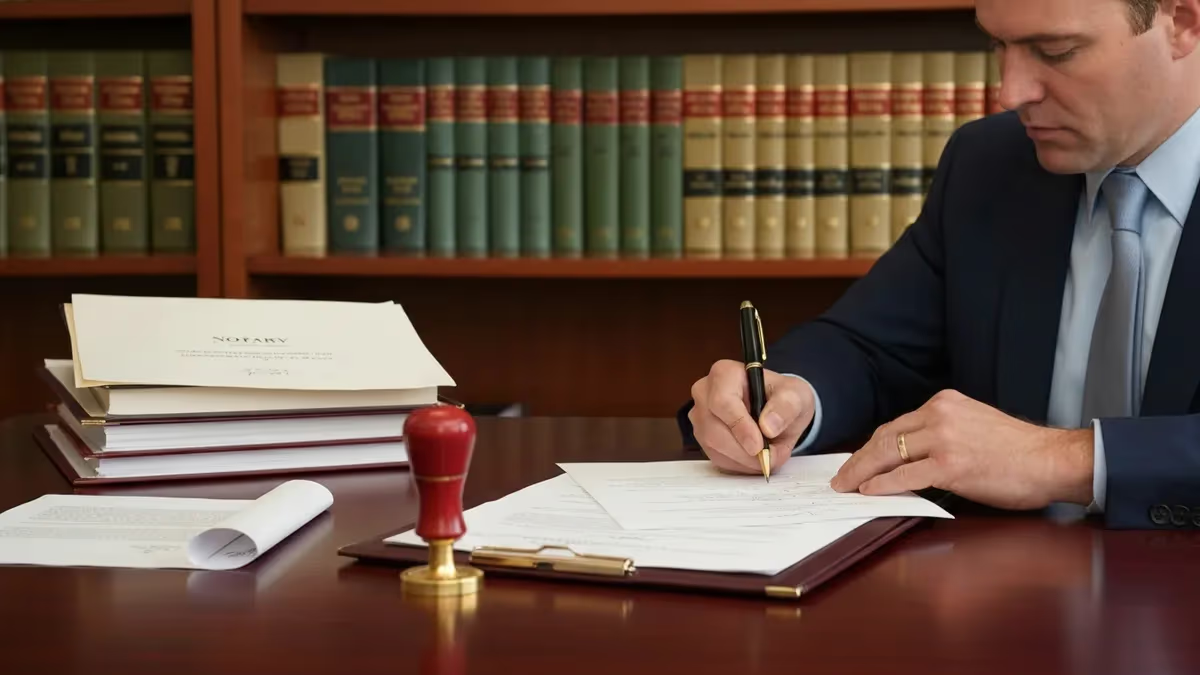
If you have ever wondered how do you get a notary public license, you are not alone. Millions of Americans pursue notary commissions each year, drawn by the relatively low cost of entry, flexible work options, and the ability to serve their communities in a meaningful legal capacity. A notary public is a state-appointed official authorized to witness signatures, administer oaths, certify document copies, and perform other acts designed to deter fraud. Understanding the full process — from eligibility to the notary public exam — sets you up for a smooth, confident application.
What is a notary public, exactly? At its core, a notary is a public officer commissioned by a state government to serve as an impartial witness in the signing of important documents. Whether you are finalizing a real estate deed, a power of attorney, or an affidavit, a notary's seal and signature add a critical layer of authentication. The role dates back centuries and remains a cornerstone of modern legal transactions, ensuring that signers are who they claim to be and that they are acting of their own free will.
The phrase notario publico is frequently searched by Spanish-speaking communities in the United States, and it is important to note a key distinction: in Latin American countries, a notario publico carries far greater legal authority than a U.S. notary public. American notaries do not provide legal advice or prepare legal documents. If you are searching for a free notary public library near me, know that many public libraries offer free notarization services as a community benefit, which can be a helpful resource while you pursue your own commission.
Every state has its own rules governing who can become a notary, what training is required, and how long a commission lasts. Most states require applicants to be at least 18 years old, a legal resident of the state, and free of certain criminal convictions. Some states — notably California, Florida, and Pennsylvania — require completion of a state-approved notary education course and passage of a written notary public exam before the commission is granted. Other states have a more simplified process but still mandate a surety bond.
The notary public stamp and notary public seal are two terms often used interchangeably, though they technically refer to slightly different tools. A notary seal traditionally refers to an embossing device that leaves a raised impression on paper, while a notary stamp (also called a rubber stamp or ink stamp) applies an inked impression. Most states accept either format, but specific requirements about what information must appear on the seal — your name, commission number, expiration date, and state — vary by jurisdiction. Purchasing the wrong stamp format can result in rejected documents.
Many people wonder about finding free public notary near me services or even free notary public near me options before deciding whether to become a notary themselves. Banks like Bank of America and Chase often provide free notarization to account holders, which is why searches for notary public in bank of america are so common. Once you hold your own commission, you may have the option to charge per-signature fees set by your state, turning your license into a supplemental income stream or even a full-time career through loan signing agent work.
This guide walks you through every stage of obtaining your notary public license, including state-specific requirements, exam preparation strategies, costs, and the ongoing responsibilities that come with your commission. Whether you are completely new to the concept or are ready to sit for the notary public exam, the sections below will give you a clear, actionable roadmap to becoming a commissioned notary public in 2026.
Notary Public Licensing by the Numbers

How to Become a Notary Public: Step-by-Step Process
Confirm Eligibility Requirements
Complete Required Education or Training
Pass the Notary Public Exam (If Required)
Submit Your Application and Surety Bond
Take the Oath of Office and Receive Your Commission
Purchase Your Notary Stamp or Seal and Journal
Understanding the specific requirements in your state is the most critical step when learning how to become a notary public. While federal guidelines establish a general framework, notary law is almost entirely state-governed, which means the process in Texas looks very different from the process in California or New York. Before you invest time and money in coursework, make sure you have reviewed the current rules on your state's official Secretary of State website, as requirements can and do change year to year.
In California, applicants must complete a six-hour state-approved notary public course before sitting for the exam, unless they are renewing an existing commission, in which case a three-hour refresher course applies. The California notary public exam consists of 30 multiple-choice questions, and applicants must score at least 70% to pass. California also requires a live-scan fingerprint background check, a $15,000 surety bond, and a filing fee with the county clerk before the commission becomes active. For a detailed breakdown, see our guide on how to become a notary public in california.
Florida takes a similar approach, requiring a state-approved three-hour education course for all first-time applicants. Unlike California, Florida does not require a written exam — the course itself certifies your readiness. Florida notaries must maintain a $7,500 surety bond and can serve a four-year commission term. The Florida Department of State processes applications online, and most applicants receive their commission within two to four weeks of submitting a complete package, including the bond rider and a $39 application fee.
Texas, by contrast, has one of the most simplified processes in the country. There is no mandatory education course, no written exam, and no bond filing with a government office. Texas applicants simply complete a one-page application, pay a $21 fee to the Secretary of State, and attach a $10,000 surety bond. Commissions are issued for four years and can be renewed online. The simplicity of the Texas process makes it one of the most accessible states for new notaries, though voluntary training is still strongly advisable to avoid costly errors.
New York requires applicants to pass a written notary public licensing exam administered by the Department of State. The New York exam covers 40 questions drawn from a published study guide, and applicants need a score of at least 70% to pass. There is no mandatory course, but the study guide is dense, covering everything from fees and prohibited acts to the proper format for acknowledgments and jurats. New York also requires applicants to register in every county where they plan to regularly practice, which involves additional filing fees at each county clerk's office.
Regardless of your state, one requirement is nearly universal: the surety bond. Many first-time applicants confuse a surety bond with errors and omissions (E&O) insurance. The surety bond is required by law and protects the public — if your notarial error causes financial harm to a client, the bond pays out and the bonding company can then seek reimbursement from you. E&O insurance, which is optional but highly recommended, protects you personally against legal defense costs and damages arising from unintentional mistakes. Most notary associations strongly recommend carrying both.
Once your commission is active, you will need to maintain it carefully. Keep detailed records in your notary journal, never notarize documents where you have a personal financial interest, always verify the identity of signers through acceptable government-issued photo ID, and stay current on changes to your state's notary law. Commission terms typically range from two years (in states like New Hampshire) to ten years (in states like Louisiana). Renewal generally follows the same process as initial application, though some states offer a simplified renewal path for existing notaries in good standing.
Notary Public Exam: What to Expect by State
California's notary public exam is administered by a state-approved vendor (currently Cooperative Personnel Services) at testing centers throughout the state. The exam contains 30 multiple-choice questions drawn from the California Notary Public Handbook, and you have one hour to complete it. Topics include notarial authority, identification of signers, acknowledgments, jurats, oaths, affirmations, and prohibited acts. A passing score is 70% (21 correct answers), and you may retake the exam if you fail, though each attempt requires a new registration fee.
Exam day preparation matters as much as content knowledge. Bring two valid forms of ID (one must be a government-issued photo ID), your exam registration confirmation, and arrive at least 15 minutes early. Personal items including phones and notes are prohibited in the testing room. Study the California Notary Public Handbook chapter by chapter, focusing on the specific dollar amounts for fees, the timeframes for filing oaths and bonds, and the exact wording required on different notarial certificates. Our free practice questions mirror the question style used on the real California exam.
Is Becoming a Notary Public Worth It?
- +Low startup cost — most states require less than $150 to get commissioned
- +Flexible side income with per-signature fees and loan signing assignments
- +High demand for mobile notaries in real estate, legal, and healthcare sectors
- +Commission enhances your resume and professional credibility
- +Remote online notarization (RON) opens a nationwide client base
- +Relatively quick to obtain — many states process applications within 2–6 weeks
- −Commission is state-specific — you cannot notarize across state lines (except with RON authorization)
- −Strict liability for errors — even honest mistakes can result in bond claims or lawsuits
- −State laws change frequently, requiring ongoing education and compliance monitoring
- −Income can be highly variable, especially when starting out without an established client base
- −Some states require exam passage, adding time and cost to the process
- −Notary journals and seal must be secured carefully — loss or theft can lead to fraud liability
Pros and Cons at a Glance
| Pros | Cons |
|---|---|
| Flexible side income with per-signature fees and loan signing assignments | Commission is state-specific — you cannot notarize across state lines (except with RON authorization) |
| High demand for mobile notaries in real estate, legal, and healthcare sectors | Strict liability for errors — even honest mistakes can result in bond claims or lawsuits |
| Commission enhances your resume and professional credibility | State laws change frequently, requiring ongoing education and compliance monitoring |
| Remote online notarization (RON) opens a nationwide client base | Income can be highly variable, especially when starting out without an established client base |
Notary Public License Application Checklist
- ✓Verify your state's current eligibility requirements on the Secretary of State's official website.
- ✓Complete a state-approved notary education course if your state mandates one.
- ✓Register for and pass the written notary public exam if required in your state.
- ✓Obtain a surety bond in the amount required by your state (typically $500–$15,000).
- ✓Complete the official notary public application form accurately and legibly.
- ✓Pay all required application and filing fees (typically $10–$50 depending on the state).
- ✓Submit your fingerprints for a background check if your state requires live-scan or ink prints.
- ✓File your oath of office with the county clerk or designated authority within the required timeframe.
- ✓Order your state-compliant notary public stamp or seal from an approved vendor.
- ✓Purchase a notary journal to record all notarial acts (required in many states, best practice everywhere).
Your Bond Protects the Public — E&O Insurance Protects You
A surety bond is a legal requirement in virtually every state and covers losses the public suffers due to your notarial misconduct or error — but the bonding company can then come after you personally for reimbursement. Errors and omissions (E&O) insurance is optional but covers your own legal defense costs and damage awards. Most professional notaries carry both, and many loan signing companies require proof of E&O coverage before assigning you work.
The financial picture of becoming a notary public is more nuanced than most people expect. The initial costs are genuinely low — often under $150 all in for application fees, bond premiums, and your stamp — but the income potential varies enormously depending on how you use your commission. A part-time notary who simply helps neighbors and coworkers might earn a few hundred dollars per year. A full-time loan signing agent in a busy real estate market can clear $75,000 or more annually, particularly in high-cost states where lenders routinely pay $75–$200 per loan signing appointment.
Loan signing agents represent the highest-earning segment of the notary profession. These are notaries who have completed additional training — typically through the Notary Signing Agent certification offered by the National Notary Association (NNA) or similar organizations — and who specialize in guiding borrowers through mortgage closing documents. A loan signing appointment typically lasts 60 to 90 minutes and involves notarizing dozens of signatures. Title companies and signing services connect loan signing agents with lenders, and experienced agents can complete multiple signings per day.
Remote online notarization (RON) has opened a powerful new revenue stream for commissioned notaries. Under RON, the notary and signer appear together via live two-way audio-visual communication, and the notary uses identity-proofing technology to verify the signer remotely. As of 2026, over 40 states have enacted permanent RON legislation, and the technology platforms that help RON — Notarize, DocVerify, NotaryNow, and others — connect notaries with clients nationwide. RON-authorized notaries are not limited to clients in their physical location, which dramatically expands earning potential.
If you are interested in exploring notary public jobs that use remote work, RON authorization is one of the fastest-growing opportunities in the field. Getting RON-authorized typically requires your existing notary commission, completion of a platform-specific training course, and — in some states — submission of a separate RON authorization application to the Secretary of State. The startup cost is higher than traditional notary work due to the required technology (a dedicated computer, ring light, high-definition webcam, and fast internet), but RON appointments can be completed from anywhere, at any hour, giving you maximum scheduling flexibility.
Beyond loan signings and RON, notaries find consistent work in hospitals and healthcare facilities (witnessing advance directives and powers of attorney), law offices (notarizing affidavits and sworn statements), immigration services (notarizing supporting documents for visa applications), and financial institutions. The growing gig economy has also created demand for mobile notaries who can travel to signers at homes, offices, coffee shops, or nursing facilities — a service that commands premium fees over standard office-based notarizations.
Cost management matters especially in your first year. Your surety bond premium is typically paid annually and may cost $50–$200 depending on the bond amount required and your credit profile. Your notary stamp needs to be replaced when it wears out or when your commission expires and you renew.
Journal refills, business cards, mileage tracking for tax purposes, and any professional membership fees (NNA membership runs about $70–$85 per year) all add up. Building a simple spreadsheet to track income and expenses from day one will make tax season far less stressful and help you see clearly whether your notary business is growing as intended.
Professional development through organizations like the National Notary Association, the American Society of Notaries, or your state's notary association keeps you current on legal changes and connects you with mentors and business referrals. Many states require or incentivize continuing education for notary renewal, and professional association coursework often satisfies these requirements. Staying informed and connected within the notary community is one of the most reliable ways to build a reputation, win repeat business, and stay out of legal trouble as your commission term progresses.

In most states, you have a narrow window — typically 30 to 90 days after receiving your commission — to file your oath of office, record your bond, and begin using your seal. Missing this window can void your commission entirely, forcing you to restart the application process and pay all fees again. Calendar these deadlines immediately upon receiving your commission certificate, and do not order your stamp or seal until after your bond and oath have been officially filed and accepted.
Your notary public stamp and notary public seal are the physical symbols of your authority, and the rules governing them are more specific — and more consequential — than most new notaries realize. Every state mandates exactly what information must appear on your official stamp or seal, and documents notarized with a non-compliant imprint can be rejected by courts, recording offices, and foreign governments. Before ordering your stamp, download and read your state's current guidelines, because the required fields and size specifications change periodically and vendor templates are not always up to date.
A standard ink stamp (rubber stamp) is the most common tool used by American notaries. It is inexpensive, easy to use, and produces a clear, legible impression that photographs and scans cleanly — important for digitally recorded transactions. The embossing seal (or dry seal), which creates a raised impression without ink, is still required or accepted in some states but is less universally legible in digital contexts.
California, for example, requires a photographically reproducible stamp, which means an ink stamp is effectively mandatory there. New York accepts both but requires that the stamp or seal be capable of being read in a certified copy.
Protecting your stamp and journal is a legal obligation in most states, not just a good practice. If your notary stamp is lost or stolen, you are typically required to notify the Secretary of State immediately and may need to file a police report.
Unauthorized use of a notary stamp is a criminal offense, and failing to report a lost or stolen stamp can expose you to liability for any fraudulent notarizations performed with your seal after the loss. Store your stamp in a locked drawer or safe when not in use, and never leave it in your car or an unlocked office.
The notary journal is equally important. Even in states where a journal is not legally required, maintaining one is considered the gold standard of professional practice and can be your strongest defense if a notarization is ever challenged.
Your journal entry should include the date and time of the notarization, the type of notarial act performed, a description of the document, the full name and address of the signer, the type of identification presented (including the ID number and expiration date), and the signer's signature in the journal itself. Some states also require the signer's thumbprint for certain high-risk document types, such as deeds affecting real property.
Training resources for notaries are more accessible than ever in 2026. State-approved online courses, YouTube channels dedicated to notary education, NNA webinars, and dedicated practice exam platforms like PracticeTestGeeks all offer targeted preparation. For those pursuing the chase bank notary public pathway or similar employer-sponsored notary programs, many financial institutions will reimburse commission and training costs for employees who become notaries in service of branch operations. Always ask your HR department about tuition or fee reimbursement before paying out of pocket.
Understanding the difference between the main notarial acts — acknowledgments and jurats — is essential both for your exam and for your daily practice. An acknowledgment is used when a signer appears before you and acknowledges that they signed the document voluntarily and that their signature is genuine; the signer does not need to sign in front of you for an acknowledgment.
A jurat (also called a sworn statement or affidavit certificate) requires the signer to sign the document in your presence and take an oath or affirmation that the contents are true. Mixing up these two acts — notarizing a document that requires a jurat as if it were an acknowledgment — is one of the most common and consequential notarial errors.
Copy certifications are another notarial act that trips up new notaries. Most states allow notaries to certify that a copy of a document is a true and correct copy of the original — but with significant exceptions. Notaries in most jurisdictions cannot certify copies of vital records (birth, death, marriage, divorce certificates) because those records must be certified by the government agency that holds them.
Similarly, notaries generally cannot certify copies of documents that have already been recorded with a government office, such as a deed or a mortgage. Knowing which documents you can and cannot certify as copies is a common exam topic and a critical operational skill.
Passing your notary public exam and keeping your commission in good standing requires a consistent study strategy, not just a last-minute cram session. The best-performing candidates treat the notary exam like any professional certification: they study from the official source material, use practice questions to identify weak areas, and simulate test conditions before the real exam date. Give yourself at least two to three weeks of dedicated preparation, even if you feel confident about the material. The wording of notary law is precise, and small variations in phrasing can lead to wrong answers.
The most effective study approach is to start with your state's official notary handbook or study guide, reading it cover to cover at least once before diving into practice questions. Highlight the specific numbers — fees, timeframes, bond amounts, commission lengths — because these are heavily tested and easy to confuse across states if you have been reading about multiple jurisdictions.
Then work through at least 150 to 200 practice questions, reviewing every incorrect answer to understand not just the right answer but why the other options are wrong. This active review process builds the kind of deep understanding that holds up under exam pressure.
Time management during the exam is straightforward since most notary exams are not particularly long (30–40 questions in 60 minutes), but it pays to answer every question you are confident about first and return to uncertain ones. Never leave a question blank — there is typically no penalty for guessing on a notary exam, and a 25–33% chance of a correct guess is better than zero. If two answer choices seem equally plausible, look for the one that most closely mirrors the language in your state's official handbook, since exam questions are often drawn almost verbatim from statutory text.
After you pass the exam and receive your commission, the learning does not stop. Notary law evolves constantly: new document types emerge, remote online notarization rules are updated, and courts issue decisions that affect how certain notarial acts must be performed. Subscribe to your state notary association's newsletter, follow the National Notary Association's legislative tracker, and set a calendar reminder to review your state's notary handbook at least once per year. Staying current is both a professional obligation and your best protection against unintentional violations that could result in commission suspension.
Building your notary business takes deliberate marketing as much as technical skill. Create a Google Business Profile listing, list yourself on notary directory sites (123Notary, Notary Rotary, SigningAgent.com), and reach out to local real estate agents, attorneys, and title companies to introduce your services.
Many first-time clients find their notary through a Google search for free notary public near me or free public notary near me — even if you charge for your services, appearing in those local search results puts you in front of people who need notarization right now. A professional email signature, basic business cards, and a reliable system for scheduling and confirming appointments go a long way in projecting credibility.
Ethical conduct is the foundation of a sustainable notary practice. Never notarize a document when the signer is not present in person (or via approved RON technology). Never notarize your own signature or a document in which you have a financial or beneficial interest. Never refuse to notarize a document based on the nationality, religion, disability, or immigration status of the signer — doing so may violate anti-discrimination laws. And never provide legal advice, prepare legal documents, or tell a client what type of notarization their document requires. These boundaries protect both your commission and your clients.
The journey from asking "what is a notary public" to holding your commission and building a thriving notary practice is entirely achievable within a matter of weeks. The barriers to entry are low, the demand is steady, and the skills you develop — careful attention to detail, professional integrity, and the ability to put nervous clients at ease during important document signings — serve you well in virtually any career. Use the practice quizzes, study guides, and state-specific resources available through PracticeTestGeeks to walk into your exam day with confidence and come out with your commission ready to go.
Sample Notary Public Exam Practice Questions
Try these questions from our free Notary Public Exam practice tests. The correct answer and an explanation follow each question.
What additional step is typically required before a commissioned notary may legally perform Remote Online Notarizations in most states?
- A. No additional steps are needed beyond a standard notary commission
- B. Completion of RON-specific training and registration of an approved platform with the state
- C. Obtaining a federal license from the Department of Justice
- D. Joining a national notary association and paying a membership fee
Answer: B. Completion of RON-specific training and registration of an approved platform with the state
Most states require notaries who wish to perform RON to complete additional training and register with the state using a state-approved RON platform before conducting remote notarizations.
A signer's name on the document is 'Robert James Smith' but their driver's license reads 'Robert J. Smith.' How should the notary proceed?
- A. Refuse to notarize because the names do not match exactly
- B. Proceed, noting any name discrepancy in the journal if the notary is reasonably satisfied of the signer's identity
- C. Have the signer change the document to match the ID exactly
- D. Ask the signer to provide a second ID with the full middle name
Answer: B. Proceed, noting any name discrepancy in the journal if the notary is reasonably satisfied of the signer's identity
Minor name variations (middle name vs. middle initial) are common and generally acceptable if the notary is otherwise satisfied of the signer's identity. The notary should note the discrepancy in their journal.
Before performing a notarization, a notary public must verify which of the following?
- A. The content of the document is legally accurate
- B. The identity of the signer through satisfactory evidence
- C. The document has been reviewed by an attorney
- D. The signer agrees with all terms in the document
Answer: B. The identity of the signer through satisfactory evidence
A notary's core duty is to verify the identity of the signer — not to evaluate document content or provide legal advice. Acceptable evidence typically includes government-issued photo ID.
A notary is asked to notarize a document in which the notary is named as the sole beneficiary. What should the notary do?
- A. Proceed, provided the signer gives written consent
- B. Proceed only if a second notary co-signs the certificate
- C. Refuse to notarize the document due to a disqualifying conflict of interest
- D. Notarize the document but disclose the conflict in a separate attached letter
Answer: C. Refuse to notarize the document due to a disqualifying conflict of interest
A notary must be a disinterested party. Having a direct financial or personal interest in a document — such as being named as a beneficiary — creates a conflict of interest that disqualifies the notary from performing that act, regardless of the signer's consent.
Notary Public Questions and Answers

Public Library Notary: Where to Find Free Notary Services Near You

Notary Public Training: Complete 2026 Guide to Requirements, Certification & Exam Prep

Remote Notary Public: The Complete Guide to Online Notarization in 2026

Notary Public License: What It Is, How to Get One, and Everything You Need to Know

NC Notary Public Course: Complete Training Guide for North Carolina
About the Author

Notary Public Law Expert & State Notary Exam Specialist
Georgetown University Law CenterAttorney Sarah Williams is a licensed attorney and National Notary Association (NNA) certified notary with a Juris Doctor from Georgetown University Law Center. She has 13 years of experience in notarial law, document authentication, and real estate closings. Sarah coaches candidates through state notary public examinations, notary signing agent certification, and loan signing agent training programs.