
NFPA Fire Safety Tips: Complete Guide to Candle Safety and Home Fire Prevention
Master NFPA candle safety tips and home fire prevention. Real stats, checklists, and expert guidance to protect your family. 🏆

NFPA candle safety tips are more than cautionary advice — they represent life-saving practices developed from decades of fire incident data collected by the National Fire Protection Association. According to NFPA research, candles cause an estimated 7,400 home fires each year in the United States, resulting in approximately 90 civilian deaths, 670 injuries, and $291 million in direct property damage annually. Understanding and applying NFPA candle safety tips is one of the most straightforward steps any household can take to dramatically reduce fire risk.
The National Fire Protection Association has been the leading authority on fire safety standards since 1896, developing codes and standards that shape fire prevention practices across every sector of American life. From residential homes to commercial buildings, hospitals to warehouses, NFPA guidelines provide the scientific and engineering foundation for safe practices that protect millions of Americans daily. Their research-based approach to fire safety means every tip and recommendation is grounded in real incident analysis, not guesswork or theoretical concern.
Home fires remain one of the most preventable causes of accidental death and injury in the United States. Each year, U.S. fire departments respond to more than 350,000 home structure fires, causing roughly 2,500 civilian deaths and over 12,000 injuries. The financial toll exceeds $7 billion annually in direct property losses alone, not counting the incalculable human cost of displacement, trauma, and loss of irreplaceable belongings. These numbers underscore the critical importance of fire safety education and consistent prevention practices at the household level.
Candles present a uniquely persistent fire hazard because they are simultaneously decorative and dangerous — often used for ambiance, religious observance, or relaxation in settings where vigilance naturally drops. December is statistically the deadliest month for candle-related fires, with Christmas Day, Christmas Eve, and New Year's Day ranking among the most dangerous days of the year. The combination of holiday distraction, increased candle use for decoration and ceremony, and guests unfamiliar with a home's layout creates conditions where fires can start, spread, and prove fatal before anyone realizes what has happened.
Beyond candles, NFPA fire safety tips encompass a comprehensive set of behaviors and equipment requirements that together create layered protection against fire. Smoke alarms, escape planning, cooking safety, electrical precautions, and proper storage of flammable materials all factor into a strong home fire safety strategy. For professionals working toward NFPA certification or compliance, understanding the full scope of these guidelines is essential — and resources like nfpa fire safety tips provide deep dives into specific standards and their practical applications.
This article walks through the most important NFPA fire safety recommendations with the detail and context needed to actually apply them — not just recite them. You will find specific statistics, practical step-by-step guidance, equipment specifications, and scenario-based advice that reflects how fires actually start and spread in real homes. Whether you are a homeowner looking to protect your family, a fire safety professional seeking a refresher, or a student preparing for NFPA-related certification, this guide provides the substantive grounding you need to understand and act on NFPA fire safety principles effectively.
Fire safety is not a one-time checklist but an ongoing discipline that requires regular review of equipment, habits, and home conditions. Smoke alarms need fresh batteries and periodic replacement. Escape plans need to be practiced, not just posted. Candles need active supervision, not just initial placement away from flammables. The NFPA's entire body of work rests on this principle: that consistent, informed behavior is what saves lives, and that knowledge without action provides false security rather than real protection.
NFPA Fire Safety by the Numbers

NFPA Candle Safety: Step-by-Step Best Practices
Choose the Right Location
Trim the Wick Before Every Use
Never Leave a Candle Unattended
Keep Away from Children and Pets
Use Proper Candle Holders
Extinguish Completely and Verify
Home fire prevention extends well beyond candle safety and encompasses the full range of hazards present in a typical American household. The NFPA's research consistently identifies cooking as the number one cause of home fires and home fire injuries, accounting for nearly half of all reported residential fires each year. Cooking fires are often caused by unattended food, improper handling of cooking oils, and the use of inappropriate cookware or heating methods. Understanding how cooking fires ignite and spread is foundational to any comprehensive home fire safety strategy.
Heating equipment represents the second leading cause of home fire deaths, responsible for approximately 14 percent of all fatal residential fires. Space heaters, fireplaces, wood stoves, and central heating systems all carry risks that can be substantially mitigated through proper installation, regular maintenance, and safe operating habits. The NFPA recommends keeping a three-foot clearance zone around all heating equipment, having chimneys and heating systems inspected annually by qualified professionals, and never using portable generators, grills, or camp stoves inside or in attached garages due to carbon monoxide risk.
Electrical fires are a third major category of home fire hazard, causing roughly 46,700 home structure fires each year and resulting in over 400 civilian deaths. Common causes include overloaded outlets, damaged or frayed wiring, improper use of extension cords as permanent wiring solutions, and aging electrical panels that cannot safely handle the demands of modern appliances and electronics. The NFPA advises homeowners to have their electrical systems inspected every ten years in newer homes and more frequently in older structures, particularly those built before 1970 when aluminum wiring and older panel technology were more common.
Smoking materials — cigarettes, cigars, and pipe tobacco — remain one of the leading causes of home fire deaths despite overall declines in smoking rates. The danger comes primarily from careless disposal of smoking materials, smoking in bed or while drowsy, and improper storage of lighters and matches in locations accessible to children.
NFPA data shows that upholstered furniture and mattresses are the most common items first ignited in smoking-related fires, largely because people fall asleep while smoking in bed or on a couch. The safest practice is to smoke only outside and use large, deep, non-tip ashtrays that are doused with water before disposal.
Dryer fires are a household hazard that many Americans underestimate, yet the NFPA reports that clothes dryers account for approximately 13,820 home fires annually, causing deaths, injuries, and significant property damage. The primary cause in the vast majority of cases is failure to clean the lint trap and duct system.
Lint is highly flammable and builds up not just in the visible trap but throughout the exhaust duct, where heat can accumulate and ignite without warning. NFPA recommends cleaning the lint filter before and after every dryer load, inspecting and cleaning the dryer duct system at least once a year, and never running the dryer while away from home or asleep.
Garage and storage area fires often receive insufficient attention in home fire safety discussions, yet these spaces frequently house some of the most dangerous fire hazards in a home: gasoline, propane, lawn chemicals, paint and paint thinner, and other flammable liquids. The NFPA recommends storing flammable liquids in approved containers away from ignition sources, keeping only small quantities on hand, and never using gasoline indoors or near open flames. Propane cylinders for gas grills should be stored upright outdoors and checked regularly for leaks by applying soapy water to connections and watching for bubbles.
Wildfire preparedness has become an increasingly important component of NFPA fire safety recommendations as climate-related fire risks expand across more regions of the United States. The NFPA's Firewise USA program provides community-based guidance on creating defensible space around structures, using fire-resistant landscaping and building materials, and developing evacuation plans suited to wildfire conditions. Homeowners in fire-prone regions should regularly clean roofs and gutters of dead leaves and debris, maintain at least 30 feet of defensible space around structures, and ensure that address numbers are clearly visible from the road to help emergency response.
Smoke Alarms, Carbon Monoxide Detectors & Escape Planning
The NFPA requires smoke alarms on every level of a home, including the basement, inside every bedroom, and outside each sleeping area. Interconnected smoke alarms — where triggering one activates all — provide the fastest whole-home alert and are strongly recommended, especially in larger residences. Combination photoelectric and ionization alarms offer the broadest detection capability, catching both fast-flaming fires and slower, smoldering fires that produce heavy smoke before open flame appears. Test alarms monthly by pressing the test button and replace the battery at least once a year or when the low-battery chirp sounds.
Smoke alarms have a finite lifespan and must be replaced every ten years regardless of whether they appear functional. Over time, the sensing chambers can become coated with dust and debris, reducing sensitivity and potentially causing both false alarms and failure to detect real fires. Never paint over smoke alarms, cover them with decorations, or remove them because of nuisance alarms from cooking — instead, install an alarm designed for kitchens or relocate the existing unit at least ten feet from cooking appliances. Hardwired alarms with battery backup provide the most reliable protection since they continue functioning even during power outages when fire risk can increase.

Candles vs. Flameless LED Alternatives: Fire Safety Trade-Offs
- +Flameless LED candles eliminate all open-flame fire risk entirely
- +LED alternatives can safely be left unattended without hazard
- +Flameless options are pet-safe and child-safe with no burn injury risk
- +LED candles can be placed near curtains or soft furnishings without concern
- +No wax drips, soot, or combustion byproducts to manage or clean
- +Battery-operated or rechargeable LEDs provide reliable, long-lasting ambiance
- −Traditional candles provide authentic flame ambiance that LEDs cannot fully replicate
- −Scented candles offer aromatherapy benefits that flameless versions approximate imperfectly
- −Religious and ceremonial traditions may require actual flame for authentic observance
- −LED candles require battery replacement or charging, adding ongoing maintenance
- −Higher upfront cost for quality LED alternatives compared to basic wax candles
- −Some LED candles have limited color temperature options that lack warmth of real flame
Pros and Cons at a Glance
| Pros | Cons |
|---|---|
| Flameless LED candles eliminate all open-flame fire risk entirely | Traditional candles provide authentic flame ambiance that LEDs cannot fully replicate |
| LED alternatives can safely be left unattended without hazard | Scented candles offer aromatherapy benefits that flameless versions approximate imperfectly |
| Flameless options are pet-safe and child-safe with no burn injury risk | Religious and ceremonial traditions may require actual flame for authentic observance |
| LED candles can be placed near curtains or soft furnishings without concern | LED candles require battery replacement or charging, adding ongoing maintenance |
| No wax drips, soot, or combustion byproducts to manage or clean | Higher upfront cost for quality LED alternatives compared to basic wax candles |
| Battery-operated or rechargeable LEDs provide reliable, long-lasting ambiance | Some LED candles have limited color temperature options that lack warmth of real flame |
Complete Home Fire Safety Checklist
- ✓Test smoke alarms on every level of your home monthly and replace batteries annually.
- ✓Replace smoke alarms that are ten years old or older, regardless of apparent function.
- ✓Install carbon monoxide alarms on every level and outside each sleeping area.
- ✓Create a written home fire escape plan with two exits from every room and a meeting place outside.
- ✓Practice your home escape plan with all household members at least twice per year, including a nighttime drill.
- ✓Trim all candle wicks to one-quarter inch before lighting and never leave a burning candle unattended.
- ✓Keep a three-foot clear zone around all space heaters, fireplaces, and portable heating equipment.
- ✓Never run a generator, grill, or camp stove inside the home, garage, or any enclosed space.
- ✓Clean your dryer's lint trap before and after every load and inspect the exhaust duct annually.
- ✓Store flammable liquids such as gasoline and paint thinner in approved containers away from heat sources.
Three of Every Five Home Fire Deaths Occur in Homes Without Working Smoke Alarms
NFPA research consistently finds that working smoke alarms cut the risk of dying in a reported home fire in half. The primary failure modes are missing batteries, dead batteries, and alarms that have exceeded their ten-year service life. Installing interconnected alarms that sound throughout the home when any single unit triggers provides the fastest whole-household warning and is one of the highest-impact fire safety investments any homeowner can make.
Kitchen fire safety is the single highest-impact area for home fire prevention given that cooking is the leading cause of residential fires in the United States. The NFPA identifies unattended cooking as the primary contributing factor in the majority of kitchen fires, making active supervision the single most important behavioral change any cook can adopt. When food is on the stove, someone should remain in the kitchen. When food is in the oven and will cook for extended periods, use a timer and check it regularly rather than assuming nothing can go wrong during a long unattended cooking session.
Grease fires are particularly dangerous because they can flash rapidly from a small flame to a kitchen-engulfing fire in seconds, and water — the most instinctive response for many people — dramatically worsens a grease fire by causing a violent steam explosion that spreads burning oil across a wide area.
NFPA guidance for grease fires calls for sliding a lid over the pan to smother the fire, turning off the burner, and leaving the lid in place until everything cools completely. Never move a pan with a grease fire and never try to carry it outside — the movement can cause spills and spreading of burning oil that creates injury risk and fire escalation.
Every kitchen should have a working fire extinguisher readily accessible — ideally a multi-purpose dry chemical extinguisher rated for Class A, B, and C fires, mounted near the exit so it can be reached without passing through flames.
When using an extinguisher on a kitchen fire, remember the PASS technique: Pull the pin, Aim at the base of the fire, Squeeze the handle, and Sweep side to side. However, extinguisher use is only appropriate when the fire is small and contained, you have a clear exit route behind you, and the room is not filling with smoke. If in any doubt, evacuate and call 911.
Oven fires behave differently from stovetop fires and should be handled accordingly. If food catches fire inside an oven, keep the oven door closed to deprive the fire of oxygen, turn off the oven, and wait for the fire to extinguish on its own. Opening the oven door provides the oxygen surge that allows a small contained fire to grow dramatically.
If the fire does not go out quickly, evacuate the kitchen, close the door behind you, and call 911. Oven fires that smolder and produce smoke without visible flame may involve heating elements that should be inspected by a qualified appliance technician before the oven is used again.
Microwave fires are an increasingly common kitchen hazard as these appliances are used for more varied cooking tasks. Common causes include metallic materials placed inside the microwave, food cooked for excessively long periods, and certain packaging materials that are not microwave-safe.
If a microwave catches fire, keep the door closed to contain the fire and unplug the appliance if safe to do so. Do not open a microwave that has fire inside it — the sudden oxygen introduction can cause flare-up. If the fire does not go out quickly after unplugging, evacuate and call 911 rather than attempting to extinguish with water or an extinguisher.
Outdoor grilling safety follows similar principles with additional considerations unique to the outdoor cooking environment. Gas grills should be inspected at the start of each grilling season for cracked hoses, damaged connections, and burner blockages from insects or debris. Always open the grill lid before igniting to prevent gas accumulation that can cause flashback.
Keep the grill at least ten feet from the house, deck railings, and overhead structures, and never leave a lit grill unattended when children or pets are present. Charcoal grill ash should be fully extinguished with water and cooled for 48 hours before disposal in a metal container — coals retain dangerous heat far longer than they appear to.
Deep fryer fires deserve special mention because of the extremely high temperatures involved and the large quantities of cooking oil used. The NFPA strongly advises against turkey fryers used outdoors near structures due to the catastrophic fire and burn injury potential when these devices tip, overflow, or malfunction.
If a deep fryer fire occurs, never attempt to move the fryer or use water — both responses dramatically worsen the outcome. Having the correct type and size of fire extinguisher nearby before beginning any deep frying operation is essential, and never leaving the fryer unattended even for short periods is the most important preventive behavior.

NFPA data shows that Christmas Day, Christmas Eve, and New Year's Day are among the highest-risk days of the year for candle fires. December alone accounts for a disproportionate share of annual candle fire deaths, driven by increased candle use for holiday decoration and ceremony, distraction from guests and celebrations, and altered sleep patterns. If you use candles for holiday observance or decoration, apply NFPA candle safety tips with extra vigilance during December and consider flameless LED alternatives for unattended displays.
Electrical safety is an area where NFPA standards have the most direct impact on the built environment through the National Electrical Code (NEC), which is adopted in some form by all 50 states and establishes the minimum safety standards for electrical installations in residential and commercial buildings.
Understanding basic NEC-aligned electrical safety practices is important for homeowners even without professional electrical training, because many electrical fire hazards arise from everyday behaviors that violate safe operating principles rather than from hidden wiring defects. Overloading circuits through excessive use of multi-outlet adapters, running extension cords under rugs, and using appliances with damaged cords are among the most common preventable causes of electrical fires.
Extension cord safety is a particularly important topic because these devices are almost universally misused in American households. Extension cords are designed for temporary use only and should never be used as permanent wiring solutions. They should not be stapled to walls or baseboards, run under carpeting or through doorways, or connected to each other in series to extend their reach.
Each extension cord has a specific amperage rating that must not be exceeded — using a lightweight lamp cord to power a space heater or air conditioner creates a fire hazard even if the cord does not immediately overheat visibly. Use only extension cords rated for the wattage of the devices they power, and inspect cords before each use for damage, fraying, or exposed wiring.
Arc fault circuit interrupters (AFCIs) represent one of the most significant electrical safety advances of recent decades, and NFPA's NEC has progressively expanded the requirement for AFCI protection to cover virtually all areas of a home's living space. AFCIs detect dangerous electrical arcing — the spark that can ignite nearby combustible materials — before it causes a fire, providing protection beyond what standard circuit breakers offer.
Older homes built before AFCI requirements were enacted often lack this protection, and homeowners in these residences may wish to consult a licensed electrician about retrofitting AFCI breakers or outlets as a cost-effective fire prevention upgrade, particularly in bedrooms where arcing in lamp and device cords creates improved risk.
Ground fault circuit interrupters (GFCIs) protect against a different electrical hazard — shock from current leakage in areas where water and electricity come into proximity. NFPA's NEC requires GFCI protection in bathrooms, kitchens, garages, outdoors, and near swimming pools. Unlike AFCIs, which prevent fires, GFCIs prevent electrocution by detecting even small current leakage and tripping the circuit within milliseconds. Test GFCI outlets monthly by pressing the test button and verifying the outlet loses power, then pressing reset to restore it. Non-functioning GFCIs should be replaced immediately by a qualified electrician rather than simply reset and ignored.
Outdoor electrical safety adds considerations beyond indoor electrical practices, including weather-resistant outlet covers, proper burial depths for underground wiring, and appropriate use of outdoor-rated extension cords and lighting.
Holiday decorative lighting creates seasonal electrical hazards that the NFPA specifically addresses: use only lights tested by a recognized testing laboratory, check each set of lights before use and discard damaged strands, never connect more light strands than the manufacturer's instructions allow, turn off holiday lights before going to sleep or leaving the home, and use indoor lights only indoors and outdoor lights only outdoors — the weatherproofing requirements differ significantly between the two.
Smart home devices and lithium-ion battery fires represent emerging electrical fire hazard categories that NFPA guidelines are addressing through updated standards and public education. Lithium-ion batteries power everything from e-bikes and scooters to smartphones and laptops, and when these batteries fail — through damage, improper charging, or manufacturing defects — they can enter a condition called thermal runaway that causes intense, fast-spreading fires that are difficult to extinguish with conventional methods.
NFPA recommends charging lithium-ion devices according to manufacturer instructions, using only manufacturer-approved chargers, not charging devices overnight or while sleeping, and storing and charging e-bikes and e-scooters away from exits and sleeping areas where a fire could block escape routes.
For those seeking comprehensive knowledge of electrical safety codes and their application, NFPA resources extend far beyond basic tips to include the full text of the NEC and related standards, training programs for electricians and inspectors, and certification pathways for fire protection professionals. Detailed exploration of NFPA standards and their real-world implications is available through the broader family of NFPA publications and through practice resources that help professionals internalize code requirements through active recall rather than passive reading.
Portable fire extinguishers are one of the most underutilized fire safety tools in American homes, primarily because most homeowners do not know which type to purchase, how to maintain it, or when and how to use it safely. NFPA 10, the Standard for Portable Fire Extinguishers, provides the technical foundation for extinguisher selection, inspection, maintenance, and testing.
For residential use, the NFPA recommends at minimum a multi-purpose dry chemical extinguisher rated 2-A:10-B:C, which is effective against ordinary combustible fires (Class A), flammable liquid fires (Class B), and electrical equipment fires (Class C) — the three most common fire types encountered in a typical home.
Proper placement of home fire extinguishers requires strategic thinking rather than simply buying one and storing it wherever space allows. The most important location is the kitchen, mounted near the exit so it can be accessed when approaching a fire rather than requiring you to pass through flames to retrieve it.
A second extinguisher in the garage is advisable given the concentration of flammable materials typically stored there. Each extinguisher should be mounted on the wall at a visible, accessible height, not stored under a sink or in a cabinet where it cannot be quickly located under stress. Ensure all household members who are old enough know where the extinguishers are located and how to use them.
Fire extinguisher maintenance is straightforward but frequently neglected. Check the pressure gauge monthly to verify the needle is in the green zone indicating adequate pressure. Have the extinguisher professionally inspected annually. Replace or have recharged after any use, even partial discharge, as a partially used extinguisher may not have sufficient agent to fight a future fire. Extinguishers should be replaced or recharged every six years for dry chemical units, or according to manufacturer guidance. A fire extinguisher that has been dropped, has visible corrosion, or shows any damage should be replaced rather than relied upon in an emergency.
Understanding fire extinguisher classes is important for making the right choice for different household locations. Class A extinguishers handle ordinary combustibles like wood, paper, and fabric. Class B handles flammable liquids and gases. Class C indicates safety for use on electrically energized equipment. Class D is for combustible metals, relevant primarily in industrial settings.
Class K is specifically designed for commercial cooking equipment using vegetable or animal oils at high temperatures. For most residential applications, a multi-purpose ABC extinguisher covers the full range of likely fire scenarios, but homeowners with specific risk factors — large garages, hobby workshops, or extensive cooking with oils — may benefit from supplemental specialized units.
The decision of when to use a fire extinguisher versus when to evacuate immediately is one that requires advance planning and clear thinking in an emergency. NFPA guidelines recommend using a fire extinguisher only when the fire is small and contained to a single object, when the room is not filling with smoke, when there is a clear exit route behind you, and when you have already called or ensured someone else has called 911.
Never position yourself between the fire and the only exit, never turn your back on a fire you have attempted to extinguish, and always be prepared to abandon the effort and evacuate if the fire does not respond to the extinguisher within the first few seconds of application.
Community fire safety resources offer additional support for households and neighborhoods seeking to strengthen their fire prevention practices beyond what any individual homeowner can accomplish alone. NFPA's Community Risk Reduction programs, the Fire Adapted Communities program, and local fire department community outreach initiatives all provide training, free smoke alarm installations, and fire safety education.
Many local fire departments offer free home fire safety inspections where a trained firefighter walks through your home and identifies specific hazards and improvement opportunities. These free resources represent some of the highest-value fire safety investments available to any household, translating professional expertise into personalized, home-specific recommendations.
Ultimately, NFPA fire safety tips work best when they are internalized as habits rather than remembered as rules. The most effective fire safety strategy combines equipment — working smoke alarms, CO detectors, and at least one fire extinguisher — with behaviors — never leaving cooking unattended, trimming candle wicks, inspecting electrical cords — and plans — a practiced escape route with a designated outside meeting place.
When these three elements work together consistently, the probability of a fire causing death or serious injury drops dramatically. NFPA's research and standards provide the roadmap; applying them consistently in daily life is the work that actually saves lives and protects property.
Sample NFPA - National Fire Protection Association Practice Questions
Try these questions from our free NFPA - National Fire Protection Association practice tests. The correct answer and an explanation follow each question.
According to NFPA 1, what is the minimum illumination level required at the floor of a means of egress during normal operation?
- A. 0.2 footcandles
- B. 1 footcandle
- C. 5 footcandles
- D. 10 footcandles
Answer: B. 1 footcandle
NFPA 1 requires a minimum of 1 footcandle of illumination measured at the floor level in the means of egress.
According to NFPA 30, what is required for flammable liquid dispensing areas to prevent static ignition?
- A. All metal equipment must be painted with conductive paint
- B. Conductive flooring must be used throughout
- C. The dispensing nozzle must be bonded to the container before dispensing
- D. Rubber gloves must be worn by all personnel
Answer: C. The dispensing nozzle must be bonded to the container before dispensing
NFPA 30 requires the dispensing nozzle to be bonded to the receiving container prior to opening the dispensing valve to prevent static sparks.
What is the required fire resistance rating for doors in a fire barrier according to the NFPA Life Safety Code?
- A. 90 minutes
- B. 20 minutes
- C. 45 minutes
- D. 60 minutes
Answer: A. 90 minutes
Fire doors in fire barriers must have a fire resistance rating of 90 minutes to effectively prevent the spread of fire.
Under NFPA 13, what type of fitting is required when changing direction on a sprinkler branch line to ensure proper drainage?
- A. 90-degree elbow
- B. 45-degree elbow
- C. Drain plug
- D. Drop nipple with a drip leg
Answer: D. Drop nipple with a drip leg
NFPA 13 requires that branch lines be pitched to drain, using drop nipples or equivalent fittings to ensure water drains to a low point.
Take the full NFPA - National Fire Protection Association practice test
NFPA Questions and Answers

NFPA 1710: Complete Guide to the Standard for Career Fire Department Operations, Deployment, and Response Times
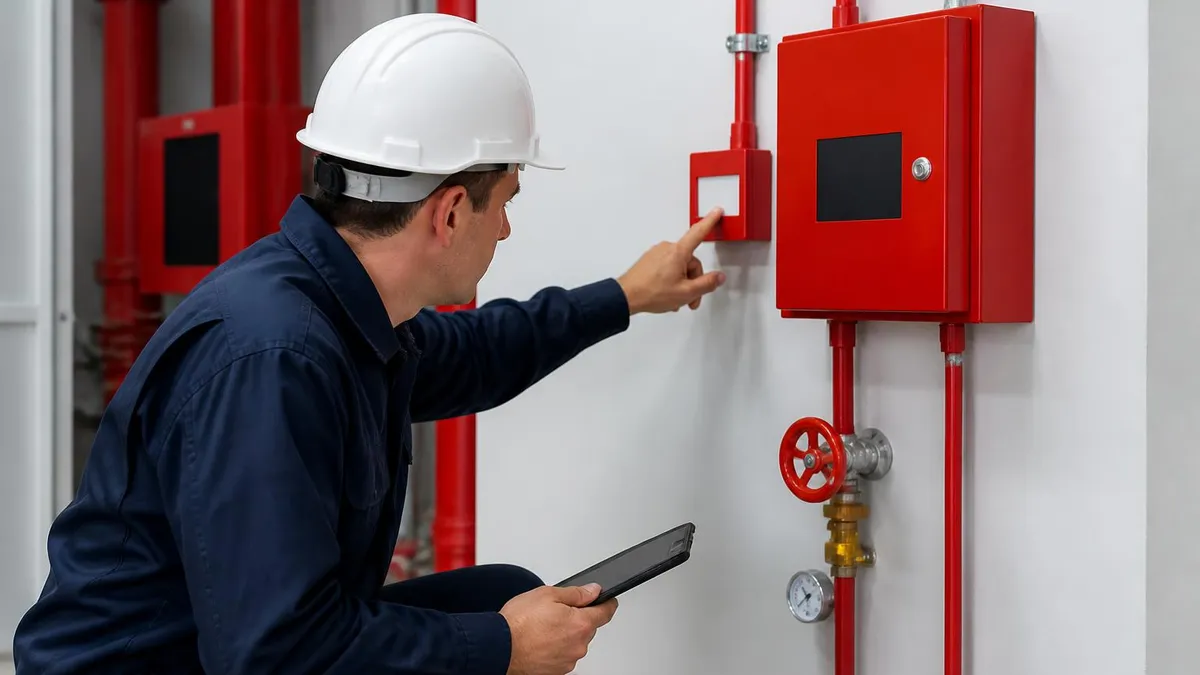
NFPA 13D Explained: Complete Guide to Sprinkler Systems in One- and Two-Family Dwellings and Manufactured Homes

NFPA 24: Complete Guide to the Standard for Private Fire Service Mains and Their Appurtenances

NFPA 1404: Complete Guide to the Standard for Fire Service Respiratory Protection Programs

NFPA 704 Placard: The Complete Guide to the Fire Diamond Hazard Identification System
About the Author

Certified Safety Professional & OSHA Compliance Expert
Indiana University of Pennsylvania Safety SciencesDr. William Foster holds a PhD in Safety Science from Indiana University of Pennsylvania and is a Certified Safety Professional (CSP) and Certified Hazardous Materials Manager. With 20 years of occupational health and safety management experience across construction, manufacturing, and chemical industries, he coaches safety professionals through OSHA certification, CSP, CHST, and safety management licensing programs.
Join the Discussion
Connect with other students preparing for this exam. Share tips, ask questions, and get advice from people who have been there.
View discussion (8 replies)