
NDT Techniques: The Complete Guide to Non-Destructive Testing Methods
Learn all major NDT techniques — ultrasonic, radiographic, magnetic particle, and more. Study guide, tips, and free practice questions. 📝

NDT techniques form the backbone of industrial quality assurance, allowing engineers and inspectors to evaluate the integrity of materials, welds, and components without causing any damage to the parts being tested. Whether you work in aerospace, oil and gas, power generation, or manufacturing, understanding the full spectrum of non-destructive testing methods is essential to passing your certification exam and performing safely in the field. The core premise is simple: detect flaws before they become failures, and do so without ever compromising the component's usability or structural integrity.
The American Society for Nondestructive Testing (ASNT) recognizes six major NDT methods as the industry standard: visual testing (VT), liquid penetrant testing (PT), magnetic particle testing (MT), radiographic testing (RT), ultrasonic testing (UT), and eddy current testing (ET). Beyond these core six, additional methods such as acoustic emission testing, leak testing, thermography, and guided wave ultrasonics have gained traction in specialized industries. Each method exploits a different physical principle to reveal different types of discontinuities, so seasoned inspectors must know when to apply which technique to get reliable results.
Choosing the right NDT technique depends on several interrelated factors: the type of material (ferromagnetic vs. non-ferromagnetic), the location of the expected defect (surface vs. subsurface vs. volumetric), the geometry of the component, access constraints, required sensitivity, and regulatory codes governing the inspection. A pipeline weld, for example, might require RT or UT to detect internal porosity, while a turbine blade surface might call for fluorescent PT or ET to catch tight fatigue cracks that would be invisible to a trained naked eye.
Certification in NDT techniques is governed by ASNT SNT-TC-1A, CP-189, and NAS 410 standards in the US, with Level I, Level II, and Level III designations that reflect increasing depth of technical knowledge and supervisory responsibility. Level I personnel perform inspections under close supervision, Level II can set up procedures and interpret results independently, and Level III personnel develop procedures, train others, and hold ultimate technical authority. Employers in sectors governed by ASME, API, and MIL specifications commonly require Level II or III certification before an inspector can sign off on a test record.
Preparing for an NDT certification exam means mastering not only the physical principles behind each method but also the equipment calibration procedures, reference standards, acceptance criteria, and documentation requirements that apply in real field conditions. Exam questions frequently test your ability to distinguish between similar-sounding concepts — for instance, the difference between a lamination and a delamination, or between sensitivity and resolution in ultrasonic testing. Understanding these distinctions at a deep level, rather than memorizing surface-level definitions, is what separates candidates who pass on the first attempt from those who do not.
If you are just starting your NDT journey, exploring comprehensive ndt techniques training resources will help you build the conceptual foundation you need before diving into method-specific practice questions and hands-on labs. A structured approach — starting with foundational physics, moving to equipment operation, and finishing with code applications — consistently outperforms cramming from practice tests alone. This article walks you through every major NDT method, compares their strengths and limitations, and gives you practical exam preparation strategies to maximize your score and your on-the-job effectiveness.
Throughout the sections below, you will find detailed breakdowns of each technique, side-by-side comparisons, study checklists, and links to free practice quizzes organized by method. Whether you are sitting for your first Level I exam or upgrading to Level III, this guide is designed to give you a complete, exam-ready understanding of the techniques that define the NDT profession in 2026 and beyond.
NDT Techniques by the Numbers

The Six Core NDT Methods at a Glance
The most fundamental NDT technique, VT uses direct or remote optical inspection to detect surface discontinuities. It requires no consumables, is the fastest method, and is always the first step in any inspection sequence before other methods are applied.
PT uses capillary action to draw a colored or fluorescent dye into surface-open discontinuities. After a developer is applied, indications become visible under white or UV light. Effective on metals, ceramics, and plastics but limited to surface-breaking defects only.
MT applies a magnetic field to ferromagnetic materials and then introduces fine iron particles. Flux leakage at discontinuities attracts the particles, forming a visible indication. Detects both surface and near-surface defects, but works only on ferromagnetic metals like carbon steel.
RT passes X-rays or gamma rays through a component onto film or a digital detector. Density variations caused by internal defects appear as contrast differences on the radiograph. Excellent for volumetric inspection of welds, castings, and complex assemblies.
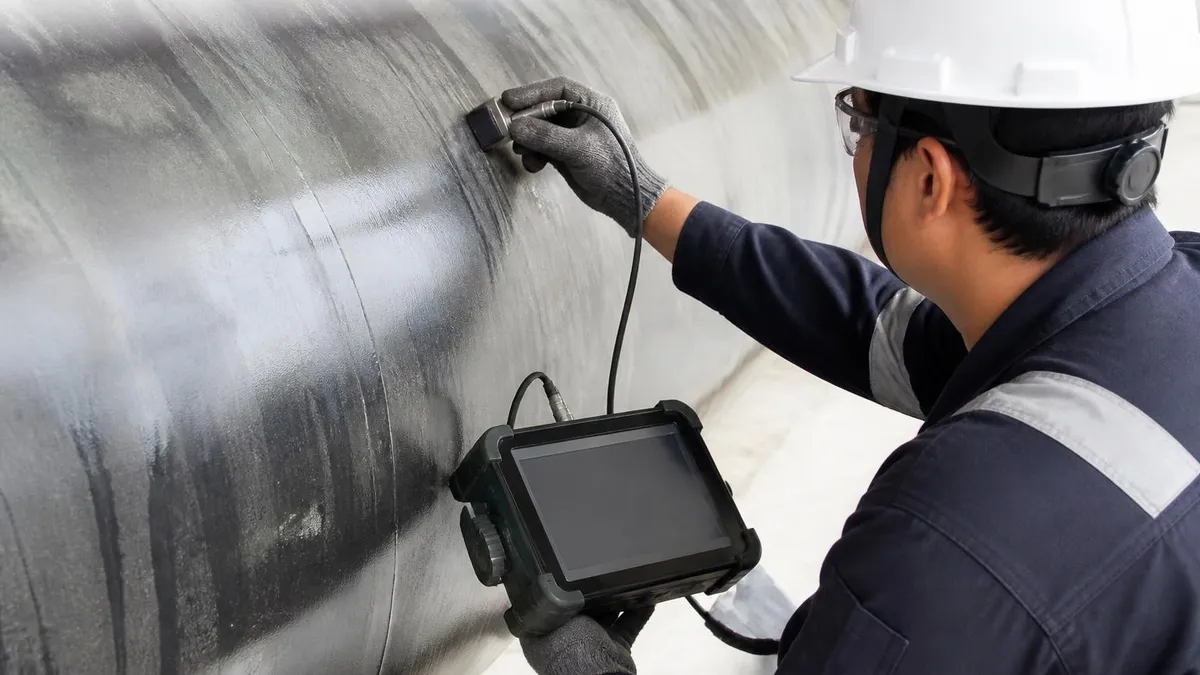
UT introduces high-frequency sound waves into a material via a transducer. Reflected echoes from internal boundaries and defects are displayed on an A-scan, B-scan, or C-scan. UT provides precise depth and sizing information and is widely used on welds, forgings, and composites.
Ultrasonic testing and radiographic testing are the two most technically demanding NDT techniques and together represent the largest portion of questions on ASNT Level II written exams. Ultrasonic testing operates by coupling a piezoelectric transducer to the test surface using a liquid couplant — typically water, glycerin, or a commercial gel — to transmit sound energy into the material. The transducer converts electrical energy into mechanical vibration at frequencies ranging from 0.5 MHz to 25 MHz depending on the application, with higher frequencies providing better resolution but less penetration depth into coarse-grained materials like austenitic stainless steel or cast iron.
In pulse-echo UT, the same transducer sends and receives sound pulses, measuring the time-of-flight of echoes to determine reflector depth. A-scan displays show amplitude versus time, giving inspectors a visual representation of the sound path through the material.
Calibration using reference blocks — most commonly the IIW (International Institute of Welding) block or the DSC (Distance-Sensitivity Calibration) block — establishes the distance-amplitude correction (DAC) curve that defines the minimum acceptable signal amplitude at any given depth. Any indication exceeding the DAC curve trigger level must be characterized and evaluated against the applicable acceptance code, such as AWS D1.1 for structural welds or ASME Section V for pressure vessel inspections.
Phased array ultrasonic testing (PAUT) has emerged as the preferred upgrade from conventional single-element UT in many modern facilities. PAUT uses a probe with multiple elements that can be individually excited with time delays to electronically steer and focus the sound beam at different angles and depths without physically moving the probe.
This produces a sectorial scan (S-scan) image that displays a fan of beam angles simultaneously, dramatically reducing inspection time while improving coverage and defect characterization accuracy. Encoded PAUT systems record position data alongside waveform data, enabling permanent digital records that replace traditional radiographic film in many pipeline and pressure vessel applications.
Radiographic testing uses ionizing radiation — either X-rays from an industrial X-ray tube or gamma rays from isotopes such as Iridium-192, Cobalt-60, or Selenium-75 — to create a shadow image of a component on film or a digital detector panel. The fundamental parameter that determines image quality is radiographic sensitivity, defined as the smallest detectable feature as a percentage of the material thickness.
ASTM E747 and E1025 define the penetrameter (IQI) standards used to verify that a radiograph meets the minimum required sensitivity before it can be used for defect evaluation. A 2-2T hole-type IQI placed on the source side of the weld, for example, confirms that holes equal to 2% of material thickness are detectable on that particular exposure.
Digital radiography (DR) and computed radiography (CR) have largely replaced film-based RT in many facilities due to faster processing times, better dynamic range, and the ability to digitally enhance images without additional exposures. However, film RT remains mandatory in some legacy codes and contracts, particularly in nuclear and military applications where code precedence takes priority over technology preference. Inspectors must understand the trade-offs: digital detectors offer real-time imaging and lower long-term consumable costs, while film provides a familiar, legally accepted permanent record with no equipment obsolescence risk over a 30-year archive period.
Gamma ray sources like Iridium-192 are favored for field work because they require no external power source and can be positioned inside pipes or vessels using crawler devices, enabling panoramic exposures of circumferential welds in a single shot. The trade-off is that gamma ray energy is fixed by the isotope's decay characteristics and cannot be adjusted the way an X-ray tube's kilovoltage can be tuned for different material thicknesses.
Cobalt-60's higher energy (1.17 and 1.33 MeV) makes it suitable for thick-section steel above 3 inches, but its high output also demands larger exclusion zones and heavier shielding during transport and storage, raising safety and logistical complexity significantly compared to Iridium-192.
Computed tomography (CT) represents the frontier of radiographic NDT, using multiple 2D projections taken at different angles to reconstruct a full 3D volumetric model of a component. Industrial CT systems are widely used in aerospace for composite inspection, electronics for solder joint analysis, and additive manufacturing to verify internal geometry against CAD models. While prohibitively expensive for general field use, CT is rapidly becoming the reference standard for complex castings and AM parts where conventional RT or UT cannot fully characterize volumetric defects with the spatial resolution required by modern design standards.
Surface, Near-Surface, and Volumetric NDT Techniques Compared
Surface NDT techniques — primarily visual testing, liquid penetrant testing, and magnetic particle testing — are designed to detect discontinuities that break the surface or lie within a few millimeters of it. PT is particularly sensitive to tight fatigue cracks and stress corrosion cracking because the capillary action pulls dye into even extremely narrow openings, making it indispensable for inspecting turbine components, aircraft skin panels, and pressure vessel nozzles where surface fatigue is the dominant failure mode.
MT excels on ferromagnetic surfaces because it can detect both surface-breaking and near-surface defects up to approximately 6 mm deep, depending on field strength and particle type. The choice between dry particle and wet fluorescent methods affects sensitivity significantly: wet fluorescent MT using UV illumination is far more sensitive than dry visible particle MT and is required by many aerospace codes such as AMS 2641. One limitation shared by both PT and MT is that they cannot inspect through coatings — painted or plated surfaces must be stripped first, adding time and cost to the inspection process.

Advantages and Limitations of NDT Techniques
- +Components remain in service immediately after inspection with no damage or downtime
- +Multiple methods can be combined on the same component for comprehensive defect coverage
- +Real-time or near-real-time results enable rapid accept/reject decisions on the production floor
- +Digital data recording (PAUT, DR, ET) creates permanent, auditable inspection records
- +Cost-effective compared to destructive testing, which sacrifices the component entirely
- +Applicable across a vast range of materials including metals, composites, ceramics, and polymers
- −Each method has specific limitations — no single NDT technique detects all defect types in all materials
- −PT and MT require thorough surface cleaning and preparation before inspection, adding process time
- −RT involves ionizing radiation, requiring licensed operators, exclusion zones, and strict safety protocols
- −UT on coarse-grained materials like austenitic stainless steel produces high background noise that masks small defects
- −ET is limited to electrically conductive materials and has restricted depth penetration in ferromagnetic metals
- −Advanced methods (PAUT, CT, TOFD) require expensive equipment and highly trained Level II/III personnel
Pros and Cons at a Glance
| Pros | Cons |
|---|---|
| Components remain in service immediately after inspection with no damage or downtime | Each method has specific limitations — no single NDT technique detects all defect types in all materials |
| Multiple methods can be combined on the same component for comprehensive defect coverage | PT and MT require thorough surface cleaning and preparation before inspection, adding process time |
| Real-time or near-real-time results enable rapid accept/reject decisions on the production floor | RT involves ionizing radiation, requiring licensed operators, exclusion zones, and strict safety protocols |
| Digital data recording (PAUT, DR, ET) creates permanent, auditable inspection records | UT on coarse-grained materials like austenitic stainless steel produces high background noise that masks small defects |
| Cost-effective compared to destructive testing, which sacrifices the component entirely | ET is limited to electrically conductive materials and has restricted depth penetration in ferromagnetic metals |
| Applicable across a vast range of materials including metals, composites, ceramics, and polymers | Advanced methods (PAUT, CT, TOFD) require expensive equipment and highly trained Level II/III personnel |
NDT Exam Prep Checklist — What to Know Before Test Day
- ✓Memorize the physical principle behind each of the six core ASNT NDT methods and the defect types each can and cannot detect.
- ✓Know the correct sequence of steps for PT: precleaning → penetrant application → dwell time → removal → developer → interpretation → postcleaning.
- ✓Understand the difference between continuous and residual magnetization in MT and when each is required by code.
- ✓Be able to calculate radiographic exposure factors using the inverse square law and material half-value layer data.
- ✓Practice reading A-scan displays and identifying back-wall echo, defect echo, and mode-converted signals in UT problems.
- ✓Study the skin effect equation for ET and understand how conductivity, permeability, and frequency affect inspection depth.
- ✓Review ASNT SNT-TC-1A qualification tables for education, training, and experience hours required at each certification level.
- ✓Know the difference between discontinuity, defect, flaw, and imperfection as defined by ASNT and applicable codes.
- ✓Practice time-limit management: ASNT Level II written exams allow roughly 90 seconds per question on average.
- ✓Complete at least two timed full-length practice exams under realistic conditions before your scheduled test date.
The Most Missed Topic on NDT Exams: Sensitivity vs. Resolution
Most first-time candidates confuse sensitivity (the ability to detect the smallest possible defect) with resolution (the ability to distinguish between two closely spaced defects as separate indications). In UT, higher frequency improves both sensitivity and resolution but reduces penetration depth. On ASNT written exams, questions that present a scenario with closely spaced weld defects and ask which transducer frequency to use are specifically testing whether you understand this trade-off — getting it wrong is one of the most common reasons candidates miss the passing threshold by a narrow margin.
Selecting the correct NDT technique for a given inspection scenario is not merely an academic exercise — it is a professional and often regulatory obligation that carries real safety consequences. The decision framework used by experienced Level III personnel begins with the material type: is it ferromagnetic? If yes, MT becomes a viable option for surface and near-surface defects. If non-ferromagnetic (aluminum, titanium, copper alloys, austenitic stainless steel), MT is entirely ruled out and PT or ET becomes the surface method of choice depending on the conductivity and geometry of the part.
The expected defect type is the second major decision driver. Fatigue cracks, stress corrosion cracking, and hydrogen-induced cracking are typically tight, planar discontinuities that are difficult to detect with RT because their narrow opening creates minimal density contrast on a radiograph unless the beam is precisely aligned with the crack plane.
UT and PT are far more reliable for tight cracks. In contrast, porosity, slag inclusions, and incomplete fusion in welds produce volumetric voids or density variations that are classic targets for RT, where they appear as clearly defined dark spots or irregular patterns against the lighter background of the base metal.
Geometry and access are the third dimension of method selection. A pipe weld can be inspected with RT using a panoramic technique if a crawler can position the source inside the pipe, but a T-joint or a fillet weld between structural members may prevent proper film placement for RT, making UT the only practical volumetric option. Similarly, PT on a complex casting with deep internal pockets may leave penetrant trapped in recesses that cannot be fully cleaned, generating non-relevant indications that complicate interpretation. In such cases, RT or CT provides a cleaner volumetric picture without the surface-preparation complexity.
Production volume and inspection speed considerations frequently determine which technique is economically viable at scale. Eddy current array (ECA) systems can scan large flat panels or complex contoured surfaces at rates of several square feet per minute, producing color-coded C-scan maps that allow one technician to cover what would require many hours of manual PT scanning.
Automated UT systems with encoded scanners and PAUT probes similarly allow rapid weld inspection on pipelines where manual scanning would create production bottlenecks. The initial capital investment in automated systems is substantial — a full PAUT system with encoders can cost $80,000 to $150,000 — but the labor savings on high-volume projects routinely justify the expenditure within a single contract.
Code and standard requirements often override purely technical considerations by mandating specific NDT techniques for particular applications regardless of alternatives that might be equally sensitive. ASME Section VIII for pressure vessels, for example, specifies which NDT methods are acceptable for different weld joint categories and material thicknesses.
AWS D1.1 for structural steel welding prescribes UT or RT for complete joint penetration welds in thick sections. API 1104 for pipeline welding allows RT, UT, and AUT (automated ultrasonic testing) for production weld inspection but sets specific qualification requirements for each. Knowing these code requirements is not optional for a working Level II inspector — it is a core job responsibility that exam questions directly test.
Environmental conditions also constrain technique selection in ways that are frequently overlooked until an inspector is in the field. PT cannot be performed below approximately 40°F (4°C) without using specially formulated low-temperature penetrant systems, because standard penetrant viscosity increases dramatically in cold environments, slowing capillary action and extending required dwell times.
UT couplant also freezes in cold weather, requiring heated couplant reservoirs or alternative couplant formulations for outdoor winter inspections. RT exclusion zones become extremely difficult to maintain in congested industrial facilities, sometimes requiring night-shift scheduling when surrounding workers are not present — adding cost and logistical complexity that must be factored into project planning.
Emerging NDT technologies are steadily expanding the technique selection matrix available to inspectors. Laser ultrasonics uses pulsed laser energy to generate and detect ultrasonic waves without physical contact, enabling UT inspection of components at high temperature — up to 1,000°C — or with complex geometries where a conventional transducer cannot make reliable contact.
Full-waveform inversion (FWI) adapted from seismic exploration is now being applied to industrial UT data sets to reconstruct quantitative images of defect shape and size with sub-wavelength resolution. Artificial intelligence defect recognition systems trained on thousands of RT and PAUT data sets can now flag potential defect indications in real time, reducing the cognitive burden on inspectors and improving consistency across multiple reviewers on large projects.

ASNT SNT-TC-1A requires that all training hours, education, and documented field experience be verified by your employer's NDT Written Practice Procedure before you sit for a Level II or Level III exam. Many candidates complete their training and lab hours but fail to get proper documentation signed before submitting their exam application, resulting in rejected applications and delayed certification by weeks or months. Confirm your employer's Written Practice Procedure requirements with your Level III supervisor at least 60 days before your planned exam date to avoid this common and entirely preventable setback.
Building a successful career in NDT requires more than passing the written exam — it requires a deliberate strategy for accumulating certifications in the right methods, targeting industries with strong demand, and positioning yourself for advancement to Level III and supervisory roles.
The most in-demand NDT certifications in the US job market as of 2026 are UT Level II (especially PAUT), RT Level II with digital radiography skills, and MT/PT Level II for aerospace manufacturing. Candidates who hold certifications in three or more methods command significantly higher salaries than single-method specialists and are far more competitive for lead inspector and quality supervisor positions.
The oil and gas sector remains the single largest employer of NDT professionals in the United States, driven by ongoing pipeline inspection, refinery turnaround maintenance, and offshore platform structural integrity programs. API codes — particularly API 570 (piping inspection), API 510 (pressure vessel inspection), and API 653 (aboveground storage tank inspection) — define the inspection requirements for these assets, and inspectors who combine ASNT Level II certification with an API inspector credential can expect salaries 20% to 35% higher than ASNT-only certified peers. The combination demonstrates both NDT technique proficiency and code-level knowledge of fitness-for-service evaluation.
Aerospace NDT is governed primarily by NAS 410 and the Aerospace NDT Board (ANAB) accreditation framework, which imposes stricter initial training hour requirements and more frequent recertification intervals than ASNT SNT-TC-1A. Aerospace Level II inspectors typically must re-demonstrate proficiency every 12 months and submit to annual vision acuity testing, compared to the 5-year recertification cycle under SNT-TC-1A.
The demanding requirements reflect the zero-defect tolerance philosophy of aerospace manufacturing, where an undetected crack in a turbine disk or airframe structure can cause a catastrophic accident with no warning. The compensation premium is correspondingly significant, with aerospace NDT Level II inspectors in major aviation hubs earning $75,000 to $95,000 annually.
Nuclear power plant NDT operates under the strictest regulatory framework of any domestic industry, governed by ASME Section XI (in-service inspection), 10 CFR 50 (NRC regulations), and utility-specific programs that require qualification under the Performance Demonstration Initiative (PDI). PDI qualification is a rigorous process in which inspectors must detect actual or representative flaws in blind specimens at a frequency that meets statistical performance requirements — it is not enough to simply know the procedure; you must demonstrate real detection capability under controlled, documented conditions.
PDI-qualified UT inspectors for reactor pressure vessel and primary coolant piping inspection are among the highest-paid NDT professionals in the country, with experienced individuals commanding $120,000 or more per year plus per diem during outage seasons.
Advancement to NDT Level III requires not only deep technical mastery but also strong written communication skills, because Level III professionals are responsible for developing Written Practice Procedures (WPPs) and inspection procedures that will guide Level I and II inspectors in the field. These documents must be clear, code-compliant, and technically defensible under audit by clients, third-party auditors, or regulatory bodies. Many Level III candidates underestimate the document-writing component of the role and are surprised to find that a significant portion of the ASNT Level III Basic exam tests technical writing judgment and procedure structure rather than physics equations.
Continuing education in NDT is not optional at any level — it is a professional obligation enforced by the recertification requirements of your certification body and expected by quality-conscious employers. Organizations like ASNT, the American Welding Society (AWS), and the API offer annual conferences, regional section meetings, and online webinars that expose working inspectors to emerging technologies, code changes, and industry research.
Staying current with ASME, AWS, and API code cycles — which publish new editions and addenda on regular schedules — is particularly critical because using an outdated edition of a code on a current contract can invalidate inspection records and expose your employer to significant contractual and liability risk.
Resources for exam preparation have never been more accessible, with online practice platforms, video lecture series, and downloadable reference summaries available for every major NDT method. The most effective exam preparation strategy combines structured study of the ASNT Study Guides for your method(s), completion of employer-approved training with hands-on lab time on actual equipment, and extensive practice with timed multiple-choice questions that mirror the format and difficulty of the actual certification exam.
Building on comprehensive ndt techniques study resources and supplementing with method-specific practice tests will position you to pass your exam confidently and perform at a high level from your very first day in the field.
Practical preparation for NDT certification exams demands a structured weekly study schedule rather than marathon cramming sessions in the days before your test. Cognitive science research consistently shows that spaced repetition — reviewing material at increasing intervals over several weeks — produces dramatically better long-term retention than massed practice.
For a typical ASNT Level II written exam covering method-specific and general knowledge, a 6-to-8-week preparation period with 10 to 15 hours of study per week is the approach most consistently reported by first-time passers, based on feedback from instructors at major NDT training centers such as those affiliated with ASNT and the NDTE (NDT Education) consortium.
In your first two weeks, focus exclusively on the physical principles underlying your target method. For UT, this means studying acoustic wave propagation, the relationship between frequency and wavelength, Snell's law applied to mode conversion at interfaces, near-field and far-field beam characteristics, and the decibel scale as it applies to signal amplitude comparisons.
For PT, focus on the chemistry of penetrant systems, the capillary action mechanism, dwell time variables (temperature, penetrant viscosity, defect geometry), and the difference between Type I fluorescent and Type II visible dye systems. Getting the physics right in weeks one and two makes everything downstream — equipment calibration, procedure steps, code applications — much easier to understand and remember.
Weeks three and four should shift emphasis to equipment operation and calibration procedures. For UT, practice setting up a DAC curve from scratch using a stepped reference block, and work through multiple examples of calculating sweep range and beam spread for different transducer frequencies and diameters.
For RT, work through exposure chart problems using multiple source types and material thicknesses, calculate required IQI sensitivity, and practice identifying acceptable versus unacceptable radiographic technique parameters per ASME Section V Table T-276. Hands-on lab access during this phase is extremely valuable — many concepts that seem abstract when reading the ASNT Study Guide click immediately when you actually touch the equipment and observe the effects in real time.
During weeks five and six, shift your attention to code applications and acceptance criteria. This phase requires knowing not just what a code says but how to apply it to a specific scenario described in an exam question. Practice reading acceptance criteria tables from AWS D1.1, ASME Section VIII, and API 1104, and work through scenario-based questions that present an inspection result and ask you to determine whether the weld is acceptable or rejectable.
These questions require you to identify the applicable code, find the correct table or paragraph, apply the acceptance criterion, and render a correct accept/reject decision — all within roughly 90 seconds per question under exam conditions.
The final one to two weeks before your exam should be devoted almost entirely to timed full-length practice exams. Use a timer and simulate actual exam conditions: no notes, no pausing, no phone. After each practice exam, review every question you missed or guessed on, trace your error back to a specific knowledge gap, and revisit the relevant ASNT Study Guide section or reference standard.
Track your scores across multiple practice exams to identify whether your performance is improving, plateauing, or declining in specific topic areas. If you consistently miss ET questions about impedance plane analysis, that is a signal to go back to the foundational material rather than simply doing more practice questions from the same pool.
Managing exam-day logistics reduces cognitive load and helps you perform at your actual ability level rather than a stress-degraded version of it. Confirm your exam location and format (paper-based or computer-based) at least two weeks in advance. Bring valid government-issued photo ID, any reference materials explicitly permitted by the administering organization (ASNT Basic closed-book exams permit no references; some employer-administered exams allow specific tables), and comfortable writing instruments.
Arrive at least 30 minutes early to complete check-in, settle into the room, and clear your working memory of travel stress before the clock starts. Eat a protein-rich meal beforehand to sustain concentration over the two-to-four-hour exam duration without energy crashes.
After you pass, invest in building your practical skills as aggressively as you built your exam knowledge. A freshly certified Level II who cannot efficiently set up a UT calibration in the field, read and record a liquid penetrant indication accurately, or communicate a clear accept/reject decision to a welding engineer is not yet a fully functional inspector — the certification is the entry ticket, not the destination.
Seek out experienced Level III mentors, volunteer for the most technically challenging inspections your employer handles, and ask detailed questions about the reasoning behind procedure parameters and code requirements. The inspectors who advance fastest in their careers are those who treat every inspection as a learning opportunity, not just a task to complete and sign off.
Sample NDT - Non-Destructive Testing Practice Questions
Try these questions from our free NDT - Non-Destructive Testing practice tests. The correct answer and an explanation follow each question.
What distinguishes an NDT 'technique' from an NDT 'method'?
- A. A technique is a broader category; a method is a specific application
- B. A technique is a specific application or variation within a method
- C. They are interchangeable terms
- D. A technique refers to the equipment used
Answer: B. A technique is a specific application or variation within a method
A technique is a specific way of applying an NDT method, such as pulse-echo or through-transmission being techniques within the ultrasonic method.
Which leak testing technique is classified as a 'through-wall' method?
- A. Visual inspection
- B. Acoustic emission monitoring
- C. Thermal imaging
- D. Magnetic particle testing
Answer: B. Acoustic emission monitoring
Acoustic emission detects stress waves generated by active leaks passing through the wall of a structure, making it a through-wall technique.
When two eddy current frequencies are used simultaneously (multifrequency technique), the primary reason for mixing channels is to:
- A. Double the penetration depth into the test material
- B. Suppress a specific interfering signal while retaining defect sensitivity
- C. Increase the overall test speed by a factor of two
- D. Eliminate the need for reference standards
Answer: B. Suppress a specific interfering signal while retaining defect sensitivity
Multifrequency mixing subtracts one channel's signal from another to cancel a known interference (such as support plate signals) while preserving sensitivity to defects.
Which leak testing method is most appropriate for detecting very small leaks in hermetically sealed electronic packages?
- A. Hydrostatic pressure testing
- B. Helium mass spectrometer leak testing
- C. Bubble immersion testing
- D. Dye penetrant testing
Answer: B. Helium mass spectrometer leak testing
Helium mass spectrometer leak testing is the most sensitive method available and is widely used for hermetically sealed electronic components.
NDT Questions and Answers
NDT Training: Complete Guide to Non-Destructive Testing Certification Courses in 2026
NDT Practice Test PDF (Free Printable 2026)

NDT Training Courses: Complete Guide to Programs, Certification & Career Requirements
NDT Test Video Answers

NDT and Welding: The Complete Guide to Non-Destructive Testing for Weld Quality Assurance
About the Author

Educational Psychologist & Academic Test Preparation Expert
Columbia University Teachers CollegeDr. Lisa Patel holds a Doctorate in Education from Columbia University Teachers College and has spent 17 years researching standardized test design and academic assessment. She has developed preparation programs for SAT, ACT, GRE, LSAT, UCAT, and numerous professional licensing exams, helping students of all backgrounds achieve their target scores.