
NDT Lab: Complete Guide to Non-Destructive Testing Laboratory Facilities, Methods, and Career Preparation
Learn what an NDT lab does, which methods are used, how facilities are structured, and how to prepare for certification. 🔎 Complete 2026 October guide.

An NDT lab is a specialized facility where trained technicians apply non-destructive testing methods to evaluate the integrity, composition, and performance of materials and components without causing any damage. These laboratories are found across aerospace, manufacturing, oil and gas, power generation, and construction industries, serving as the frontline defense against catastrophic equipment failures. Understanding how a modern NDT lab operates is essential for anyone pursuing a career in inspection, quality assurance, or materials science, because the laboratory environment shapes every practical skill a technician develops.
NDT laboratories range from small, single-method shops equipped with only a liquid penetrant station to large, multi-method facilities capable of running radiographic, ultrasonic, magnetic particle, eddy current, and visual inspection simultaneously. The size and scope of any given lab depends on the industry it serves, the volume of parts inspected, and the regulatory standards governing that sector.
Aerospace NDT labs, for example, must comply with strict FAA and NADCAP accreditation requirements, while a small fabrication shop may operate under AWS welding inspection codes. Knowing the regulatory backdrop of a specific lab environment is just as important as mastering the hands-on techniques performed within it.
Technicians who work in an ndt lab environment are expected to understand not only how to operate sophisticated equipment but also how to document findings, interpret indications, and communicate results to engineers and quality managers. This combination of technical skill and professional judgment is what separates a competent NDT professional from someone who simply follows a checklist. Certification bodies such as ASNT, the American Society for Nondestructive Testing, establish the training and examination standards that define competency at each method level, from Level I through Level III.
The physical layout of a well-organized NDT lab reflects the logical flow of inspection work. Incoming parts arrive at a receiving area where they are logged, cleaned if necessary, and staged for the appropriate inspection method. Each method station — whether it is a fluorescent penetrant line, an ultrasonic immersion tank, or a digital radiography suite — is designed to maximize throughput while maintaining strict contamination controls. For methods like liquid penetrant testing, separate zones for pre-cleaning, application, development, and interpretation are maintained to prevent cross-contamination and ensure repeatable results across different operators and shifts.
Safety is a cornerstone of any NDT lab operation. Radiographic testing stations require shielded rooms, radiation dosimetry badges for all personnel, and formal radiation safety officer oversight. Magnetic particle inspection involves strong magnetic fields and fluorescent inks that require ventilation and UV-light safety protocols. Even seemingly low-hazard methods like ultrasonic testing involve repetitive motion risks and exposure to coupling gels that require proper handling. Understanding the safety requirements for each method area is a mandatory part of any technician's initial training and is revisited regularly through refresher courses and internal audits.
For students and early-career professionals, visiting or working in an NDT lab is often the most significant part of their educational journey. Classroom instruction provides the theoretical foundation — understanding wave propagation in ultrasonics, the capillary action principles behind liquid penetrant testing, or the electromagnetic induction concepts governing eddy current methods — but it is hands-on lab time that converts abstract knowledge into reliable skill. Many certification programs, including those accredited by ASNT SNT-TC-1A, specify minimum documented hours of hands-on experience in each method before a candidate is eligible to sit for a written or practical examination.
This article explores the structure of a professional NDT lab, the methods practiced within it, the career opportunities available, and the practical steps you can take to prepare for certification. Whether you are exploring NDT as a new career path or deepening your expertise as a working technician, understanding the lab environment will accelerate your professional development and improve your inspection outcomes in every setting you encounter.
NDT Lab Industry by the Numbers

Types of NDT Laboratory Facilities
Located on the production floor, these labs inspect components at various manufacturing stages. They use high-volume automated systems and are closely integrated with quality control workflows to catch defects before assembly, reducing rework costs and ensuring dimensional and structural conformance.
Third-party facilities that accept parts from multiple clients across industries. These labs typically hold NADCAP, ISO 17025, or ASNT accreditations to demonstrate impartiality and technical competence. They are commonly used by aerospace OEMs, oil and gas operators, and defense contractors for specialized or high-stakes inspections.
Fully equipped vans or portable kits that bring NDT capabilities to pipelines, bridges, offshore platforms, and remote job sites. Technicians in mobile labs must be proficient in adapting standard lab procedures to variable conditions including temperature extremes, limited lighting, and confined-space access challenges.
Academic and vocational training facilities designed to develop technician competency in a controlled environment. They use calibration blocks, weld coupons, and intentionally flawed specimens so students can practice detecting realistic discontinuities. Many offer hands-on hours that count toward ASNT certification experience requirements.
R&D NDT labs focus on advancing inspection methods rather than routine production work. They develop new sensor technologies, phased array ultrasonic techniques, computed tomography protocols, and automated robotic inspection systems for next-generation industrial applications in aerospace and nuclear sectors.
The methods practiced in a professional NDT lab are determined by the materials being inspected, the types of discontinuities expected, and the acceptance standards specified by the applicable code or customer requirement. Liquid penetrant testing, often called PT, is among the most widely used lab methods because it works on any non-porous material — metals, ceramics, and plastics alike — and requires relatively inexpensive equipment.
The process involves applying a penetrant to a cleaned surface, allowing it to dwell, removing excess penetrant, and applying a developer that draws the penetrant out of surface-breaking flaws to form visible indications that the inspector interprets and records.
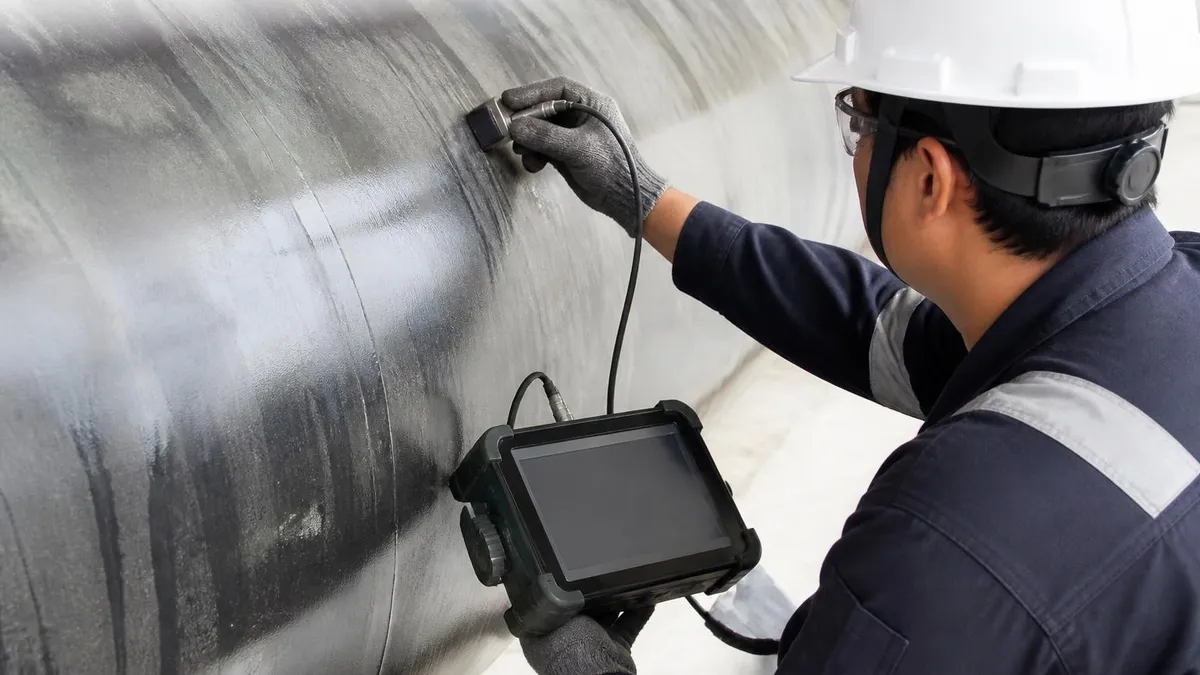
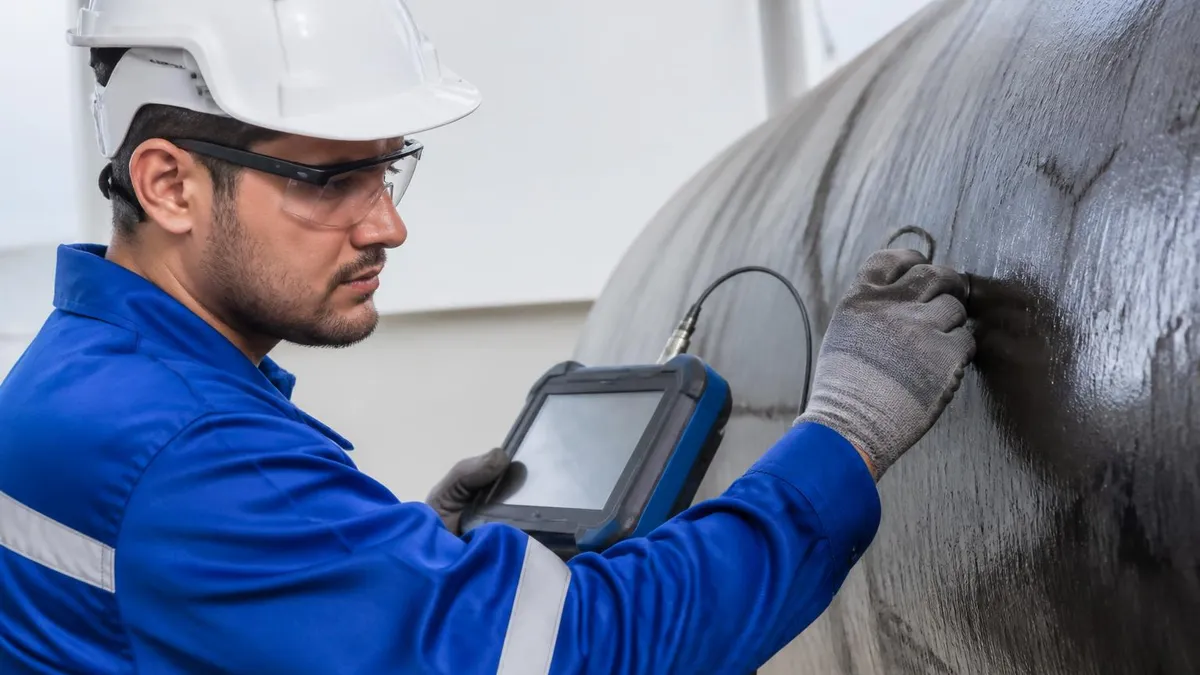
Ultrasonic testing, commonly abbreviated UT, is arguably the most versatile and powerful method in the NDT lab toolkit. High-frequency sound waves are introduced into a component using a transducer, and the returning echoes are analyzed to detect internal discontinuities such as voids, cracks, inclusions, and delaminations. Conventional UT uses a single-element transducer, while phased array ultrasonic testing (PAUT) uses a multi-element probe that can electronically steer and focus the sound beam, producing cross-sectional images of the component interior. PAUT has become the preferred method in aerospace weld inspection and pipe-to-fitting examinations where precise flaw sizing and positioning are required.
Magnetic particle testing, known as MT, is used exclusively on ferromagnetic materials. A magnetic field is induced in the part, and iron oxide particles — either dry powder or wet fluorescent suspension — are applied to the surface. Where magnetic flux leaks from a surface or near-surface discontinuity, the particles collect to form an indication that reveals the flaw's shape, orientation, and relative severity.
MT is widely used in the inspection of welds, forgings, and castings in the power generation and heavy equipment industries, and it is one of the methods for which a trainee will spend significant lab time developing the muscle memory and visual acuity needed to correctly identify relevant indications.
Radiographic testing, or RT, involves directing X-rays or gamma rays through a component onto a detector — traditionally film but increasingly a digital flat-panel detector or computed radiography (CR) phosphor plate. The density variations in the resulting image reveal internal flaws such as porosity, lack of fusion, cracks, and inclusions.
RT provides a permanent, reviewable record of the inspection and is required by many codes including ASME Section V for pressure vessel welds. Working in an RT bay requires radiation safety training, and most jurisdictions require technicians to pass a radiation worker safety examination before they are authorized to operate radiographic equipment independently.
Eddy current testing uses electromagnetic induction to detect surface and near-surface discontinuities in conductive materials. When an alternating current coil is placed near a conductive part, it induces eddy currents in the material. Flaws, conductivity changes, and dimensional variations disrupt these currents, producing a measurable impedance change in the probe coil.
ET is exceptionally fast and can be automated for high-volume tubing inspection, aircraft skin scanning, and heat exchanger tube testing. Because it is sensitive to many variables simultaneously — conductivity, permeability, geometry, and lift-off — interpreting eddy current signals demands substantial training and practical experience before a technician can reliably distinguish relevant indications from noise.
Visual testing, or VT, is the foundation of all other NDT methods and is often underestimated by newcomers. Direct VT requires unobstructed access and suitable illumination, while remote VT uses borescopes, endoscopes, pan-tilt-zoom cameras, and robotic crawlers to inspect areas inaccessible to direct observation.
Augmented reality overlays and AI-assisted image analysis are being integrated into modern VT systems to improve defect detection probability and reduce technician fatigue during long inspection campaigns. Any technician working in an NDT lab environment should be proficient in VT before advancing to more specialized methods, as the ability to recognize surface conditions, joint geometries, and environmental factors is the common visual language underlying every other technique.
Leak testing rounds out the primary lab methods and encompasses a surprisingly wide range of techniques — from simple bubble testing using soapy water, to pressure and vacuum decay methods, to helium mass spectrometry for ultra-sensitive leak detection on cryogenic or high-vacuum systems. Understanding which leak testing technique to apply requires knowledge of acceptable leak rates, the nature of the contained media, and the sensitivity required by the applicable specification. Technicians specializing in leak testing often find employment in the HVAC, semiconductor, pharmaceutical packaging, and compressed gas industries, where containment integrity is both a safety imperative and a regulatory requirement.
NDT Lab Accreditation, Standards, and Compliance
NADCAP, the National Aerospace and Defense Contractors Accreditation Program, is the gold standard for NDT lab accreditation in the aerospace supply chain. Achieving NADCAP accreditation requires a laboratory to demonstrate compliance with specific NDT checklists covering equipment calibration, procedure qualification, personnel certification, and record keeping. Audits are performed by eAuditNet, and findings must be closed within defined timelines or the lab risks losing its approved supplier status with major OEMs including Boeing, Airbus, and General Electric Aviation.
For labs pursuing or maintaining NADCAP status, the investment in documentation and process control is substantial. Each NDT method requires its own checklist and may require separate audits. Training records, equipment calibration logs, written practice documents, and procedure approvals must all be current and readily retrievable. Technicians working in NADCAP-accredited labs are typically required to hold ASNT certification at Level II or above and to complete recurring annual training to maintain their qualifications under the lab's written practice.

Working in an NDT Lab: Advantages and Challenges
- +Stable demand across aerospace, oil and gas, power, and manufacturing sectors keeps NDT lab employment consistent even during economic downturns
- +Multiple method specializations allow technicians to diversify skills and command higher salaries as they advance from Level I to Level III
- +Hands-on work in a lab environment is intellectually engaging, combining physics, materials science, and practical problem-solving on every shift
- +ASNT certification is internationally recognized, enabling career mobility across states and countries without repeating the entire credentialing process
- +NDT lab work directly contributes to public safety — inspecting aircraft components, pressure vessels, and pipelines prevents failures that could injure or kill people
- +Growing adoption of phased array UT, computed radiography, and automated eddy current systems creates continuous opportunities to learn advanced technology
- −Radiographic testing lab environments expose technicians to ionizing radiation, requiring strict dosimetry monitoring and administrative dose limits
- −Physical demands of lab work — prolonged standing, repetitive scanning motions, and working in confined spaces during field assignments — can cause musculoskeletal strain over time
- −Certification maintenance requires ongoing training hours and periodic recertification examinations, creating a continuous time and cost burden for working technicians
- −High-consequence inspection decisions create significant professional and legal liability, particularly in safety-critical aerospace and nuclear applications
- −Entry-level Level I positions often pay modestly compared to other technical trades, requiring several years of experience before earnings reach their full potential
- −Night shifts, travel to remote job sites, and call-out work for emergency inspections are common in field-adjacent NDT lab roles, affecting work-life balance
NDT Lab Certification Preparation Checklist
- ✓Confirm your target method and level align with your employer's written practice or the ASNT CP-189 central certification pathway
- ✓Accumulate the minimum documented hands-on experience hours required by SNT-TC-1A for each method at your target level
- ✓Complete a formal training course from an ASNT-approved training provider covering both theoretical and practical components
- ✓Study the applicable codes and standards — ASME Section V, AWS D1.1, ASTM E standards — relevant to your inspection environment
- ✓Practice interpreting real or representative weld coupons, calibration blocks, and intentionally flawed specimens under timed conditions
- ✓Take multiple full-length practice examinations covering all general, specific, and practical knowledge areas for your target method
- ✓Review the Level II vision acuity requirements and schedule your Jaeger and Snellen eye examination well before your certification exam date
- ✓Organize your training records, experience log, and supervisor attestations into a complete application package for submission
- ✓Schedule your written general and specific examinations through your employer's Level III or through ASNT's online examination portal
- ✓Complete your practical examination on representative test specimens under the observation of a certified Level III examiner
Hands-On Hours Are Non-Negotiable
ASNT SNT-TC-1A requires a minimum of 400 documented hours of hands-on experience for Level II certification in ultrasonic testing — more than any other common NDT method. Starting your experience log from day one of training, even in a student role, is the single most important administrative step you can take to accelerate your certification timeline and avoid delays when you are ready to test.
Career paths within the NDT lab world are more varied than most newcomers expect. The most straightforward trajectory moves a technician from Level I to Level II to Level III within a single method such as ultrasonic testing, with each advancement bringing broader inspection authority, higher pay, and greater responsibility for procedure development and personnel oversight.
However, many experienced technicians choose to multi-method, earning certification in three or more techniques to increase their employability and their value to employers who need flexible lab staffing. A technician certified in UT, PT, and MT, for example, can cover the vast majority of surface and volumetric inspection needs across manufacturing and fabrication environments.
The Level III path is particularly rewarding and demanding. An ASNT Level III certification requires passing a comprehensive written examination covering basic principles, method-specific theory, and a practical component administered by ASNT. Level III holders are responsible for writing and approving inspection procedures, interpreting and applying codes and standards, qualifying and certifying Level I and II personnel, and serving as the technical authority for all inspection decisions within their lab. Many Level III technicians also consult independently, reviewing procedures for multiple clients or serving as expert witnesses in litigation involving material failures or inspection disputes.
Specialty roles within NDT labs also offer compelling career branches. Phased array ultrasonic testing specialists command premium salaries in pipeline and pressure vessel inspection because PAUT requires sophisticated data acquisition and analysis software skills on top of the traditional UT foundation. Radiographic film interpreters who are proficient in both conventional X-ray and computed tomography are in high demand from aerospace clients. Automated eddy current technicians who can program robotic scanning systems find employment in nuclear steam generator inspection, one of the most technically demanding and well-compensated niches in the entire NDT profession.
Quality assurance and laboratory management roles represent another career branch for experienced NDT professionals. Many labs need managers who understand the technical side of inspection work deeply enough to set up calibration systems, manage equipment lifecycles, interface with accreditation auditors, and train junior staff. Transitioning from hands-on inspection to lab management typically requires developing business acumen alongside technical expertise — understanding budgeting, client management, regulatory compliance, and human resources in addition to maintaining current technical certifications.
The intersection of NDT with data science and artificial intelligence is creating entirely new career possibilities that did not exist a decade ago. Machine learning algorithms trained on large datasets of radiographic images, phased array B-scans, and eddy current signals are being developed to assist or automate flaw detection and sizing.
NDT professionals with programming skills, data analysis experience, and deep method expertise are uniquely positioned to lead these development efforts or to serve as the domain-expert interpreters who validate AI-assisted inspection systems before they are deployed in safety-critical applications. This emerging field combines the rigor of traditional NDT with the innovation of technology development.
Compensation in NDT lab work varies significantly by industry, location, level of certification, and method specialty. Entry-level Level I positions in general manufacturing might start around $18 to $22 per hour, while an experienced Level II UT technician in the oil and gas or aerospace sector can earn $75,000 to $95,000 annually.
Level III professionals managing labs or serving as independent consultants frequently exceed $100,000 per year, particularly in nuclear, defense, and aerospace markets where the combination of technical depth and regulatory expertise is genuinely scarce. Geographic hotspots for NDT employment include Houston, Texas (oil and gas), Wichita, Kansas (aerospace manufacturing), and the Gulf Coast region (offshore and petrochemical).
Professional development does not stop after initial certification. ASNT offers a strong library of continuing education resources through its NDT Handbook series, annual conference proceedings, and online training modules. Active membership in ASNT provides access to peer networking, job boards, and regional section meetings where technicians share new techniques, discuss code changes, and build the professional relationships that often lead to career-advancing opportunities. For anyone serious about building a long-term career in NDT lab work, active participation in the professional community is as important as keeping certifications current.

ASNT CP-189 central certifications expire every five years and require documented continuing education and a recertification examination. Employer certifications under SNT-TC-1A may have shorter renewal cycles defined by the company's written practice — often annually for Level I and every three years for Level II. Letting a certification lapse can immediately disqualify you from performing inspection work on safety-critical components, so calendar reminders for renewal deadlines should be set the day you receive any new certification card.
Preparing effectively for NDT lab certification examinations requires a structured study approach that balances theoretical study with practical application. Many candidates make the mistake of focusing exclusively on one or the other — memorizing formulas without understanding the underlying physics, or spending all their time scanning specimens without developing the conceptual framework needed to interpret ambiguous indications correctly. The written examination tests whether you understand why a technique works, not just that it does, so every study session should connect hands-on observations to the underlying principles that explain them.
Building a strong theoretical foundation starts with the relevant ASNT study guides and the NDT Handbook volumes published for each method. For ultrasonic testing, this means understanding wave modes, velocity equations, near-field and far-field effects, beam divergence, refraction angles, and the decibel math used to calibrate sensitivity.
For penetrant testing, it means understanding surface tension, contact angle, wettability, and how developer particle size affects bleed-out and indication visibility. These are not abstract concepts — they directly govern how you adjust your technique in response to what you observe on actual parts, and exam writers know this, which is why calculation-based and application-judgment questions appear on every Level II written exam.
Practice examinations are one of the most efficient tools for certification preparation. A well-designed practice test exposes you to the question style, the vocabulary, and the level of conceptual depth expected by the examining body. More importantly, reviewing the detailed explanations for questions you answer incorrectly helps you identify the specific knowledge gaps that would otherwise cost you points on the real exam. Taking timed practice exams also builds the pacing discipline needed to complete 80 or more questions within the allotted time without rushing and making avoidable errors in the final minutes.
For candidates preparing for the practical examination component, deliberate practice on intentionally flawed specimens is the most effective preparation method. ASNT and many training providers offer calibration blocks and weld coupons with known flaws of specific types, sizes, and orientations. Practicing on these specimens while recording your indications, sizing your measurements, and comparing your results against the documented answer key develops the repeatable technique and confident judgment that examiners look for during the practical assessment.
It is worth noting that practical exams often penalize false calls — indications reported where none exist — as heavily as missed defects, so developing sensitivity to the difference between relevant indications and non-relevant geometric or surface reflections is critical.
Study groups and mentored practice sessions with a certified Level III are invaluable for candidates who have access to them. A Level III mentor can observe your technique, identify inefficiencies in your scanning pattern or equipment setup, explain the code basis for acceptance criteria you may find arbitrary, and share the kind of experiential knowledge that cannot be found in any textbook. If your current employer does not offer formal mentoring, professional associations like ASNT regional sections often connect junior technicians with experienced members who are willing to offer informal guidance or co-study sessions ahead of certification exams.
Time management during active certification preparation is another underappreciated factor. Most candidates working toward NDT lab certification are doing so while already employed full-time, often accumulating their required experience hours during the same period. Building a realistic weekly study schedule — dedicating specific evenings or weekend mornings to review rather than studying in unstructured bursts — produces far better retention and reduces the anxiety that comes from cramming in the final days before an exam.
Spacing your study sessions over eight to twelve weeks, with cumulative review of earlier material at regular intervals, exploits the well-documented spacing effect in memory consolidation and leads to more durable knowledge retention under exam pressure.
Finally, the role of online practice resources has grown substantially in recent years and represents an accessible, low-cost complement to formal classroom training. Platforms that offer method-specific practice questions, timed full-length mock exams, and performance analytics by knowledge domain allow candidates to identify their weakest areas with precision and target their remaining study time accordingly.
Used alongside hands-on lab practice and a thorough reading of the applicable codes and standards, these digital tools provide a comprehensive preparation ecosystem that gives serious candidates the best possible chance of passing on their first attempt and beginning their NDT lab career with confidence and competence.
Succeeding in an NDT lab career over the long term requires more than passing examinations and accumulating certifications. The technicians who build the most respected careers in this field combine technical mastery with a genuinely inquisitive mindset — they want to understand why an indication looks the way it does, not just how to classify it against an acceptance criterion. This curiosity drives continuous learning and positions experienced technicians to contribute to procedure improvement, technology adoption, and the mentoring of the next generation of lab professionals.
Equipment calibration discipline is one of the hallmarks that distinguishes excellent NDT lab technicians from merely competent ones. Calibration is not a bureaucratic requirement to be completed as quickly as possible before starting a job — it is the foundation upon which every measurement and comparison in the inspection rests.
A technician who approaches calibration with rigor, documenting each reference reflector reading, verifying linearity, and confirming that environmental conditions such as temperature are within the range specified by the procedure, produces results that hold up under audit, dispute, or root-cause investigation. Shortcuts in calibration are among the most common sources of missed defects in NDT failure analyses.
Documentation and report writing are skills that NDT lab professionals frequently wish they had developed more deliberately earlier in their careers. Every indication found during an inspection must be described with sufficient precision that another technician reviewing the report years later could locate the area, understand the inspection method and sensitivity used, and make an informed judgment about the indication's relevance.
Poor documentation — vague location descriptions, missing calibration references, or inconsistent terminology — undermines the value of the inspection and creates liability risk for both the technician and the lab. Investing time in learning your lab's reporting standards and the terminology specified by applicable codes pays dividends throughout your entire career.
The integration of digital tools is transforming how NDT labs document and manage inspection data. Digital radiography systems with integrated image archiving, phased array data acquisition systems with automated flaw-sizing algorithms, and lab information management systems (LIMS) that track part genealogy, inspection history, and certification status are increasingly standard in high-volume labs. Technicians who develop proficiency with these digital environments — including the ability to troubleshoot software settings, export data in required formats, and interpret software-generated sizing results critically rather than accepting them uncritically — will find themselves far more employable and productive in modern lab environments.
Cross-training between NDT methods is a career investment with reliable long-term returns. The most valuable NDT lab professionals are those who can evaluate a component and select the optimal inspection method based on the material, geometry, expected flaw type, and applicable code — then execute that inspection at a high level of competence. This kind of informed method selection requires genuine fluency with multiple techniques, not just surface familiarity. Cross-trained technicians also serve as an important redundancy resource for labs that cannot afford to have a single-method specialist absent on a critical production day.
Staying current with code revisions and industry standards updates is an ongoing professional responsibility that many technicians underestimate. ASME, AWS, ASTM, and API all publish periodic revisions to their inspection standards, and significant changes can alter acceptance criteria, required technique parameters, or qualification requirements for personnel.
A technician performing aerospace weld inspections to a superseded AWS D1.1 edition, for example, may produce results that are technically invalid even if the inspection itself was executed flawlessly. Subscribing to standards update notifications, attending code committee webinars, and reviewing revision summaries when new editions are published is the professional minimum for anyone performing code-governed inspections.
The NDT lab profession rewards those who approach it as a craft rather than simply a job. The satisfaction of finding a critical flaw before a part enters service — knowing that your skill and diligence may have prevented a failure that could have injured a worker, downed an aircraft, or ruptured a pipeline — is a source of genuine professional pride that sustains many NDT technicians throughout long careers.
Building that skill takes time, structured training, rigorous certification preparation, and the kind of continuous professional engagement described throughout this article. The laboratory is where that skill is forged, and it remains the center of the NDT profession for every technician who takes the work seriously.
NDT Questions and Answers
NDT Training: Complete Guide to Non-Destructive Testing Certification Courses in 2026
Non-Destructive Testing Courses: Complete Training Guide for NDT Certification in 2026

NDT Aerospace: Complete Guide to Non-Destructive Testing in Aviation and Aerospace Industries
NDT Meaning: What Is Non-Destructive Testing and Why It Matters

NDT Classes: Complete Guide to Non-Destructive Testing Training Programs and Certification
About the Author

Educational Psychologist & Academic Test Preparation Expert
Columbia University Teachers CollegeDr. Lisa Patel holds a Doctorate in Education from Columbia University Teachers College and has spent 17 years researching standardized test design and academic assessment. She has developed preparation programs for SAT, ACT, GRE, LSAT, UCAT, and numerous professional licensing exams, helping students of all backgrounds achieve their target scores.