
NDT Certification: Complete Guide to Levels, Methods, and Salary 2026 October
NDT certification guide covering Level I, II, III requirements, UT/RT/MT/PT/ET methods, ASNT vs ISO 9712, training hours, and salary by method. ✍🏼

NDT certification proves you can run nondestructive tests on welds, pipelines, aircraft frames, and pressure vessels without damaging the part. Employers in oil, gas, aerospace, power generation, and structural steel will not let an inspector touch a job until that certification is in hand. The market for qualified Level I, II, and III technicians keeps growing because aging infrastructure needs constant verification.
This guide walks through the certification routes that hiring managers actually recognize, the methods you can test in, the training hours each level demands, and the salary tiers tied to every credential. You will also see how exams are structured, what employers screen for during interviews, and how to keep your card current once you earn it. Bookmark our NDT practice test hub before you sit for any written paper.
One last note before you commit to the certification path: shadow a working tech for a day if you can. Calling a local fabrication shop and asking for an informal site visit costs nothing and tells you whether the work suits your temperament. Some candidates fall in love with the theory and hate the field reality of cold mornings, heavy equipment cases, and demanding schedules. Better to learn that in an hour than two years into training.
Free Boilermaker Nondestructive Testing Certification Study Tools
Interactive Boilermaker Nondestructive Testing Certification resources on PracticeTestGeeks, free to start:
- Boilermaker Nondestructive Testing Certification flashcards — review key terms and concepts card by card
- Boilermaker Nondestructive Testing Certification study guide — topic-by-topic overview of what the exam covers
- Boilermaker Nondestructive Testing Certification cheat sheet — one-page printable summary for last-minute review
NDT Certification by the Numbers
The Two Certification Frameworks That Matter
Most US employers follow ASNT SNT-TC-1A (employer-based) or ASNT ACCP and CP-189 (central). European and offshore work runs on ISO 9712. Pick the framework your target industry actually uses before you pay for any course.
SNT-TC-1A is a recommended practice, not a hard standard. Your employer writes a written practice based on it and certifies you in-house. ACCP is centralized, meaning ASNT itself certifies you after a written exam, a practical exam, and verified experience. ISO 9712 is third-party only and is the default for North Sea, Middle East, and most pipeline work outside North America. The card you hold dictates which jobs you can bid on, so check tender requirements before enrolling in a school.
A common mistake new techs make is paying for a generic forty-hour course and assuming any employer will honor it. They will not. The course must match the method, the hours must match the level, and the certifying agent must sign off on documented on-the-job hours. Our NDT Level 2 practice test reflects the question style used in employer written exams.

The Six Core NDT Methods
High-frequency sound waves detect internal flaws in welds, forgings, and plates. Highest paying method due to interpretation complexity.
X-ray or gamma source produces film or digital images of internal defects. Requires radiation safety credential on top of NDT cert.
Surface and near-surface flaws in ferromagnetic materials. Fast, cheap, and the entry-level workhorse on most weld jobs.
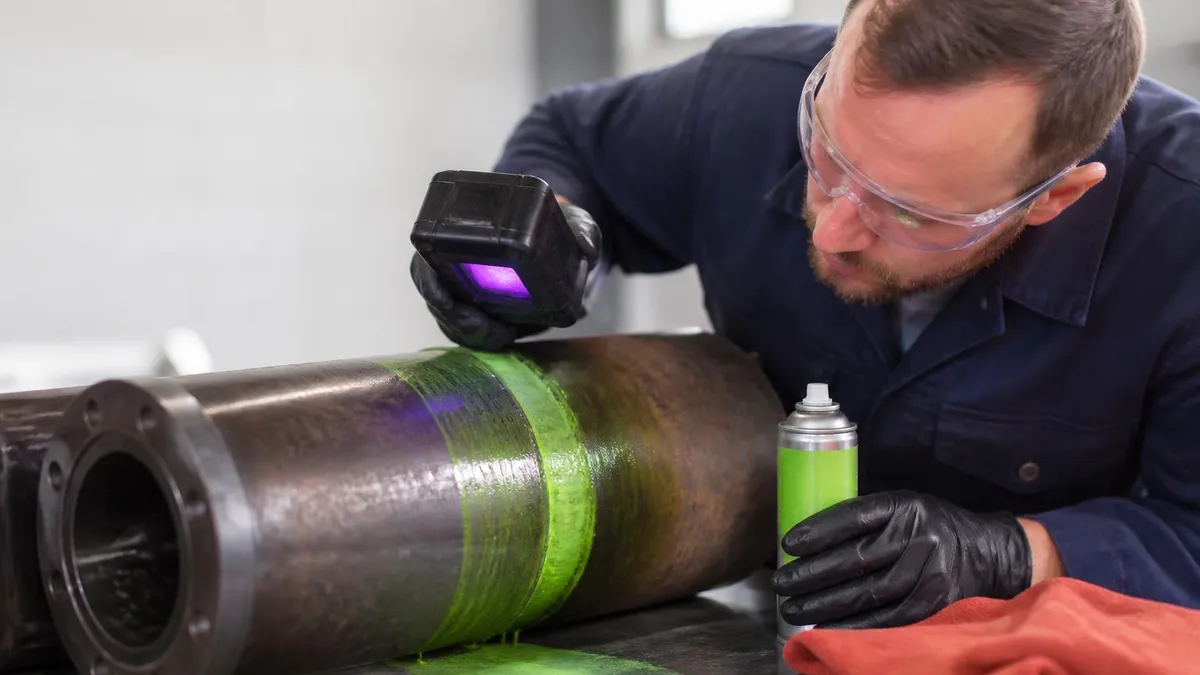
Capillary action draws dye into surface cracks. Works on any nonporous material and is often paired with MT on fabrication shops.
Direct or remote visual inspection. Cheap to certify but underrated. Often the gate-keeper before any other method runs.
Electromagnetic induction for tube inspection, heat exchangers, and aircraft skin. Strong demand in power and aerospace.
Beyond the test mechanics, there is the question of which sector to target. Oil and gas pays well but follows commodity cycles. Aerospace pays steadily and demands the most rigorous documentation; you may certify on a Pratt and Whitney program and find your card invalid the day you move to a Boeing line. Power generation, especially nuclear, pays a premium but requires fingerprint background checks and additional radiation training. Civil infrastructure, including bridge and pipeline inspection, is the steadiest sector and is now flush with federal funding.
Structural steel fabrication is the most accessible entry point. Local AWS-certified shops are usually willing to hire a Level I MT and PT tech with documented forty-hour courses and grow them in-house. The pay is modest but the experience hours come fast because shops run inspection nearly every shift. A new tech can move from Level I to Level II in eighteen months at a busy shop, faster than in service companies where you may not see consistent work in a single method for years.
Each method has three levels. Level I trainees set up the equipment and record indications under supervision. Level II inspectors interpret results, write reports, and approve or reject components. Level III professionals write procedures, train other techs, and audit programs. Your pay scale and authority climb sharply with each step. A Level II UT inspector typically earns roughly double what a Level I MT trainee earns on the same job site.
Training hours are stacked. To reach UT Level II, the SNT-TC-1A recommendation calls for 40 hours of Level I classroom plus 40 hours of Level II classroom, then 400 hours of monitored field experience at each level. RT and ET have similar requirements. MT and PT are lighter, often four hours of classroom and a few weeks of experience. The NDT Level 3 practice test covers procedure writing, code interpretation, and method-specific theory at the senior level.
Authority and Pay at Each Level
The certification exam itself is split into three parts: a general written exam covering method theory, a specific written exam covering codes and the employer's procedures, and a practical exam where you run an actual inspection on a calibration block or test piece with planted flaws. Each part must be passed at 70 percent or higher, and the composite score must reach 80 percent. Most candidates fail the specific written portion because they undertrain on the employer's written practice document.
Vision requirements are strict. You must pass a near-vision test using a Jaeger J-1 or J-2 card at twelve inches, and a color perception test if your method involves color-coded indications. The vision test is annual and many techs lose certification because they skip the yearly check. Build the habit of scheduling vision testing the same week as your birthday so it never slips.
Key Codes You Will Be Tested On
Nondestructive examination requirements for boilers and pressure vessels. Covers UT, RT, MT, PT, ET procedures and qualification. Required for nearly all pressure equipment in North America.
Structural Welding Code for steel. Defines acceptance criteria for visual, MT, PT, UT, and RT of structural welds in buildings, bridges, and offshore platforms.
Welding of pipelines and related facilities. Required knowledge for oil and gas transmission pipeline inspection. Covers RT and UT acceptance criteria for girth welds.
Process piping in refineries and chemical plants. Acceptance criteria for welds in chemical, petrochemical, and pharmaceutical facilities. Frequently tested in turnaround inspection.
In-service inspection of pressure vessels, piping, and storage tanks. Required for fixed equipment inspectors and frequently bundled with NDT credentials at refineries.
European ultrasonic testing of welded joints. Default standard for European fabrication and pipeline work. Knowledge required for ISO 9712 candidates.
Even if your method certification is valid for five years, your vision test is only valid for twelve months. A lapsed vision test invalidates every NDT card you hold until you retest. Schedule it on a recurring calendar reminder.
Vision and Medical Requirements
- ✓Jaeger J-1 or J-2 near vision card readable at 12 inches
- ✓Color perception test passed for methods with color indications
- ✓Distance vision corrected to 20/40 or better in at least one eye
- ✓Hearing test for offshore and confined space work
- ✓Respirator fit test for paint and coating inspections
- ✓Drug screen for refinery, nuclear, and pipeline contracts
- ✓Background check and fingerprinting for nuclear sites
- ✓TWIC card medical evaluation for port and refinery facilities
Final Steps Before Exam Day
- ✓Confirm your target employer's certification framework (SNT-TC-1A, ACCP, or ISO 9712)
- ✓Complete required classroom hours for your method and level
- ✓Log monitored field experience hours in a signed and dated logbook
- ✓Pass current-year Jaeger J-1 or J-2 near-vision test
- ✓Pass color perception test if method requires color discrimination
- ✓Study the general physics and theory for your specific method
- ✓Memorize relevant code sections (ASME V, AWS D1.1, API 1104)
- ✓Practice on calibration blocks with known flaw locations
- ✓Complete at least 200 mixed-format practice questions
- ✓Review the employer's written practice document line by line
Salary varies sharply by method, region, and shift type. A Level II UT inspector on a Gulf Coast refinery turnaround can clear six figures during shutdown season working sixty-hour weeks. The same inspector in a fabrication shop in the Midwest might earn $72,000 on straight forty-hour weeks. Offshore work, particularly in Norway or West Africa, pays the highest day rates but demands ISO 9712 certification and offshore survival training.
Travel techs typically out-earn shop techs by twenty to thirty percent because they accept per-diem, weekend work, and short-notice mobilizations. The trade-off is being on the road two hundred plus days per year. Many techs start in a fabrication shop, earn their Level II in two or three methods, then move to a service company for the travel premium. Our ASNT Level 2 practice test mirrors the central exam style used for ACCP candidates.
Pros and Cons of an NDT Career
- +Strong demand across oil, gas, aerospace, power, and structural steel
- +No four-year degree required for technician roles
- +Clear pay-progression tied to certification level
- +Skills transfer internationally with ISO 9712
- +Per-diem and travel premiums add 20-30% to base pay
- +Multiple method certifications stack for higher rates
- −Long classroom plus field-hour requirements before Level II
- −Annual vision testing is non-negotiable
- −Radiographic work involves radiation exposure tracking
- −Travel jobs require 200+ days on the road
- −Certifications expire and require renewal exams
- −Employer-based SNT certs may not transfer between companies
Pros and Cons at a Glance
| Pros | Cons |
|---|---|
| Strong demand across oil, gas, aerospace, power, and structural steel | Long classroom plus field-hour requirements before Level II |
| No four-year degree required for technician roles | Annual vision testing is non-negotiable |
| Clear pay-progression tied to certification level | Radiographic work involves radiation exposure tracking |
| Multiple method certifications stack for higher rates | Certifications expire and require renewal exams |

Recertification under SNT-TC-1A happens at five-year intervals. The employer can choose to recertify by written and practical exam or by documented continued performance with no significant breaks. Most companies require a written exam at renewal to keep their insurance carriers happy. Build a habit of reviewing your method's general theory three to six months before your renewal date so you do not cram at the last minute and risk failing.
ISO 9712 renewal is more rigorous. After five years you must show continued work in the method and pass a vision test for level renewal. At the ten-year mark you must pass a full recertification exam. Lose the certification and you restart from scratch, including the experience hours, which is brutal for senior techs. Calendar reminders at the three-year mark prevent this.
Beyond the card itself, employers want a clean logbook, traceable experience hours signed by a Level III, and evidence you have worked the specific code (ASME, AWS, API) used on their projects. Generic experience does not translate; code-specific experience does.
The strongest career path is to certify in MT and PT first, work in a fabrication shop for a year to build hours, then add UT Level II while still employed. From there, RT or ET unlock the higher-paying refinery, pipeline, and aerospace work. Level III certification, ideally in two methods, is the gateway to procedure writing, training, and management roles inside larger inspection firms. Many Level IIIs move into consulting after a decade in the field.
For candidates who want to stay technical without managing people, automated and advanced methods are the growth lane. Phased array UT, time of flight diffraction, and digital radiography pay premiums of twenty to forty percent over conventional methods. These advanced certifications stack on top of a conventional Level II, so the conventional path is still the right starting point. Our NDT ultrasonic testing practice test covers conventional UT theory and code interpretation in depth.
Mapping a Multi-Year Career
- ✓Year 1: Earn MT and PT Level II in a fabrication shop
- ✓Year 2: Add UT Level II while building shop hours
- ✓Year 3: Move to a service company for travel premium
- ✓Year 4: Add RT or ET Level II for high-paying refinery work
- ✓Year 5: Pursue Level III in your strongest method
- ✓Ongoing: Maintain annual vision tests and renewal logs
For the written exam, the strongest preparation tactic is to answer at least three hundred practice questions covering general theory, specific procedures, and code references. Time yourself. Most candidates can answer correctly without time pressure but stumble when the clock is running. Simulate exam conditions every weekend for a month before your sitting. For the practical, request to run a dry-run on the actual calibration block your employer uses. Familiarity with that specific block beats generic practice every time.
Bring two copies of your logbook, your training certificates, and a current vision test result to the exam. Examiners can reject you on the spot for missing paperwork even if you are technically ready to test. A cheap document wallet kept with your tool bag prevents this. After passing, request a signed and dated certificate from the certifying agent within forty-eight hours; some employers delay this and the lag can cost you a per-diem job that needed a verified card.
One area new techs overlook is documentation discipline during a job. After each inspection, you must produce a written report that lists the part identification, the procedure number, the technique used, the equipment serial numbers, the calibration block used, the date, your signature, and the disposition of each indication.
Sloppy reports get rejected by clients and cause rework that costs the inspection company money. Build templates in advance, keep them on a tablet, and fill them in during the job rather than at the end of the day. Senior techs are valued as much for clean reports as for technical skill.
If you plan to move internationally, study the language demands ahead of time. Middle East work is mostly conducted in English with some Arabic on official forms. Norwegian offshore platforms run safety briefings in Norwegian even when inspection paperwork is in English; expect a basic language test during onboarding. South American projects, especially in Brazil and Argentina, prefer techs with conversational Portuguese or Spanish. Add a language credential alongside ISO 9712 if your target region requires it and your salary negotiating power doubles overnight.
Health and safety credentials stack onto your NDT card. OSHA 10 or OSHA 30 is expected on US construction sites. The TWIC card is required for US port and refinery work. H2S Alive is mandatory for oil and gas. Confined space entry training opens up pressure vessel and storage tank work. Rope access certifications (IRATA or SPRAT) at Level I unlock wind turbine and high-rise inspection at premium rates. Map out the auxiliary credentials your target sector requires before you accept a job offer; a missing twenty-dollar card can disqualify you from a thousand-dollar shift.
Most six-figure NDT positions require auxiliary credentials beyond the method certification: OSHA 30, TWIC, H2S Alive, confined space, and sometimes rope access. Plan these acquisitions alongside your method progression rather than as an afterthought.
One nuance new candidates miss is the difference between method-specific and code-specific knowledge. The method-specific exam tests physics and procedures. The code-specific exam tests how to apply that method under a specific code like ASME Section V, AWS D1.1, or API 1104. Most failures happen on the code-specific portion because candidates underestimate how granular the questions are. You can be a competent UT tech and still fail because you cannot recite the acceptance criteria from ASME B31.3 paragraph 344.5 from memory.
Build your study around the code your employer actually uses. Print the relevant sections, tab them, and rewrite the acceptance criteria in your own words. Quiz yourself on rejection thresholds, weld discontinuity types, and reporting timelines. When you take the practical, examiners often ask you to recite the acceptance criteria you would apply to a planted flaw. Hesitation here looks like incompetence even if you ran a perfect inspection. The ASNT Level 3 practice test covers code interpretation in much greater depth than typical Level II material.
The employer paperwork side of certification is the silent career killer. Even strong techs lose jobs because a logbook gets misplaced, a Level III signature is missing, or a vision test expired during a turnaround. Treat your certification documents the same way a pilot treats a logbook. Keep originals in a fireproof folder at home, scanned copies on a cloud drive, and a working copy in your tool bag. Renew vision tests on your birthday month, log every job on the same day you complete it, and have your Level III sign off on hours quarterly rather than annually.
Networking inside the industry pays disproportionate dividends. The NDT field is small, perhaps thirty thousand certified techs in the United States, and reputations travel fast. Join the local ASNT section, attend the annual conference if your employer pays for it, and connect with Level IIIs on LinkedIn who write for journals. Most of the highest paying field jobs are filled through referrals before they hit a job board. Showing up to a section meeting once a quarter is the single highest return activity for career growth that costs you nothing but an evening.
Finally, plan for the long arc. NDT is physically demanding work. Climbing scaffolds, crawling through pressure vessels, and working in extreme heat or cold is tolerable in your twenties and thirties but punishing later. The senior techs who stay in the field comfortably almost always pivot to Level III, training, or quality assurance roles by their mid-forties. Start building those credentials and that reputation in your first decade so you have options later. A career that earns six figures at forty-five and ninety thousand at sixty is the goal, not a flat one hundred thousand that ends in burnout.
To close the loop on what hiring managers want: they want a tech who shows up, follows the procedure to the letter, writes a clean report, and does not need supervision after the first month. The certification card opens the door. Your reputation, documentation discipline, and willingness to learn additional methods keep that door open for thirty years.
Treat every job, even the boring shop work, as a chance to build the resume that gets you the offshore platform or aerospace line role five years from now. The candidates who plan this carefully outpace those who chase the highest day rate every year and burn out by forty.
Learn more in our guide on NDT Practice Test PDF (Free Printable 2026). Learn more in our guide on ndt meaning. Learn more in our guide on destructive and non destructive testing.
Salary Range by Sector
Sample Boilermaker Nondestructive Testing Certification Practice Questions
Try these questions from our free Boilermaker Nondestructive Testing Certification practice tests. The correct answer and an explanation follow each question.
Which foundational principle is MOST important for success in Boilermaker Nondestructive Testing Certification?
- A. Maximizing financial returns
- B. Commitment to continuous learning, ethical practice, and quality outcomes
- C. Maintaining minimum certification requirements
- D. Specializing in only one narrow area
Answer: B. Commitment to continuous learning, ethical practice, and quality outcomes
Success requires continuous learning, ethical practice, and focus on quality outcomes.
How should Boilermaker Nondestructive Testing Certification professionals handle equipment showing signs of malfunction during operation?
- A. Continue operating while monitoring
- B. Immediately cease operation, secure the equipment, and report
- C. Attempt field repairs while running
- D. Finish the current task first
Answer: B. Immediately cease operation, secure the equipment, and report
Immediate cessation prevents safety hazards, further damage, or compromised results.
How should Boilermaker Nondestructive Testing Certification professionals handle procedures that have been updated or revised?
- A. Continue using the original method
- B. Review updates, complete required training, and implement revised procedures
- C. Wait for mandatory enforcement
- D. Only apply updates to new cases
Answer: B. Review updates, complete required training, and implement revised procedures
Professionals must review changes, complete training, and implement revised procedures.
When new equipment is introduced in Boilermaker Nondestructive Testing Certification, what is REQUIRED before staff use it?
- A. A brief verbal overview
- B. Formal training, competency verification, and documentation
- C. Watching a colleague use it once
- D. Reading the manual independently
Answer: B. Formal training, competency verification, and documentation
Formal training, competency verification, and documented training completion are required.
Take the full Boilermaker Nondestructive Testing Certification practice test
NDT Questions and Answers
About the Author

Educational Psychologist & Academic Test Preparation Expert
Columbia University Teachers CollegeDr. Lisa Patel holds a Doctorate in Education from Columbia University Teachers College and has spent 17 years researching standardized test design and academic assessment. She has developed preparation programs for SAT, ACT, GRE, LSAT, UCAT, and numerous professional licensing exams, helping students of all backgrounds achieve their target scores.
Join the Discussion
Connect with other students preparing for this exam. Share tips, ask questions, and get advice from people who have been there.
View discussion (8 replies)