
Destructive and Non-Destructive Testing: Methods, When to Use Each, and Industry Applications
Destructive and non-destructive testing methods compared: tensile, hardness, ultrasonic, radiographic, dye penetrant. When to use each. Industry 📝
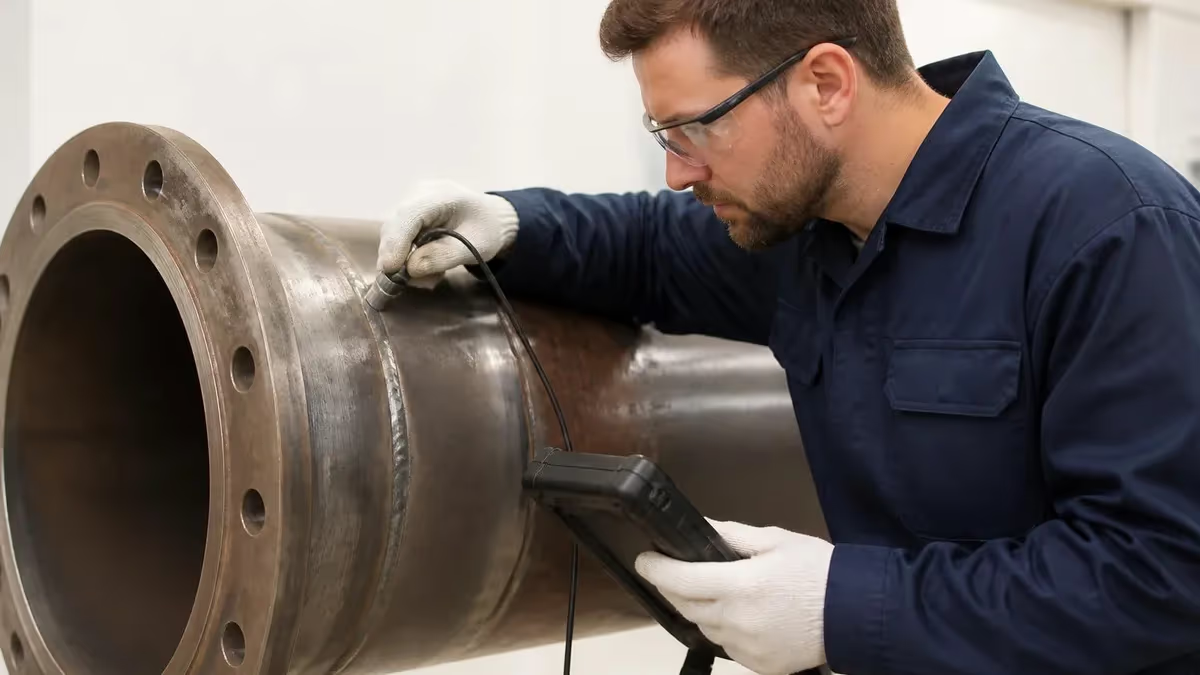
Destructive and non-destructive testing are the two fundamental approaches to evaluating materials and welded structures. Destructive testing (DT) requires sacrificing the sample being tested — pulling it until it breaks, cutting it open to examine internal structure, or otherwise rendering it unusable. Non-destructive testing (NDT) examines materials and welds without damaging them, allowing the tested component to remain in service. Both have their place in quality assurance; the choice depends on what you're testing, what failure modes matter, and whether you can afford to destroy samples.
Destructive testing is more thorough for some questions. A tensile test pulls a steel coupon until it breaks, measuring yield strength, ultimate strength, and elongation. A Charpy impact test breaks a notched specimen with a swinging pendulum to measure toughness. A macroscopic section test cuts open a weld to inspect internal structure. These tests answer questions that NDT often can't — material strength, internal microstructure, fracture characteristics — but they consume the sample.
Non-destructive testing is less thorough but allows in-service inspection. Visual inspection (VT), liquid penetrant testing (PT), magnetic particle testing (MT), ultrasonic testing (UT), radiographic testing (RT or X-ray), eddy current testing (ET), and several other methods detect surface and subsurface defects without damaging the part. NDT is essential for evaluating components that can't be sacrificed — installed pipelines, completed welded structures, aircraft components in service, pressure vessels.
The combined approach is typical in industry. Destructive testing is used for: qualifying welding procedures (you weld test plates, then destructively test them), qualifying welders (welders make test welds that get destroyed for evaluation), and validating production samples. Non-destructive testing is used for: inspecting completed welds in service, periodic in-service inspection, and quality acceptance of completed components.
For NDT technicians, certification matters significantly. The American Society for Nondestructive Testing (ASNT) sets standards. Levels I, II, and III represent increasing certification depth. Level II is the typical certification for working NDT technicians; Level III is for engineers and quality managers who develop NDT procedures. The certification process involves training (40-200+ hours depending on method and level), supervised experience hours, and examinations covering theory and practical application.
This guide covers destructive testing methods, the major NDT methods (VT, PT, MT, UT, RT, ET), when to use each approach, industry standards governing testing, and the certification path for NDT technicians. It's intended for engineers planning quality programs, students considering NDT careers, and quality professionals seeking to better understand testing options.
Learn more in our guide on NDT Practice Test PDF (Free Printable 2026). Learn more in our guide on ndt meaning. Learn more in our guide on asnt ndt certification.
Free Boilermaker Nondestructive Testing Certification Study Tools
Interactive Boilermaker Nondestructive Testing Certification resources on PracticeTestGeeks, free to start:
- Boilermaker Nondestructive Testing Certification flashcards — review key terms and concepts card by card
- Boilermaker Nondestructive Testing Certification study guide — topic-by-topic overview of what the exam covers
- Boilermaker Nondestructive Testing Certification cheat sheet — one-page printable summary for last-minute review
Destructive vs Non-Destructive Testing
- Destructive (DT): Sample is destroyed during test. Reveals strength, ductility, microstructure. Required for qualifying procedures and welders.
- Non-Destructive (NDT): Sample remains usable. Reveals defects without damage. Required for in-service inspection.
- Common DT methods: Tensile, Charpy impact, hardness, macroscopic section, bend tests
- Common NDT methods: VT (visual), PT (dye penetrant), MT (magnetic particle), UT (ultrasonic), RT (radiographic), ET (eddy current)
- Certification body: ASNT (American Society for Nondestructive Testing). Levels I, II, III.
- Typical career: NDT technician earns $50K-$90K. Level III certifications and engineering roles $90K-$130K+.
- Industry use: Welding fabrication, aerospace, oil/gas pipeline, nuclear, automotive, power plants
Destructive testing methods in detail. The tensile test is the most common destructive test for metals. A coupon (round bar or flat strip with reduced cross-section in the middle) is gripped on both ends and pulled until it breaks. The machine records load vs. extension. From this graph, you derive: yield strength (the point where elastic deformation transitions to plastic), ultimate tensile strength (the maximum stress before fracture), elongation (how much the sample stretched before breaking, as a percentage), and reduction of area (how much the cross-section shrank in the necked region).
For welded components, tensile tests confirm the weld is at least as strong as the base metal — if the sample fails in the base material rather than the weld, the weld is acceptable. Tensile tests of welds qualify welding procedures (WPS - Welding Procedure Specification) and welder performance (WPQ - Welder Performance Qualification). These are documented per AWS D1.1 (for steel structural welding), ASME Section IX (for pressure vessels and piping), and other codes.
Charpy impact testing measures toughness — the ability of a material to absorb energy during sudden loading without fracturing. A notched bar specimen is broken by a swinging pendulum; the energy absorbed (in joules or foot-pounds) is reported. Charpy testing is particularly important for low-temperature applications (Arctic pipelines, refrigeration vessels) and for high-strain-rate applications (impact-resistant structures).
Hardness testing measures resistance to indentation. Methods: Brinell (large indenter, used for thick sections), Rockwell (smaller indenter, faster to perform), Vickers (small diamond indenter, very precise), and Knoop (similar to Vickers but for harder/thinner materials). Hardness correlates with tensile strength for most metals — you can estimate tensile strength from hardness without breaking a sample.
Macroscopic section testing cuts a weld cross-section, polishes the surface, and etches it with acid to reveal the weld's internal structure. The result shows penetration depth, fusion between weld and base metal, presence of porosity, slag inclusions, or cracks. Macroscopic sections are used in welding procedure qualification and in failure analysis of welded components.
Bend tests determine ductility of welds. A test coupon (usually a flat strip) is bent around a die until it reaches a specified angle. Cracks in the bend zone indicate inadequate ductility. Different bend tests apply: face bend (weld face on outside of bend), root bend (weld root on outside), and side bend (weld cross-section on outside). Each evaluates different aspects of weld quality.
Destructive Testing Methods
Pull sample to fracture. Yields strength, ductility, elongation data. Standard for qualifying welds, materials.
Notched bar broken by pendulum. Measures toughness. Critical for low-temp and high-impact applications.
Brinell, Rockwell, Vickers, Knoop indentation tests. Correlates with strength. Faster than tensile.
Cut, polish, etch weld cross-section. Reveals internal structure. Required for welding procedure qualification.
Bend coupon to specified angle. Surface cracks indicate inadequate ductility. Face, root, side bend variants.
Cyclic or sustained loading until failure. Long-duration tests. Used for components in service with cyclic stress.
Non-destructive testing methods in detail. Visual Testing (VT) is the most basic and most underrated NDT method. A trained inspector examines the component under good lighting, sometimes with magnification or remote visual aids (borescopes, drones). VT detects surface cracks, undercut, overlap, porosity that breaks the surface, and other visible defects. It's the foundation of all welding inspection — and the cheapest method to perform.
Liquid Penetrant Testing (PT, sometimes called dye penetrant or PI) detects surface-breaking defects. The component is cleaned, a colored penetrant is applied (usually red), the excess is wiped off, and a developer is applied (white powder that draws penetrant out of cracks). Surface defects show as red lines against the white developer background. PT works on most non-porous materials (steel, aluminum, titanium, etc.). It detects only surface defects — not subsurface flaws.
Magnetic Particle Testing (MT) detects surface and near-surface defects in ferromagnetic materials (steel, iron, nickel). The component is magnetized, then fine iron particles (dry powder or wet suspension) are applied. The particles cluster at magnetic flux leakage points caused by surface or near-surface defects. More sensitive than PT for subsurface defects but only works on magnetic materials.
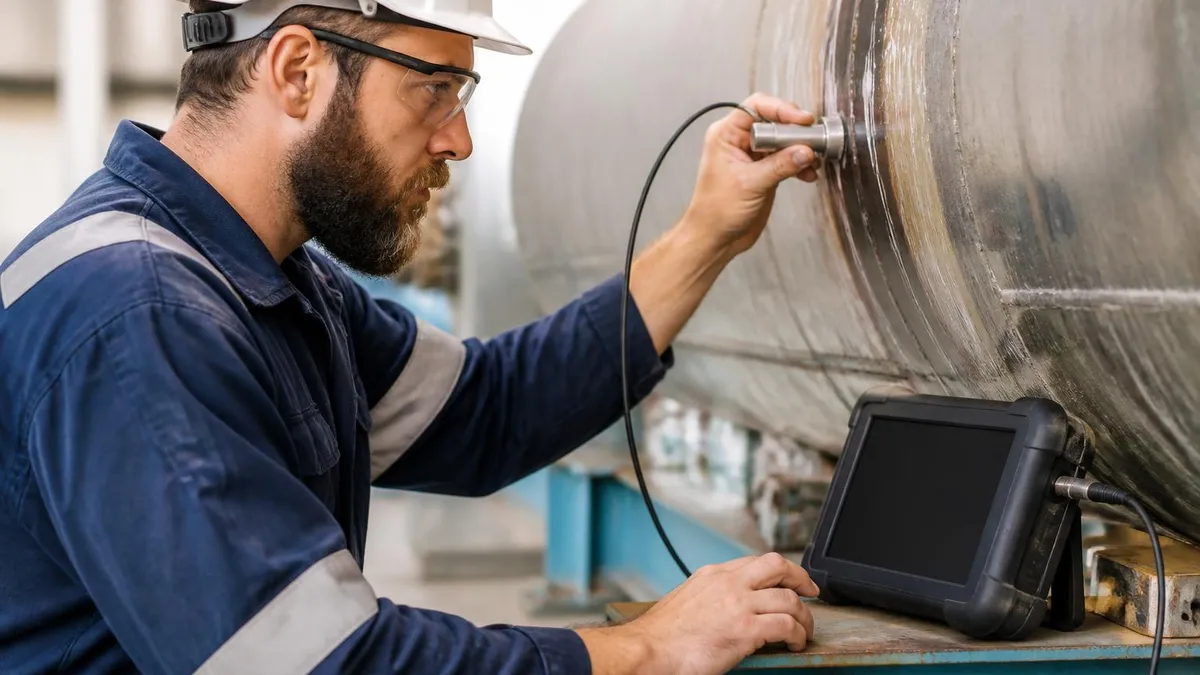
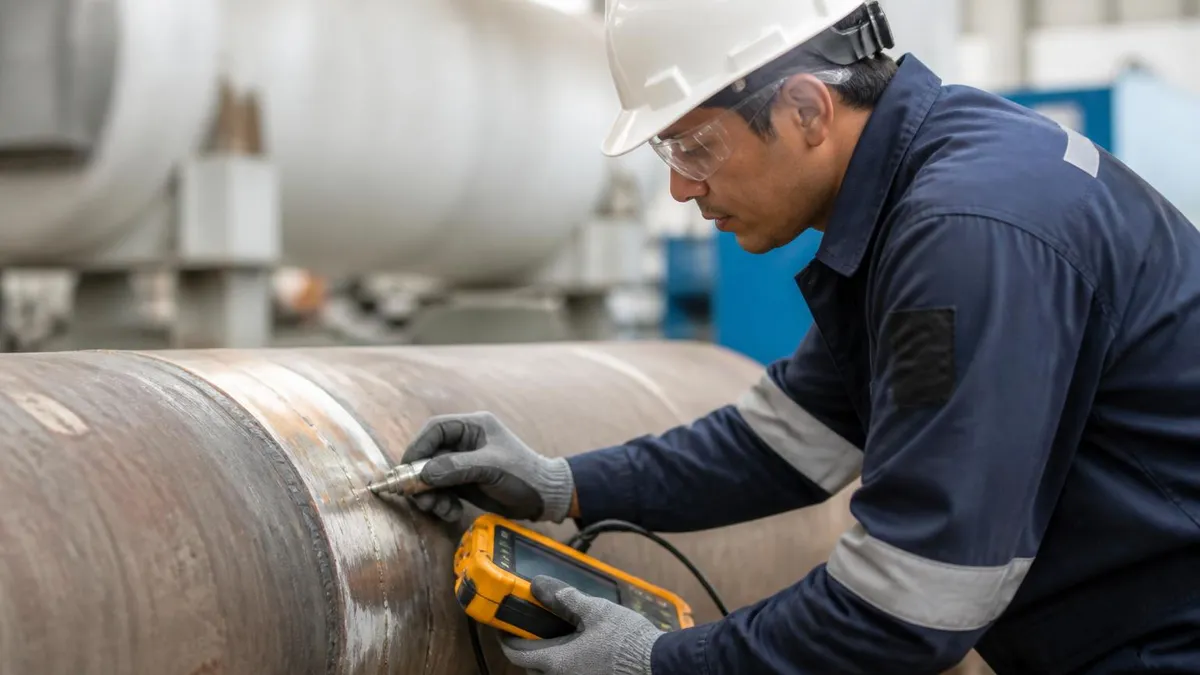
Ultrasonic Testing (UT) uses high-frequency sound waves to detect internal defects. A probe sends ultrasonic waves into the material; defects cause reflections that the probe receives. The technician sees a screen display showing reflection patterns. UT can detect deep internal flaws (10+ inches into steel), measure material thickness, and characterize defect size and location. Requires significant training to interpret correctly.
Radiographic Testing (RT, often called X-ray or gamma ray) uses penetrating radiation to image internal structure. A radiation source on one side, film or digital detector on the other. Defects appear as variations in image density on the film. RT shows internal flaws across the entire section. Best for welds and complex geometry. Requires safety training and licensing for radiation handling.
Eddy Current Testing (ET) uses electromagnetic induction to detect surface and near-surface defects in conductive materials. A coil generates eddy currents in the material; defects disrupt the currents, which the coil senses. Particularly useful for inspecting pipes, tubes, and aerospace components. Fast and automated for production environments.
NDT Methods in Detail
- What it detects: Surface defects (cracks, undercut, overlap, surface porosity)
- Materials: Any visible material
- Tools: Eye, magnifier, borescope, drone
- Speed: Fast (minutes to hours depending on complexity)
- Cost: Lowest of all NDT methods
- Best for: Initial inspection of all welded components, surface finish verification
NDT certification through ASNT (American Society for Nondestructive Testing) is the industry standard in the U.S. The ASNT TC-1A document provides recommended practice for personnel qualification and certification. Three levels exist: Level I (qualified to perform calibrations and tests under direction of higher-level personnel), Level II (qualified to perform tests, interpret results, and direct Level I personnel), Level III (qualified to develop procedures, train others, and provide overall technical direction).
Training hours by method and level vary. For UT Level II (the most common professional credential): typically 240 hours of training (with prior Level I background) plus 1,200+ hours of supervised experience. For PT Level II: 32 hours training plus 70 experience hours. For VT Level II: 16 hours training plus 70 experience hours. Each method has its own requirements.
The certification examinations are administered by employers (for ASNT TC-1A internal certifications) or by ASNT directly (for ASNT Level III certifications, which are nationally recognized). The exam includes a general written test on the method, a specific written test on the employer's procedures and equipment, and a practical test using the actual equipment.
For NDT technicians, the typical career path: start as Level I trainee → progress to Level II in 1-2 years → after several years of experience, pursue Level III in your primary methods. Most senior NDT professionals hold Level III in 2-3 methods (UT, RT, MT typically) plus Level II in others. The Level III certification opens roles in quality engineering, NDT procedure development, and management.
Salary by NDT level: Level I (apprentice or trainee) typically $40K-$55K. Level II (working technician) $55K-$85K. Level III (senior engineer or quality manager) $85K-$130K. Specialized roles (aerospace NDT, nuclear NDT, pipeline NDT) command premium pay due to industry-specific certification requirements and inspection complexity.
NDT careers are stable and growing. Job market is strong in: oil and gas pipelines (substantial inspection requirements driven by safety regulations), aerospace (every commercial aircraft requires extensive NDT throughout manufacturing and service), nuclear power (highly regulated NDT requirements for reactor components), power generation (boilers, turbines, pressure vessels), and manufacturing (quality assurance for welded products). The field doesn't have major automation disruption risk — NDT is hands-on inspection work that's hard to automate.

NDT Certification Path
Perform calibrations and basic tests under supervision. 40-80 training hours per method. Typical first 1-2 years.
Perform tests, interpret results. Direct Level I personnel. 240+ training hours plus 1,000+ experience hours per method.
Develop procedures, train others, provide technical direction. Multiple methods. Higher-level certifications. $90K-$130K typical.
ASNT Level III is nationally recognized. ASNT TC-1A is internal employer certifications. Both are common.
VT, PT, MT, UT, RT — the five most common. Eddy current (ET) and other methods are specialty options.
Aerospace, nuclear, pipeline industries have additional certifications beyond ASNT — NAS 410 (aerospace), ASNT in nuclear contexts.
Choosing the right testing approach for a specific situation. The question "DT or NDT?" usually isn't either/or — most quality programs use both. The decision is which methods, when, and how often.
For developing a welding procedure (WPS): destructive testing is required. You can't qualify a procedure without breaking samples to verify mechanical properties. Tensile, bend, Charpy impact (for code-required cases) are standard DT methods for WPS qualification.
For qualifying a welder: destructive testing typically. The welder makes test plates that get bent and tensile-tested to verify they can produce sound welds. Some codes allow radiographic testing as an alternative to destructive testing for welder qualification.
For inspecting production welds: NDT primarily. Visual is universal. PT/MT for surface defects. UT or RT for internal flaws. The specific requirements depend on the code (AWS D1.1, ASME Section IX, API 1104, etc.) and the criticality of the application.
For in-service inspection of installed components: NDT only. The component is already in service; you can't destroy it. Periodic NDT inspections (UT thickness measurements on pipelines, RT on critical welds, ET on heat exchanger tubes) catch deterioration before failure.
For failure analysis: combined approach. NDT first to characterize the failure non-destructively (locate the crack, measure dimensions, assess surrounding material). Then destructive testing of the failed component to determine root cause (metallographic examination, hardness testing, mechanical testing of representative samples).
Specific industry codes drive specific test requirements. AWS D1.1 (American Welding Society Structural Welding Code - Steel) is the dominant code for buildings and bridges. ASME Section IX (Welding and Brazing Qualifications) applies to pressure vessels and pipings. API 1104 (Welding of Pipelines) for oil and gas. AWS D17.1 (Aerospace Welding). Each has specific destructive and non-destructive testing requirements.
A common misconception is treating destructive testing and non-destructive testing as alternatives. They serve different purposes. DT proves strength, ductility, and other mechanical properties — questions NDT can't fully answer. NDT detects defects that DT might miss (surface cracks, subsurface flaws in retained components). Quality programs in welded fabrication, aerospace, and pressure vessel manufacturing typically require BOTH: destructive testing for procedure and personnel qualification, plus non-destructive testing for production quality acceptance and in-service inspection. The right question isn't "which to use" but "which combination for this application".
Industry applications of DT and NDT. Aerospace manufacturing uses extensive NDT throughout aircraft production — engine components, structural welds, composite layups, fasteners. Every commercial aircraft has comprehensive NDT records. The aerospace industry favors PT, MT, UT, ET, and increasingly automated NDT methods (phased array UT, automated eddy current systems).
Oil and gas pipeline industry uses destructive testing for procedure qualification and NDT for production inspection and in-service monitoring. Long-distance pipelines undergo regular in-line inspection (smart pigs) that use ultrasonic and magnetic flux leakage methods to detect corrosion and defects without taking pipelines out of service. The 2010-onward emphasis on pipeline safety has substantially increased NDT requirements.
Nuclear power industry has the most rigorous NDT requirements. Every weld on reactor pressure vessels, primary coolant piping, and other critical components is extensively NDT-inspected during fabrication and periodically during operation. Nuclear NDT technicians require specific industry training beyond ASNT base certifications. The work is well-compensated due to the certification investment and safety responsibility.
Power generation (non-nuclear) uses NDT for boilers, turbines, pressure vessels, and steam piping. Failure analysis of failed components frequently uses combined DT and NDT to determine root cause and prevent recurrence. The aging fleet of U.S. power plants creates substantial inspection demand.
Manufacturing (structural welding, vehicle frames, pressure equipment) uses DT for procedure and welder qualification, then production-line NDT for quality acceptance. Automated NDT (robotic UT scanning, automated visual inspection systems) is increasingly common in high-volume manufacturing.
Construction and civil engineering (steel buildings, bridges, water/wastewater facilities) follows AWS D1.1 or similar codes. Visual inspection is universal; PT/MT and UT used on critical welds. RT is rare in routine construction (radiation safety in active job sites is challenging) but used in shop-fabricated components.
NDT Career Stats
Becoming an NDT Technician
Initial Education
Entry-Level Hire
Level I Certification
Build Experience (1-2 years)
Level II Certification
Specialize and Advance
Radiographic Testing (RT) uses ionizing radiation — X-rays from electronic generators or gamma rays from radioactive isotopes (Iridium-192, Cobalt-60). Operating radiographic equipment requires radiation safety training and, in most jurisdictions, formal licensing. The Nuclear Regulatory Commission (NRC) regulates the use of radioactive isotopes; state radiation control programs regulate X-ray equipment. RT technicians often hold additional Radiation Safety Officer (RSO) certifications. The radiation safety aspect adds time and cost to RT certification compared to other NDT methods but the higher pay typically justifies the additional investment.
Equipment costs and operational considerations. NDT equipment varies dramatically in cost. Penetrant testing supplies: a few hundred dollars annually for a small operation. Magnetic particle equipment: $1,000-$5,000 for a basic yoke setup, $10,000+ for fluorescent wet horizontal magnetic systems. Ultrasonic flaw detector: $5,000-$30,000 for basic units, $50,000+ for phased array systems. Radiographic equipment: $20,000-$100,000+ for X-ray generators or isotope cameras, plus ongoing source replacement costs.
Eddy current equipment: $3,000-$25,000 depending on capability. Specialized systems for aerospace and pipeline inspection can run $100,000+. The newer phased array ultrasonic systems used for advanced inspection are typically $50,000-$200,000.
For shops getting started with NDT, the typical investment pattern: VT and PT first (lowest cost). MT next if you handle ferromagnetic materials. UT for thicker sections or higher-criticality work. RT only if you have the radiation safety infrastructure and consistent demand to justify. Most small fab shops outsource RT to specialized NDT service providers; only large operations or shops with very specific inspection requirements run their own RT.
NDT service providers represent another industry segment. Companies like Acuren, Mistras, Applus, and Element Materials Technology specialize in providing NDT services on contract. Smaller customers (shops without full-time NDT capability) hire these companies to inspect specific projects. NDT service providers employ many of the certified technicians in the field.
For students considering NDT careers, community college programs offer associate's degrees in NDT or Welding Technology with NDT specialization. These 2-year programs cover the fundamentals and provide Level I trainee-level experience before entering the workforce. Cost: $10K-$25K typically. The combination of formal education plus apprenticeship-style training at an employer is a common path into the field.
For experienced welders considering transition to NDT, the path is reasonable. Welders already understand the materials and processes; learning NDT methods on top of that is straightforward. Many NDT technicians are former welders who moved into inspection for less physically demanding work or higher pay. The career change typically requires 2-3 years of certification work but builds on existing knowledge.
Destructive Pros and Cons
- +Destructive has a publicly available content blueprint — you know exactly what to prepare for
- +Multiple preparation pathways accommodate different schedules and budgets
- +Clear score reporting shows specific strengths and weaknesses
- +Study communities share current insights from recent test-takers
- +Retake policies allow recovery from a difficult first attempt
- −Tested content scope requires substantial preparation time
- −No single resource covers everything optimally
- −Exam-day performance can differ from practice test performance
- −Registration, prep, and retake costs accumulate significantly
- −Content changes between versions can make older materials less reliable
Pros and Cons at a Glance
| Pros | Cons |
|---|---|
| Destructive has a publicly available content blueprint — you know exactly what to prepare for | Tested content scope requires substantial preparation time |
| Multiple preparation pathways accommodate different schedules and budgets | No single resource covers everything optimally |
| Clear score reporting shows specific strengths and weaknesses | Exam-day performance can differ from practice test performance |
| Study communities share current insights from recent test-takers | Registration, prep, and retake costs accumulate significantly |
| Retake policies allow recovery from a difficult first attempt | Content changes between versions can make older materials less reliable |
Sample Boilermaker Nondestructive Testing Certification Practice Questions
Try these questions from our free Boilermaker Nondestructive Testing Certification practice tests. The correct answer and an explanation follow each question.
When performing magnetic particle testing using the wet fluorescent method, inspection must be conducted under:
- A. Normal white light conditions above 100 foot-candles
- B. Ultraviolet (black) light with ambient white light below 2 foot-candles
- C. Infrared light at wavelengths above 700 nm
- D. Daylight only to avoid UV exposure hazards
Answer: B. Ultraviolet (black) light with ambient white light below 2 foot-candles
Wet fluorescent MT requires UV-A (black) light to excite the fluorescent particles, and ambient white light must be below 2 foot-candles to maximize contrast of indications.
When using magnetic particle testing (MT) near flammable materials in a boiler, what safety precaution is mandatory?
- A. Eliminate ignition sources and ensure adequate ventilation before applying wet MT fluids
- B. Apply MT fluid rapidly to minimize exposure time
- C. Disable smoke detectors to avoid false alarms
- D. Increase ambient temperature to improve fluid flow
Answer: A. Eliminate ignition sources and ensure adequate ventilation before applying wet MT fluids
Wet MT fluids are often petroleum-based and flammable; eliminating ignition sources and ventilating the area prevents fire hazards.
When evaluating a radiographic film, the 'IQI sensitivity' is considered acceptable when:
- A. The IQI itself is not visible on the film
- B. The required wire or hole of the designated IQI is visible on the film
- C. The darkest area of the film is below optical density 1.0
- D. The IQI is placed on the film side closest to the detector
Answer: B. The required wire or hole of the designated IQI is visible on the film
Radiographic sensitivity is verified by confirming that the essential wire (wire-type IQI) or the required hole (hole-type IQI) is visible on the processed film, demonstrating adequate contrast and definition.
Which federal agency has authority to enforce radiation safety regulations when radiographic testing (RT) is performed on boilers?
- A. Nuclear Regulatory Commission (NRC)
- B. OSHA
- C. EPA
- D. NIOSH
Answer: A. Nuclear Regulatory Commission (NRC)
The NRC regulates the use of radioactive materials including industrial radiography sources, and states with Agreement State status enforce equivalent rules.
Take the full Boilermaker Nondestructive Testing Certification practice test
NDT Questions and Answers
Destructive and non-destructive testing form the foundation of quality assurance in welded fabrication and many other industries. The combined approach — destructive testing for qualification and validation, non-destructive testing for production inspection and in-service monitoring — is the standard approach in welding, aerospace, oil and gas, nuclear, and power generation industries. Understanding when to use each is essential for quality engineers, welding professionals, and inspection technicians.
For people considering NDT as a career, the field offers stable employment with good pay relative to education requirements. The 2-3 year path to ASNT Level II certification, combined with practical experience, leads to $55K-$85K base salaries. Advanced certifications (Level III) and industry specialization (aerospace, nuclear, pipeline) lead to $100K+ roles. The work is technical and hands-on, with limited automation risk and consistent demand across the industries that rely on welded structures.
About the Author

Educational Psychologist & Academic Test Preparation Expert
Columbia University Teachers CollegeDr. Lisa Patel holds a Doctorate in Education from Columbia University Teachers College and has spent 17 years researching standardized test design and academic assessment. She has developed preparation programs for SAT, ACT, GRE, LSAT, UCAT, and numerous professional licensing exams, helping students of all backgrounds achieve their target scores.
Join the Discussion
Connect with other students preparing for this exam. Share tips, ask questions, and get advice from people who have been there.
View discussion (8 replies)