
NASM Personal Trainer Certification: Complete 2026 October Guide
NASM personal trainer certification guide: 📝 packages, cost ($799-$1899), the OPT model, exam format, pass rate, study plan, and career options.

NASM Personal Trainer Certification: Complete 2026 Guide
The NASM personal trainer certification is the most widely held credential in the U.S. fitness industry, with more than 600,000 trainers certified worldwide since the program launched in 1987. It's offered by the National Academy of Sports Medicine, a Phoenix-based education company, and it carries NCCA accreditation — the gold standard recognized by every major gym chain in America, from Equinox and Life Time down to Planet Fitness, Crunch, EOS, 24 Hour Fitness, and LA Fitness. If you've ever scrolled through a job posting for a personal trainer, odds are NASM showed up in the "preferred certifications" line.
What sets NASM apart isn't just the name. It's the OPT model — Optimum Performance Training — a five-phase exercise programming framework that has quietly become the de facto language fitness pros use to describe periodization. Stabilization. Strength endurance. Hypertrophy. Maximal strength. Power. If those phrases sound familiar, that's NASM at work in the background. The whole exam, top to bottom, hinges on you understanding how to move clients through those phases safely.
This guide is the long-form version of every question a future NASM trainer asks before clicking "buy": the four study packages, what's in each one, exam mechanics, the real pass rate, what the test actually tests, how long it takes, and the career options on the other side. Curious about how NASM stacks up next to other big names? The nasm cpt versus ACE breakdown handles that head-to-head. For dollar figures and renewal details, the nasm certification cost page goes deep on the financial side.
One more thing before we dig in. NASM prices fluctuate hard. The list prices below are the standard 2026 rack rates, but flash sales drop them 30 to 60 percent regularly. Black Friday, January New-Year sales, Memorial Day, and back-to-school in August are the four predictable windows.
If you can wait a few weeks, you'll almost certainly catch a sale. Don't pay full price unless you're in a rush — and even then, the email signup discount alone usually shaves 20 percent off whatever's showing on the homepage. NASM also offers payment plans through Affirm with zero interest for the first six months on most packages.
Why NASM Dominates the U.S. Fitness Industry
NASM holds about 40 percent of the U.S. personal trainer credential market, more than any other single cert. Three things explain that dominance.
First, it's NCCA-accredited, the only third-party seal big-box gym chains will accept on a hiring application. Second, the OPT model gives gym managers a common language to evaluate a new trainer's program-design skills, which makes NASM-certified trainers easier to hire and onboard.
Third, the certification has been around since 1987, longer than most competitors, so two generations of trainers have already passed through it. That long shelf life means hiring managers, gym owners, and senior trainers already know what a NASM-CPT can do on day one. Brand familiarity reduces friction in every part of the hiring funnel.
The result is straightforward. When a gym posts a personal trainer opening, NASM is usually the first cert listed under "preferred." When an online coaching platform vets new applicants, NASM is on the shortlist of accepted credentials.
When a hospital wellness program or corporate fitness vendor builds a roster of contractors, NASM trainers are almost always included. The credential carries real career equity in a way that some cheaper alternatives simply don't.
Before you commit, grab the nasm practice exam PDF to get a feel for what the questions actually look like. It's the fastest way to gut-check whether the science depth matches your study appetite.
- Founded: 1987 (Phoenix, AZ)
- Accreditation: NCCA (National Commission for Certifying Agencies)
- Exam: 120 questions, 2 hours, online proctored or Pearson VUE
- Passing score: 70%
- First-time pass rate: ~64% (jumps to ~85% with NASM official prep)
- Renewal: Every 2 years, 2.0 CEUs required
- Prerequisites: 18+, high-school diploma/GED, valid CPR/AED before exam day
The Four NASM CPT Study Packages

Inside the NASM-CPT Exam
The exam itself is 120 multiple-choice questions delivered over a two-hour window. You can take it online from home with a live proctor watching through your webcam, or in person at any Pearson VUE testing center. The two formats are scored identically.
Online is faster to schedule but stricter on your environment. No second monitor, no notes, no phone, no people walking through the room. Pearson VUE is a tighter chair but more relaxed mentally because the room is already controlled.
The 120 questions split across six domains. Assessment takes up 18 to 22 percent of the test, with heavy emphasis on postural and movement screens. The overhead squat assessment alone could generate 8 to 10 questions.
Program design is the biggest chunk at 26 to 30 percent, and it's almost entirely OPT-model questions. Which phase do you use for a deconditioned 55-year-old with low-back pain? How do you progress sets and reps as a client moves from Phase 1 to Phase 2? Exercise technique, client interaction, professional development, and behavioral coaching round out the remaining domains.
What "70% to pass" really means
NASM uses a scaled score, not a raw percentage. You need 70 out of 100 on the scaled scale, which roughly translates to getting 84 to 90 of the 120 questions right.
The exact cut shifts slightly by form because some forms have harder questions. Pre-test items — about 20 unscored questions seeded into the test — don't count against you, but you won't know which ones they are. The score report appears on screen the moment you click "submit." Pass or fail, you get the result instantly.
If you fail
You're allowed to retake the exam, but there's a 30-day waiting period and a $199 retake fee unless your package included retake insurance (All-Inclusive and Guided Study both do). Most people who fail the first time pass the second attempt — the gap is usually a single content domain they didn't prep deeply enough. Pull your domain breakdown from the failure report and triple down on whichever section scored under 60 percent. The nasm exam practice test covers all six domains with explanations, which is the fastest way to identify those gaps.
Eligibility checklist
You must be at least 18, hold a high-school diploma or GED, and present a current CPR/AED certification on or before exam day. NASM doesn't run the CPR class — you grab that from the American Red Cross, American Heart Association, or any equivalent provider with a hands-on skills check. A few states also require a separate business license for personal training. Check your state board before launching. The nasm exam eligibility page walks through every prerequisite step by step.
Online proctored vs Pearson VUE — which to pick
Pick online proctored if you live more than 30 minutes from a Pearson VUE site, if you test better in your own space, or if you want to schedule on short notice (slots open 24 hours out). Pick Pearson VUE if your home environment is noisy, if your internet is unreliable, or if you're prone to webcam-induced anxiety. The pass rates are statistically identical between the two formats, so this is purely a comfort decision.
The 20-question wildcard
Roughly 20 of the 120 questions are unscored "pre-test" items — NASM uses them to calibrate future test forms. You can't tell which ones they are, so treat every question as if it counts. This also means a single tough question won't sink you: if you blank on something, mark it, move on, and come back at the end. The flag-and-return feature works the same in both online and in-person formats.
NASM CPT at a Glance
Four official tiers — Self-Study ($799), Premium Self-Study ($1,099), All-Inclusive ($1,499), Guided Study ($1,899). Sales drop these 30-60% throughout the year. Black Friday and back-to-school are the biggest discount windows. Premium Self-Study is the most common choice; All-Inclusive is the best value if you'll use the retake insurance and job-guarantee perks.
5 Things Only NASM Students Know
- Why: It's the master postural assessment — feeds into corrective programming for the entire OPT model
- Tip: Memorize compensations + likely under/overactive muscles cold
- Why: Stabilization Endurance phase applies to anyone with movement dysfunction, even elite athletes
- Tip: Don't assume Phase 1 = easy on test questions
- Why: NASM tests sets, reps, tempo, rest — not specific lifts
- Tip: Memorize the acute-variable chart for all 5 OPT phases
- Format: Eccentric/Isometric/Concentric — e.g., 4/2/1 for stabilization
- Tip: Practice writing tempo for each OPT phase from memory
- Why: Client interaction + behavior change is 11-15% of the exam
- Tip: Learn Stages of Change + motivational interviewing basics

The OPT Model: The Heart of NASM
If you walk away from this guide knowing only one thing, make it this: the Optimum Performance Training model is the spine of every NASM exam, every textbook chapter past Chapter 6, and every program template the certification hands you. Master the OPT and you'll pass. Skip it and you won't. Period.
The model has five phases organized into three broader categories. Phase 1 is Stabilization Endurance — slow tempos, high reps, unstable surfaces, foundation work for anyone with poor movement quality. Phase 2 is Strength Endurance, the first hybrid block: a heavy compound paired with a lighter stabilization version of the same movement, supersetted.
Phase 3 is Hypertrophy, classic bodybuilding territory: 6-12 reps, 3-5 sets, moderate-to-heavy load, 0-60 seconds rest. Phase 4 is Maximal Strength, the powerlifting block: 1-5 reps at 85-100% intensity, 3-6 sets, long rest. Phase 5 is Power, the explosive cap: a heavy compound paired with an explosive plyometric or medicine-ball variation in a contrast superset.
NASM doesn't expect you to memorize specific exercises — it expects you to know the acute variables for each phase. Sets, reps, tempo, rest, intensity. Write those out from memory before exam day until you can do it in 90 seconds. That single flashcard drill answers 15 to 20 exam questions on its own.
How Long Does It Take?
NASM officially recommends 10 to 12 weeks of study. That's a comfortable cadence at roughly 8 to 10 hours per week — enough time to read each chapter twice, do the practice quizzes, and run through the OPT acute variables several times. Most candidates who follow that schedule pass on their first attempt.
If you're studying full-time (a career transition, between jobs, summer break), you can compress this to 4 to 6 weeks at 25-30 hours per week. The brain absorbs fitness science fast when you're not splitting attention with a day job. Just don't go shorter than four weeks. The OPT acute variables need spaced repetition to stick, and cramming them in a weekend doesn't work.
The slower end — 16 to 20 weeks — is fine if you're juggling a full-time job and parenting. Just keep momentum. People who drift past six months tend to forget Chapter 4 by the time they reach Chapter 14. The NASM study guide has chapter-by-chapter pacing recommendations and shows you which chapters to spend extra time on.
OPT Model Memory Drill (Write Daily)
- ✓Phase 1 Stabilization Endurance: 12-20 reps, 1-3 sets, slow 4/2/1 tempo, 0-90s rest, 50-70% intensity
- ✓Phase 2 Strength Endurance: 8-12 reps, 2-4 sets, moderate 2/0/2 tempo, 0-60s rest, 70-80% intensity, superset
- ✓Phase 3 Hypertrophy: 6-12 reps, 3-5 sets, moderate 2/0/2 tempo, 0-60s rest, 75-85% intensity
- ✓Phase 4 Maximal Strength: 1-5 reps, 4-6 sets, fast/explosive 1/0/1 tempo, 3-5 min rest, 85-100% intensity
- ✓Phase 5 Power: 1-10 reps, 3-6 sets, explosive 1/0/X tempo, 3-5 min rest, 30-45% (power) or 85-100% (compound)
- ✓Memorize the table cold — write all 5 phases from blank paper in under 90 seconds
- ✓Test yourself once a day in the final 14 days before the exam
How NASM Compares to the Other Big Certs
You'll see five other names regularly: ACE, ACSM, ISSA, NSCA, and NESTA. Quick sketch — ACE leans heavier on behavior change and lifestyle coaching, ideal if you see yourself in wellness or health coaching. ACSM is the research-heavy choice favored by clinical and corporate settings. ISSA is cheaper and faster but less industry-respected. NSCA owns the strength and conditioning niche for athletes. NESTA is the budget option.
NASM sits in the sweet spot: scientifically rigorous (the OPT model is peer-reviewed), industry-dominant (every gym accepts it), and middle-of-the-road on price. If you're starting from zero and want maximum optionality post-certification, NASM is the safest bet. The nasm training curriculum page covers each of NASM's specialty programs after the base CPT.
Career Paths After You Pass
The base NASM-CPT opens four broad lanes. The first is the gym floor — every chain hires NASM-certified trainers at competitive rates, with Equinox, Life Time, and Crunch typically paying the highest base. The second is the online coaching world, where NASM credibility helps you charge premium rates on platforms like Trainerize and TrueCoach.
The third is specialty settings: corporate wellness, senior fitness, post-rehab, sports performance. The fourth is adjacent careers — health coaching, fitness writing, brand ambassadorship, course creator. Many trainers blend two or three lanes within their first three years.
Salary varies wildly by city and hustle. The honest range: $30K to $45K in your first year, $50K to $70K once you've built a book of clients, and $90K to $150K+ if you reach the top 5 percent of independent trainers or break into online coaching with a personal brand. Specializations stack on top. Adding CES, PES, or the NASM Nutrition Coach typically bumps your hourly rate by $15 to $30. The NASM certification jobs page maps the typical career ladder and the specialty add-ons worth pursuing first.
Continuing Education After You Pass
The NASM credential isn't a one-and-done. Every two years you'll need 2.0 CEUs plus a current CPR/AED card to keep your certification active. NASM publishes a full catalog of in-house CEU courses (many are free for credential holders) and accepts CEUs from external providers like ACSM and ACE. The renewal fee is around $99 every two years. Skip the deadline and you'll pay a reinstatement fee plus catch-up CEUs, so set a calendar reminder six months out.
The most common CEU path is to stack a specialty credential. The Corrective Exercise Specialist is the top pick for trainers who work with desk-bound clients or anyone with movement dysfunction. The Performance Enhancement Specialist targets athletes and explosive sports. The Nutrition Coach is a hot growth area as more clients ask for diet guidance alongside training.
Should You Pick NASM in 2026?
If you want a credential that virtually guarantees gym-chain hiring eligibility, opens online coaching doors, and builds on a science-backed framework you'll actually use with real clients, NASM is the safe bet. If you're price-sensitive and don't mind a less-recognized name, ISSA at $799 will get you on a gym floor too, just with a smaller career runway.
For the broadest career runway with the best brand recognition, NASM remains the default answer for most aspiring trainers in 2026. The OPT model is genuinely useful, the exam is rigorous enough that passing means something, and the post-certification CEU ecosystem keeps you growing for years. Pair the base CPT with a CES or PES specialty within your first 18 months and you'll be earning at the top of the market by year three.

Self-Study vs Guided Study
- +Self-Study ($799): cheapest entry, fully self-paced, no schedule pressure
- +Self-Study: ideal if you already have a fitness background or kinesiology degree
- +Guided Study ($1,899): highest first-time pass rate of any package
- +Guided Study: weekly live sessions force you to actually study each week
- +Guided Study: 1-on-1 mentorship with NASM master coach answers your weirdest questions
- −Self-Study: no live support — if you get stuck on the OPT model, you're alone
- −Self-Study: easy to procrastinate and stretch a 12-week plan into 9 months
- −Self-Study: missing video lectures (you'll want Premium Self-Study at least)
- −Guided Study: $1,100 more than Self-Study (or $800 more than Premium)
- −Guided Study: scheduled live sessions don't work for shift workers or parents with unpredictable evenings
Your 12-Week NASM Study Plan
Weeks 1-2: Foundations
Weeks 3-4: Assessment
Weeks 5-6: OPT model intro
Weeks 7-8: Acute variables
Weeks 9-10: Special populations & coaching
Week 11: Full review
Week 12: Practice tests
Pre-Exam Checklist (Two Weeks Out)
- ✓CPR/AED certificate uploaded to NASM portal — must be current on exam day
- ✓Government-issued photo ID matches the name on your NASM account exactly
- ✓Exam scheduled — online proctored OR Pearson VUE location confirmed
- ✓OPT acute variables chart memorized — write it from blank paper in under 90 seconds
- ✓Overhead squat assessment compensations memorized (all 4 movement compensations)
- ✓Behavior change Stages of Change memorized in order
- ✓Two full-length practice exams completed with 80%+ score
- ✓Webcam, mic, and quiet room tested for online proctoring (or test center route confirmed)
- ✓Computer reset and updated 24 hours before exam (online proctored route)
- ✓Healthy meal + 8 hours sleep night before — fitness pros should not skip the basics
NASM by the Numbers
Key Facts at a Glance
| Item | Value | Details |
|---|---|---|
| Passing score | 70% | |
| Exam time limit | 2 hrs | |
| Questions on exam | 120 |
Sample NASM Practice Questions
Try these questions from our free NASM practice tests. The correct answer and an explanation follow each question.
To maintain their certification, how many Continuing Education Units (CEUs) must a NASM Certified Personal Trainer complete every two years?
- A. 1.0 CEUs and a current CPR/AED certification.
- B. 2.0 CEUs and a current CPR/AED certification.
- C. 1.5 CEUs, including 0.5 from a live workshop.
- D. 2.5 CEUs, with at least 1.0 from NASM-specific courses.
Answer: B. 2.0 CEUs and a current CPR/AED certification.
NASM requires Certified Personal Trainers to complete 2.0 CEUs (which is equivalent to 20 contact hours) every two years to be eligible for recertification. This must include 0.1 CEUs for maintaining a current CPR/AED certification.
A NASM Certified Personal Trainer (CPT) must recertify how often to maintain their credential?
- A. Every 2 years
- B. Every 5 years
- C. Annually
- D. Only once after passing
Answer: A. Every 2 years
NASM CPTs must recertify every two years to keep the credential active.
A personal trainer is working with a new client who has type 2 diabetes and wants to lose weight. The client asks for a specific meal plan that eliminates all carbohydrates. Which of the following is the most appropriate course of action for the trainer?
- A. Provide a 7-day low-carbohydrate meal plan based on publicly available health guidelines.
- B. Educate the client on the role of carbohydrates, fats, and proteins and suggest they consult with a Registered Dietitian for medical nutrition therapy.
- C. Prescribe a specific vitamin and mineral supplement regimen to compensate for the lack of carbohydrates.
- D. Design an exercise program and advise the client to follow a ketogenic diet found on a popular health blog.
Answer: B. Educate the client on the role of carbohydrates, fats, and proteins and suggest they consult with a Registered Dietitian for medical nutrition therapy.
It is outside the scope of practice for a personal trainer to prescribe specific meal plans or provide medical nutrition therapy, especially for a client with a medical condition like diabetes. The appropriate action is to provide general nutrition education and refer the client to a qualified medical professional, such as a Registered Dietitian, for personalized dietary prescription.
A personal trainer notices a client's knees cave inward (valgus collapse) during a bodyweight squat. Which corrective strategy should be prioritized FIRST according to the NASM CEx model?
- A. Strengthen the vastus medialis with leg extensions
- B. Inhibit overactive adductors and TFL with self-myofascial release
- C. Immediately add resistance to strengthen the glutes
- D. Prescribe plyometric drills to improve power output
Answer: B. Inhibit overactive adductors and TFL with self-myofascial release
The NASM Corrective Exercise continuum begins with Inhibit (SMR to overactive muscles such as the adductors and TFL) before lengthening, then activating underactive muscles, and finally integrating the pattern. Skipping inhibition leaves the overactive muscles pulling the knee into valgus.
NASM Questions and Answers





About the Author
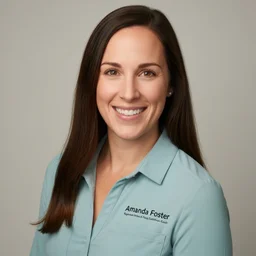
Registered Dietitian & Fitness Certification Coach
University of FloridaAmanda Foster holds a Master of Science in Kinesiology from the University of Florida and is a Registered Dietitian and NASM Certified Personal Trainer. She has helped over 1,000 fitness professionals prepare for their ACE, NASM, ACSM, and specialty nutrition certifications, specializing in evidence-based exercise science and macro nutrition coaching methodology.