
N-400 Interview: What to Expect and How to Prepare 2026 October
🆕 Pass the n-400 interview questions exam with confidence. Practice questions with detailed explanations, hints, and instant feedback on every answer.

What Is the N-400 Naturalization Interview?
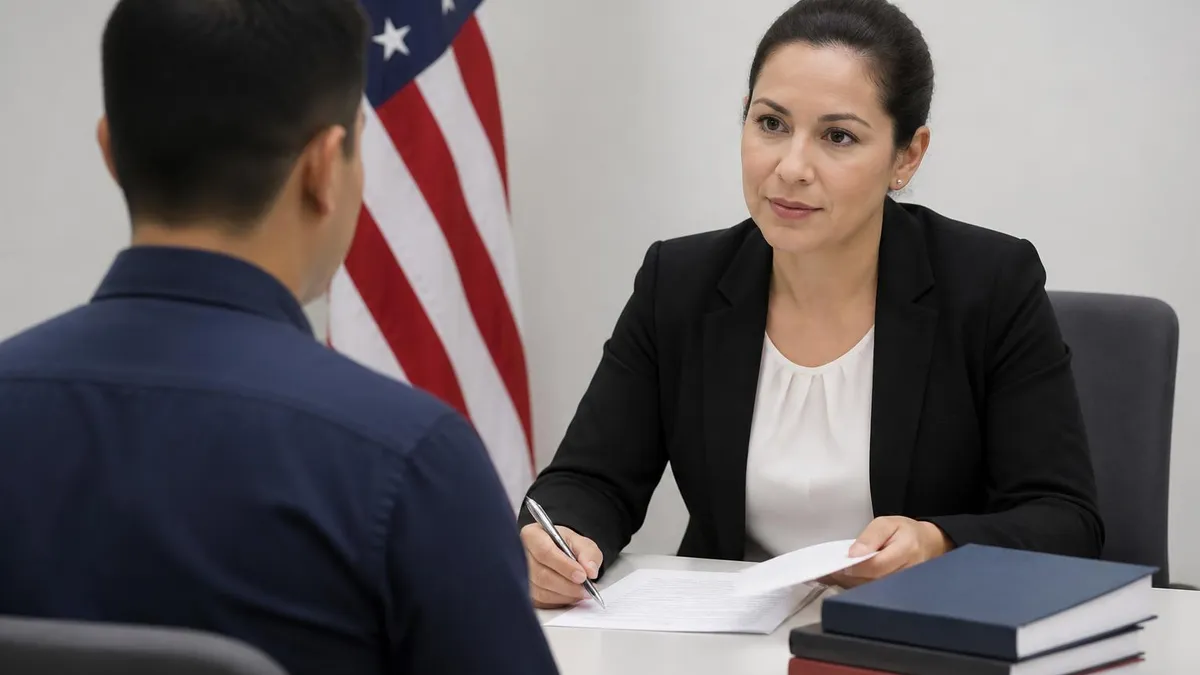
The N-400 interview is the in-person appointment where a USCIS officer reviews your naturalization application, tests your English language ability, and administers the civics test. It's the final major step in the U.S. citizenship process before the oath ceremony. Most applicants are understandably nervous about it — but with proper preparation, the interview is straightforward for anyone who meets the eligibility requirements and has been honest on their N-400.
The interview takes place at a USCIS field office. USCIS will mail you an interview notice with the date, time, and location several weeks in advance. You must bring that notice with you, along with your Permanent Resident Card (green card), a government-issued photo ID, your current and expired passports, and the original versions of any documents you submitted as part of your application. USCIS may also request additional documents depending on your specific circumstances.
The interview covers three main areas. First, the USCIS officer will administer the English language test — a speaking portion, a reading portion, and a writing portion. Second, the officer will ask you up to 10 questions drawn from the 100 official n 400 citizenship questions. You must answer at least 6 correctly to pass. Third, the officer will go through your N-400 application for naturalization line by line to confirm your responses are accurate and to ask follow-up questions about your background, travel history, tax compliance, and any arrests or legal issues.
The entire interview usually takes between 20 and 45 minutes, though complex cases can run longer. Some applicants are approved at the interview and receive their oath ceremony date the same day. Others receive a written decision in the mail within a few weeks. A small percentage receive a Request for Evidence (RFE) or are called back for a second interview if the officer has unresolved questions.
Understanding what the officer is actually evaluating — your English ability, your civics knowledge, and the accuracy of your N-400 — helps you focus your preparation on what matters. This guide walks through each component in detail so you know exactly what to expect and how to get ready.
It helps to remember that the USCIS officer conducting your interview isn't looking for reasons to deny your application — their job is to verify that you meet the legal requirements for naturalization and that the information in your application is accurate. Officers handle dozens of interviews per week and follow a structured protocol. If you're honest, prepared, and organized, the interview is not an adversarial experience. The vast majority of applicants who meet the legal requirements and prepare appropriately are approved.
One thing that surprises many applicants: the English speaking test begins the moment you enter the room. The officer's assessment of your spoken English starts from your first response to "please state your full name and address." There's no separate formal "speaking test" — the officer evaluates your English throughout the entire conversation. So don't think of the speaking portion as a discrete test you pass or fail; think of it as the normal flow of the interview itself.

How to Prepare for the N-400 Interview
Preparation falls into three categories: civics study, English practice, and document organization. Don't underestimate any of them. Even applicants who've lived in the U.S. for many years and speak fluent English can struggle with the civics test if they haven't reviewed the material recently. And document disorganization — showing up without a required original or unable to locate something the officer asks for — causes unnecessary delays.
For the civics test, start with the official USCIS list of 100 civics questions and answers. USCIS publishes this list on their website, and the officer can only ask questions from it. Learn every answer until you can recall them quickly and accurately. Don't just recognize the answers — practice speaking them aloud, because fluency under mild stress matters. Some applicants find it helpful to record themselves and listen back, or to practice with a family member or friend who asks questions randomly. The N-400 interview questions from the official USCIS list should be your primary study material.
For English preparation, the reading and writing tests are not difficult — they're designed to confirm basic English literacy, not to test advanced language skills. Practice reading sentences aloud clearly, and practice writing dictated sentences by hand. If you make a spelling error on the writing test, the officer will typically allow you to correct it if you catch it yourself. Practice under mild time pressure to reduce nerves.
For the N-400 review portion, re-read your N-400 checklist and make sure you remember everything you wrote. If your circumstances have changed since you filed — new address, new employer, additional travel outside the U.S. — be prepared to update the officer. The officer will ask you to confirm your answers under oath, so if anything has changed, say so clearly rather than confirming something that's no longer accurate.
Organize your documents the night before. Make a checklist: interview notice, green card, current passport, expired passports, state-issued photo ID, original marriage or divorce certificates if applicable, tax transcripts for the past 5 years (or 3 years if married to a U.S. citizen), and any other documents you submitted with your application. Bring originals and copies. Put everything in a folder in the order you expect to need them.
Dress professionally. Arrive early — USCIS field offices can have security lines, and being rushed adds unnecessary stress. Turn off your phone. When you enter the interview room, the officer will swear you in before the interview begins. From that point forward, everything you say is under oath.
Mental preparation matters as much as academic preparation. Many applicants know the civics answers cold when they study at home, then experience mental blanks under the mild stress of the interview. The solution is to simulate the interview environment: practice answering civics questions while standing up, speaking to another person, with mild time pressure. The speaking aloud practice is particularly important — knowing an answer in your head is different from saying it confidently to a stranger.
If you don't understand a question the officer asks, say so. The officer can rephrase the question. It's far better to ask for clarification than to answer a question you misunderstood. Officers are trained to work with applicants and expect that some questions may need to be rephrased. Staying calm, listening carefully, and asking for clarification when needed are all legitimate strategies — they're not signs of weakness or insufficient English ability.
N-400 Interview: Documents to Bring
- ✓USCIS interview appointment notice (Form N-400 interview notice)
- ✓Permanent Resident Card (green card) — original
- ✓Current valid passport — original
- ✓All expired passports (if you've had multiple passports)
- ✓State-issued driver's license or photo ID
- ✓Federal tax returns or tax transcripts for past 5 years (3 years if married to U.S. citizen)
- ✓All original supporting documents submitted with your N-400 application
- ✓Marriage certificate (if married) or divorce decree (if previously married)
- ✓Selective Service registration proof (males who registered between ages 18–26)
- ✓Any legal name change documents if your name differs from your green card

Common Questions Officers Ask During the N-400 Review
Beyond the civics and English tests, the N-400 review portion involves the officer asking you to confirm your responses to each part of your application. Some sections of the N-400 generate follow-up questions regardless of what you answered — the officer asks them by protocol. Others generate follow-up only if your answers suggest there's something to explore further.
Travel history is a common area of focus. The N-400 asks you to list all trips outside the United States in the past 5 years (or 3 years if filing based on marriage to a citizen). The officer may ask whether you ever failed to return when expected, whether any trip was extended due to legal issues, and whether you maintained your U.S. domicile while abroad.
If you had extended trips outside the U.S. — generally 180 days or more in a single trip — the officer will ask questions to confirm you maintained your continuous residence requirement. Understand your own N-400 processing time and travel history thoroughly before the interview.
Tax compliance is another focus area. The officer will ask whether you've filed your federal, state, and local tax returns for the past 5 years. If you weren't required to file due to low income, be prepared to explain. If you owe back taxes, be prepared to show an installment agreement with the IRS. Unresolved tax obligations can result in a continuance of your application until the issue is resolved.
The selective service section applies to male applicants who were between the ages of 18 and 26 while living in the U.S. as a lawful permanent resident. If you were required to register and failed to do so, the officer will ask about it. USCIS can grant naturalization in some cases even with a failure to register, particularly if you're now over 31, but you'll need to submit a statement explaining the failure and a letter from the Selective Service System confirming your status.
Criminal history is disclosed in Part 12 of the N-400. Even if your offense was minor, expunged, or occurred decades ago, you must disclose it. The officer will ask follow-up questions about any disclosed arrests, charges, or convictions. Failing to disclose a criminal matter that USCIS later discovers is far more damaging to your application than the underlying offense itself.
If you're filing based on marriage to a U.S. citizen, expect specific questions about the genuineness of your marriage, your shared life, and the history of your relationship. The officer may ask how you met, where you celebrated your anniversary, and other details that genuine couples know easily. Review your application's N-400 required documents for marriage-based cases before the interview.
One of the most common mistakes applicants make is failing to update the officer when circumstances have changed since filing. If you moved, changed jobs, or had additional travel outside the U.S. after submitting your N-400, tell the officer proactively. The officer will ask you to confirm your application information under oath — trying to leave out a recent change creates an inconsistency that the officer may discover anyway from background checks. Being forthright about changes demonstrates honesty and usually results in no more than a quick update to your file.
Don't bring children to the N-400 interview unless absolutely necessary. USCIS field offices have limited waiting areas, and having children present can be distracting for you during an interview that requires your full attention. If possible, arrange childcare for the interview appointment. Similarly, don't bring extra people "for support" — only your attorney (if you have one) is permitted to accompany you into the interview room.
Age-Based Exemptions to the English and Civics Tests
If you are 50 years old or older and have been a lawful permanent resident for at least 20 years, you are exempt from the English language test. You may take the civics test in your native language (you must bring your own interpreter).
Commonly called: The 50/20 rule
Documents needed: Your interview appointment notice will typically note the exemption once USCIS identifies you qualify based on your N-400 information. Bring documentation of your age and green card issuance date.
Civics test still required: Yes — you must still pass the civics test, but you can answer in your native language with an interpreter you provide.
N-400 Interview: What Works in Your Favor and What Doesn't
- +Thorough preparation of all 100 civics questions eliminates the most common interview failure point
- +The English reading and writing tests use simple sentences — consistent practice reduces the only real language barrier
- +Bringing organized, complete documents prevents delays and demonstrates seriousness to the officer
- +Being honest about your entire background — including issues you're concerned about — protects you from the far more serious problem of a fraud finding
- +Understanding the N-400 application you filed, including your travel and employment history, keeps your answers consistent and credible
- −Unprepared applicants who haven't studied the civics questions seriously risk failing and delaying their path to citizenship by 60–90 days
- −Missing required original documents at the interview often results in the officer issuing a Request for Evidence and rescheduling
- −Changes in circumstances after filing (new travel, new address, new legal issues) that aren't proactively disclosed can create inconsistencies the officer notices
- −Not practicing speaking English under mild pressure can cause performance anxiety that makes simple questions feel harder than they are
- −Forgetting details from your N-400 — especially travel dates, addresses, or employer names — causes hesitation that can raise unnecessary questions from the officer
Pros and Cons at a Glance
| Pros | Cons |
|---|---|
| The English reading and writing tests use simple sentences — consistent practice reduces the only real language barrier | Missing required original documents at the interview often results in the officer issuing a Request for Evidence and rescheduling |
| Bringing organized, complete documents prevents delays and demonstrates seriousness to the officer | Changes in circumstances after filing (new travel, new address, new legal issues) that aren't proactively disclosed can create inconsistencies the officer notices |
| Being honest about your entire background — including issues you're concerned about — protects you from the far more serious problem of a fraud finding | Not practicing speaking English under mild pressure can cause performance anxiety that makes simple questions feel harder than they are |
After the Interview: What Happens Next
There are several possible outcomes at the end of your N-400 interview. The most common — and the one you're working toward — is an approval. The officer tells you your application has been approved, and you either receive your oath ceremony date right then or receive a notice in the mail within a few days or weeks.
If the officer approves you at the interview, you may be scheduled for an oath ceremony on the same day (especially at field offices that hold same-day oath ceremonies) or you'll receive a separate notice scheduling your ceremony. At the oath ceremony, you'll take the Oath of Allegiance and receive your naturalization certificate. That certificate is your proof of U.S. citizenship until you obtain a U.S. passport.
A second possible outcome is a continuance. This means the officer can't make a final decision yet — typically because they need to review additional evidence, because a background check is pending, or because you need to submit additional documents. You'll receive a Request for Evidence (RFE) specifying exactly what USCIS needs. Respond to an RFE completely and promptly; incomplete responses extend the delay.
A third outcome is a second interview. This typically happens when the officer has unresolved questions about your background that require more investigation or consultation before a decision can be made. A second interview isn't a denial — but it does mean additional scrutiny of your application. Review your N-400 eligibility documentation carefully if you're called back, and consider consulting with an immigration attorney before the second interview.
A denial is the least common outcome for prepared applicants. USCIS will send you a written denial explaining the grounds. You have 30 days from receipt of the denial to request a hearing before a USCIS officer, or you can refile a new N-400 after addressing the underlying issue. Check the N-400 timeline carefully if you're planning to reapply, as certain disqualifying conditions have waiting periods before you can reapply.
For most applicants who've prepared properly and have a clean background, the interview is the last hurdle before citizenship. The oath ceremony follows, and with it, your U.S. passport application — one of the most tangible rewards of completing the naturalization process.
The oath ceremony is typically scheduled within a few weeks to a few months after interview approval, depending on the field office. Some field offices hold same-day oath ceremonies for applicants approved that morning. Others schedule group ceremonies with dozens or hundreds of applicants at once, sometimes held at courthouses or community venues. At the ceremony, you'll surrender your Permanent Resident Card, take the Oath of Allegiance, and receive your Certificate of Naturalization.
Guard this document carefully — it's difficult and expensive to replace. Once you have your naturalization certificate, you can apply for a U.S. passport, register to vote, obtain a Social Security update, and access other benefits of citizenship. The naturalization certificate is your official proof of U.S. citizenship for all these purposes.
Sample N-400 - Application for Naturalization Practice Questions
Try these questions from our free N-400 - Application for Naturalization practice tests. The correct answer and an explanation follow each question.
What should an applicant do if they cannot attend their scheduled naturalization interview?
- A. Contact USCIS as soon as possible to reschedule before the interview date
- B. Simply not attend and wait for a new notice
- C. File a new N-400 application
- D. Attend on a different day without notifying USCIS
Answer: A. Contact USCIS as soon as possible to reschedule before the interview date
Applicants should contact USCIS immediately to request a rescheduled interview before the missed appointment date.
What happens during the N-400 naturalization interview?
- A. The officer reviews the N-400, tests English, administers civics questions, and asks about eligibility
- B. The officer only administers the civics test
- C. The officer only reviews documents submitted with the application
- D. The officer conducts a background check in person
Answer: A. The officer reviews the N-400, tests English, administers civics questions, and asks about eligibility
The interview covers a review of the N-400 application, English reading and writing tests, up to 10 civics questions, and eligibility questions.
What oath must the applicant take at the beginning of the N-400 interview?
- A. An oath to tell the truth during the interview
- B. The Oath of Allegiance to the United States
- C. An oath to uphold the Constitution after naturalization
- D. An oath affirming their address and identity
Answer: A. An oath to tell the truth during the interview
At the start of the interview, the USCIS officer administers an oath requiring the applicant to tell the truth.
What should an applicant do if they do not understand a question during the naturalization interview?
- A. Politely ask the officer to repeat or rephrase the question
- B. Guess the answer
- C. Remain silent and wait
- D. Ask a family member in the waiting room
Answer: A. Politely ask the officer to repeat or rephrase the question
Applicants should ask the officer to repeat or clarify any question they do not understand — officers are accustomed to this.
Take the full N-400 - Application for Naturalization practice test
N-400 Interview Questions and Answers
About the Author

Educational Psychologist & Academic Test Preparation Expert
Columbia University Teachers CollegeDr. Lisa Patel holds a Doctorate in Education from Columbia University Teachers College and has spent 17 years researching standardized test design and academic assessment. She has developed preparation programs for SAT, ACT, GRE, LSAT, UCAT, and numerous professional licensing exams, helping students of all backgrounds achieve their target scores.
Join the Discussion
Connect with other students preparing for this exam. Share tips, ask questions, and get advice from people who have been there.
View discussion (9 replies)