
Los Angeles MEPS: Complete Guide to LA Military Processing 2026 September
Free Los Angeles MEPS: 🗨️ Complete Guide to LA practice test with questions and answer explanations. Prepare for the 2026 September exam with instant scoring.
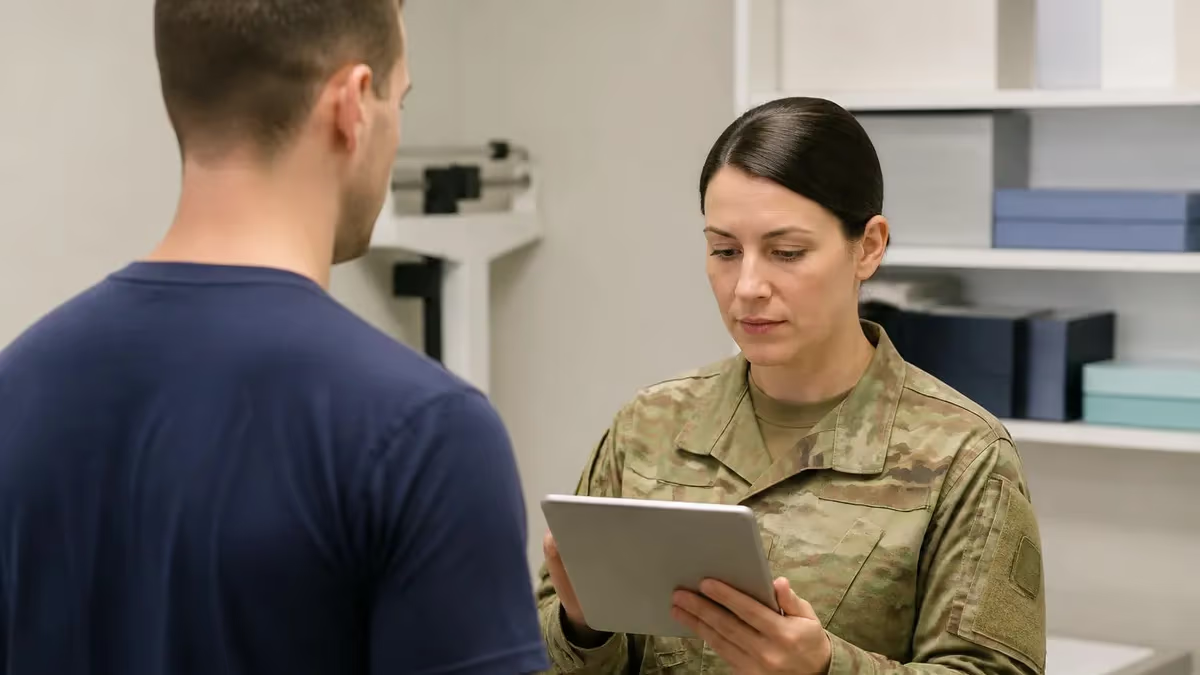
The Los Angeles Military Entrance Processing Station (MEPS) is the gateway for military enlistment across Southern California's vast recruiting area. Located at 5051 Rodeo Road in Los Angeles, the station processes recruits from all five military branches — Army, Navy, Marine Corps, Air Force, and Coast Guard — serving recruiters from Los Angeles, Orange County, the Inland Empire, and the surrounding region. If you're enlisting from anywhere in Southern California and your recruiter has scheduled you for MEPS, there's a good chance you'll process through Los Angeles.
Understanding what is meps before your appointment removes the stress that comes from not knowing what to expect. MEPS processing is thorough and time-consuming, but it follows a predictable sequence: check-in, medical examination, ASVAB testing (if not already completed), background review, career counseling, and the oath of enlistment. The Los Angeles station processes recruits five days a week and handles high daily volumes, which means the facility is well-organized and the staff are experienced with efficient processing.
The Los Angeles MEPS building is a dedicated federal facility staffed by military personnel from the United States Military Entrance Processing Command (USMEPCOM). Medical staff include licensed physicians, physician assistants, nurses, and technicians who conduct the full physical examination. Guidance Counselors represent each branch and are responsible for MOS/rating/AFSC (job code) selection and enlistment contract execution. The station operates under standardized USMEPCOM protocols — the process in Los Angeles is functionally identical to the process at any other MEPS in the country.
Most recruits process at Los Angeles MEPS over two days: Day 1 involves the ASVAB test (if you haven't already taken it at your recruiting station) and check-in at the contracted hotel. Day 2 is full processing — physical exam, background review, job selection, and oath. Your recruiter arranges all transportation and hotel accommodations; there's no cost to you for either. The government-contracted hotel is near the facility and serves recruits from multiple branches, all going through processing on the same cycle.
This guide covers everything specific to the Los Angeles MEPS experience: the address and directions, parking and public transit options, what to bring, how the day runs, and what to expect from each processing stage. Whether this is your first time at MEPS or you're a recruiter preparing candidates, the details here are specific to the LA station and current as of 2026.
For future service members concerned about the intimidation factor of MEPS, it helps to know that the vast majority of recruits who arrive prepared and honest complete the process without complications. The physical examination is thorough but not punitive — the goal is to confirm you can safely complete basic training and military service, not to find reasons to reject qualified candidates. Most medical findings at MEPS fall into three categories: clearly qualified, waiverable, or disqualifying. Only the third category ends your processing permanently, and many conditions that initially appear disqualifying are actually waiverable with proper documentation.
MEPS processes recruits for all five military branches simultaneously in shared facilities. You'll be assigned to your branch-specific processing track but will share waiting areas, medical examination stations, and the oath ceremony auditorium with recruits from the Army, Navy, Marine Corps, Air Force, and Coast Guard. The shared facility experience is intentional — MEPS is where future service members from all branches first experience the common identity of U.S. military service, before the branch-specific identities of basic training and beyond take over.
The medical examination at Los Angeles MEPS follows standard USMEPCOM protocols but takes longer than at smaller stations due to the volume of recruits processed daily. Plan for a full day — most recruits finish between 4:00 and 6:00 PM on processing day, though time varies with individual circumstances and the daily recruit load. Stations processing 80 or more recruits per day have peak periods where wait times between examination rooms are longer than at lower-volume facilities.
Vision and hearing testing happen early in the examination sequence. The LA MEPS facility has multiple audiometry booths and visual acuity lanes to handle the volume. Recruits who wear glasses or contacts should bring them, along with their current prescription if available. If your uncorrected vision is borderline for your desired branch or MOS category, having your prescription on hand speeds the evaluation. The orthopedic evaluation — duck walk, squat, balance tests — is conducted in groups and is typically one of the faster stations in the sequence.
The urine drug screen is non-negotiable. Los Angeles MEPS tests for all standard controlled substances at federal cutoff thresholds, and California's cannabis laws provide no exception — THC metabolites will disqualify you regardless of whether marijuana is legal in your state. The collection is observed. Any attempt to tamper with or substitute a specimen is a federal offense that permanently disqualifies you from military service. Recruits who test positive are immediately disqualified and must reapply after a significant waiting period, subject to branch-specific reapplication policies.
Mental health history receives additional scrutiny at MEPS compared to what it did a decade ago. The questionnaire asks about diagnosed conditions, psychiatric hospitalizations, medications, and behavioral health treatment history. If you have any of these in your background, discuss them with your recruiter before your MEPS appointment — your recruiter can help you understand what documents to bring and whether a waiver will be needed. Surprises during the mental health review cause more delays than proactively disclosed and documented history.
Understanding meps military processing in detail helps you approach the day with realistic expectations. Most recruits who prepare honestly and arrive with complete documentation complete LA MEPS processing without complications. The station processes hundreds of future servicemembers each week, and the staff are experienced at moving recruits efficiently through the sequence while maintaining the thoroughness the medical and legal standards require.
If your medical examination raises a condition that requires additional documentation — a prior surgery report, a letter from a specialist, updated lab values — MEPS may schedule a "medical hold" while that information is gathered. A medical hold pauses your processing without disqualifying you, but it extends your timeline. The recruiter plays a critical role during medical holds: staying in communication, coordinating with the MEPS medical officer, and helping you obtain the required records quickly. Recruits who enter medical holds with good documentation typically resolve them within two to four weeks.
Orthopedic findings deserve special attention at LA MEPS because Southern California's active outdoor culture means many recruits arrive with sports and recreational injuries — ACL reconstructions, shoulder repairs, stress fractures — that they've lived with for years without incident. The key question for each orthopedic finding is functional: can you perform basic training physical demands without risk of re-injury or significant limitation? Well-documented, fully healed repairs with surgical clearance notes from an orthopedic surgeon often clear waiver processing faster than poorly documented or undisclosed histories of the same conditions.

Los Angeles MEPS Preparation Guide
- Address — 5051 Rodeo Road, Los Angeles, CA 90016. The facility is accessible via I-10 westbound to Crenshaw Boulevard north.
- Hotel shuttle — Your recruiter arranges the government hotel, which provides direct shuttle service to MEPS on processing day. Use this — don't try to drive or rideshare to MEPS independently on processing morning.
- Public transit — The area is served by Metro Bus lines, but processing day starts before standard transit hours. The hotel shuttle is more reliable.
- Parking at MEPS — Limited visitor parking is available at the facility, but recruits are expected to use the hotel shuttle arrangement, not personal vehicles.
Job selection at the Los Angeles MEPS follows the same process as any other station but reflects the military's personnel needs at the time of your processing. Southern California is a major recruiting area, which means LA MEPS processes recruits for all five branches daily — Army, Navy, Marine Corps, Air Force, and Coast Guard each have dedicated Guidance Counselors on site. Your Guidance Counselor presents available positions in your branch based on your ASVAB scores and current enlistment openings. Specific jobs, bonuses, and training pipeline availability vary by processing date.
The Los Angeles area has significant concentrations of military veterans and active-duty service families, particularly around bases like Naval Base Ventura County (Port Hueneme), Marine Corps Air Station Camp Pendleton, and Edwards Air Force Base. Recruits enlisting for assignments at California installations may ask about station of choice options during MOS counseling — these aren't always available, but they're worth asking about if California duty is a priority for you. Your Guidance Counselor will tell you whether your chosen MOS qualifies for station of choice provisions under current policy.
The meps meaning as a gateway extends beyond just testing — MEPS is also where the government makes a legal commitment to you. Your enlistment contract is a binding federal document specifying your job, training start date, enlistment length, and any bonuses or options you've negotiated. Once signed, the terms are enforceable on both sides. Review the contract carefully before signing and ask your Guidance Counselor to explain any clause you don't understand. Verbal promises that aren't in the contract aren't part of your agreement.
The oath ceremony at Los Angeles MEPS typically takes place in the late afternoon, after all branches have completed their respective job selection and contracting. You'll join recruits from all five branches in the auditorium for a joint ceremony administered by a commissioned officer. Family members are not typically allowed into the MEPS facility itself, but many families gather outside the facility afterward to meet their newly-enlisted service members. Your recruiter may have specific information about where families can wait and what the post-ceremony process looks like at the LA station.
For Navy recruits processing through Los Angeles MEPS, the Guidance Counselor will use your ASVAB scores and NAVET (Navy Enlisted Classification) requirements to present available ratings (Navy job codes). High-demand Navy ratings in nuclear propulsion (requiring a separate Nuclear Propulsion Officer Candidate screening), submarine service, and cybersecurity have additional qualification requirements beyond ASVAB scores alone. If any of these pathways interest you, discuss them with your Navy recruiter before MEPS so the Guidance Counselor knows your interest and can identify whether you meet the additional screening criteria.
Air Force recruits processing at LA MEPS will work with a Space and Air Force Guidance Counselor to identify available AFSC (Air Force Specialty Code) options. The Air Force maintains some of the most competitive ASVAB score requirements for its technical career fields — Airborne Operations, Cyber Systems Operations, and electronic warfare AFSCs regularly require line scores in the upper quartile. Recruits who prepared specifically for these fields by studying the relevant ASVAB subtests before MEPS are far better positioned to qualify for their target AFSCs than those who relied on general preparation alone.

- ✓Confirm your exam appointment and location
- ✓Bring required identification documents
- ✓Arrive 30 minutes early to check in
- ✓Read each question carefully before answering
- ✓Flag difficult questions and return to them later
- ✓Manage your time — don't spend too long on one question
- ✓Review flagged questions before submitting
Los Angeles MEPS: What to Know
- +High-volume station with experienced, efficient processing staff
- +All five branches processed — recruits for any branch can process here
- +Government hotel and shuttle service removes transportation logistics
- +Results from ASVAB testing available same day for immediate job counseling
- +Located in major metro area with proximity to multiple military installations
- +Weekend processing available in some circumstances — confirm with recruiter
- −High daily volume means longer waits between medical examination stations
- −LA traffic makes independent transportation to MEPS unreliable
- −Processing days are long — plan for 8 to 12 hours at the facility
- −Hotel accommodations are functional but basic — don't expect amenities
- −Families cannot accompany recruits inside the MEPS facility
- −Medical disqualifications require waiver processing that extends timeline

After completing LA MEPS and taking the oath, you enter the Delayed Entry Program (DEP) and begin counting down to your ship date. The period between MEPS and shipping is typically the most productive time to focus on physical conditioning and test preparation. For recruits shipping to Army or Marine Corps basic training — both physically intensive programs — arriving fit is a significant advantage that reduces injury risk and allows you to focus on the tactical and leadership skills that actually advance your career. Use DEP time for deliberate, progressive training rather than casual activity.
DEP meetings at your recruiting station keep you connected with your recruiter and your branch's future soldier or future sailor programs. These meetings provide preparation information, allow you to ask questions, and help the recruiter confirm that you remain qualified (maintaining your medical and legal status) through your DEP period. Recruits who keep their recruiter informed, stay physically active, and remain out of legal trouble during DEP have the smoothest transition to basic training.
If circumstances change during your DEP period — a medical issue develops, you have a legal encounter, you change your mind about enlisting — contact your recruiter immediately. DEP can be discharged voluntarily, and the process for doing so is cleaner when you communicate openly rather than simply not showing up on ship day. Not shipping without prior communication creates complications for you, your recruiter, and your branch's processing records. Open communication protects everyone involved.
For recruits who processed through meps at other locations before relocating to Southern California — or who are considering which MEPS to process through based on their recruiter's area — the Los Angeles station handles the same process as every other USMEPCOM facility. Your ASVAB scores, medical records, and prior MEPS documentation transfer between stations without requiring re-processing, as long as your records were completed at an approved MEPS location within the applicable timeframes.
Several California National Guard units — Army and Air — also process recruits through Los Angeles MEPS for initial enlistment. National Guard processing follows the same MEPS sequence but results in a different contract type: the Guard contract specifies part-time service commitment alongside your full-time civilian life, plus any initial active-duty training required for your MOS or AFSC.
Guard recruits from Southern California should verify with their State Recruiting Officer which MEPS station their unit uses before scheduling — some Guard units in the region process at Los Angeles, while others may use Fresno MEPS or other Northern California stations depending on unit location.
The experience of processing at Los Angeles MEPS is a preview of military life in one specific way: you will spend time waiting without knowing exactly how long. The sequence is predictable; the timing is not. Recruits who approach this with patience rather than frustration adjust better to the institutional pace they'll encounter throughout military service.
Bring a book, review your study materials, or mentally rehearse the questions you want to ask your Guidance Counselor. The waiting time at MEPS is information too — it's your first experience of the "hurry up and wait" culture that defines military service at every level.
MEPS Practice Test Questions
Prepare for the MEPS - Military Entrance Processing Stations exam with our free practice test modules. Each quiz covers key topics to help you pass on your first try.
MEPS Introduction to MEPS
MEPS Exam Questions covering Introduction to MEPS. Master MEPS Test concepts for certification prep.
MEPS ASVAB
Free MEPS Practice Test featuring ASVAB. Improve your MEPS Exam score with mock test prep.
MEPS Paragraph Comprehension
MEPS Mock Exam on Paragraph Comprehension. MEPS Study Guide questions to pass on your first try.
MEPS Military Entrance Processing Stations...
MEPS Test Prep for Military Entrance Processing Stations (MEPS) Applicant Processing and Standards. Practice MEPS Quiz questions and boost your score.
MEPS Military Entrance Processing Stations...
MEPS Questions and Answers on Military Entrance Processing Stations (MEPS) ASVAB Aptitude Testing. Free MEPS practice for exam readiness.
MEPS Military Entrance Processing Stations...
MEPS Mock Test covering Military Entrance Processing Stations (MEPS) Enlistment and Oath Ceremony. Online MEPS Test practice with instant feedback.
MEPS Military Entrance Processing Stations...
Free MEPS Quiz on Military Entrance Processing Stations (MEPS) Job Counseling and Contracts. MEPS Exam prep questions with detailed explanations.
MEPS Military Entrance Processing Stations...
MEPS Practice Questions for Military Entrance Processing Stations (MEPS) MEPS Medical Examinations. Build confidence for your MEPS certification exam.
MEPS Military Entrance Processing Stations...
MEPS Test Online for Military Entrance Processing Stations (MEPS) Moral and Background Screening. Free practice with instant results and feedback.
MEPS Applicant Pre-Screening Process
MEPS Study Material on Applicant Pre-Screening Process. Prepare effectively with real exam-style questions.
MEPS Applicant Processing and Conduct
Free MEPS Test covering Applicant Processing and Conduct. Practice and track your MEPS exam readiness.
MEPS ASVAB Administration and Purpose
MEPS Exam Questions covering ASVAB Administration and Purpose. Master MEPS Test concepts for certification prep.
MEPS ASVAB Aptitude Testing
Free MEPS Practice Test featuring ASVAB Aptitude Testing. Improve your MEPS Exam score with mock test prep.
MEPS Enlistment Contracts and Oaths
MEPS Mock Exam on Enlistment Contracts and Oaths. MEPS Study Guide questions to pass on your first try.
MEPS Job Selection and Counseling
MEPS Test Prep for Job Selection and Counseling. Practice MEPS Quiz questions and boost your score.
MEPS Job Selection and Enlistment
MEPS Questions and Answers on Job Selection and Enlistment. Free MEPS practice for exam readiness.
MEPS Medical Examination Procedures
MEPS Mock Test covering Medical Examination Procedures. Online MEPS Test practice with instant feedback.
MEPS Medical Examination Process
Free MEPS Quiz on MEPS Medical Examination Process. MEPS Exam prep questions with detailed explanations.
MEPS Moral and Background Standards
MEPS Practice Questions for Moral and Background Standards. Build confidence for your MEPS certification exam.
Los Angeles MEPS Questions and Answers
About the Author
Retired Military Officer & Armed Forces Test Preparation Specialist
United States Army War CollegeColonel Steven Harris (Ret.) served 28 years in the US Army, earning a Master of Arts in Military Science from the Army War College and a Bachelor of Science in Criminal Justice. He has coached thousands of military enlistment and officer candidate program applicants through the ASVAB, AFQT, AFCT, OAR, and officer selection assessment processes across all military branches.
Join the Discussion
Connect with other students preparing for this exam. Share tips, ask questions, and get advice from people who have been there.
View discussion (8 replies)