
Mensa Official Website: What Is Mensa, How to Join, and What to Expect
Why is my menses late? Plus: what is Mensa, how to join, and how to prep. Everything explained in one place. 🧠

If you have ever typed "why is my menses late" into a search engine, you are not alone — it is one of the most searched health questions in the United States, with over 14,800 monthly searches. But this article also answers a completely different question: what is Mensa, the high-IQ society? Both topics share a confusingly similar word, and we cover both in plain language. The mensa official website belongs to American Mensa, a nonprofit organization that admits members who score in the top 2 percent of the population on a standardized IQ test.
Understanding the difference between "menses" and "Mensa" is genuinely useful. Menses refers to the monthly menstrual cycle — the shedding of the uterine lining that typically occurs every 21 to 35 days in people with uteruses. Mensa, by contrast, is a Latin word meaning "table," chosen to symbolize equality among members. The organization was founded in England in 1946 and now has over 50,000 members in the United States alone, making American Mensa one of the largest high-IQ societies in the world.
Late menses, medically called oligomenorrhea or amenorrhea depending on severity, can result from stress, sudden weight changes, thyroid dysfunction, polycystic ovary syndrome (PCOS), pregnancy, or perimenopause. A period that arrives more than seven days after its expected date is generally considered late. Tracking your cycle with an app or a paper calendar is the single most useful step you can take to identify patterns, because irregularity is often the first sign of an underlying hormonal issue worth discussing with a healthcare provider.
Menses irregular periods are extremely common — studies suggest that up to 30 percent of people who menstruate experience cycle irregularity at some point in their reproductive lives. Irregular cycles are defined as those that vary by more than eight days in length from cycle to cycle. While occasional irregularity is normal, persistent irregularity lasting three or more consecutive cycles warrants medical evaluation. Conditions such as PCOS, endometriosis, and thyroid disorders are among the most frequent culprits, and each responds well to early treatment.
On the Mensa side, the organization offers members access to a nationwide network of intellectually curious people, local and national events, special interest groups covering hundreds of topics, and a suite of online resources. The admission requirement is simple in concept but demanding in practice: you must demonstrate that your score on a qualifying intelligence test places you in the 98th percentile or above. Roughly one in fifty people meet this threshold, which means Mensa membership is genuinely selective without being impossibly exclusive.
This article is designed to serve both audiences — those searching for health information about menses and those curious about the Mensa organization. We will walk through the causes of late or irregular periods, the meaning of menses-related symptoms like cramping and diarrhea, and the full picture of what Mensa membership involves, from the qualifying test to the benefits of belonging. Whether your search brought you here for health answers or intellectual community, you will leave with the information you need to take a confident next step.
By the end of this guide, you will understand what menses diarrhea is and why it happens, how menses postpone tablets work and whether they are safe, what clots in menses indicate, and how the Mensa admissions process works from application to acceptance. We have organized everything into clear sections so you can jump directly to the topic most relevant to you without wading through content that does not apply to your situation.
Menses and Mensa by the Numbers
Key Facts at a Glance
| Item | Value | Details |
|---|---|---|
| Normal menstrual cycle length | 21–35 days | Cycles outside this range may need evaluation |
| IQ percentile required for Mensa | Top 2% | Approximately 1 in 50 people qualify |
| Year Mensa was founded | 1946 | Originally established in Oxford, England |
Menses Meaning: Understanding Your Monthly Cycle
Menses is the medical term for the monthly menstrual flow. It refers specifically to the blood, tissue, and fluid shed from the uterine lining when a fertilized egg does not implant. A typical period lasts three to seven days and involves 30 to 80 milliliters of total flow.
Cycle length can vary naturally from 21 to 35 days, and flow can range from light to heavy. Variations of a few days from month to month are completely normal. What matters most is whether your own cycle remains relatively consistent from one month to the next over time.
Consult a healthcare provider if your period is more than seven days late, if you experience severe cramping or clots larger than a quarter, if your cycle changes dramatically from its usual pattern, or if you have missed three or more consecutive periods without a known cause.
Cycle tracking apps like Clue, Flo, and Apple Health allow you to log period start and end dates, symptoms, and flow intensity. After three to six months of consistent tracking, patterns emerge that make it much easier for your doctor to diagnose irregularity and identify the underlying cause.
Understanding why menses is late requires looking at the full range of biological and lifestyle factors that regulate the hypothalamic-pituitary-ovarian axis, which is the hormonal system that controls your cycle. The most important thing to know is that this system is exquisitely sensitive to external conditions. Chronic stress, for instance, causes the body to produce elevated cortisol, which can suppress the release of gonadotropin-releasing hormone (GnRH) and delay or prevent ovulation entirely. Without ovulation, menstruation either does not occur or occurs much later than expected.
Significant weight changes — both loss and gain — are among the most common causes of late or missed periods. Extreme caloric restriction or excessive exercise can cause hypothalamic amenorrhea, a condition in which the brain essentially shuts down reproductive function to preserve energy for survival. Athletes, dancers, and people with eating disorders are particularly vulnerable. On the other end of the spectrum, excess body fat can produce additional estrogen that disrupts the normal hormonal cycle, leading to menses irregular periods that are unpredictable in timing and flow.
Thyroid dysfunction is another frequent cause of late menses that often goes undiagnosed for years. Both hypothyroidism (underactive thyroid) and hyperthyroidism (overactive thyroid) can disrupt the menstrual cycle. The thyroid gland influences nearly every cell in the body, including the reproductive hormones. A simple blood test measuring TSH (thyroid-stimulating hormone) can diagnose thyroid disorders, and treatment typically restores a regular cycle within a few months. If you have experienced unexplained weight changes, fatigue, or hair loss alongside cycle irregularity, ask your doctor to check your thyroid function.
Polycystic ovary syndrome, commonly called PCOS, affects an estimated 5 to 10 percent of people of reproductive age and is one of the leading causes of irregular or absent periods. In PCOS, the ovaries produce excess androgens (male hormones), which interfere with the normal development and release of eggs. The result is often cycles that vary wildly in length — sometimes 60 days, sometimes 90 days, sometimes not occurring at all for several months. PCOS is also associated with insulin resistance, acne, and excessive hair growth in areas like the chin and upper lip.
Pregnancy is always the first possibility to rule out when menses is late, even if you believe you have been using contraception consistently. Home pregnancy tests are highly accurate when taken at least one day after a missed period and can detect the hormone hCG in urine with over 99 percent accuracy. If you have had unprotected sex in the past month, take a pregnancy test before pursuing other explanations. Early pregnancy symptoms — nausea, breast tenderness, fatigue, and frequent urination — can overlap significantly with premenstrual symptoms, making it genuinely difficult to tell them apart based on symptoms alone.
Certain medications can also delay menstruation. Hormonal contraceptives, especially progestin-only pills, hormonal IUDs, and the contraceptive injection (Depo-Provera), commonly cause irregular or absent periods as a normal side effect. Antipsychotic medications, antidepressants, and corticosteroids can also affect cycle regularity by altering hormone levels or raising prolactin, a hormone that suppresses ovulation. If you started a new medication and your cycle changed shortly afterward, the medication may be responsible — but do not stop taking prescribed medications without consulting your doctor first.
Perimenopause, the transition period leading up to menopause, can begin as early as the late thirties or early forties and typically involves significant changes in cycle regularity before periods stop entirely. During perimenopause, estrogen levels fluctuate unpredictably, causing cycles to become shorter, longer, heavier, lighter, or more erratic. The average age of menopause in the United States is 51, but perimenopause can last anywhere from two to twelve years. If you are in your forties and your cycle has become unpredictable, perimenopause is a strong possibility worth discussing with your gynecologist.
Clots in Menses, Diarrhea, and Irregular Periods Explained
Clots in menses are extremely common and usually benign. They form when menstrual blood pools in the uterus or vagina and coagulates before it exits the body. Small clots — roughly the size of a dime or smaller — during the heaviest days of your period are considered normal and do not require medical attention. The body releases anticoagulants during menstruation to prevent clotting, but when flow is heavy, these anticoagulants cannot keep up, resulting in visible clots.
Clots larger than a quarter, or clots that occur consistently throughout your period rather than just on heavy days, may indicate an underlying condition such as uterine fibroids, endometriosis, adenomyosis, or a thyroid disorder. Uterine fibroids are noncancerous growths that affect an estimated 20 to 80 percent of people with uteruses by age 50 and can cause dramatically heavy periods with large clots. If heavy clotting is accompanied by severe cramps, pelvic pressure, or periods that last longer than seven days, a pelvic ultrasound can help identify the cause and guide treatment options.

Menses Postpone Tablets: Are They Safe and Effective?
- +Norethisterone (the most common postpone tablet) is clinically proven to delay menstruation by 3–17 days when taken correctly
- +Useful for travel, athletic competitions, weddings, or other events where menstruating would be inconvenient
- +Available by prescription in the US and over the counter in some countries, making access relatively straightforward
- +Effects are temporary — your period typically arrives within a few days of stopping the medication
- +Low short-term risk profile when used occasionally by people without contraindications
- +Can be prescribed by a telemedicine provider, making it accessible without an in-person visit
- −Not suitable for people with a history of blood clots, liver disease, breast cancer, or unexplained vaginal bleeding
- −Common side effects include bloating, breast tenderness, mood changes, nausea, and spotting
- −Does not provide contraceptive protection — you can still become pregnant while taking it
- −When your period returns, it may be heavier or more crampy than usual as the uterine lining catches up
- −Not intended for regular use — relying on postpone tablets every month carries unknown long-term risks
- −Should not be started mid-cycle without medical guidance, as timing is critical for effectiveness
Menses Panties, Period Products, and Cycle Management Checklist
- ✓Track your cycle start date each month using an app or paper calendar to identify your personal pattern.
- ✓Choose period underwear (menses panties) with an absorbency level matched to your flow — light, moderate, or heavy duty options exist.
- ✓Wash period underwear in cold water before the first wash to set the fabric and maximize absorbency.
- ✓If you experience heavy clotting, log the size and frequency of clots so you can describe them accurately to your doctor.
- ✓Take ibuprofen 400–600 mg at the first sign of cramping rather than waiting for pain to peak, for better relief.
- ✓Reduce caffeine and high-sodium foods in the three days before your expected period to minimize bloating and diarrhea risk.
- ✓If your period is more than seven days late and a pregnancy test is negative, schedule an appointment with a healthcare provider.
- ✓Discuss menses postpone tablets with a doctor at least two weeks before the event you need to plan around, as they must be started at a specific cycle phase.
- ✓Replace tampons or menstrual cups every four to eight hours to prevent toxic shock syndrome risk.
- ✓If you experience severe diarrhea and menses simultaneously, stay hydrated with electrolyte-containing fluids to prevent dehydration.
One in 50 People Qualify for Mensa — Could You Be One of Them?
The Mensa qualifying score corresponds to the 98th percentile on any of roughly 200 approved standardized tests. If you scored highly on any standardized test — including the SAT, ACT, GRE, or military ASVAB — you may already have qualifying evidence on file. American Mensa accepts prior test scores taken within the past five years as proof of eligibility, meaning you might be able to join without taking any new test at all. Check the official Mensa evidence policy before scheduling a new exam.
So what is Mensa, exactly, and why do so many people search for information about it every month? Mensa International is the world's oldest and largest high-IQ society, with chapters in more than 100 countries and a combined global membership exceeding 145,000 people.
The organization's name comes from the Latin word for table, reflecting the founding principle that members sit as equals regardless of race, religion, gender, nationality, or profession. A nuclear physicist and a truck driver who both score in the top 2 percent are equally welcome — the only criterion is cognitive ability as measured by a standardized test.
American Mensa, the United States chapter, is headquartered in Carollton, Texas, and serves as the primary point of contact for Americans seeking membership. The organization offers two main pathways to membership. The first is to take the Mensa Admission Test, a proprietary two-part exam administered at supervised testing sessions held throughout the year at locations across the country.
The test takes about two hours and costs around $40 for adults. The second pathway is to submit evidence of prior testing — a qualifying score on an approved standardized test such as the Stanford-Binet, Wechsler Adult Intelligence Scale, SAT, ACT, or GRE, taken within the past five years.
The Mensa Admission Test itself consists of two separate proctored tests, each normed to the general population. To qualify, you must score at or above the 98th percentile on at least one of the two tests. You do not need to score in the 98th percentile on both — a strong performance on one is sufficient. The tests measure a broad range of cognitive abilities, including verbal reasoning, numerical reasoning, spatial visualization, working memory, pattern recognition, and abstract reasoning. There is no single "type" of intelligence that the test exclusively favors, which means well-rounded cognitive ability tends to be rewarded.
Mensa membership offers a surprisingly rich array of benefits that extend well beyond the prestige of belonging to a high-IQ group. Members gain access to over 150 special interest groups (SIGs) covering topics as diverse as astronomy, board games, philosophy, cooking, travel, parenting, science fiction, and cryptocurrency. These groups connect members with shared passions who happen to also share a high level of cognitive ability, creating unusually stimulating conversations and friendships. The national Annual Gathering (AG) draws thousands of members each summer for a week of talks, games, social events, and competitions.
Local chapters of Mensa — called local groups — organize their own events throughout the year. These vary enormously by region but typically include pub trivia nights, game days, book clubs, dinner parties, and community service activities. The social dimension of Mensa is frequently cited by long-time members as the most valuable part of membership. Many members describe feeling genuinely understood by fellow Mensans in a way that they do not always experience in everyday social settings, where the intensity of intellectual conversation can sometimes be difficult to sustain with people who are not similarly wired.
The annual cost of American Mensa membership is relatively modest — approximately $79 per year for adults, with reduced rates for seniors, students, and life members. There is also a one-time application processing fee of around $40 if you are submitting prior test evidence rather than taking the Mensa exam. Compared to many professional organizations or social clubs, Mensa is quite affordable, particularly given the breadth of resources, publications, and events that membership unlocks. The organization publishes the Mensa Bulletin magazine, distributed to all members, which covers science, technology, culture, and Mensa community news.
One frequently misunderstood aspect of Mensa is what the organization is not. Mensa does not claim that IQ is the only important measure of human worth, intelligence, or potential. The organization explicitly acknowledges that emotional intelligence, creativity, practical skills, and social wisdom are valuable traits that standardized tests do not capture. Mensa's focus on cognitive ability measured by IQ tests is simply its organizational niche — the way a chess club focuses on chess or a running club focuses on running. Membership signals a specific aptitude, not overall superiority as a human being.

American Mensa accepts qualifying scores from over 200 approved standardized tests as proof of eligibility, including the SAT (scores from 1974 to 1994 require a different cutoff than post-1994 scores), ACT, GRE, Miller Analogies Test, and numerous professional intelligence assessments. Scores must be from a supervised, proctored administration within the past five years. Contact American Mensa directly to request the full prior evidence list before scheduling a new exam, as many applicants discover they already have qualifying documentation in hand.
Preparing for the Mensa Admission Test requires a strategic approach because the exam tests a wide range of cognitive skills in a timed format that can feel unfamiliar even to high achievers. Most people who fail their first attempt do so not because they lack the cognitive ability to qualify, but because they underestimate the importance of pacing, test familiarity, and anxiety management. Understanding the structure of the exam before you sit down to take it is one of the highest-return investments of your preparation time, because surprises during a timed test are the enemy of optimal performance.
The Mensa Admission Test comprises two separately normed assessments: the Mensa Wonderlic and a second proprietary test. Each test takes approximately 30 minutes, and the full session including instructions and breaks lasts roughly two hours. The Wonderlic portion involves rapid-fire questions covering vocabulary, analogies, numerical series, and spatial reasoning, with a premium on speed as well as accuracy. The second test emphasizes pattern recognition, abstract reasoning, and matrix-style problems similar to Raven's Progressive Matrices. Both tests are multiple choice, and there is no penalty for guessing, so you should never leave a question blank.
Practice tests are the cornerstone of effective Mensa preparation. Working through timed practice sets under realistic conditions does three things simultaneously: it familiarizes you with the question formats so you do not waste time figuring out what is being asked during the real exam, it helps you calibrate your pacing so you can reach every question before time runs out, and it identifies your specific weak areas so you can target your study time efficiently.
After each practice session, review every question you missed or guessed on — understanding why you got something wrong is far more valuable than simply knowing that you did.
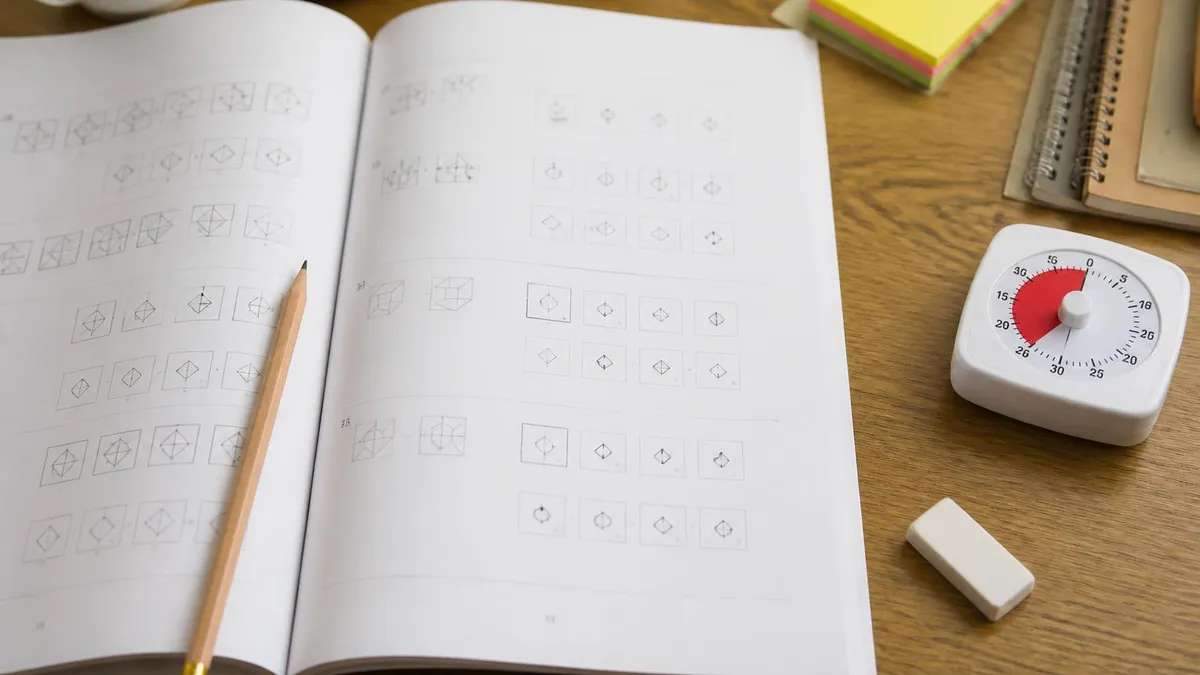
Spatial visualization is the skill most commonly cited by Mensa test-takers as their biggest challenge. These questions require you to mentally rotate two- or three-dimensional shapes, identify which shape would result from folding a flat pattern, or determine which of several answer choices is a rotation rather than a reflection of a given figure. If spatial reasoning is not your strongest suit, dedicated practice with spatial puzzles — including tangrams, Tetris-style block games, and online rotation tests — can produce meaningful improvement within a few weeks of consistent practice.
Number series completion is another high-frequency question type on the Mensa exam. These questions present a sequence of numbers and ask you to identify the next number or the missing term in the sequence. The underlying patterns range from simple arithmetic progressions (add 3 each time) to more complex alternating sequences, geometric progressions, or sequences based on Fibonacci-like rules.
The key to speed on these questions is learning to quickly recognize the most common pattern types rather than working from scratch on every question. Exposure to a large volume of practice problems is the most effective way to build this pattern recognition skill.
Verbal reasoning questions on the Mensa exam typically include analogies, odd-one-out vocabulary sets, and synonym or antonym identification. A strong vocabulary is an asset here, but the more critical skill is the ability to identify the precise logical relationship between words and apply it consistently. Reading broadly — especially in domains outside your professional expertise — is one of the most enjoyable and effective ways to build vocabulary. Crossword puzzles, vocabulary flash card apps, and reading literary magazines or serious journalism also help develop the word-level precision that verbal reasoning questions demand.
Time management on test day is critically important. Many test-takers discover during practice that they spend too long on difficult questions and run out of time before reaching easier ones at the end of the test. The optimal strategy is to move through questions at a consistent pace, mark any question that requires more than 30 seconds of thought, and return to marked questions only after you have answered all the others.
This approach ensures that you collect every point that is available to you without getting stuck in a time trap on a single hard question. On a site like this one, you can take free timed practice tests to build the mental discipline this strategy requires before you enter the testing room.
Building a consistent study schedule in the four to six weeks before your Mensa test date is far more effective than last-minute cramming. Research on cognitive performance consistently shows that spaced repetition — reviewing material at increasing intervals over time — leads to stronger long-term retention than massed practice (doing everything in a few intense sessions right before the exam). Aim for 30 to 45 minutes of focused practice each day rather than three-hour marathon sessions on weekends, and prioritize the question types that gave you the most trouble during early practice sessions.
Sleep is a non-negotiable component of cognitive performance, and it becomes especially critical in the final week before your test. During deep sleep, the brain consolidates the day's learning, clears metabolic waste products that impair neural function, and restores the working memory capacity you will need to process novel problems quickly.
Adults need seven to nine hours of sleep per night, and even one night of poor sleep (less than six hours) has been shown to impair performance on reasoning and working memory tasks to a degree comparable to mild intoxication. Protect your sleep in the week before your exam as seriously as any other part of your preparation.
Physical exercise in the days before your test is another evidence-based performance enhancer that most test-takers overlook. Aerobic exercise increases blood flow to the prefrontal cortex, the brain region most responsible for abstract reasoning, working memory, and cognitive flexibility — exactly the capacities the Mensa test measures. A 30-minute brisk walk or moderate jog the morning of your test can improve your cognitive performance for the next several hours. This is not a marginal effect — studies have measured meaningful improvements in processing speed and fluid intelligence immediately following moderate aerobic exercise.
On the day of the test, eat a balanced meal two hours before your scheduled session to stabilize blood glucose without causing the energy crash that follows a high-sugar meal. Bring water if the testing rules allow it, since mild dehydration impairs concentration.
Arrive at the testing location 15 minutes early so you can find your seat, complete any required paperwork, and settle your nerves before the proctor begins instructions. Rushing in at the last minute creates unnecessary stress that consumes cognitive resources you need for the test itself. Bring a photo ID — it is required for all proctored Mensa sessions.
Managing test anxiety is a skill that can be learned and practiced before exam day. If you notice during practice tests that anxiety causes you to freeze on difficult questions or to second-guess correct answers, try incorporating brief mindfulness exercises into your daily routine. Even five minutes of focused breathing per day has been shown to reduce anxiety and improve cognitive control over time.
On the day of the test, if you feel your anxiety rising, take three slow, deliberate breaths — inhaling for four counts, holding for four counts, exhaling for six counts — before reading the next question. This activates the parasympathetic nervous system and reduces the fight-or-flight response that anxiety triggers.
After your test, expect a wait of approximately two to four weeks before receiving your results by mail. American Mensa sends a letter notifying you whether you qualified, and if so, inviting you to complete your membership application. If you did not qualify on your first attempt, Mensa allows you to retest once per year.
Many successful Mensans did not qualify on their first try — the second attempt, informed by the experience of the first, often produces a qualifying score. Use the intervening time to continue practicing and to analyze the question types that challenged you most during the first attempt.
Once you receive your qualifying notification and complete your membership, you will gain access to the full range of Mensa resources immediately. Your first steps as a new member should include joining your local group, exploring the special interest groups that align with your passions, and registering for the annual Mensa gathering if timing and budget allow. The Mensa community is notably welcoming to new members, and most people find that the social connections they make in their first year of membership are the aspect of belonging that they value most over the long term.
Sample Mensa Practice Questions
Try these questions from our free Mensa practice tests. The correct answer and an explanation follow each question.
The ratio of boys to girls in a class is 3:4. If 6 more boys join and 2 girls leave, the ratio becomes 1:1. How many students were in the class originally?
- A. 42
- B. 49
- C. 56
- D. 63
Answer: C. 56
Let boys = 3k and girls = 4k; setting 3k+6 = 4k−2 gives k = 8, so original total = 7k = 56.
How many unit cubes make up a 3×3×3 cube with the inner core removed (only the outer shell remains)?
- A. 26
- B. 27
- C. 18
- D. 24
Answer: A. 26
A 3×3×3 cube has 27 unit cubes total; removing the 1 center cube that is not visible from any face leaves 26.
All roses are flowers. Some flowers fade quickly. What can be deduced?
- A. Some roses may fade quickly
- B. All roses fade quickly
- C. No roses fade quickly
- D. All flowers are roses
Answer: A. Some roses may fade quickly
Since all roses are flowers, and some flowers fade quickly, it's possible that some of those flowers that fade quickly are roses. However, we cannot be certain — we can only say some roses MAY fade quickly.
If the length of a rectangle increases by 50% and the width decreases by 50%, what happens to the area?
- A. A. Stays the same
- B. B. Decreases by 25%
- C. C. Increases by 25%
- D. D. Decreases by 50%
Answer: B. B. Decreases by 25%
Original area = LW. New area = 1.5L × 0.5W = 0.75LW. The area decreases by 25%.
Mensa Questions and Answers

Mensa Puzzles & Games: What Is Mensa, How It Works, and How to Prepare

Mensa Membership Benefits: What You Actually Get When You Join

Is the Mensa IQ Test Accurate? What the Science Actually Says

Mensa Membership Test: Complete Guide to Requirements, Scoring, and How to Prepare

How Accurate Is the Mensa IQ Test? What the Science Actually Says
About the Author

Educational Psychologist & Academic Test Preparation Expert
Columbia University Teachers CollegeDr. Lisa Patel holds a Doctorate in Education from Columbia University Teachers College and has spent 17 years researching standardized test design and academic assessment. She has developed preparation programs for SAT, ACT, GRE, LSAT, UCAT, and numerous professional licensing exams, helping students of all backgrounds achieve their target scores.