
LTO Exam Reviewer — Complete Guide 2026
Pass the LTO exam with confidence. Practice questions with detailed explanations and instant feedback on every answer. 🔎
What Is the LTO Written Exam?
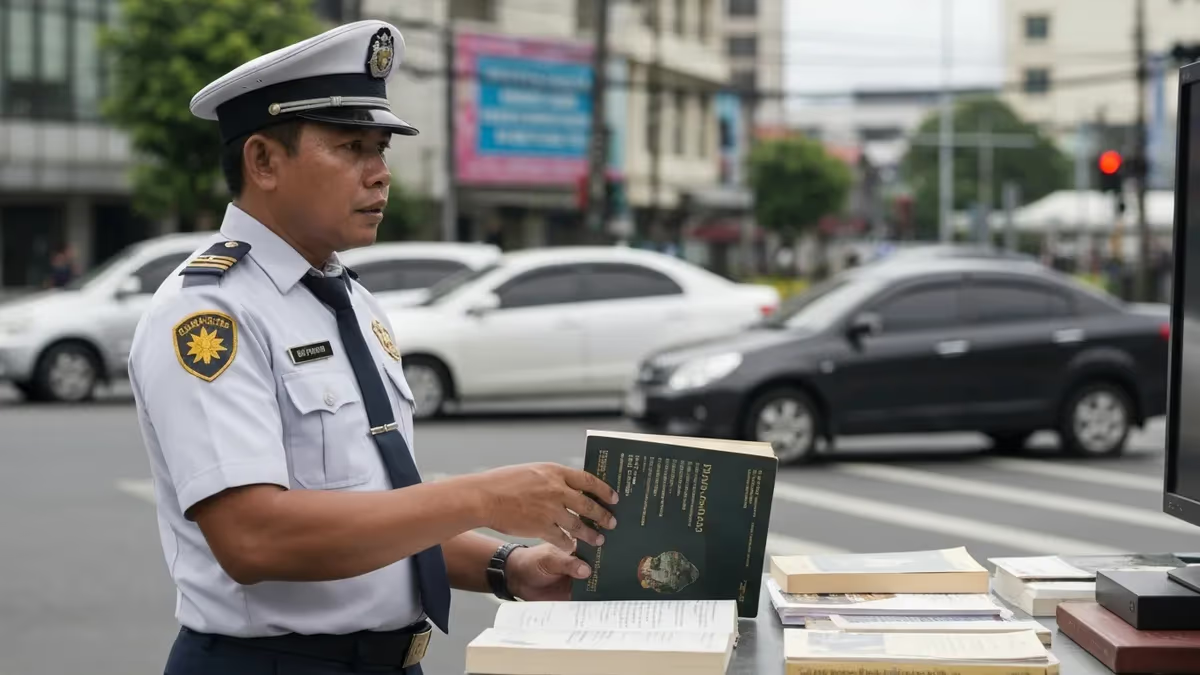
The LTO (Land Transportation Office) written examination is the standardized test administered by the Philippine government's Land Transportation Office to all applicants for a driver's license. The exam is a required step in the licensing process — you must pass the written test before proceeding to the practical driving examination and medical clearance. Practice with the free LTO - Exam Reviewer practice test on PracticeTestGeeks (600+ questions with answer explanations).
Who takes the LTO exam:
- Student Permit applicants: First-time applicants who want to learn to drive legally — must pass the LTO written exam to obtain a Student Permit
- Non-Professional License applicants: Drivers licensing for private vehicle use — written exam required
- Professional License applicants: Drivers licensing for public utility or commercial transport — additional requirements beyond the Non-Professional exam
Exam format:
- Multiple choice written test — administered at LTO offices nationwide
- 40 questions for the Student Permit exam; 40 questions for Non-Professional and Professional exams
- Passing score: 70% (28 of 40 correct)
- Questions drawn from the official LTO exam item bank on traffic laws, road signs, and safe driving
Practice with our lto exam reviewer covering the full range of official LTO exam topics and road signs.
- The LTO CDE Online Validation Exam, used for driver's license renewal applications, has 25 questions. (Land Transportation Office (LTO), Department of Transportation, Republic of the Philippines)
- Under LTO Memorandum Circular No. AHS-2008-949, the LTO written exam for a non-professional driver's license has 40 questions. (elibrary.judiciary.gov.ph)
- The LTO CDE Online Validation Exam has no time limit for answering the questions. (Land Transportation Office (LTO), Department of Transportation, Republic of the Philippines)
- To get a certificate from the LTO CDE Online Validation Exam, you need 80%, or at least 20 correct answers out of 25 questions. (Land Transportation Office (LTO), Department of Transportation, Republic of the Philippines)
- To pass the LTO written exam for a non-professional driver's license, an applicant needs at least 30 correct answers out of 40 questions. (elibrary.judiciary.gov.ph)
- The LTO CDE Online Validation Exam is taken online through the LTMS portal, and you must log in to an LTMS account to take it. (Land Transportation Office (LTO), Department of Transportation, Republic of the Philippines)
Facts verified Oct 17, 2026 against Land Transportation Office (LTO), Department of Transportation, Republic of the Philippines. Dates that have passed are removed automatically.
LTO Exam at a Glance
| Item | Detail | Official source |
|---|---|---|
| Number of questions (CDE Online Validation Exam (license renewal)) | 25 questions | Land Transportation Office (LTO), Department of Transportation, Republic of the Philippines |
| Number of questions (Non-professional driver's license written exam) | 40 questions | elibrary.judiciary.gov.ph |
| Number of questions (Professional driver's license written exam) | 60 questions | elibrary.judiciary.gov.ph |
| Time limit (CDE Online Validation Exam (license renewal)) | No time limit | Land Transportation Office (LTO), Department of Transportation, Republic of the Philippines |
| Passing score (CDE Online Validation Exam (license renewal)) | 80% (20 of 25 correct) | Land Transportation Office (LTO), Department of Transportation, Republic of the Philippines |
| Passing score (Non-professional driver's license written exam) | 30 of 40 correct (75%) | elibrary.judiciary.gov.ph |
| Passing score (Practical driving exam) | 70 points (start at 100, deductions for errors) | elibrary.judiciary.gov.ph |
| Passing score (Professional driver's license written exam) | 45 of 60 correct (75%) | elibrary.judiciary.gov.ph |
| Delivery (CDE Online Validation Exam (license renewal)) | Online via LTMS portal (login required) | Land Transportation Office (LTO), Department of Transportation, Republic of the Philippines |
Facts verified Oct 17, 2026 against Land Transportation Office (LTO), Department of Transportation, Republic of the Philippines. Dates that have passed are removed automatically.
Free LTO - Exam Reviewer Study Tools
Interactive LTO - Exam Reviewer resources on PracticeTestGeeks, free to start:
- Free LTO Traffic Safety Questions and Answers — 16 questions with instant scoring and answer explanations
- LTO - Exam Reviewer flashcards — review key terms and concepts card by card
- LTO - Exam Reviewer study guide — topic-by-topic overview of what the exam covers
- LTO - Exam Reviewer cheat sheet — one-page printable summary for last-minute review
LTO Exam — Topics Covered
The LTO written exam draws questions from three primary content areas:
1. Road Signs (Panatagan sa Daan):
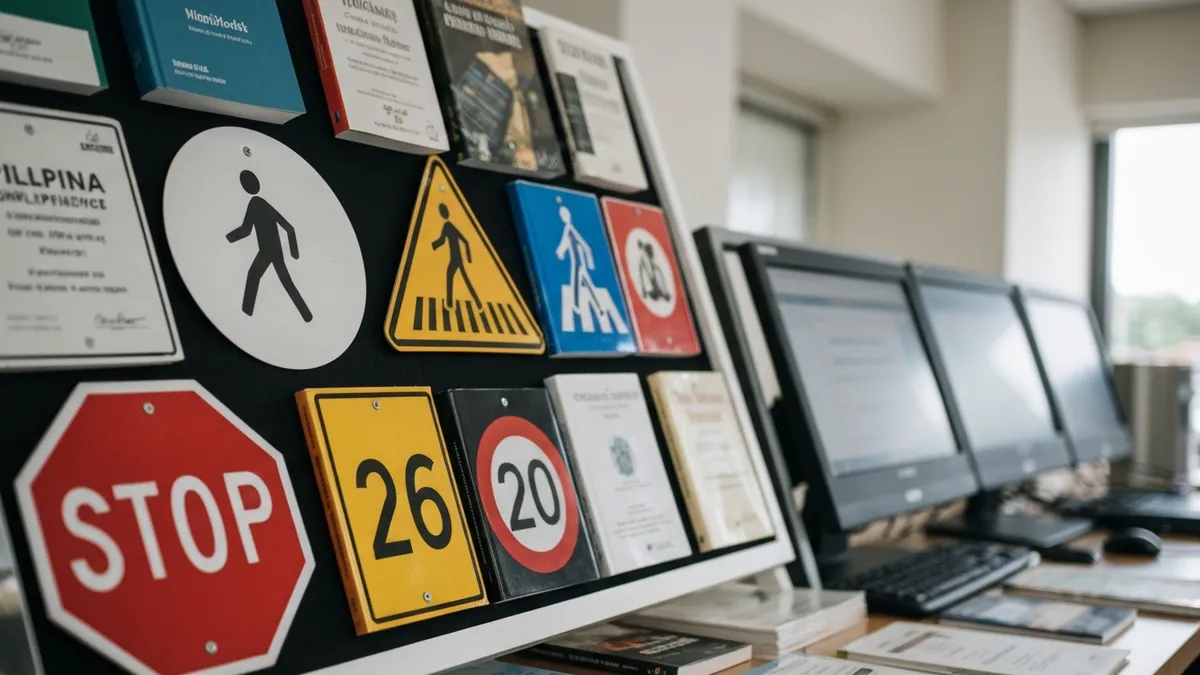
Philippine road signs are classified into three categories: Regulatory Signs (white background — must be obeyed, e.g., speed limits, no entry, no U-turn), Warning Signs (yellow background — warn of hazards ahead, e.g., curve ahead, pedestrian crossing), and Informational/Guide Signs (green or blue background — provide directions, distances, and service information). Knowing the color-coding and specific meanings of common signs is essential — road sign questions account for a large portion of the LTO exam.
2. Traffic Laws and Regulations (Republic Act 4136):
Republic Act 4136, the Land Transportation and Traffic Code, governs all Philippine road users. Key topics include: speed limits (60 kph on national roads, lower in school zones and residential areas), right-of-way rules, overtaking procedures, proper use of lanes, use of headlights, and penalties for traffic violations. The Anti-Drunk and Drugged Driving Act (RA 10586) and the Seat Belt Law (RA 8750) are also tested.
3. Safe and Defensive Driving:
Questions cover defensive driving principles, proper vehicle handling in hazardous conditions (rain, fog, night driving), correct following distances, proper lane changing procedures, how to handle skids, and road etiquette. The LTO exam also tests knowledge of what to do at the scene of an accident.
For comprehensive practice, use our lto exam reviewer covering all three content areas with official-format questions and answers.

LTO Exam Preparation Checklist
- ✓Study all three categories of road signs: Regulatory (white), Warning (yellow), Informational (green/blue)
- ✓Memorize speed limits: 60 kph national roads, 20 kph school zones, follow posted limits in residential areas
- ✓Know right-of-way rules: at uncontrolled intersections, the driver on the right goes first
- ✓Learn no-overtaking zones: hills, curves, bridges, tunnels, intersections, solid yellow center line
- ✓Review Republic Act 4136 key provisions — the foundational traffic law for LTO exam questions
- ✓Understand the Seat Belt Law (RA 8750) and Anti-Drunk Driving Law (RA 10586) requirements
- ✓Practice at least 3 full 40-question mock exams before your LTO testing appointment
- ✓Aim for 35+ correct on practice tests (87%+) to have a strong buffer above the 70% passing threshold
LTO Pros and Cons
- +LTO has a defined, publicly available content blueprint — candidates know exactly what to prepare for
- +Multiple preparation pathways (self-study, courses, coaching) accommodate different learning styles and schedules
- +A growing ecosystem of study resources means candidates at any budget level can access quality preparation materials
- +Clear score reporting allows candidates to identify specific strengths and weaknesses for targeted remediation
- +Professional recognition associated with strong performance provides tangible career and academic benefits
- −The scope of tested content requires substantial preparation time that competes with existing professional or academic commitments
- −No single resource covers the full content scope — candidates typically need multiple study tools for comprehensive preparation
- −Test anxiety and exam-day performance variability mean preparation effort does not always translate linearly to scores
- −Registration, preparation, and potential retake costs accumulate into a significant financial investment
- −Content and format can change between exam versions, making older preparation materials less reliable
Pros and Cons at a Glance
| Pros | Cons |
|---|---|
| LTO has a defined, publicly available content blueprint — candidates know exactly what to prepare for | The scope of tested content requires substantial preparation time that competes with existing professional or academic commitments |
| Multiple preparation pathways (self-study, courses, coaching) accommodate different learning styles and schedules | No single resource covers the full content scope — candidates typically need multiple study tools for comprehensive preparation |
| A growing ecosystem of study resources means candidates at any budget level can access quality preparation materials | Test anxiety and exam-day performance variability mean preparation effort does not always translate linearly to scores |
| Clear score reporting allows candidates to identify specific strengths and weaknesses for targeted remediation | Registration, preparation, and potential retake costs accumulate into a significant financial investment |
| Professional recognition associated with strong performance provides tangible career and academic benefits | Content and format can change between exam versions, making older preparation materials less reliable |
🚦 How many questions are on the LTO exam and what score do you need to pass?
The LTO written exam has 40 multiple choice questions for Student Permit, Non-Professional, and Professional applicants. You need at least 28 correct (70%) to pass. Aim for 35+ on practice tests for a safe margin.
START LTO PRACTICE TEST🛑 What are the three categories of Philippine road signs on the LTO exam?
Regulatory signs (white background, must be obeyed — speed limits, no entry, no U-turn), Warning signs (yellow background, hazards ahead — curves, pedestrian crossings), and Informational/Guide signs (green or blue, directions and services). Color-coding questions appear often on the LTO exam.
START LTO SAMPLE EXAM📜 What is Republic Act 4136 and why does the LTO exam test it?
RA 4136, the Land Transportation and Traffic Code, is the core law behind most LTO exam questions — covering speed limits, right-of-way, overtaking rules, lane use, and headlight use. Nearly every traffic-law question on the LTO reviewer traces back to this act.
START LTO ONLINE REVIEWER🛣️ What is the standard speed limit on Philippine national roads?
Cars and motorcycles are limited to 60 kph on national roads under RA 4136. School zones drop to 20 kph during school hours, and residential or hospital areas often post lower limits. Expressways allow higher limits, up to 100 kph on some stretches.
START LTO PRACTICE TEST🍺 What does the Anti-Drunk and Drugged Driving Act (RA 10586) require?
RA 10586 sets blood alcohol content limits for drivers — 0.00% for motorcycle, public utility, and student-permit drivers, and 0.05% for other licensed drivers — with escalating penalties for violations. The LTO exam tests these limits directly.
START LTO EXAM REVIEWER🔒 What does the Seat Belt Law (RA 8750) require of drivers and passengers?
RA 8750 requires the driver and all passengers in the front and back seats of a private vehicle to wear seat belts at all times while the vehicle is in motion. Non-compliance is a common LTO exam question and carries fines under the law.
START LTO PRACTICE TEST↪️ What is the right-of-way rule at an uncontrolled intersection in the Philippines?
At an uncontrolled intersection with no traffic signal or signage, the driver approaching from the right has the right of way. This rule is a frequent topic on the LTO exam reviewer and applies whether or not another vehicle arrived first.
START LTO SAMPLE EXAM🚫 Where is overtaking prohibited under LTO traffic rules?
Overtaking is prohibited on hills, curves, bridges, tunnels, and intersections, and wherever a solid yellow center line is marked. The LTO exam frequently tests recognition of these no-overtaking zones alongside road-sign questions.
START LTO ONLINE REVIEWER🎓 What is the difference between the Non-Professional and Professional LTO exam?
Both the Non-Professional and Professional LTO exams use a 40-question format covering road signs, traffic laws, and safe driving. The Professional exam (for public utility and commercial drivers) adds requirements on passenger safety, cargo rules, and franchise regulations beyond the Non-Professional scope.
START NON-PRO PRACTICE TEST🔁 Can you retake the LTO exam if you fail, and how should you prepare?
Yes — if you fail the LTO written exam, you can retake it at your next scheduled LTO appointment. The best preparation is completing several full 40-question practice exams beforehand and reviewing road signs, RA 4136, and defensive-driving rules until you consistently score 35+ out of 40.
START LTO PRACTICE TESTSample LTO - Exam Reviewer Practice Questions
Try these questions from our free LTO - Exam Reviewer practice tests. The correct answer and an explanation follow each question.
A vehicle's brakes fade during a long downhill descent. The best action to prevent complete brake failure is to:
- A. Continuously apply the brakes fully throughout the descent
- B. Use engine braking by downshifting to a lower gear before and during the descent
- C. Turn off the engine to reduce speed naturally
- D. Apply the parking brake fully at the steepest point
Answer: B. Use engine braking by downshifting to a lower gear before and during the descent
Engine braking through downshifting reduces the load on the service brakes, preventing brake fade during long descents.
A vehicle's emissions must comply with standards set by which law in the Philippines?
- A. RA 4136 only
- B. RA 8749 (Philippine Clean Air Act) as enforced through LTO registration requirements
- C. RA 9003 (Ecological Solid Waste Management Act)
- D. Local government ordinances only
Answer: B. RA 8749 (Philippine Clean Air Act) as enforced through LTO registration requirements
RA 8749 (Philippine Clean Air Act) sets emission standards for motor vehicles, enforced through LTO registration requiring an emissions test certificate.
A driver with a suspended license who is caught operating a vehicle faces which consequence?
- A. Only a verbal warning
- B. Revocation of the license and possible criminal liability
- C. A fine of PHP 50 only
- D. Automatic reinstatement after paying a small fee
Answer: B. Revocation of the license and possible criminal liability
Driving with a suspended license can result in revocation of the license and possible criminal charges.
A white stop bar painted across a lane at an intersection means the driver must:
- A. Slow down but may proceed without stopping if clear
- B. Stop with the front of the vehicle behind the stop bar
- C. Stop only when a red light is showing
- D. Use the bar as an alignment guide for parking
Answer: B. Stop with the front of the vehicle behind the stop bar
A white stop bar is a pavement marking that defines where a vehicle must legally stop — the front of the vehicle must not cross the bar when stopping.
LTO Exam Questions and Answers




How this page was made: written with AI tools. Exam facts are checked against the official sources listed below. Not reviewed by a subject-matter expert. Editorial policy
Sources & references
Exam facts on this page (fees, format, dates, passing scores) are checked against these official sources; the date is our last check. Editorial policy
- portal.lto.gov.ph — Test delivery, exam format, passing score, time limit · verified Oct 2026
- elibrary.judiciary.gov.ph — Exam format, passing score · verified Oct 2026