
Is LPN Worth It? Honest Career Breakdown for 2026 September
Is LPN worth it in 2026 September? ✅ Explore salary, job outlook, pros/cons, and whether becoming an LPN is the right career move for you.
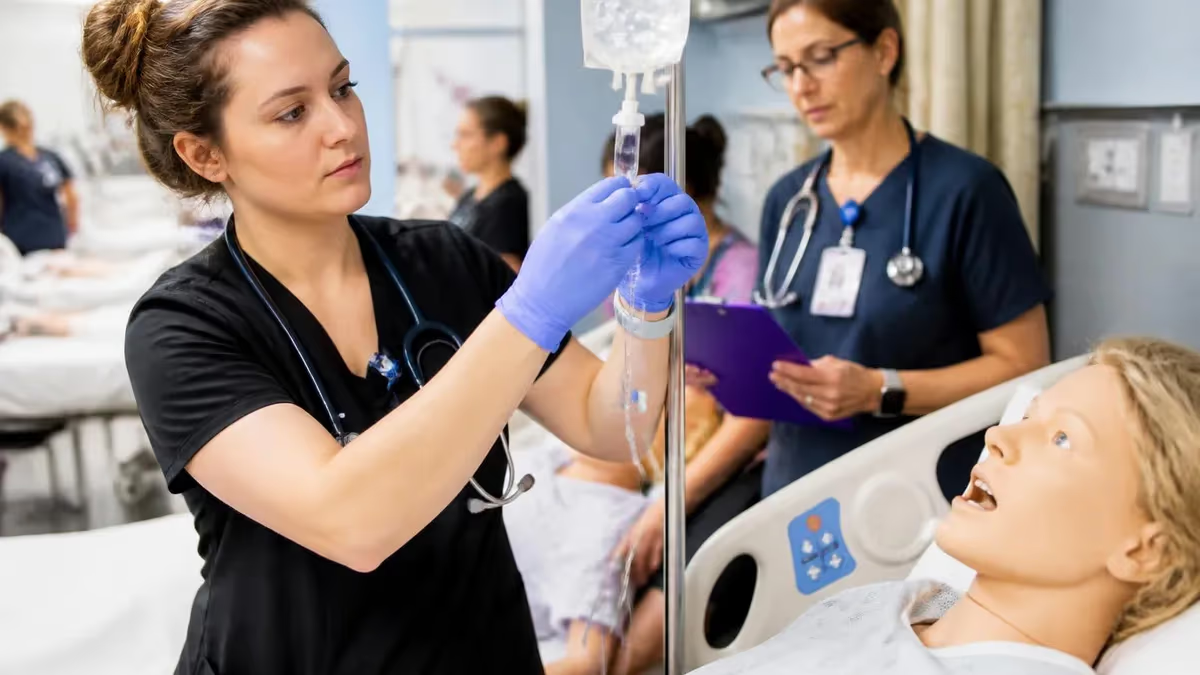
If you are weighing whether is lpn worth it as a career path, you are asking exactly the right question before investing your time and money. Licensed Practical Nurses play an essential role in the American healthcare system, delivering hands-on patient care in hospitals, nursing homes, clinics, and home health settings every single day. The LPN credential offers a faster route into nursing than a registered nurse degree, typically requiring only 12 to 18 months of accredited training versus two to four years for an RN program.
The demand for LPNs across the United States remains strong heading into 2026. The Bureau of Labor Statistics projects steady employment growth in long-term care and home health sectors, driven by an aging Baby Boomer population that requires more medical services than any prior generation. With over 950,000 LPNs currently employed nationwide, the profession is well-established, well-respected, and offers genuine entry-level stability for people seeking a healthcare career without a four-year college commitment.
Financially, the numbers tell a realistic story. The median annual salary for LPNs in the United States sits around $58,000 to $64,000, with higher earners in specialty settings like correctional facilities, home health agencies, and busy urban hospitals pushing well past $70,000. When you compare that earning potential against the relatively modest cost of an LPN diploma program — often $10,000 to $25,000 at community colleges and vocational schools — the return on investment can be compelling for the right candidate.
Beyond salary, the LPN career offers something many desk jobs simply cannot: genuine human connection and the satisfaction of making a measurable difference in patients' lives every shift. LPNs take vital signs, administer medications, change wound dressings, monitor patient conditions, and coordinate care with physicians and registered nurses. This variety of daily tasks keeps the work engaging and prevents the monotony that plagues many office-based careers where the work feels disconnected from real-world outcomes.
There are, of course, honest trade-offs to consider. LPN scope of practice is more limited than that of an RN or nurse practitioner, and in some hospital systems, LPN positions have been replaced by RNs or patient care technicians. Physical demands are real — LPNs spend long shifts on their feet, lifting and repositioning patients, which takes a cumulative toll on the body over a career. Workplace stress levels can run high in understaffed facilities, and emotional burnout is a documented challenge in direct patient care roles.
The good news is that the LPN credential can serve as a strategic stepping stone. Many nurses begin as LPNs, gain clinical experience, earn competitive wages while working, and then pursue bridge programs like LPN-to-RN or LPN-to-BSN pathways that allow them to advance their careers without starting over. This ladder approach makes the LPN an attractive entry point for people who are certain about nursing but want to build their skills and financial base before committing to a longer degree program.
Ultimately, whether becoming an LPN is worth it depends on your personal goals, financial situation, geographic location, and preferred work setting. This article provides a comprehensive, honest analysis of LPN salaries, job duties, educational requirements, career growth options, and the real pros and cons — so you can make a fully informed decision before enrolling in a program or sitting for the NCLEX-PN exam.
LPN Career by the Numbers

LPN Education Costs at a Glance
Understanding the financial picture is central to evaluating whether an LPN career is worth pursuing. The median annual salary for Licensed Practical Nurses in the United States hovers between $58,000 and $64,000 according to the most recent Bureau of Labor Statistics data, but that figure masks a wide range of earning potential depending on your state, employer, and specialty area. LPNs in California, Alaska, and Connecticut earn significantly more than the national median, with top earners in those states surpassing $75,000 annually.
Work setting is one of the most powerful determinants of LPN compensation. Nursing care facilities and skilled nursing facilities represent the largest employer of LPNs nationwide, but they do not always pay the highest wages. Home health care agencies and correctional facilities frequently offer premium pay because the work environment involves more independence and, in some cases, higher physical or emotional demands. Hospital-based LPN positions often pay competitive rates but have become less common in states like New York and Massachusetts where RN staffing models have been adopted more broadly.
The cost-to-earnings ratio for an LPN education compares favorably to many college degree programs when analyzed objectively. A community college diploma program costing $12,000 combined with the $200 NCLEX-PN exam fee means a new LPN can fully recoup their educational investment within three to six months of starting their first job at a median salary. Compare this to a four-year bachelor's degree that often costs $60,000 to $120,000 — the LPN credential offers dramatically faster financial break-even, which matters enormously for students who cannot afford to delay their income for years.
Overtime availability is another underappreciated financial factor. Healthcare facilities, particularly nursing homes and hospitals, frequently operate with staffing shortages that translate into readily available overtime hours for motivated LPNs. An LPN earning $30 per hour who regularly picks up four hours of overtime each week can add more than $12,000 to their annual income, pushing their total compensation into territory that rivals many jobs requiring more education. This overtime accessibility is a real and practical advantage that many LPN practitioners leverage strategically.
Employer-sponsored education benefits deserve mention as well. Many healthcare systems actively recruit LPNs and offer tuition reimbursement programs specifically designed to encourage advancement along the LPN-to-RN pathway. An LPN who secures employment with a hospital system that provides $5,000 to $10,000 per year in education benefits can fund an RN bridge degree almost entirely through employer contributions while continuing to earn a full salary. This transforms the LPN role from a terminal credential into a financially self-funding launch pad for career advancement.
Geographic flexibility adds another dimension to the financial calculation. Unlike many specialized degrees tied to specific industries concentrated in particular cities, LPN credentials are valid across all 50 states (with endorsement processes), and healthcare demand exists in rural areas where cost of living is lower and competition for positions is reduced. An LPN earning $55,000 in a rural Midwest community may enjoy a quality of life equivalent to an urban worker earning $80,000, once housing costs, commuting expenses, and local price levels are factored into the comparison.
When the full financial picture is assembled — fast program completion, modest upfront cost, immediate earning potential, overtime availability, employer education benefits, and geographic flexibility — the economic case for the LPN credential is genuinely solid. It is not a path to wealth, but for someone entering healthcare without an existing degree, the LPN represents one of the most efficient credentials available for transitioning into a stable, meaningful, and reasonably compensated career in a sector with long-term demand fundamentals that remain favorable.
LPN Work Settings: Where You Can Build Your Career
Long-term care facilities, including skilled nursing facilities and nursing homes, employ the largest share of LPNs in the United States. In these environments, LPNs serve as the primary nursing staff responsible for administering medications, monitoring chronic conditions, coordinating with physicians, and delivering daily personal care to residents. The patient relationships in this setting tend to be ongoing and meaningful, as LPNs often work with the same residents for months or years at a time.
The staffing ratios in long-term care can be demanding, with some facilities assigning one LPN responsibility for 15 to 30 residents during a shift. This requires strong organizational skills and the ability to prioritize care needs efficiently. Pay in this sector ranges from approximately $48,000 to $62,000 annually, though facilities in high-demand regions frequently add shift differentials for evenings, nights, and weekends that can meaningfully increase take-home pay for LPNs willing to work non-standard hours.

LPN Career: Honest Pros and Cons
- +Fast path to a healthcare career — most programs complete in 12 to 18 months
- +Strong job stability driven by aging population and long-term care demand
- +Meaningful, hands-on patient care with real daily impact on lives
- +Lower educational cost compared to RN or advanced practice degrees
- +Clear advancement pathway via LPN-to-RN bridge programs
- +Diverse work settings including hospitals, clinics, home health, and corrections
- −Scope of practice is more limited than RN, especially in acute hospital settings
- −Physical demands of the job — long hours standing, lifting, repositioning patients
- −LPN hospital positions have declined in some states as RN staffing models expand
- −Emotional burnout risk is elevated in direct patient care, especially long-term care
- −Median salary lower than RN by approximately $20,000 to $30,000 annually
- −Advancement to higher-paying roles requires additional education and time investment
Steps to Become a Licensed LPN in 2026
- ✓Research accredited LPN diploma or certificate programs in your state
- ✓Verify the program is approved by your state board of nursing
- ✓Complete prerequisite courses such as anatomy, biology, and medical terminology
- ✓Submit your application and pass any required entrance exams like the TEAS or HESI
- ✓Complete all clinical hours as required by your program (typically 500+ hours)
- ✓Apply for the NCLEX-PN exam through your state board of nursing after graduation
- ✓Register with Pearson VUE and schedule your NCLEX-PN testing appointment
- ✓Study consistently using practice questions, review books, and NCLEX-style tests
- ✓Pass the NCLEX-PN with a minimum competency level across all content areas
- ✓Submit your state licensure application and pay the required licensing fee
Many RNs started as LPNs — and earned their way through nursing school
Bridge programs allow working LPNs to earn RN credentials in as little as 12 to 18 additional months, often with employer tuition reimbursement. Starting as an LPN means you build clinical experience and earn a competitive salary while pursuing advancement — a financially smart strategy that thousands of nurses across the U.S. have used successfully to reach RN or even BSN status without taking on crushing student debt.
One of the most compelling arguments for the LPN credential is the career advancement architecture that surrounds it. Unlike some entry-level certifications that function as dead ends, the LPN sits on a well-defined ladder that leads directly upward toward registered nurse, bachelor of science in nursing, and beyond. LPN-to-RN bridge programs exist at community colleges and universities across all 50 states, and many are available in hybrid or online formats designed specifically for working nurses who cannot attend full-time in-person classes.
The practical value of LPN experience when advancing to RN status is significant and often underestimated. Nursing students who enter RN bridge programs with LPN backgrounds consistently report feeling more clinically confident than their peers who are entering nursing with no prior patient care experience. The thousands of hours of hands-on assessment, medication administration, and patient communication that an LPN accumulates over even two or three years of practice translate directly into faster skill acquisition and greater comfort in the clinical components of advanced nursing education.
Specialization is another dimension of career growth that LPNs can pursue without necessarily advancing to a higher credential. Specialty certifications in IV therapy, wound care, gerontology, and long-term care management allow LPNs to command premium wages and increased professional recognition within their existing scope of practice. An LPN with a certified wound care nurse credential, for example, often earns 10 to 20 percent more than colleagues without specialty credentials and may take on a consulting or supervisory role within their facility that provides additional compensation and professional development opportunities.
Leadership and supervisory pathways also open to experienced LPNs in certain settings. In long-term care and home health, senior LPNs frequently move into charge nurse roles, shift supervisor positions, or care coordination roles that involve less direct bedside work and more oversight and administrative responsibility. These positions carry higher pay and greater professional autonomy while remaining within the LPN scope of practice, providing a meaningful middle-career advancement option for LPNs who want growth without committing to another degree program immediately.
The geographic mobility of the LPN credential represents another underappreciated form of career flexibility. The Nurse Licensure Compact, or NLC, currently includes more than 40 participating states and allows LPNs holding a multistate license to practice in any member state without obtaining additional individual state licenses. This compact dramatically expands job market access and enables LPNs to pursue travel nursing contracts, relocate for family reasons, or pursue opportunities in states with higher pay without the bureaucratic delay of state-by-state licensure applications.
Travel LPN positions through healthcare staffing agencies represent a high-earning opportunity that many LPNs overlook when evaluating whether the credential is financially worthwhile. Travel LPN contracts typically offer weekly pay packages that include a base taxable hourly rate plus untaxed housing and meal stipends, and the effective total compensation can easily reach $75,000 to $90,000 on an annualized basis for LPNs willing to accept 13-week contract assignments in underserved markets. Facilities in rural areas, post-hurricane recovery zones, and states with seasonal population surges like Florida and Arizona frequently offer premium rates for travel LPN contracts.
When the full scope of advancement options is considered — LPN-to-RN bridges, specialty certifications, charge nurse roles, the Nurse Licensure Compact, and travel nursing contracts — the LPN credential looks considerably more dynamic than a simple entry-level position. It is a foundation from which motivated nurses can build careers that evolve continuously in terms of compensation, responsibility, and clinical sophistication across many years and many different practice settings.

The NCLEX-PN uses computerized adaptive testing (CAT), meaning the number of questions you receive — between 85 and 150 — adjusts based on your performance. As of 2023, the exam was updated to the Next Generation NCLEX (NGN) format, which includes new question types like extended drag-and-drop and clinical judgment scenarios. Candidates should prepare specifically for NGN-style questions using updated 2025–2026 practice resources rather than older NCLEX prep materials that predate the format change.
Deciding whether the LPN career is genuinely right for you requires honest self-assessment across several dimensions beyond salary and job outlook. The most successful and satisfied LPNs consistently share certain characteristics: a genuine interest in people and their health and wellbeing, physical and emotional resilience in the face of demanding work conditions, and a collaborative professional orientation that allows them to function effectively as part of interdisciplinary care teams rather than as independent practitioners.
If you are primarily motivated by a desire to work directly with patients and provide tangible, measurable help during vulnerable moments in people's lives, the LPN role delivers that experience with exceptional immediacy and regularity.
Unlike many healthcare support roles where patient contact is brief or incidental, LPNs are typically the nurses who spend the most direct time at the bedside — the professionals patients come to know by name, trust with their concerns, and remember long after discharge. For people who derive deep satisfaction from that kind of sustained human connection, the LPN is an exceptionally rewarding career choice despite its limitations in scope and pay relative to RN positions.
If you are considering the LPN as a direct alternative to pursuing an RN and are genuinely uncertain which credential fits your goals better, the comparison deserves careful thought. If you have the academic preparation, financial resources, and time to complete an RN program, the higher salary ceiling, broader scope of practice, and greater hospital employment access of the RN credential may make the additional investment worthwhile.
If, however, you need to begin earning sooner, have limited funds for education, or want to enter the field rapidly to confirm that nursing is genuinely right for you before committing to a longer program, the LPN path makes strong practical sense.
Age and life stage also factor meaningfully into the calculation. A 22-year-old weighing a 12-month LPN program against a 24-month RN associate degree program has different financial stakes than a 45-year-old career changer who needs income within the next year. Older career changers frequently find the LPN pathway highly attractive precisely because it delivers licensure and employment quickly, without requiring years of deferred income that may be genuinely unaffordable given existing financial obligations like mortgages, children's needs, or aging parents requiring support.
The emotional demands of nursing deserve candid acknowledgment when evaluating whether this career is right for you personally. LPNs in long-term care frequently work with patients who are declining, dying, or experiencing significant loss of independence and cognitive function.
The cumulative emotional weight of that work, while deeply meaningful, can also be exhausting and requires deliberate self-care, professional boundary-setting, and strong peer support to manage sustainably over a long career. Candidates who are drawn to nursing but have significant anxiety about death, grief, or sustained exposure to human suffering should explore their emotional readiness honestly before committing to direct patient care roles.
Physical stamina is a prerequisite that deserves realistic evaluation. LPN shifts — whether 8 hours or 12 hours — involve continuous walking, standing, bending, and lifting. Back injuries are a documented occupational hazard in nursing, and facilities increasingly use mechanical lift equipment and safe patient handling policies to reduce injury risk, but the physical demands remain real. Candidates with pre-existing musculoskeletal conditions should speak with their physicians about whether the physical requirements of direct patient care nursing are sustainable for them before enrolling in an LPN program.
For the right person — someone who is caring, physically capable, financially motivated by reasonable rather than extravagant income goals, and interested in a stable healthcare career with clear advancement options — the LPN credential delivers genuine, lasting value. The combination of affordable education, fast credentialing, meaningful daily work, solid salary, and upward mobility makes the LPN one of the most efficient and rewarding healthcare credentials available to Americans who want to build a nursing career without a four-year degree commitment as their starting point.
Preparing effectively for the NCLEX-PN exam is one of the most critical investments you will make in your LPN career, and the quality of your preparation directly influences your first-attempt pass rate and the speed at which you can begin earning. The national first-attempt pass rate for NCLEX-PN candidates typically ranges between 80 and 85 percent for U.S.-educated candidates, but that number is an average that conceals wide variation based on program quality and individual preparation habits. Candidates who prepare strategically consistently perform above average.
The Next Generation NCLEX format introduced in 2023 changed the exam in ways that require updated preparation approaches. NGN questions go beyond simple recall and application testing to assess clinical judgment — the ability to recognize cues in a patient scenario, analyze information, generate hypotheses, take action, and evaluate outcomes. This shift means passive reading of review books is insufficient preparation. Active practice with NGN-style questions, including extended drag-and-drop, highlight-the-answer, and matrix-style items, is essential for candidates sitting the exam in 2025 and 2026.
A structured, consistent study schedule outperforms marathon cramming sessions for most NCLEX candidates. Research on nursing board exam preparation consistently shows that candidates who study in regular sessions of one to two hours over eight to twelve weeks retain content better and perform better on exam day than those who attempt to compress preparation into an intensive two-week period before testing. Building your study schedule around your life rather than trying to fit your life around your study schedule improves adherence and reduces pre-exam burnout significantly.
Content prioritization matters enormously in NCLEX-PN preparation because the exam blueprint assigns different weights to different content areas. Safe and effective care environment topics including coordinated care and safety carry heavy weight, as do health promotion, physiological integrity, and pharmacological therapies. Candidates who identify and prioritize their weakest content areas early in their preparation — rather than spending equal time on all topics — make the most efficient use of their available study hours and address the gaps that are most likely to affect their score.
Practice question banks are the single most valuable study tool for the majority of NCLEX candidates. Sitting for full-length practice exams under timed conditions, reviewing every rationale for both correct and incorrect answers, and tracking your performance by content category allows you to measure your progress objectively and direct your remaining study time toward areas of genuine weakness. Aim for consistent performance above 60 to 65 percent correct on practice sets before scheduling your actual exam, as that threshold correlates reasonably well with readiness at the competency level the NCLEX uses.
Self-care in the weeks leading up to your exam is not an indulgence — it is a preparation strategy. Sleep deprivation, poor nutrition, and chronic anxiety impair cognitive performance measurably, and the NCLEX-PN demands sustained concentration and clear clinical reasoning throughout the testing session. Candidates who arrive at the testing center well-rested, physically healthy, and emotionally regulated perform better than equally knowledgeable candidates who arrive exhausted and anxious. Build sleep, exercise, and relaxation into your preparation schedule with the same intentionality you apply to content review and practice questions.
After passing the NCLEX-PN and receiving your license, your continued professional development as an LPN will define the trajectory of your career. Joining professional organizations like the National Association of Licensed Practical Nurses connects you with continuing education resources, networking opportunities, and advocacy support for the LPN profession.
Seeking out a mentor in your first position — an experienced LPN, RN, or charge nurse willing to guide your clinical development — accelerates your growth as a new nurse and helps you build the clinical confidence and judgment that distinguish excellent LPNs from adequate ones over the long arc of a healthcare career.
LPN Questions and Answers

LPN Requirements 2026: Complete Guide to Becoming a Licensed Practical Nurse

LPN IV Certification: Complete 2026 Guide to Training, Requirements & Cost

LPN Programs in Florida: Complete 2026 Guide to Accredited Schools, Costs, Requirements & Licensure

LPN Salary Wisconsin 2026: Average Pay, Top Cities, and How to Earn More

LPN Duties: Complete Guide to Daily Responsibilities and Scope of Practice
About the Author

Registered Nurse & Healthcare Educator
Johns Hopkins University School of NursingDr. Sarah Mitchell is a board-certified registered nurse with over 15 years of clinical and academic experience. She completed her PhD in Nursing Science at Johns Hopkins University and has taught NCLEX preparation and clinical skills courses for nursing students across the United States. Her research focuses on evidence-based exam preparation strategies for healthcare certification candidates.
Join the Discussion
Connect with other students preparing for this exam. Share tips, ask questions, and get advice from people who have been there.
View discussion (7 replies)