
Florida Department of Law Enforcement (FDLE): The Complete Guide 2026 September
Florida Department of Law Enforcement guide: FDLE divisions, background checks, special agent jobs, records, jurisdiction, contacts, and how to apply. 🔎
What FDLE Is and What It Does
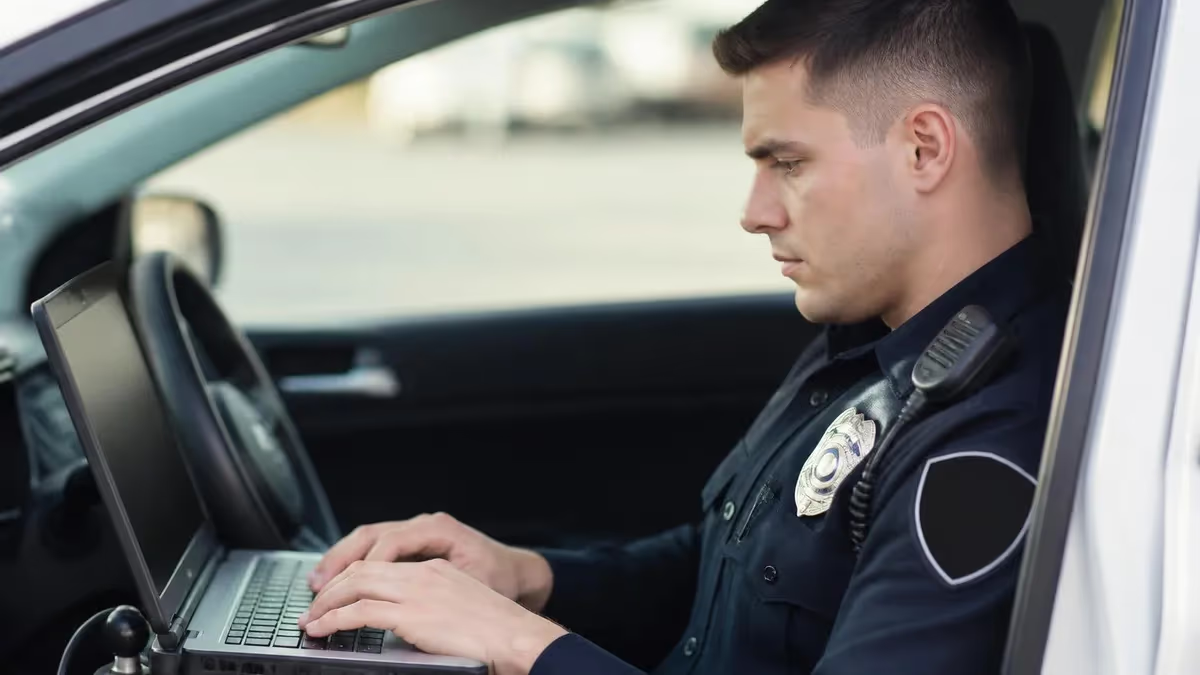
The Florida Department of Law Enforcement (FDLE) is the state's primary investigative agency. Headquartered in Tallahassee since 1967, it runs criminal investigations, manages statewide records and fingerprints, operates seven regional crime labs, and sets training standards for roughly 80,000 sworn officers across Florida. FDLE is not a patrol agency — that work belongs to the Florida Highway Patrol, county sheriffs, and city police.
- Founded: 1967, under the Florida Cabinet
- HQ: 2331 Phillips Road, Tallahassee, FL 32308
- Phone: 850-410-7000
- Website: fdle.state.fl.us
- Commissioner: Appointed by the Governor and Cabinet
- Regional Offices: Pensacola, Jacksonville, Orlando, Tampa, Miami, Fort Myers, West Palm Beach
Florida Department of Law Enforcement: The Complete Guide to FDLE
If you've ever applied for a Florida job that needed a background check, looked up a sex offender, or read about a high-profile homicide investigation in the state, you've probably bumped into the Florida Department of Law Enforcement without realizing it. FDLE sits at the center of Florida's criminal justice system. And yet most residents can't quite say what it does or how it differs from the sheriff's office down the road.
Here's the short version. FDLE is a state agency, created by the Florida Cabinet in 1967, with jurisdiction across all 67 counties. It runs forensic labs, holds criminal histories, certifies officers, and investigates the cases too big or too tangled for a single police department to handle alone. Think public corruption, narcotics trafficking, missing children, terrorism, and major homicides. It doesn't write traffic tickets, and it doesn't answer 911.
This guide walks through everything that actually matters — what FDLE does day to day, how its six divisions are organized, what services you as a Florida resident can request, and what the career path looks like if you're thinking about becoming a Special Agent. We'll cover fees, timelines, and the specific differences between FDLE and the agencies it most often gets confused with.
Why FDLE Matters for Florida Residents and Job Seekers
Three reasons. First, FDLE is the gatekeeper for Florida's criminal history records — that $24 records check you ran on a babysitter, contractor, or yourself? FDLE.
Second, FDLE sets the bar for every officer in the state. If you want to become a Florida cop, your training, your certification, and your decertification (if it ever comes to that) all run through FDLE's Criminal Justice Standards and Training Commission. Third, it's where some of Florida's best-paid investigative careers live, including the FDLE Special Agent role — roughly the state-level equivalent of an FBI agent.
FDLE also coordinates Florida's Amber Alerts, Silver Alerts, and Missing Endangered Persons alerts. When a child or vulnerable adult goes missing, FDLE pushes the alert statewide, hands it to broadcasters, and lights up highway message signs. None of that is glamorous, but it saves lives.
To understand where FDLE fits into the bigger picture, our guide to the law enforcement definition walks through how state, county, and federal agencies divide up the work across the United States.
One more reason FDLE matters: licensing. Real estate agents, nurses, teachers, security guards, contractors, build parents — they all run through an FDLE fingerprint check before the state hands them a license. If you've ever filed a Live Scan submission, those prints went to FDLE first, then to the FBI. Skip that step, and you don't get the job.
The 1967 Origin Story (Briefly)
Before FDLE existed, Florida ran its statewide criminal records through a smaller Bureau of Law Enforcement. By the mid-1960s — with population booming, organized crime moving south from New York and New Jersey, and forensics getting more technical — lawmakers decided a single, centralized agency made more sense.
In 1967, the Florida Cabinet created what eventually became FDLE. The agency picked up forensic services first, then expanded into intelligence, investigations, and training. The seven-office regional model came later, mostly in the late 1970s and 1980s, so investigators wouldn't be six hours away from Tallahassee when a case broke in Miami.
FDLE by the Numbers
Key Facts at a Glance
| Item | Value | Details |
|---|---|---|
| Founded | 1967 | |
| Records Check Fee | $24 | |
| Academy Length | ~6 months |
Five FDLE Services the Public Actually Uses
- Cost: $24 per name
- Turnaround: Online: instant. Mail: 7-14 days
- Use: Employment, gun purchase, volunteer screening
- Cost: Free
- Where: fdle.state.fl.us → Sexual Offenders/Predators
- Search by: Name, ZIP code, county, or map radius
- Cost: Varies by vendor (~$45-$75)
- Use: Professional license, school, healthcare
- Provider: FDLE-approved Live Scan vendors statewide
- Cost: $75 application fee + court fees
- Eligibility: No prior seals; specific offense list
- Steps: Apply to FDLE → certificate → file with court
- Cost: Free public service
- Channels: Highway signs, broadcasters, wireless alerts
- Coordinator: FDLE Missing Endangered Persons Information Clearinghouse
FDLE: Divisions, Records, Careers, and How It Compares
FDLE is built around six operational divisions. Each one specializes — together they cover what local agencies can't.
- Criminal Justice Information Services (CJIS): Runs the Florida Crime Information Center (FCIC), holds criminal history files, processes fingerprints, and links Florida to the national NCIC database.
- Criminal Investigations: Major crimes, public corruption, narcotics, financial crimes, missing children, and counterterrorism. Field agents work out of the seven regional offices.
- Forensic Services: Seven regional labs handling DNA, toxicology, firearms/tool marks, latent prints, digital forensics, and chemistry. They serve every county sheriff and police department in Florida.
- Criminal Justice Professionalism: Sets training and certification standards through the CJSTC. Every Florida officer is certified — and, when needed, decertified — by this division.
- Florida Capitol Police: Provides security at the Capitol Complex and state buildings in Tallahassee.
- Executive Direction and Business Support: Budget, HR, IT, fleet, and legal. The administrative spine that keeps the other five divisions running.
Note: the Florida Highway Patrol (FHP) is not part of FDLE — FHP sits under the Department of Highway Safety and Motor Vehicles. The two agencies work together constantly but report up different chains.
How FDLE Compares to Sheriffs and Local Police
Florida's law enforcement is layered. Three layers, mostly. At the city level, you have police departments — Tampa PD, Miami PD, Orlando PD, Jacksonville Sheriff's Office (consolidated city-county) and so on — handling 911 calls, patrol, traffic enforcement, and most misdemeanor and felony arrests within city limits.
At the county level, the elected sheriff runs the Sheriff's Office, with jurisdiction across the unincorporated county plus the county jail, court security, and civil process. And then, at the state level, FDLE.
FDLE rarely shows up first on a call. Local agencies almost always do. FDLE steps in when a case crosses jurisdictions, involves a public official, requires specialized forensic work, or just outgrows what a smaller department can handle. A small-town homicide with limited resources might get FDLE assistance within hours. A corruption case against a county commissioner? Almost certainly FDLE from day one.
Worth knowing: FDLE has full statewide arrest authority. An FDLE agent can make an arrest in Pensacola at 9 a.m. and another in Key West that evening — same badge, same authority. A city police officer can't do that. A sheriff's deputy is limited to their county. That statewide reach is the whole point of having a state-level investigative agency.
How to Request an FDLE Background Check (Step by Step)
The online process takes about ten minutes. You'll need a credit card, the subject's full name, date of birth, and a clear reason for the request. Here's the path:
- Go to fdle.state.fl.us and click Criminal History Information.
- Choose Search Florida Criminal History Records.
- Read the user agreement, then create an account or log in.
- Enter the subject's full name and date of birth. Pay the $24 fee per name.
- Receive the report immediately on screen. Save the PDF for your records.
If you need a fingerprint-based check (for a state professional license, healthcare role, or school district job), skip the name-based version and use a Live Scan vendor instead. The fingerprint check is much more reliable because it doesn't depend on common-name matches. With names alone, false positives and false negatives are both possible.
One catch: an FDLE check covers Florida only. If your subject lived out of state, add an FBI Identity History Summary on top, or pay for a national database search through a private background-check company. For employers running checks at scale, FDLE offers a subscription product called Florida Rap Back, which notifies you whenever an employee picks up a new Florida arrest.

Requesting an FDLE Records Check — Step-by-Step Checklist
- ✓Confirm what you actually need: name-based check ($24) for casual screening, or fingerprint-based via Live Scan for licensing
- ✓Gather subject info: full legal name, full date of birth, any known aliases
- ✓Have a credit card ready — FDLE does not accept money orders for online checks
- ✓Go to fdle.state.fl.us, click Criminal History Information, then Search Public Records
- ✓Create an FDLE account (or log into an existing one) and accept the user agreement
- ✓Enter the subject's name and DOB carefully — typos in DOB can return false negatives
- ✓Pay the $24 fee and download the PDF report immediately for your records
- ✓If you need a certified copy, request it through the mail-in option for $25
- ✓For licensing or employment that requires fingerprints, find an FDLE-approved Live Scan vendor near you
- ✓Remember: an FDLE check is Florida-only — add an FBI Identity History Summary for nationwide results
Florida Wildlife Commission Law Enforcement: A Cousin, Not a Division
The Florida Fish and Wildlife Conservation Commission (FWC) has its own sworn law enforcement division. FWC officers patrol Florida's waters, parks, and conservation lands, enforce hunting and fishing regulations, and act as state-certified general law enforcement officers — meaning they can enforce any Florida law, not just wildlife regulations. They're not part of FDLE. Different agency, different chain of command, different uniforms.
That said, FWC and FDLE coordinate on joint cases involving environmental crime, wildlife smuggling, illegal sales of protected species, and boating fatalities. If you've been pulled over on a Florida lake or stopped at a hunting checkpoint, that was almost certainly an FWC officer, not FDLE. FWC also handles search and rescue on state waters, alongside the U.S. Coast Guard.
FDLE Salary, Benefits, and the Special Agent Career Path
FDLE Special Agents start around $55,000 base salary, with regional pay adjustments for high-cost areas like Miami and Fort Lauderdale. After five years, agents typically earn $70,000 to $80,000. Senior agents and supervisors push past $90,000, and the most senior positions — Special Agent Supervisor and Special Agent in Charge — sit in the six-figure range, sometimes $110,000-plus before specialty pay.
Benefits round out the package. State pension through the Florida Retirement System (high three earnings, special risk class for sworn members), state health and dental, take-home vehicle, paid leave, and overtime under federal labor law. Special assignments such as task force duty, undercover work, and aviation can add specialty pay. Many FDLE agents stay 25-30 years and retire with a pension worth roughly 80 percent of their final pay.
The hiring funnel is competitive — typically a few hundred applicants for every cohort. Beyond the basics (citizenship, bachelor's degree, one year of investigative experience, clean record), you'll pass a written exam, physical assessment, polygraph, psych evaluation, medical exam, drug screen, and full background investigation.
The whole process from application to academy can take six to nine months. Read our breakdown of law enforcement requirements for a closer look at what the standard police hiring funnel looks like — FDLE's is similar but stricter.
FDLE Timeline: 1967 to Today
1967
1970s
1980s
1990s
2000s
2010s
2020s
FDLE Service Fees (2025-26)

What Makes FDLE Different (and Sometimes Controversial)
FDLE is structured differently than most state police agencies. In many states, the highway patrol and state investigative bureau are the same agency. In Florida they're split — FHP under Highway Safety, FDLE under the Cabinet. That separation gives FDLE focus, but it also means FDLE doesn't have the visible street presence a state trooper provides. Most Floridians never see an FDLE agent in uniform.
For a look at how visible Florida policing actually presents itself, check our guide to law enforcement uniforms across agencies — uniforms, patches, and rank insignia vary wildly between FHP, sheriff's offices, and city police. FDLE's own uniform is dark blue with a distinctive shoulder patch, but you'll mostly see it at ceremonial events and academy graduations rather than on the street.
FDLE has also drawn scrutiny over the years for high-profile investigations involving sitting politicians, school district scandals, and cases where its findings disagreed with local prosecutors. That's partly the agency doing its job. It's partly the unavoidable friction of a small state agency working alongside 67 elected sheriffs and a few hundred police chiefs.
Florida law enforcement is decentralized by design. FDLE is the glue holding the statewide picture together.
The Forensic Side: What FDLE's Crime Labs Do
FDLE runs seven regional crime labs — Tallahassee, Pensacola, Jacksonville, Orlando, Tampa, Fort Myers, and Miami. Together they process evidence for nearly every Florida sheriff and police department, plus FDLE's own cases. The largest categories of work are DNA analysis, toxicology, firearms and tool marks, latent prints, controlled substances, and digital forensics on phones and computers.
DNA is the biggest single workload. The labs maintain CODIS, the Combined DNA Index System linking Florida samples to national records, and they've made significant cold case clearances over the past decade — including several murders that sat unsolved for 20-plus years before forensic genealogy techniques cracked them. Digital forensics is growing fastest, with phone extraction and cloud data now central to nearly every serious investigation.
Lab capacity is a perennial concern. Florida is a big state with a lot of crime, and the labs can run months behind on non-priority cases. FDLE prioritizes by risk — anything involving a violent crime or pending trial jumps the queue. Routine narcotics cases or property crime evidence may wait longer. Local prosecutors and defense attorneys alike track FDLE turnaround times closely.
FDLE Special Agent vs Sheriff's Deputy
- +Statewide arrest authority — work cases across all 67 counties
- +Investigative focus from day one (no years on patrol first)
- +Florida Retirement System benefits and take-home vehicle
- +Specialized assignments: corruption, narcotics, terrorism, cybercrime
- +Stable Florida-based career — no required out-of-state moves
- +Strong federal partnership via FBI, DEA, and ATF task forces
- −Bachelor's degree required (most sheriff offices accept HS diploma)
- −Polygraph, psychological, and full background — long hiring timeline
- −Lower starting pay than some metro sheriff offices in South Florida
- −Plain clothes, on-call schedule, frequent travel between regions
- −Fewer openings than county agencies — competitive each cycle
- −No K-9, SWAT, or aviation career path as broad as a big sheriff office
Florida Law Enforcement Certification: How FDLE Sets the Standard
Every sworn officer in Florida — city cop, sheriff's deputy, state trooper, FDLE agent — holds a certification issued through FDLE's Criminal Justice Standards and Training Commission. The cert is portable across agencies, so an officer who leaves Tampa PD for Orange County Sheriff doesn't start over.
The training requirement is roughly 770 hours of basic recruit training, run through dozens of FDLE-approved academies at community colleges and regional training centers across the state. Curriculum covers law, defensive tactics, firearms, vehicle operations, first aid, and communications.
Recruits then pass the State Officer Certification Examination, often shortened to SOCE. Pass the exam, get hired, and the certification is yours so long as you stay current with annual in-service training (typically 40 hours per year, more for specialized roles). FDLE also has the authority to suspend or revoke a certification — what's called decertification — for serious misconduct. That power is what keeps the system honest.
FDLE Discounts, Perks, and Who Qualifies
FDLE sworn personnel qualify for most of the law enforcement perks that other Florida officers receive — gym memberships, restaurant chains, travel deals, and certain retail discounts. The discount programs are run by the businesses themselves; FDLE doesn't operate a separate program. Active FDLE credentials usually unlock the same discounts an FHP trooper or city officer would receive. See our overview of law enforcement discounts for what's available nationwide and how to access it.
Florida residents can also support FDLE — and other Florida agencies — through the Support Law Enforcement specialty license plate. A portion of the plate fee goes to the Florida Sheriffs Youth Ranches and to the Florida Police Chiefs Association, both of which fund community programs and family support for officers killed in the line of duty.
How to Contact FDLE: Phone Numbers and Regional Offices
The main FDLE headquarters number is 850-410-7000. That line gets you to records, public affairs, and general questions. For records requests specifically, use the Customer Service line at 850-410-8161. For the press, call the Office of Public Information at 850-410-7001.
For criminal complaints, never call FDLE first. Call your local police or sheriff's office. They handle the initial report and then loop in FDLE if the case fits the criteria for state involvement. Calling FDLE direct on a routine matter wastes time on both ends and slows the case down.
The seven regional offices each handle the counties closest to them. Pensacola covers the western Panhandle. Jacksonville covers the Northeast. Orlando covers Central Florida. Tampa covers the Tampa Bay area. Miami covers Miami-Dade and Monroe. Fort Myers covers Southwest Florida. West Palm Beach covers the Treasure Coast and Palm Beach County. Each office has a Special Agent in Charge who runs investigations in that footprint.
Final Thoughts on FDLE
FDLE is the kind of agency you mostly hope you never need. When you do, though — running a background check on a new hire, looking up a registered offender near your home, getting fingerprinted for a license, or watching a major case wind through the news — it's the agency quietly doing the work. Knowing what FDLE does, what it doesn't do, and how to access its services is part of being a well-informed Florida resident.
Law Enforcement Questions and Answers
More Law Enforcement Guides

Law Enforcement Definition: What It Means, Who Does It, and How It Works
Law Enforcement Requirements: How to Qualify to Become a Police Officer

Law Enforcement Uniforms: Complete Guide to Police Dress, Duty Gear, and Tactical Apparel

Law Enforcement Discounts 2026: Complete Guide for Active Duty and Retired Officers
How to Pass the Law Enforcement Exam: Proven Study Guide & Tips
Law Enforcement Practice Test 2026
About the Author

Educational Psychologist & Academic Test Preparation Expert
Columbia University Teachers CollegeDr. Lisa Patel holds a Doctorate in Education from Columbia University Teachers College and has spent 17 years researching standardized test design and academic assessment. She has developed preparation programs for SAT, ACT, GRE, LSAT, UCAT, and numerous professional licensing exams, helping students of all backgrounds achieve their target scores.
Join the Discussion
Connect with other students preparing for this exam. Share tips, ask questions, and get advice from people who have been there.
View discussion (5 replies)