
Indiana Law Enforcement Academy (ILEA): Application, Basic Course, Training, and Career Path for Officers
Indiana Law Enforcement Academy (ILEA) guide: ✏️ application requirements, 16-week Basic Course training, specialized programs, costs, careers in
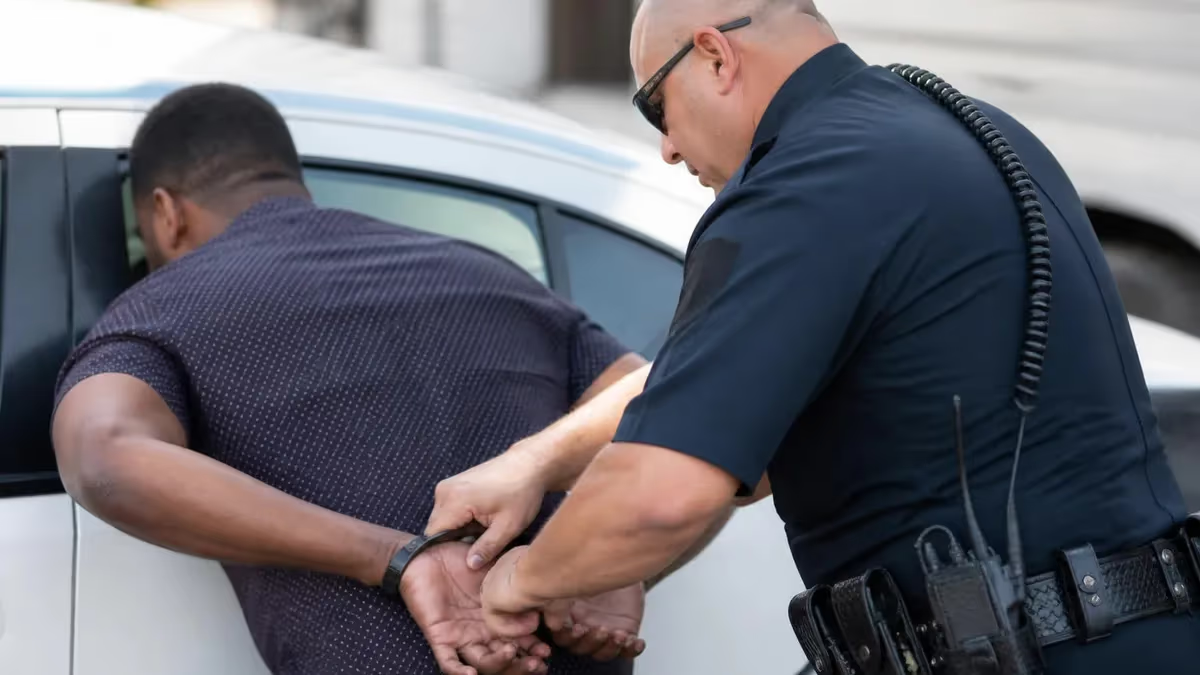
The Indiana Law Enforcement Academy (ILEA) is the state agency that trains law enforcement officers throughout Indiana. Located in Plainfield, Indiana (just outside Indianapolis), ILEA provides the foundational training required for most municipal, county, and state police officers in the state. Graduating from ILEA's Basic Course is essentially a prerequisite for working as a sworn officer in Indiana, with limited alternative paths available.
What ILEA offers. Basic Course (Tier I): 16 weeks / 640 hours of intensive training. Pre-Basic Course: optional preparatory program. Advanced Training: specialized courses for current officers. Specialized Courses: SRO (School Resource Officer), traffic enforcement, accident reconstruction, drug recognition, etc. Continuing Education: hours required for officer certification maintenance.
Who attends. New officers hired by Indiana law enforcement agencies — sheriff's departments, municipal police departments, Indiana State Police, university police, conservation officers. Officers are typically already hired by their agency and attend ILEA paid by their employer. Self-sponsored attendees occasionally (rare; mostly for specific specialty courses).
The Basic Course. 16 weeks of training covering: criminal law and procedure, traffic enforcement, patrol procedures, firearms, defensive tactics, emergency vehicle operations, communications, mental health crisis response, ethics, community policing, accident investigation, narcotics identification, professional development. Approximately 640 hours total. Long days; intense pace.
Indiana Law Enforcement Training Board. ILEA operates under the Indiana Law Enforcement Training Board (Indiana State Statute 5-2-1). The Board sets standards, oversees curriculum, and certifies officers as having met state requirements. Graduating ILEA earns the Indiana Law Enforcement Officer (LEO) credential.
This guide covers the Indiana Law Enforcement Academy in detail — application process, Basic Course curriculum, specialized training, career path for officers, and what to expect. It's intended for prospective Indiana law enforcement officers, current officers seeking advancement, and those evaluating careers in Indiana law enforcement.

Key Information
- Full name: Indiana Law Enforcement Academy
- Location: Plainfield, Indiana (near Indianapolis)
- Operates under: Indiana Law Enforcement Training Board
- Basic Course: 16 weeks / 640 hours
- Tuition (Basic Course): Free for officers hired by Indiana agencies; agency pays
- Attending capacity: ~200 officers per year
- Living quarters: On-site (dorm-style)
- Specialty training: SRO, traffic, drug recognition, accident reconstruction
- Continuing education: ILEA provides hours for license renewal
- Alternative paths: Limited (FBI Academy, military police backgrounds in some cases)
- Pass rate: ~80-90% complete program
- Post-academy: Officer credential (LEO) issued
How to attend ILEA. The application path.
Step 1: Apply for law enforcement employment. ILEA admission is generally tied to hiring by an Indiana law enforcement agency. Most candidates are hired by an agency first, then sent to ILEA. Hiring process: apply with agency, pass written exam, physical fitness test, background check, polygraph, psychological evaluation, medical exam.
Step 2: Agency sends you to ILEA. Once hired and through the hiring process, your agency schedules you for ILEA. Class sizes are limited (~50 per class); spots fill quickly. Agencies coordinate with ILEA on scheduling.
Step 3: Pre-Academy preparation. Before ILEA, do: physical fitness training (the academy is physically demanding), study basic legal concepts (Indiana Code, basic constitutional principles), review hiring materials from your agency.
Step 4: Report to ILEA. Live in on-site dormitories during training. 16-week residential program. Limited home time during the program (weekends sometimes). Substantial commitment.
Step 5: Complete Basic Course. Pass all courses and physical fitness standards. Pass the comprehensive final exam. Pass the practical scenario-based testing.
Step 6: Graduate as Indiana Law Enforcement Officer. Receive credential. Return to your agency. Continue with field training officer (FTO) program at your agency.
Step 7: Post-academy field training. 8-16 weeks of supervised field training at your agency. Apply what you learned at ILEA in actual patrol situations. Pass to become certified officer.
Pre-Basic Course alternative. Some candidates without prior law enforcement experience or military training take the Pre-Basic Course before Basic Course. Provides additional preparation for those who need it. Optional but helpful for first-time officers.
Self-sponsored candidates. Rare. Most candidates have agency hiring before ILEA. Some specialty courses allow self-sponsored attendees (paying tuition directly). Basic Course typically requires agency sponsorship.
Path to ILEA
Most attendees hired by Indiana agency first. Pass agency hiring process.
Background check, polygraph, psychological eval, medical exam. Standard for officers.
Agency coordinates scheduling. Class size limited (~50 per class). Spots fill quickly.
16-week residential program. Dorm-style accommodations. Limited home time.
Pass all courses, physical standards, comprehensive final exam, practical testing.
8-16 weeks supervised patrol at your agency. Apply academy learning in real situations.
The ILEA Basic Course curriculum. 640 hours covering wide range of topics.
Legal training (~125 hours). Criminal law and procedure. Constitutional law (4th, 5th, 6th Amendments). Search and seizure. Use of force law. Evidence law. Court testimony. Crime scene investigation. Domestic violence law.
Patrol procedures (~75 hours). Patrol techniques and best practices. Traffic enforcement and stops. Vehicle searches. Building searches. Crowd control and demonstrations. Active shooter response.
Firearms training (~120 hours). Handgun marksmanship. Tactical shooting. Low-light shooting. Shoot/don't shoot scenarios. Rifle and shotgun. Force-on-force training.
Defensive tactics (~80 hours). Empty-hand control. Ground defense. Weapon retention. Knife defense. Less-lethal options (TASER, baton, OC spray). Handcuffing and searching.
Emergency vehicle operations (~40 hours). Pursuit driving. Emergency response. Skid recovery. Defensive driving. Tactical vehicle operations.
Communications and de-escalation (~40 hours). Verbal de-escalation. Mental health crisis response. Communicating across cultures. Active listening. Conflict resolution.
Traffic enforcement and accidents (~50 hours). Traffic law specifics. Accident investigation and reconstruction. DUI detection. Speed measurement. Commercial vehicle enforcement.
Specialty topics (~110 hours). Drug recognition. Narcotics identification. Crime scene processing. Interviewing and interrogation. Use of body cameras. Indiana-specific law (Indiana Code, specific local procedures). Ethics and integrity. Community policing.
The schedule is intensive — 8-12 hour days typical. Weekend study time required. Multiple instructors covering specialties. Practical scenarios reinforce theoretical learning.
Basic Course Modules
125 hours. Criminal law and procedure. Constitutional rights (4th, 5th, 6th). Search and seizure law. Use of force law. Evidence law. Court testimony preparation. The legal foundation of policing.
Daily life at ILEA. The realities of academy attendance.
Daily schedule. Wake-up: 5:30-6:00 AM typical. Physical training: 1-1.5 hours. Breakfast and prep. Classroom training: 4-6 hours. Lunch. Practical training: 3-4 hours (firearms, driving, defensive tactics depending on day). Dinner. Evening study/review: 1-2 hours. Lights out: 10:00-10:30 PM.
Living arrangements. Dorm-style accommodations on-site. Roommates typical. Shared bathrooms. Cafeteria for meals. Limited personal time. Weekends sometimes home, sometimes at academy.
Physical demands. Daily PT (physical training). Cumulative fatigue over 16 weeks. Defensive tactics training is physically demanding (sparring, ground work). Firearms training requires concentration despite fatigue.
Mental demands. Intense classroom learning. Multiple subjects daily. Frequent quizzes and tests. Comprehensive final exam at end. Material complexity requires daily review.
Discipline. Military-style discipline expected. Uniform requirements. Strict schedule adherence. Respect for instructors and leadership. Failure to comply has consequences.
Stress and pressure. Academic pressure (must pass academic standards). Physical pressure (PT, firearms, tactics). Time pressure (no time to fall behind). Social pressure (your performance is observed by classmates and instructors). Some attrition due to stress (people quit; others fail and don't graduate).
Pay during academy. Most attendees are full-employees of their hiring agency. Paid full salary during academy ($45,000-65,000 typical for new officer). Some agencies provide additional academy stipend.
Family considerations. Spouses and children stay at home in most cases. Limited communication during weekday training. Phone calls, occasional visits possible. The 16 weeks are demanding on family relationships.
Pass rates and dropouts. Approximately 80-90% complete the program successfully. Some quit (5-10%) due to stress, family issues, change of heart. Some fail to graduate (10-15%) due to academic or physical performance. Both quitting and failing are setbacks for both the officer and the agency.

ILEA Statistics
Key Facts at a Glance
| Item | Value | Details |
|---|---|---|
| Basic Course duration | 16 weeks (640 hours) | |
| Daily training hours | 8-12 hours | |
| Cost (per officer) | Free if sponsored by agency |
Specialized training programs offered by ILEA. Beyond the Basic Course.
School Resource Officer (SRO) certification. For officers working in K-12 schools. Specialized training in: working with juveniles, working with school administrators, juvenile justice law, crisis response in schools, mental health in adolescents. Approximately 40-80 hours additional training.
Drug Recognition Expert (DRE). Certified DRE program. Identifies impairment from drugs other than alcohol. 72-hour course plus practical certification. Useful for DUI enforcement and drug-related cases.
Accident Reconstruction. Specialized course on motor vehicle crash investigation and reconstruction. Useful for serious crashes, fatality investigations. Technical skill-intensive training.
Crisis Intervention Team (CIT). Training in mental health crisis response. 40-hour course. Recognizes signs of mental illness. De-escalation techniques. Resources and referrals for mental health crisis.
Field Training Officer (FTO) certification. For officers who train new recruits at their agencies. Adult learning principles. Documentation. Evaluation. Mentorship.
SWAT/SRT training. Tactical response unit training. Different agency-specific programs. May involve external trainers as well as ILEA.
K-9 handler training. Working with police K-9s. Multiple weeks of training. Bond development with K-9. Tracking, narcotics detection, suspect apprehension.
Investigations. Detective/investigative courses. Interview techniques. Crime scene processing. Cold case work. Specialized investigations (financial, computer crimes, sex crimes).
Supervisory training. For officers becoming supervisors. Leadership skills. Personnel management. Discipline procedures. Department culture leadership.
Continuing Education. ILEA provides courses to maintain officer certification. Required hours vary by agency and seniority. Topics constantly updated based on new laws, technologies, best practices.
Advanced Officer Training. After several years on patrol, officers may take advanced courses to develop expertise in specific areas. Most go through multiple specialty courses during career.
ILEA Specialized Training
School Resource Officer training. 40-80 hours additional.
72-hour course. Identify impairment from drugs other than alcohol.
Motor vehicle crash investigation. Technical skill-intensive.
40-hour course. Mental health crisis response, de-escalation.
Train new recruits. Adult learning principles.
Detective courses. Interviews, crime scenes, specialized investigations.
Career path for Indiana law enforcement officers. From ILEA to retirement.
Year 1: Patrol officer/recruit. Recent ILEA graduate. Field Training Officer (FTO) program 8-16 weeks. Patrol shifts (typically rotating shifts including overnight, weekends). Building experience and skills. Salary $45,000-65,000 typical.
Years 2-5: Patrol officer. Experienced patrol officer. Take specialty training (DRE, SRO, CIT). Some take advanced patrol courses. Build relationships with community. Salary increases to $50,000-75,000.
Years 5-10: Specialization. Move to specialized units: investigations, narcotics, traffic, school resource, K-9, SWAT. Or continue patrol with seniority benefits. Salary $55,000-85,000.
Years 10-15: Senior officer / Supervisor. May promote to sergeant. Supervises other officers. May lead specialty unit. Salary $65,000-95,000.
Years 15-20: Lieutenant / Captain. Mid-level command. Department-wide responsibilities. Salary $75,000-115,000.
Years 20+: Senior command. Captain, major, deputy chief, chief. Department leadership. Salary $90,000-150,000+.
Retirement. Indiana Public Retirement System (INPRS). Most officers retire around 25-30 years of service. Pension provides 50-70% of salary in retirement (varies by years of service). Some retire earlier with reduced pension; some work past 30 years for enhanced pension.
Lateral moves. Officers can move between agencies in Indiana. Each agency has its own salary scale, benefits, culture. Some officers spend entire career at one agency; others move multiple times.
Federal opportunities. Some Indiana officers pursue federal law enforcement (FBI, ATF, DEA, Secret Service, US Marshals, ICE, CBP). Federal jobs typically pay better but require relocation and different application process.
Private sector. After law enforcement career, some move to private security, corporate investigations, training/consulting. Federal pension stays in place while working in second career.
Officer Career Trajectory
Year 1: Recruit/FTO
Years 2-5: Patrol Officer
Years 5-10: Specialization
Years 10-15: Sergeant
Years 15-20: Lieutenant/Captain
Years 20+: Senior Command
Retirement: 25-30 Years

Hiring agencies and how they coordinate with ILEA. The pipeline of Indiana law enforcement.
Indiana State Police (ISP). State police agency. Trooper positions. ILEA Basic Course required. Indiana State Police Recruit Academy supplements ILEA with state-specific training. Hiring typically once per year for trooper classes.
Indianapolis Metropolitan Police Department (IMPD). Largest municipal police force. Hires regularly. ILEA Basic Course required for new officers. Substantial benefits.
Smaller municipal departments. Most Indiana cities have police departments. Smaller departments may hire less frequently. Salary varies by city size.
Sheriff's departments. Each Indiana county has a sheriff's department. Combined with state police, provide rural law enforcement. ILEA training required.
University police. Universities have campus police. Indiana University Police Department, Purdue University Police Department, others. ILEA training required for sworn officers.
Conservation officers (Indiana DNR). Enforce hunting, fishing, boating, and conservation laws. State agency. Specialized training in addition to ILEA Basic Course.
Federal agencies with Indiana presence. FBI, DEA, ATF, US Marshals — separate federal hiring; don't go through ILEA. Some federal agents previously served as Indiana officers.
How agencies typically hire. Open hiring period. Application submission. Written exam. Physical fitness test (PT test). Background investigation. Polygraph examination. Psychological evaluation. Medical examination. Interview. Conditional job offer. Send to ILEA.
Salary comparison. Indiana State Police: $55,000-90,000 typical range. IMPD: $50,000-95,000. Indianapolis metro: $48,000-85,000. Smaller cities: $40,000-65,000. Sheriff's deputies: $42,000-70,000. Wide variation by agency, experience, rank.
Benefits. Health insurance. Retirement (INPRS). Paid time off. Equipment allowance. Career progression. Pension after 25-30 years.
For prospective officers: research agencies thoroughly. Different agency cultures, salaries, benefits, advancement opportunities. Talk to officers from each agency before applying. Match agency to your career goals and lifestyle preferences.
Indiana Agency Comparison
Preparing for ILEA. Steps before reporting to the academy.
Physical preparation. Cardiovascular fitness: ability to run 1.5 miles in under 14:00 (or your agency's standard). Strength: push-ups, sit-ups in test standards. Flexibility: helpful for defensive tactics. General fitness training: 4-6 months before academy ideal. Build to passing PT standards comfortably.
Mental preparation. Learn basic legal concepts: Indiana Code, constitutional rights (4th, 5th, 6th Amendments). Study basic firearms safety (you'll be tested). Familiarize with basic patrol terminology. Read books about policing: Officer Down (Patrick Henrich), Blue Bloods (various), Code of Ethics for Law Enforcement Officers.
Personal preparation. Handle family logistics: 16 weeks of limited home time. Spouse/family support critical. Communicate expectations. Plan for limited financial flexibility during academy (full salary but no time for side income). Resolve any pending personal matters before academy.
Hiring agency briefing. Most agencies provide pre-academy briefing. Specific equipment to bring. Specific expectations. Contact information. Don't be afraid to ask questions.
What to bring. Standard uniforms (provided by agency typically). Personal items (clothing, toiletries). Notebook and writing materials. Cash for snacks and small purchases. Phone (used carefully). No weapons or ammunition unless authorized by ILEA.
Time to invest in preparation. 3-6 months ideal before reporting. Last 2 weeks before academy: minimal commitments at home so you can mentally and physically prepare. Last week: rest, organize, prepare logistics.
Common challenges and how to address them. Physical fitness gap: training program for 3+ months before academy. Lack of legal knowledge: study basic concepts. Stress about academy: talk to recent graduates. Family concerns: communicate openly with family about commitment.
Pre-Basic Course option. Optional preparatory course for candidates wanting additional preparation. 2-4 weeks of pre-academy training. Some agencies recommend or require it for candidates without prior law enforcement experience. Helpful for first-time officers.
The 16-week ILEA Basic Course is intensive and residential. You'll be home very limited time during the program (occasional weekends). For married officers or those with children, family support is essential. Have detailed conversations with your spouse/family before reporting: how will household responsibilities be handled? How will family finances work? How will children's needs be met? Identify support network — extended family, friends, neighbors. The strongest indicator of successful ILEA completion is strong family support. Without it, the academy is much harder and family relationships can suffer.
Common questions about ILEA.
Q: How long is ILEA's Basic Course? A: 16 weeks (640 hours total training). Intensive residential program at Plainfield, Indiana.
Q: Do I have to attend ILEA to be a police officer in Indiana? A: Yes, in most cases. Indiana State Statute 5-2-1 establishes ILEA's role. Exceptions are very limited (FBI Academy, military police backgrounds in some cases). Plan on attending ILEA.
Q: What if I'm not yet hired by an agency? A: Most candidates are hired by an agency first, then sent to ILEA. Some self-sponsored attendance possible but rare. Focus on getting hired first; ILEA follows.
Q: Does ILEA cost money? A: For officers sponsored by Indiana agencies: no, agency pays. For self-sponsored attendees (rare): tuition applies for specific courses.
Q: What's the pass rate? A: Approximately 80-90% complete the Basic Course. Some quit (5-10%); some fail (10-15%). Failures most often due to: physical fitness standards, academic standards (particularly legal training), or character issues.
Q: What happens if I fail ILEA? A: Depends on your agency and the reason for failure. Some agencies allow re-application after additional preparation. Some terminate employment. Personal issues vs academic vs physical failures handled differently.
Q: Can I be a police officer in another state if I trained at ILEA? A: ILEA training meets Indiana standards. Other states may accept it for lateral transfers, with possible additional state-specific training required. Verify with the specific state's training board.
Q: Do I get paid during ILEA? A: Yes — by your hiring agency (typically full salary plus possible academy stipend). You're an agency employee during ILEA.
Q: Can I take ILEA part-time? A: No. Basic Course is residential and full-time. Specialty courses may be shorter and less residential.
ILEA Pros and Cons
- +ILEA has a publicly available content blueprint — you know exactly what to prepare for
- +Multiple preparation pathways accommodate different schedules and budgets
- +Clear score reporting shows specific strengths and weaknesses
- +Study communities share current insights from recent test-takers
- +Retake policies allow recovery from a difficult first attempt
- −Tested content scope requires substantial preparation time
- −No single resource covers everything optimally
- −Exam-day performance can differ from practice test performance
- −Registration, prep, and retake costs accumulate significantly
- −Content changes between versions can make older materials less reliable
LAW Questions and Answers
The Indiana Law Enforcement Academy serves as the primary training facility for Indiana law enforcement officers. The 16-week Basic Course produces well-prepared officers ready to begin patrol duty after field training. For prospective officers, the path is clear: get hired by an Indiana agency, attend and pass ILEA, return to your agency for field training, then begin a 25-30 year career in Indiana law enforcement.
For prospective Indiana officers: prepare physically and mentally before applying. Research specific agencies thoroughly. Communicate with family about the commitment. Talk to recent graduates and current officers. The career offers stability, meaningful work, and good benefits — but also stress, irregular hours, and the inherent risks of policing. Make the decision based on full information, not just appeal of the uniform or pay. With the right preparation and family support, an Indiana law enforcement career through ILEA can be deeply rewarding.
About the Author

Educational Psychologist & Academic Test Preparation Expert
Columbia University Teachers CollegeDr. Lisa Patel holds a Doctorate in Education from Columbia University Teachers College and has spent 17 years researching standardized test design and academic assessment. She has developed preparation programs for SAT, ACT, GRE, LSAT, UCAT, and numerous professional licensing exams, helping students of all backgrounds achieve their target scores.
Join the Discussion
Connect with other students preparing for this exam. Share tips, ask questions, and get advice from people who have been there.
View discussion (5 replies)