
ITLS Certification: Complete Guide to International Trauma Life Support
Prepare for the ITLS Certification: Complete Guide to certification. Practice questions with answer explanations covering all exam domains. 📝
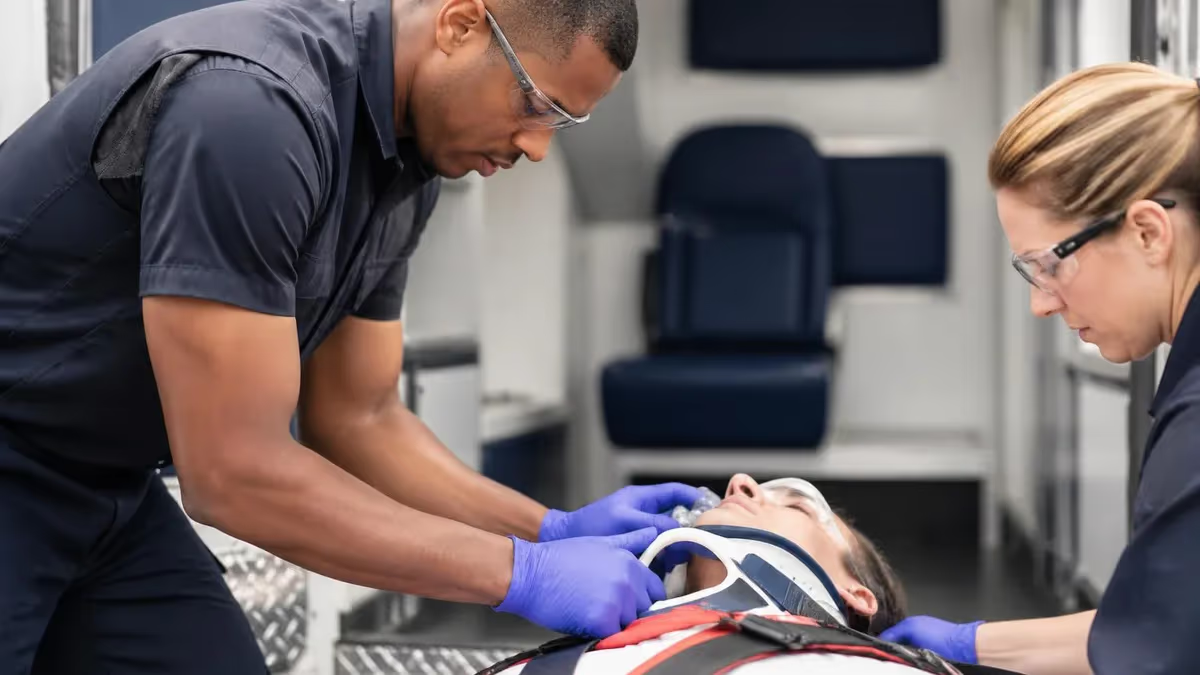
ITLS — International Trauma Life Support — is one of the most recognized prehospital trauma certifications in emergency medicine. Developed to standardize trauma care before patients reach the hospital, the program trains EMS providers to rapidly assess and manage life-threatening injuries. It replaced the earlier Basic Trauma Life Support (BTLS) curriculum and is now administered globally by ITLS International, which oversees standards across more than 80 countries.
The certification is available at two levels: ITLS Basic, designed for EMTs and first responders, and ITLS Advanced, aimed at paramedics and registered nurses who perform advanced interventions. Both levels share a core framework built around rapid patient assessment, scene safety, and systematic intervention priorities that mirror real-world trauma calls. The shared foundation means providers who earn Basic certification and later advance to paramedic can transition to the Advanced track without relearning the underlying assessment structure.
Earning your ITLS certification signals to employers that you can manage trauma patients efficiently under pressure. Agencies across North America, Europe, and dozens of other countries recognize the credential as a benchmark for prehospital trauma competency, making it a valuable addition to any EMS professional's resume. The two-year renewal cycle also ensures certified providers stay current with evolving evidence-based trauma protocols rather than relying on outdated approaches.
What Is ITLS?
International Trauma Life Support grew out of decades of research into prehospital trauma mortality. The program's core philosophy is that the majority of preventable trauma deaths result from airway obstruction, uncontrolled hemorrhage, and tension pneumothorax — all conditions that trained providers can identify and manage in the field before hospital resources become available. The ITLS course meaning centers on speed, systematic assessment, and decisive action during the critical minutes before hospital arrival.
ITLS International oversees the curriculum, instructor certification, and quality assurance for affiliated chapters worldwide. The current curriculum, updated in the 9th edition, incorporates evidence-based changes to hemorrhage control, spinal motion restriction, and tourniquet use that reflect modern trauma science. Instructors must complete a separate ITLS instructor course and maintain their own provider certification to teach the program at any accredited chapter — a requirement that protects the integrity of certification standards globally.
The program covers a wide range of trauma scenarios: blunt and penetrating mechanisms, burns, pediatric emergencies, obstetric trauma, and multi-system injuries. This breadth ensures that certified providers are prepared for the full spectrum of calls encountered in real EMS practice, from urban penetrating trauma to rural farm injuries. Each scenario type receives dedicated instructional time rather than a brief mention, giving providers genuine depth across all major trauma categories they will realistically encounter in the field.

ITLS Course Format
The ITLS course runs 16 to 18 hours, typically spread over two consecutive days. Day one focuses on didactic instruction and cognitive foundations — providers learn the ITLS Assessment, patient prioritization, and the pathophysiology behind major trauma injuries. Pre-course reading from the ITLS textbook is strongly encouraged so students arrive prepared to engage with the material rather than hearing it for the first time in a classroom setting.
Day two is skills-intensive. Students rotate through practical stations covering airway management, hemorrhage control, spinal assessment, shock management, and patient packaging. Each station is facilitated by a certified instructor who gives immediate performance feedback. Stations are designed to replicate field conditions, so providers practice with real equipment under time pressure rather than in an abstract, theoretical setting.
The course concludes with a written exam and, for those who have not already passed skills stations, any remediation needed. Some chapters offer an ITLS online course for the didactic portion, allowing students to complete classroom content at their own pace before attending an in-person skills day.
This hybrid model has made the certification accessible to providers in rural areas with limited local training options and to shift workers who cannot easily block two consecutive days off from work. Ask your chapter coordinator whether a hybrid option is available in your region before assuming you must complete the full two-day in-person format.
ITLS Study Tips
What's the best study strategy for ITLS?
Focus on weak areas first. Use practice tests to identify gaps, then study those topics intensively.
How far in advance should I start studying?
Most successful candidates begin 4-8 weeks before the exam. Create a structured study schedule.
Should I retake practice tests?
Yes! Take each practice test 2-3 times. Focus on understanding why answers are correct, not memorizing.
What should I do on exam day?
Arrive 30 min early, bring required ID, read questions carefully, flag difficult ones, and review before submitting.
ITLS Written Exam Overview
The ITLS written exam consists of 50 multiple-choice questions drawn from the course curriculum. Candidates must score at least 74% — 37 correct answers — to pass. Questions test recognition of injury patterns, correct assessment sequence, treatment priorities, and knowledge of specific interventions such as needle decompression, tourniquet application, and airway adjunct selection.
The exam is administered on paper at the course site immediately after completion of all skills stations. Most chapters do not allow open-book testing, so candidates must know the material thoroughly. Those who fail the written exam typically have one opportunity to retest within a specified window, though policies vary by chapter.
Eligibility Requirements
ITLS Basic is open to any certified emergency responder with a minimum EMT-Basic level credential. This includes EMTs, emergency medical responders, and equivalent certifications recognized in the candidate's home country. No additional prerequisites beyond active certification are required, making the course accessible to entry-level providers early in their careers who want to build a strong, tested trauma foundation from the very start of their EMS work.
ITLS Advanced requires a higher level of clinical training. Eligible candidates include paramedics, registered nurses with emergency or critical care experience, physician assistants, and physicians. The advanced curriculum assumes proficiency with advanced airway management and IV/IO access, so candidates who lack these skills may struggle with skills station performance even if they grasp the cognitive material well during lecture portions of the course.
Both levels require candidates to be currently certified in CPR at the healthcare provider level — either AHA BLS or an equivalent standard. Some chapters also require proof of current EMS or clinical employment, though this varies by region. Contacting a local ITLS course near me provider is the best way to confirm exact prerequisites before enrolling, as chapter-specific policies can differ from the international baseline requirements. Verifying eligibility before registration prevents last-minute enrollment complications on course day and ensures you're fully prepared.
Study Tips for ITLS Success
Preparation for the ITLS test should start at least one week before the course date. Read the assigned textbook chapters in order — the ITLS textbook is written to mirror the course sequence, so following it chapter by chapter builds a logical mental framework before you encounter the material in class. Focus especially on the ITLS Assessment algorithm, which forms the backbone of the written exam and every skills station.
Practice the assessment sequence out loud or with a study partner. Verbalizing steps — announcing what you find, what you suspect, and what you're doing — mirrors the skills station format where instructors listen for correct decision points. Providers who only study passively from text often freeze during stations when asked to narrate their assessment. Active recall practice closes that gap quickly.
Targeted use of ITLS testing resources, including practice questions organized by topic, helps identify weak areas before the actual exam. Focus remediation time on hemorrhage control decision trees, shock classification, and pediatric assessment differences — these are reliably high-yield topics. Avoid cramming all review into the night before; spaced repetition across several days produces far better retention of the clinical decision-making content that separates passing candidates from those who need to retest.

ITLS Certification: Pros and Cons
- +Globally recognized by EMS agencies in 80+ countries
- +Two-day format allows working providers to certify without extended leave
- +Curriculum updated to reflect current trauma science (9th edition)
- +Hybrid online/in-person options available through many chapters
- +Covers the full trauma spectrum including pediatric and obstetric emergencies
- +Strong skills-station format builds real muscle memory, not just test knowledge
- −Certification expires every two years, requiring ongoing renewal investment
- −Course availability varies significantly by geographic region
- −Advanced level requires paramedic or RN credential — not accessible to all EMTs
- −Pre-course reading expectation adds preparation time outside class hours
- −Chapter-specific policies create inconsistent experiences across regions
- −Written exam must be passed alongside skills stations — dual failure risk
Renewal and Recertification
ITLS certification is valid for two years from the date of successful course completion. Renewal requires attendance at an approved ITLS refresher course — you cannot renew by written exam alone. Refresher courses run approximately 8 hours and focus on skills competency reassessment and any curriculum updates since your original certification. Completion of the refresher resets your two-year clock and issues a new certification card with the updated expiration date.
Some providers opt for full recertification rather than a refresher, particularly if they want a thorough review of content or if their schedule aligns better with a full course date. Both pathways result in an equivalent two-year certification. Many employers track ITLS expiration dates as part of credential management, so plan renewal well before your card expires to avoid a lapse that could affect scheduling, deployment, or eligibility for specialty assignments.
If you hold both ITLS Basic and ITLS Advanced certifications, each carries its own expiration date and renewal requirement. Providers who move up from Basic to Advanced during their career should confirm with their chapter whether completing an Advanced recertification satisfies the Basic renewal simultaneously. Contact ITLS International or your regional chapter for definitive guidance on dual-certification renewal pathways in your jurisdiction, as policies differ between regions.
ITLS Certification Checklist
- ✓Confirm you hold a current EMT or paramedic/RN credential (per your desired level)
- ✓Obtain current BLS Healthcare Provider certification (AHA or equivalent)
- ✓Locate an accredited ITLS course near you via the ITLS International chapter finder
- ✓Purchase or access the ITLS textbook (9th edition) and complete pre-course reading
- ✓Register for the course and confirm any chapter-specific prerequisites
- ✓Practice the ITLS Assessment sequence verbally before skills stations
- ✓Complete the 16–18 hour course including all required skills stations
- ✓Pass the 50-question written exam with a score of 74% or higher
- ✓Receive your ITLS card and add the certification to your credentials records
- ✓Schedule your refresher course before the two-year expiration date
How to Prepare Effectively
Effective preparation for ITLS training combines textbook review with deliberate skills practice. Start by reading the ITLS Assessment chapter multiple times until you can recite the sequence from memory. This single algorithm underpins both the written exam and every practical station, so fluency here pays dividends across the entire course. Build a mental checklist you can deploy automatically under the stress of a simulated trauma call where an instructor is watching every decision you make.
One common mistake is underestimating the skills stations. Many providers who score well on practice questions still struggle with stations because they've never practiced verbalizing clinical decisions aloud. Partner up with a colleague before the course and run through scenarios using real equipment — cots, backboards, tourniquets, cervical collars. The physical and verbal rehearsal builds confidence that prevents freezing during evaluated stations where hesitation can translate into a critical failure mark.
Review commonly tested decision points repeatedly: when to apply a tourniquet versus wound packing, when selective spinal assessment is appropriate, and the specific signs distinguishing tension pneumothorax from hemothorax. Use our free practice questions to stress-test your knowledge under timed conditions. Identifying gaps a few days before the course leaves time for focused remediation rather than last-minute panic reading the night before your certification attempt.

Career Benefits of ITLS Certification
Holding a current ITLS certification strengthens your position in a competitive EMS job market. Many municipal EMS systems, hospital-based services, and air medical programs list ITLS as a preferred or required credential. In regions where trauma calls represent a significant percentage of the call volume, supervisors and medical directors specifically seek providers who have demonstrated competency through a structured trauma curriculum rather than through on-the-job exposure alone — your certification is evidence that you've been tested.
Beyond employment benefits, ITLS provides a framework that improves patient outcomes. Providers report that the systematic assessment structure helps them stay organized on chaotic multi-casualty scenes or high-acuity calls where cognitive load is intense. The habit of running through a consistent mental checklist reduces the risk of missed injuries — a problem that contributes significantly to preventable trauma mortality at the prehospital stage, particularly for providers who work infrequently on major trauma calls.
For nurses and paramedics interested in specialty roles — flight medicine, tactical EMS, or emergency department work — ITLS pairs well with other certifications such as PHTLS, TNCC, or TCRN. Maintaining a portfolio of current trauma credentials demonstrates ongoing professional development and keeps clinical skills sharp between major incidents. Many providers treat ITLS renewal as a built-in refresher that recalibrates their trauma care every two years and reminds them of protocol updates they might otherwise miss.
Finding an ITLS Course and Registering
The ITLS International website maintains a global directory of accredited chapters and upcoming course dates. Use the chapter finder to locate an ITLS course near me — results include contact information, course types offered (Basic, Advanced, refresher, instructor), and scheduled dates. Some chapters post registrations directly on the ITLS International portal, while others manage enrollment through their own websites or phone contact. Reach out early; popular course dates often fill weeks in advance.
For providers in areas without nearby chapter coverage, the ITLS class online hybrid option is worth investigating. Several ITLS-affiliated chapters offer fully online didactic content that you complete at your own pace, then pair with a single in-person skills day at a participating site. This format reduces total travel and can be completed on a more flexible schedule than a traditional two-day course, making it a strong fit for providers with variable shift schedules or family obligations.
When comparing course options, confirm that the chapter is currently accredited by ITLS International and that the instructor holds a current instructor credential. Non-accredited courses — sometimes marketed under similar names — do not produce a valid ITLS card recognized by employers or credentialing bodies. A quick verification call to ITLS International's regional office before you register can prevent wasting time and money on an invalid course that your employer will not accept.
ITLS Practice Test Questions
Prepare for the ITLS - International Trauma Life Support exam with our free practice test modules. Each quiz covers key topics to help you pass on your first try.
ITLS Adult Advanced
ITLS Exam Questions covering Adult Advanced. Master ITLS Test concepts for certification prep.
ITLS Adult Basic
Free ITLS Practice Test featuring Adult Basic. Improve your ITLS Exam score with mock test prep.
ITLS Airway Management and Ventilation
ITLS Mock Exam on Airway Management and Ventilation. ITLS Study Guide questions to pass on your first try.
ITLS Burns and Environmental Trauma
ITLS Test Prep for Burns and Environmental Trauma. Practice ITLS Quiz questions and boost your score.
ITLS Extremity Trauma Management
ITLS Questions and Answers on Extremity Trauma Management. Free ITLS practice for exam readiness.
ITLS Geriatric Trauma Considerations
ITLS Mock Test covering Geriatric Trauma Considerations. Online ITLS Test practice with instant feedback.
ITLS Head and Spinal Trauma
Free ITLS Quiz on Head and Spinal Trauma. ITLS Exam prep questions with detailed explanations.
ITLS Hemorrhage Control and Shock
ITLS Practice Questions for Hemorrhage Control and Shock. Build confidence for your ITLS certification exam.
ITLS - International Trauma Life Support A...
ITLS Test Online for - International Trauma Life Support Airway Management and Ventilation. Free practice with instant results and feedback.
ITLS - International Trauma Life Support B...
ITLS Study Material on - International Trauma Life Support Burns and Environmental Trauma. Prepare effectively with real exam-style questions.
ITLS - International Trauma Life Support E...
Free ITLS Test covering - International Trauma Life Support Extremity Trauma Management. Practice and track your ITLS exam readiness.
ITLS - International Trauma Life Support G...
ITLS Exam Questions covering - International Trauma Life Support Geriatric Trauma Considerations. Master ITLS Test concepts for certification prep.
ITLS - International Trauma Life Support H...
Free ITLS Practice Test featuring - International Trauma Life Support Head and Spinal Trauma. Improve your ITLS Exam score with mock test prep.
ITLS - International Trauma Life Support H...
ITLS Mock Exam on - International Trauma Life Support Hemorrhage Control and Shock. ITLS Study Guide questions to pass on your first try.
ITLS - International Trauma Life Support P...
ITLS Test Prep for - International Trauma Life Support Patient Assessment and Management. Practice ITLS Quiz questions and boost your score.
ITLS - International Trauma Life Support P...
ITLS Questions and Answers on - International Trauma Life Support Pediatric Trauma Considerations. Free ITLS practice for exam readiness.
ITLS - International Trauma Life Support T...
ITLS Mock Test covering - International Trauma Life Support Thoracic and Abdominal Trauma. Online ITLS Test practice with instant feedback.
ITLS - International Trauma Life Support T...
Free ITLS Quiz on - International Trauma Life Support Trauma in Pregnancy. ITLS Exam prep questions with detailed explanations.
ITLS Patient Assessment and Management
ITLS Practice Questions for Patient Assessment and Management. Build confidence for your ITLS certification exam.
ITLS Pediatric Trauma Considerations
ITLS Test Online for Pediatric Trauma Considerations. Free practice with instant results and feedback.
Your Next Steps
Start your ITLS journey by confirming which level — Basic or Advanced — aligns with your current credential and career goals. If you're an EMT aiming to build a strong trauma foundation, ITLS Basic is the right starting point and provides skills that apply immediately on the job. If you're a paramedic or RN looking to sharpen advanced trauma interventions and gain a portable credential recognized across healthcare settings, ITLS Advanced delivers the deeper clinical framework you need.
Once you've chosen your level, locate an accredited chapter using the ITLS International chapter finder and register for an upcoming course. Order the 9th edition textbook as soon as you register and begin the pre-course reading immediately — providers who complete the assigned reading before day one consistently perform better on both the written exam and skills stations. Don't leave textbook review until the night before when retention is at its lowest.
Supplement your preparation using our free ITLS practice questions and full-length practice tests. Working through multiple-choice questions under timed conditions replicates the pressure of the actual written exam and reveals content gaps while you still have days to address them. Combine that targeted question practice with verbal rehearsal of the ITLS Assessment sequence and you'll walk into your course with the confidence and competency to pass on your first attempt and earn a credential that elevates your career.
ITLS Questions and Answers
About the Author

Educational Psychologist & Academic Test Preparation Expert
Columbia University Teachers CollegeDr. Lisa Patel holds a Doctorate in Education from Columbia University Teachers College and has spent 17 years researching standardized test design and academic assessment. She has developed preparation programs for SAT, ACT, GRE, LSAT, UCAT, and numerous professional licensing exams, helping students of all backgrounds achieve their target scores.
Join the Discussion
Connect with other students preparing for this exam. Share tips, ask questions, and get advice from people who have been there.
View discussion (9 replies)