
Grease Trap Sizing Under the International Plumbing Code: A Practical Guide 2026
🎯 Grease trap sizing international plumbing code explained: flow-rate math, interceptor types, installation rules, and exam tips for IPC Chapter 10.

Grease trap sizing international plumbing code questions trip up more students and new plumbers than almost any other Chapter 10 topic. The reason is simple: the IPC tells you when a grease interceptor is required, but it leans on referenced standards and local amendments for the exact math. If you have ever wondered what is the international plumbing code and how it handles kitchen waste, this guide walks through the logic from definitions to calculations to exam traps.
The International Plumbing Code, published by the International Code Council, is the model plumbing code adopted in most US states and many municipalities. Chapter 10, titled Traps, Interceptors and Separators, holds the rules that govern grease interceptors, oil separators, and sand interceptors. Section 1003 is where a restaurant kitchen, school cafeteria, or hospital food service area gets its requirements. Understanding that chapter is essential for both field work and for passing a certification or licensing exam.
Grease is a problem because it behaves differently at different temperatures. Hot kitchen wastewater carries dissolved fats and oils that look harmless leaving a dishwasher. Once that water cools in the building drain, the fats solidify, cling to pipe walls, and combine with food solids into hardened blockages. Municipal sewer utilities spend millions every year clearing these fatbergs, which is why the IPC requires interceptors on fixtures that discharge grease-laden waste before it reaches the public sewer.
Sizing is the step where theory meets money. An undersized interceptor lets grease pass through during peak service, drawing citations from the local pretreatment program. An oversized gravity unit costs thousands more to excavate, install, and pump out. A hydromechanical unit selected without checking flow rate may fail its first inspection. Getting the number right requires knowing the fixtures connected, their drainage volume, the time allowed to drain, and the standard the manufacturer used to rate the device.
Two families of devices appear in the code. Hydromechanical grease interceptors, often called grease traps, are compact units installed indoors under or near sinks, rated by flow rate in gallons per minute. Gravity grease interceptors are large underground tanks, commonly 750 to 5,000 gallons or more, that rely on retention time and baffles. The IPC treats them in separate subsections, and each follows a different sizing approach, so exam questions often test whether you can tell them apart.
Another layer is the adopted edition. States adopt the IPC on different cycles, and many amend Section 1003 to match their own pretreatment ordinances. A county in Texas may require a 1,000-gallon minimum gravity interceptor for any new food establishment, while a city in Ohio may accept a point-of-use hydromechanical unit. The model code gives you the framework, but the authority having jurisdiction has the final word on capacity, location, and maintenance frequency.
This article breaks the topic down in practical order. You will see the key statistics, the fixtures that require interception, the flow-rate and drainage-fixture-unit methods, a worked example, installation rules, maintenance expectations, and common mistakes on the exam. Along the way, you can test yourself with free quizzes on traps, interceptors, and separators. By the end, you should be able to read a kitchen fixture schedule and explain how an interceptor would be selected for it.
Grease Interceptors Under the IPC by the Numbers

When the IPC Requires a Grease Interceptor
Section 1003 requires an interceptor or automatic grease removal device for fixtures and equipment with grease-laden waste in food preparation areas of restaurants, hotel kitchens, hospitals, school kitchens, bars, and clubs.
Pot sinks, prerinse sinks, dishwashers, floor sinks near cooking lines, and kettle drains typically discharge through the interceptor. Designers confirm each connection against the approved plan and the local pretreatment ordinance before sizing.
Restroom fixtures, hand sinks, and sanitary drains normally bypass the interceptor. Sending toilet waste through a grease unit overloads its capacity and defeats the separation process, so the code and most local rules prohibit it.
These powered units skim grease continuously and are accepted as an alternative to a traditional interceptor where the code allows. They must be tested to the referenced standard and installed per the manufacturer's listing.
Sizing starts with identifying every fixture that discharges grease-laden waste. In a typical restaurant that includes the three-compartment pot sink, prerinse sink, dishwasher, floor sinks near the cooking line, and sometimes the mop sink. Hand sinks and restroom fixtures normally stay off the interceptor line because they add water but little grease. The designer lists each fixture, its capacity, and the interceptor location. This inventory drives every later calculation, so mistakes here carry through the whole design.
For hydromechanical interceptors, the widely used approach follows Plumbing and Drainage Institute guidance referenced by the code. Take the fixture's capacity in gallons, multiply by 0.75 to account for the fact that a bowl is rarely filled to the brim when the plug is pulled, then divide by the drain time in minutes. A one-minute drain period is typical. The result is the flow rate in gallons per minute that the interceptor must handle.
Here is a worked example. A three-compartment sink has bowls measuring 24 by 24 by 12 inches. Each bowl holds about 30 gallons, so three bowls total 90 gallons. Multiplying by 0.75 gives 67.5 gallons. Dividing by a one-minute drain time yields 67.5 gpm, though many designers use a two-minute drain period for a result near 34 gpm. The prerinse sink and dishwasher are then added, and the total is rounded up to the next available interceptor rating.
Flow rate alone is not the whole story, because every hydromechanical unit also has a grease retention capacity. A common rule of thumb pairs roughly two pounds of retained grease with each gallon per minute of rated flow, so a 50 gpm unit holds about 100 pounds. Higher capacity means longer service intervals. Kitchens that cook fried foods, rotisserie chicken, or barbecue produce more grease and may justify a unit one size above the minimum calculation.
Gravity grease interceptors use a different logic. Instead of rated flow, the engineer sizes the tank by retention time, holding the wastewater long enough for fats to float and solids to settle. Local ordinances often set a minimum such as 750 or 1,000 gallons and add formulas based on seats served, meals per day, or drainage fixture units. Because the IPC defers heavily to local rules here, always confirm the adopted amendment before sizing.
The drainage fixture unit method appears in some jurisdictions and on exam questions. Each fixture has an assigned DFU value from the code tables, and the total DFUs connected to the interceptor correlate to a required flow rating or tank volume. Many kitchen fixtures carry values of 2 or 3 DFUs. Adding the loads gives a total that you compare against a local sizing chart, then you select the interceptor whose rating meets or exceeds that figure.
Remember that sizing is only one piece of the broader international plumbing code technical knowledge examiners expect. You must also know that the interceptor requires a vented trap arrangement, a flow control fitting where the manufacturer demands it, and accessible cleanouts. Questions frequently mix these topics, such as asking which element is missing from a drawing that shows a correct interceptor size but no vent. Studying sizing together with installation rules will save you points.
What Is the International Plumbing Code Saying About Interceptor Types?
Hydromechanical grease interceptors, commonly called grease traps, are factory-built units installed inside the building near the fixtures they serve. They are tested and rated to ASME A112.14.3 or PDI G101, which assign a flow rate in gallons per minute and a grease retention capacity in pounds. Typical sizes range from 4 gpm for a single sink up to 100 gpm or more for large kitchens.
Because these units are compact, they need frequent maintenance. Small restaurants often use one for a pot sink or prerinse station, installing a separate unit at each location. Inspectors check the data plate to verify that the rated flow matches the calculation on the approved plans. If the plate is missing or the unit is swapped for a smaller model, the installation fails until the proper unit is documented.

Is a Hydromechanical Grease Trap Better Than a Gravity Interceptor?
- +Lower upfront cost than excavating and installing an underground tank
- +Fits inside small kitchens near the fixtures it serves
- +Factory-tested rating makes plan review simple
- +Installation is fast and usually needs no heavy equipment
- +Easy for staff to inspect and skim between pump-outs
- +Works well for single stations such as a prerinse sink
- −Small capacity means cleaning every few weeks in busy kitchens
- −Indoor location can produce odors during servicing
- −Undersizing after a kitchen expansion is common
- −Often not accepted for new construction under local amendments
- −Flow control fittings and vents must be installed correctly
- −Staff may neglect cleaning because it is a manual task
Grease Trap Sizing International Plumbing Code Checklist
- ✓List every fixture that discharges grease-laden waste.
- ✓Confirm the adopted IPC edition and local amendments.
- ✓Measure each bowl and convert cubic inches to gallons.
- ✓Apply the 0.75 factor to each fixture's capacity.
- ✓Divide by the drain time to find flow in gpm.
- ✓Add the loads and round up to the next unit rating.
- ✓Check the unit's retention capacity against kitchen volume.
- ✓Verify the standard on the data plate, such as ASME A112.14.3.
- ✓Show trap, vent, and flow control details on the plans.
- ✓Provide an accessible cover and a cleaning log location.
Always Round Up, Never Down
When your calculated flow falls between two interceptor ratings, choose the larger one. A 42 gpm result means selecting a 50 gpm unit, not a 35. Undersized interceptors are the most common sizing error, and they cause grease to bypass the unit during peak service.
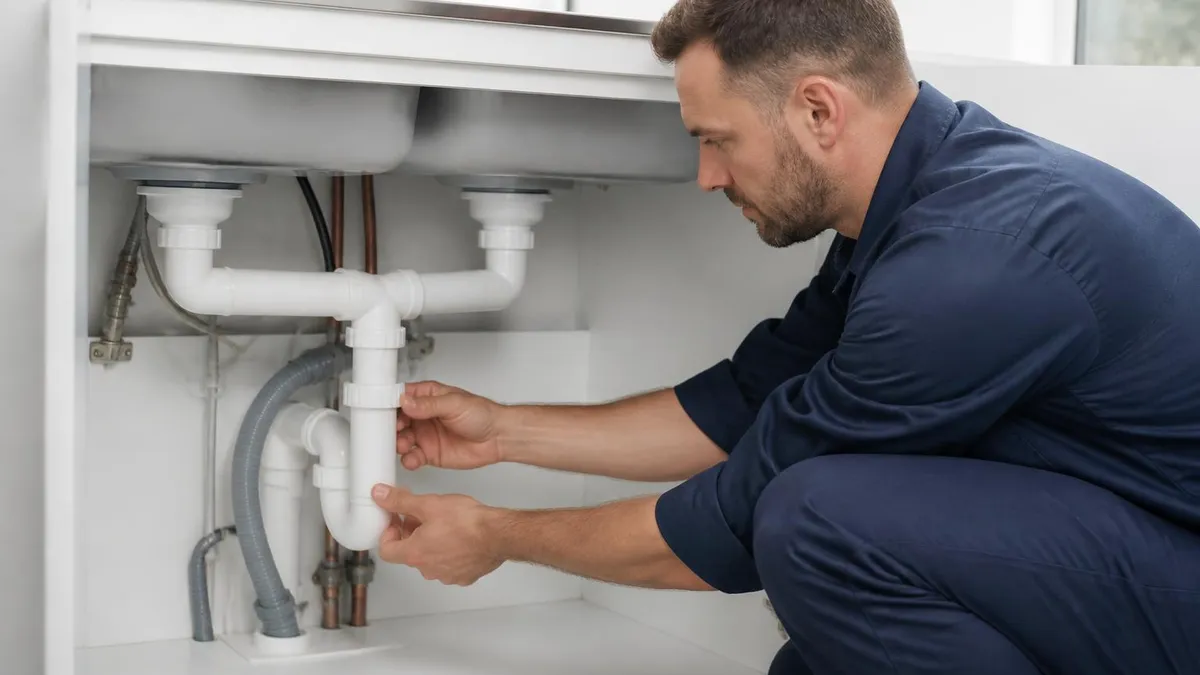
Installation rules are where a correct calculation can still fail inspection. The IPC requires that every fixture connected to an interceptor be individually trapped and vented, and the interceptor itself must be vented in accordance with Chapter 9. Venting prevents siphonage of the trap seals and allows the unit to drain at its rated flow. Without proper venting, a hydromechanical interceptor can pull air through its flow control fitting and discharge grease downstream.
Location matters as much as size. Hydromechanical interceptors should sit as close to the fixtures they serve as practical, because long horizontal runs allow hot grease to cool and coat the pipe before it reaches the unit. Many manufacturers recommend limiting the run to about 25 feet. The unit must also be accessible for cleaning, which rules out burying it under a permanent equipment line or behind a wall without an access panel.
Flow control is another detail inspectors check. Many hydromechanical units rely on a flow control fitting, sometimes called a flow restrictor, installed upstream with an air intake. The fitting limits flow to the rated gpm so the interceptor has time to separate grease. The IPC and the referenced standards expect interceptors to be installed according to manufacturer instructions, so skipping the fitting violates both the listing and the code. Document it on the permit drawings.
Gravity grease interceptors add structural and access requirements. They must have manholes or access openings of sufficient size, often 24 inches in diameter, extended to grade with a secure cover. Inlet and outlet baffles or tees direct flow so grease floats toward the top and clear water leaves from below. Because these tanks sit underground, engineers also consider buoyancy in high groundwater, traffic loading under parking lots, and sampling ports for the local utility.
Piping materials and slope also appear on the exam. Drain lines serving the interceptor follow the usual Chapter 7 slope of one-quarter inch per foot for pipes up to 2.5 inches in diameter, and the outlet connects to the building drain through a properly sized line. Cleanouts must be provided so that blockages can be rodded without removing the unit. Undersized piping downstream of an interceptor is a common finding on plan reviews.
What may not connect is just as important. Many jurisdictions prohibit food waste disposers from discharging into a hydromechanical interceptor because shredded solids fill the unit quickly. Toilets, urinals, and other sanitary fixtures should not drain through a grease interceptor, since they overload hydraulic capacity and send solids that defeat the separation process. Clear-water sources are usually kept separate as well, so check the plan to confirm fixtures are routed to the right line.
Finally, consider how the design supports future maintenance. Providing space for a vacuum truck hose, labeling the interceptor on the plumbing plan, and posting a service tag at the unit save trouble later. Inspectors want to see that the owner can reach the device, remove the cover, measure the grease layer, and record each cleaning. A design that satisfies the sizing table but ignores access often draws a correction notice before the final inspection.

The model IPC is a starting point. Many states and cities amend Section 1003 with stricter minimum capacities, cleaning intervals, or bans on certain unit types. Verify the adopted edition and local ordinance before sizing for a project or answering an exam question about jurisdiction-specific rules.
Even a perfectly sized interceptor fails if nobody cleans it. The most widely adopted maintenance benchmark is the 25 percent rule, which says the unit must be pumped or cleaned when the combined depth of floating grease and settled solids reaches one quarter of the liquid depth. Some jurisdictions set fixed intervals instead, such as every 30 days for hydromechanical units and every 90 days for gravity tanks. The IPC points to local authority for the schedule.
Hydromechanical units usually need more frequent attention because their capacity is small. A busy restaurant with a 50-pound unit might fill it in two to four weeks, while a low-volume cafe could go six. Staff can lift the lid, scrape the baffle, skim the grease layer, and place it in a rendering container, but the unit still needs full pump-outs by a licensed hauler on a regular basis. Keep the fixture schedule and cleaning log near the unit.
Gravity interceptors are serviced by licensed haulers using vacuum trucks. The hauler removes the entire contents, including floating grease, wastewater, and bottom sludge, because returning the liquid to the tank is prohibited in most areas. After pumping, the tank is inspected for cracks, baffle damage, and corroded covers, then refilled with clean water to restore the liquid seal. The hauler issues a manifest that the restaurant keeps on file, often for three years.
Additives and enzymes are a frequent source of confusion. Products marketed as grease digesters may break fats into smaller droplets that pass through the interceptor and re-solidify downstream in the sewer. Most pretreatment programs do not accept additives as a replacement for pumping, and some ban them outright. An inspector who sees a bucket of enzyme powder next to an overfull unit will still cite the owner for failing to clean.
Common violations tell you what inspectors look for. Typical citations include missing or buried covers, interceptors bypassed with a hidden pipe, undersized units after a kitchen expansion, missing cleaning records, and discharge of fryer oil down a floor drain. Another frequent finding is a new fixture, such as an added dish machine, connected to the interceptor without recalculating the flow. Each of these violations can bring fines, mandatory pump-outs, or even permit suspension.
Fats, oils, and grease programs have also pushed owners toward best management practices. Scraping plates before washing, using drain screens, collecting used fryer oil for recycling, and training new employees on proper disposal can cut grease loading by a third or more. These practices extend pump-out intervals and lower hauling costs. For exam purposes, remember that source control complements, but never replaces, a properly sized and maintained interceptor.
When a kitchen changes, the interceptor must be reviewed again. Adding a second fryer line, converting a bakery to a full-service restaurant, or installing a commercial dishwasher can double the flow into the unit. A change of occupancy normally triggers a plan review where the plumbing inspector recalculates the load. Owners who skip that step often discover the problem only after a sewer backup, when emergency pumping and a retrofit cost far more than the original design.
Preparing for questions on grease interceptors is easier when you sort them into three buckets: when one is required, how it is sized, and how it is installed and maintained. Make a one-page summary with the key definitions, the 0.75 factor, the one-minute drain time, and the 25 percent rule. Review that sheet each morning for a week. Short, repeated exposure builds recall far better than a single long cram session.
Practice the arithmetic until it feels automatic. Work at least ten problems with different fixture combinations, such as a two-compartment sink plus a prerinse station, or a 20-gallon pot filler with a floor sink. Always compute capacity in gallons first, apply the 0.75 factor, divide by drain time, and then round up to the next interceptor size. Writing each step prevents the most common error, which is skipping the conversion from cubic inches to gallons.
Learn the vocabulary exactly as the code uses it. The IPC says grease interceptor for the device and grease-laden waste for the discharge, and exam writers pay attention to those terms. Know that an oil separator serves garages and car washes, a sand interceptor serves wash bays, and a grease interceptor serves food service. Questions often hide the answer in a scenario, so identify the waste stream before you look at the answer choices.
Use your code book intelligently. Tab Chapter 10, Table 709.1 for fixture units, and the definitions in Chapter 2. During an open-book exam, speed depends on knowing where information lives, not on reading the text for the first time. Highlight the section numbers you use repeatedly and practice looking up answers under a timer. If your exam is closed-book, flashcards pairing section numbers with key phrases work well.
Take practice quizzes in realistic conditions. Set a timer, remove your notes, and answer in one sitting, then review every miss and write down why the correct choice was right. Our free traps, interceptors, and separators quiz is a good place to start, followed by drainage and general regulations sets. Track your score by chapter. If one chapter lags below 75 percent, return to the text and rebuild that section before taking another test.
Pay attention to edition differences. If your jurisdiction adopted the 2018 or 2021 IPC, make sure your study materials match, because section numbers and sizing tables shift between editions. Check your state licensing board or the ICC website for the exam reference list. When a question mentions a local ordinance or authority having jurisdiction, the safest answer usually defers to the stricter requirement. That habit is both good exam strategy and good field practice.
On exam day, read each question twice and underline the numbers. Eliminate answers that violate basic principles, such as sending toilet waste through a grease interceptor or omitting a vent. If you are unsure, estimate the flow rate and see which choice is closest, since most sizing questions use round numbers. Finally, sleep well the night before. A rested mind catches details like unit conversions, which separate a passing score from a near miss.
IPC Questions and Answers


Written and edited by Nathan Beja, founder of Practice Test Geeks, with AI assistance. Exam facts are checked against the official sources linked below. Editorial policy
Sources & references
Exam facts on this page (fees, format, dates, passing scores) are checked against these official sources; the date is our last check. Editorial policy
- iccsafe.org — Renewal, score validity, retake policy, score release, eligibility, passing score, exam format, time limit, fees, test delivery · verified Nov 2026