
HVAC Ducts Sweating: Why It Happens, What It Costs You, and How to Stop It for Good
HVAC ducts sweating? 💡 Learn why condensation forms, the damage it causes, and the best fixes to stop moisture for good.
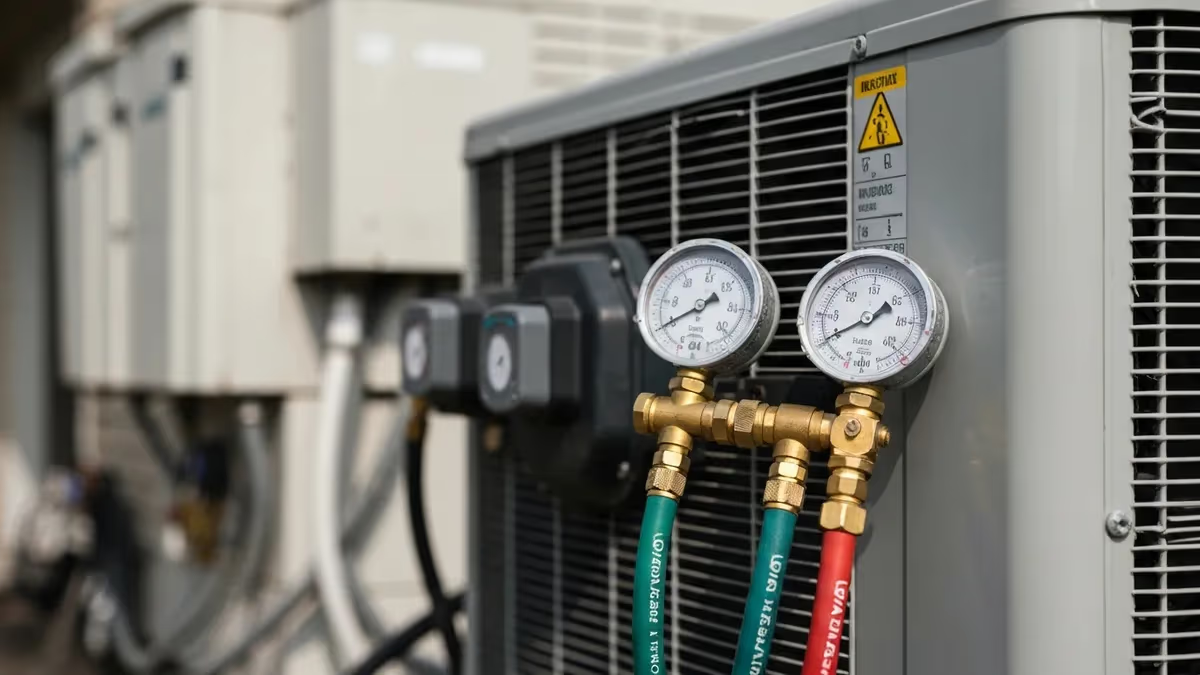
HVAC ducts sweating is one of those problems that sneaks up on homeowners and building managers alike. You walk into your basement or crawl space on a humid summer day and notice water droplets clinging to the outside of your ductwork, or worse, dripping onto the floor below. This condensation is not a sign that your air conditioner is working too hard — it is a sign that warm, moist air is making contact with a cold surface, and the physics of that encounter are working against you every single hour your system runs.
The root cause of sweating ducts is straightforward thermodynamics. When supply ducts carry conditioned air at temperatures between 50°F and 60°F through unconditioned spaces where the ambient air is 80°F or higher with relative humidity above 60 percent, the duct surface drops below the dew point of the surrounding air. At that threshold, water vapor in the air converts to liquid water on the duct surface, just as a cold glass of ice water sweats on a warm afternoon. The problem is not the glass — it is the environment around it.
Understanding hvac ducts sweating matters because the consequences extend well beyond a damp floor. Persistent moisture on and around ductwork accelerates rust on metal ducts, causes fiberglass insulation to lose its R-value, promotes mold and mildew growth inside wall cavities and ceiling spaces, and can eventually compromise the structural integrity of floor joists and drywall. A problem that starts as harmless-looking water droplets can evolve into a costly remediation project if left unaddressed for a single summer season.
Sweating ducts are especially common in the American South and Southeast, where summer dew points routinely exceed 70°F and crawl spaces are both common and poorly sealed. But the issue is not limited to humid climates. Anywhere that supply ductwork runs through an unconditioned attic, basement, garage, or crawl space — which describes the majority of homes built before 2000 — the conditions for condensation exist for at least part of the year. Even in dry climates, poorly insulated ducts in a hot attic can sweat during the early morning hours when outdoor temperatures drop.
The good news is that sweating ducts are a solved problem. A combination of proper duct insulation, vapor barriers, ventilation control, and in some cases dehumidification can eliminate condensation entirely. The challenge is diagnosing which specific factors are driving the problem in a given installation, because the fix for an uninsulated duct in a vented crawl space is different from the fix for an over-cooled supply register in a high-humidity basement. Getting the diagnosis right the first time saves money and prevents the frustration of repeat repairs.
This guide covers everything you need to know about HVAC duct condensation: the physics behind it, the most common causes ranked by frequency, the health and structural risks it creates, the repair and prevention options available to you, and how to evaluate whether this is a DIY project or a job for a licensed HVAC technician. Whether you are a homeowner trying to understand a wet basement ceiling or an HVAC student studying for your certification exams, the information here will give you a complete, practical foundation for tackling this widespread problem.
We also include a diagnostic checklist, cost breakdowns for common repairs, and answers to the questions homeowners ask most often. By the end of this article, you will understand not just why your ducts are sweating but exactly what steps to take to stop it — and how to prevent it from coming back next summer when humidity levels climb again.
HVAC Duct Condensation by the Numbers
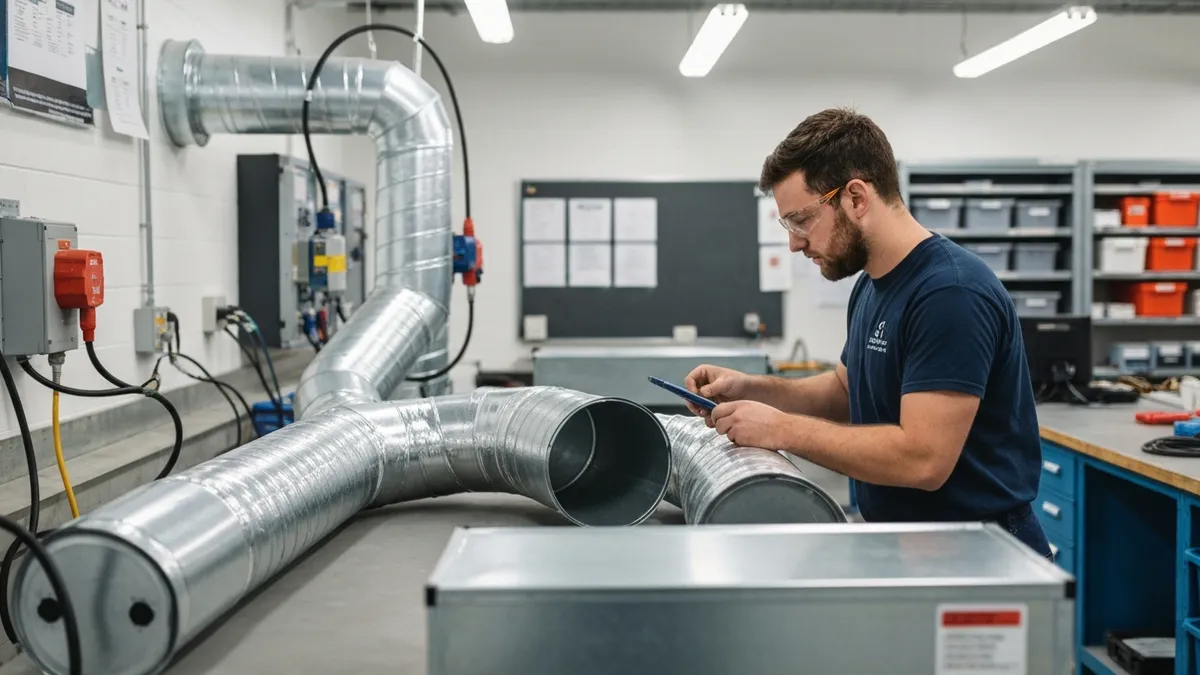
Why HVAC Ducts Sweat: The Step-by-Step Physics
Cold Conditioned Air Fills the Duct
Warm Humid Air Surrounds the Duct
Duct Surface Falls Below Dew Point
Water Accumulates and Drips
Moisture Penetrates Surrounding Materials
Structural and Air Quality Damage Develops
The damage that HVAC duct condensation causes falls into three broad categories: structural damage, energy efficiency losses, and indoor air quality degradation. Understanding each category helps you prioritize repairs and make a compelling case to a landlord, insurance adjuster, or building owner who may not grasp why a little water on the ducts is worth fixing immediately rather than monitoring for another season.
Structural damage begins with the duct itself. Uncoated galvanized steel ductwork, which represents the majority of residential duct systems installed before 1990, begins to rust when exposed to sustained moisture. Surface rust is cosmetic at first, but it progresses to perforation over several years, creating air leaks that reduce system efficiency and allow conditioned air to escape into unconditioned spaces. Flexible duct — the corrugated plastic variety common in attic installations — can develop moisture trapped between the inner liner and outer jacket, causing the jacket to degrade and the insulation layer to become waterlogged and functionally useless.
Beyond the duct itself, water that drips from sweating supply lines soaks into whatever material lies below. In a basement or crawl space, that means concrete floors, vapor barriers, and wood sill plates. In an attic, it means insulation batts and the drywall below. Wet fiberglass insulation loses approximately 40 percent of its effective R-value immediately upon saturation, and it does not recover fully even after drying unless it is replaced. This means that a system already struggling with condensation is simultaneously losing its ability to protect itself from future condensation — a compounding feedback loop.
The energy efficiency impact of sweating ducts is significant and often underappreciated. When conditioned air leaks through rust holes or degraded duct joints, your air conditioning system must work harder and longer to maintain the set temperature, increasing both energy consumption and equipment wear.
The EPA estimates that duct air leakage accounts for 20 to 30 percent of energy losses in a typical home HVAC system. Add the R-value collapse of wet insulation, and a sweating duct problem can easily add $200 to $400 per cooling season to your utility bills in a mid-sized home, depending on climate and system size.
Indoor air quality is perhaps the most urgent concern for occupants. Mold and mildew that grow on damp duct surfaces or in the surrounding insulation release spores and mycotoxins into the air stream. Because supply ducts carry conditioned air directly into living spaces, contamination near or on supply ductwork reaches occupants almost immediately. Common symptoms include aggravated asthma and allergies, chronic sinus irritation, headaches, and in cases of heavy mold exposure, more serious respiratory effects. Families with young children, elderly members, or immunocompromised individuals face the greatest health risk from mold-contaminated duct systems.
The liability dimension matters too, particularly for landlords and commercial building owners. If a tenant or employee can demonstrate that a known moisture problem caused mold growth that in turn caused documented health effects, the property owner may face significant legal exposure. Insurance claims related to mold remediation are increasingly scrutinized, and many policies explicitly exclude mold damage that results from long-term neglect of a known moisture source. Addressing sweating ducts proactively is not just good maintenance — it is risk management.
Finally, consider the secondary damage pathways that extend beyond the duct system itself. Moisture dripping from basement ductwork onto wood floor joists creates conditions for both mold growth and structural wood rot. A single joist weakened by sustained moisture exposure can eventually require sistering or full replacement, a repair costing $500 to $1,500 per joist depending on accessibility.
In crawl space installations, chronic moisture contributes to overall crawl space humidity problems that affect the entire home, including elevated indoor humidity levels, musty odors throughout the living space, and accelerated degradation of anything stored in the crawl space. The scope of damage from what appears to be a localized duct problem can be surprisingly broad.
Fix Options for Sweating Ducts by Location
Crawl spaces are the most common location for sweating duct problems in the American South and Southeast. The fix almost always involves two parallel interventions: insulating the ducts themselves to raise their exterior surface temperature above the dew point, and reducing the humidity of the crawl space air so that even an imperfectly insulated duct does not sweat. Duct insulation with a minimum R-6 rating and a continuous, sealed vapor barrier jacket is the starting point. Use foil-faced insulation for maximum vapor resistance, and seal all seams with foil tape rather than standard duct tape, which degrades over time.
The crawl space encapsulation component is equally important. An open, vented crawl space continuously imports warm, humid outdoor air — exactly the conditions that cause condensation on cold supply ducts. Sealing the crawl space with a heavy-gauge polyethylene liner (minimum 6 mil, ideally 10–20 mil), insulating the foundation walls, and controlling humidity with a dedicated crawl space dehumidifier reduces the moisture load dramatically. A properly encapsulated crawl space can maintain relative humidity below 55 percent year-round, eliminating the dew point crossover that causes sweating entirely. Expect to pay $3,000 to $8,000 for professional crawl space encapsulation depending on size and condition.

DIY Duct Insulation vs. Hiring an HVAC Professional
- +DIY insulation saves $500–$1,500 in labor costs on accessible duct runs
- +Pre-cut duct wrap insulation is available at major home improvement stores
- +Homeowners can complete accessible basement or garage duct wrapping in a weekend
- +DIY allows you to inspect every inch of ductwork for leaks and damage while insulating
- +Adding insulation immediately reduces condensation risk without waiting for contractor availability
- +Self-adhesive insulation products make vapor barrier sealing easier for non-professionals
- −Crawl space and attic duct insulation requires physical stamina and confined-space comfort that many homeowners lack
- −Improper insulation installation with gaps or unsealed vapor barriers can trap moisture and worsen the problem
- −Identifying the correct R-value and vapor barrier combination for your specific climate zone requires research
- −DIY work does not come with a labor warranty, and mistakes may void manufacturer product warranties
- −Duct leakage sealing with mastic requires skill and access equipment that most homeowners do not own
- −A professional can identify related problems — oversized AC, undersized ducts, air handler issues — that a DIYer will miss
HVAC Duct Condensation Prevention Checklist
- ✓Inspect all supply duct runs in unconditioned spaces for missing, damaged, or wet insulation at the start of each cooling season.
- ✓Verify duct insulation meets minimum R-6 rating for humid climates (R-8 in climate zones 1–3 per IECC guidelines).
- ✓Seal all duct seams and connections with mastic sealant or metal-backed tape before applying insulation wrap.
- ✓Measure crawl space or basement relative humidity — address any reading above 60% with mechanical dehumidification.
- ✓Inspect crawl space vapor barrier for tears, gaps at foundation walls, and unsealed penetrations for pipes or wires.
- ✓Check that attic ventilation is adequate — a minimum 1:150 net free vent area ratio per IRC requirements.
- ✓Verify that your air conditioner is not oversized — short-cycling systems cool air faster than they dehumidify it, worsening duct sweating.
- ✓Confirm that supply air temperature leaving registers is not below 50°F, which indicates an airflow or refrigerant charge problem.
- ✓Inspect flexible duct connections at air handlers and diffusers for disconnections where moist unconditioned air can enter.
- ✓Schedule a professional duct leakage test (blower door with duct pressurization) if duct sealing history is unknown or suspected.
The Most Effective Fix Targets the Air, Not Just the Duct
Insulating your ducts raises their exterior surface temperature, but if surrounding air humidity is extreme enough, even a well-insulated duct can still sweat. The most durable fix combines duct insulation with mechanical humidity control — a dehumidifier, crawl space encapsulation, or attic air sealing — to lower the dew point of the air surrounding your ductwork. Targeting a relative humidity below 55% in all unconditioned spaces eliminates condensation risk entirely, regardless of duct insulation quality.
Repair costs for sweating ducts vary widely depending on the scope of the problem, the accessibility of the affected duct runs, and whether you hire a professional or do the work yourself. Understanding the typical cost ranges for each repair type helps you budget accurately and evaluate contractor quotes. The numbers below represent national averages for 2025–2026 and should be adjusted upward by 15 to 30 percent in high-cost-of-living markets like New York, San Francisco, or Boston.
The least expensive fix — and often the most overlooked — is sealing duct leaks before adding insulation. Leaky ducts allow moist unconditioned air to enter the duct system and also allow cold conditioned air to leak out, chilling the duct exterior more than necessary.
Mastic sealant costs $15 to $25 per quart, and a DIY sealing project on an accessible basement duct system typically requires two to three quarts plus several rolls of metal-backed tape. Professional duct sealing using Aeroseal technology, which injects an aerosol sealant that coats leaks from the inside, costs $1,500 to $3,000 for a whole-house treatment but can reduce duct leakage by 90 percent and carries a 10-year warranty.
Basic duct insulation wrap for accessible basement or garage duct runs costs $0.50 to $1.50 per linear foot for materials if done DIY, or $2.50 to $5.00 per linear foot installed professionally including labor and a vapor barrier jacket. A typical 1,500 square foot home with 80 linear feet of exposed supply duct might spend $400 to $600 DIY or $800 to $1,200 professionally for complete insulation coverage. Attic and crawl space duct insulation is more expensive due to access difficulty — expect $1,500 to $3,500 for professional installation in challenging spaces.
Crawl space encapsulation, which is often the most cost-effective long-term solution for homes with sweating crawl space ducts, runs $3,000 to $8,000 depending on crawl space size, current moisture conditions, and whether a mechanical dehumidifier is included. Homes with active water intrusion through foundation walls or floors will need those issues addressed first, potentially adding $2,000 to $15,000 for interior drainage systems or exterior waterproofing before encapsulation makes sense. A qualified crawl space contractor can assess which interventions are necessary and provide a sequenced repair plan.
Whole-basement dehumidifiers capable of handling high-humidity basements cost $400 to $900 for the unit plus $100 to $300 for professional installation including a hard-piped condensate drain line. Running a 70-pint dehumidifier in a humid climate adds approximately $30 to $60 per month to your electricity bill during peak summer months, so factor that operating cost into your decision between dehumidification alone versus the higher upfront cost of encapsulation, which typically does not require continuous mechanical dehumidification once the crawl space is properly sealed.
For homeowners dealing with sweating ducts caused by an oversized air conditioning system, the fix may require replacing or downsizing the AC unit — a significantly larger investment. An oversized AC cools the space rapidly but cycles off before completing a full dehumidification cycle, leaving indoor relative humidity elevated. This drives moisture into unconditioned spaces and compounds duct sweating. A properly sized replacement unit, selected using Manual J load calculation, costs $3,500 to $8,000 installed for a typical residential system but pays back through lower energy bills, better comfort, and elimination of the moisture problems that an oversized system creates.
When evaluating whether to DIY or hire a professional, consider not just the cost differential but the diagnostic value of a professional assessment. An experienced HVAC technician can identify whether your sweating problem stems from duct insulation deficiency, crawl space humidity, system sizing, refrigerant charge issues, or a combination of factors — and can prioritize the repairs that will have the greatest impact. Spending $150 to $300 on a diagnostic service call before committing to repairs can save you from investing in solutions that address the symptom rather than the cause.

Wrapping insulation around ductwork that is already wet, rusted, or showing signs of mold growth traps the existing moisture and creates a dark, humid environment ideal for mold proliferation. Before insulating, dry the duct surfaces completely, treat any visible mold with an EPA-registered mold encapsulant, replace sections of ductwork with active rust perforation, and identify and address the moisture source. Insulating over a wet duct masks the problem while accelerating the damage underneath.
A long-term prevention strategy for HVAC duct sweating goes beyond fixing the immediate condensation problem — it requires addressing the building science fundamentals that create the conditions for condensation in the first place.
Homes built before the widespread adoption of energy codes in the 1990s were typically designed with supply ductwork routed through the most convenient path rather than the most energy-efficient one, which often means miles of duct running through hot attics and humid crawl spaces with minimal insulation. Correcting these design decisions is an investment in long-term system performance that pays dividends in lower energy bills, better comfort, and reduced maintenance costs.
The most impactful long-term prevention measure is bringing ductwork inside the conditioned building envelope. Every linear foot of duct that runs through conditioned space rather than an unconditioned attic, basement, or crawl space is a linear foot that cannot sweat, cannot leak conditioned air into unconditioned space, and does not require ongoing insulation maintenance. While rerouting existing ductwork is expensive and disruptive, it is worth planning as part of a larger renovation. When a kitchen or bathroom renovation opens walls and ceilings, take the opportunity to reroute any supply or return duct runs that currently pass through unconditioned spaces.
Whole-home humidity control is the second pillar of a long-term prevention strategy. A whole-house ventilation system with a heat recovery ventilator (HRV) or energy recovery ventilator (ERV) manages fresh air exchange while recovering heat and — in the case of an ERV — moisture from exhaust air. In humid climates, an ERV can significantly reduce the latent load on your air conditioning system by preconditionin incoming fresh air, lowering indoor humidity levels and reducing the temperature differential between supply ducts and surrounding air. ERV systems cost $1,200 to $3,500 installed and are increasingly standard in high-performance new construction.
Maintaining your air conditioning system in proper working order is an often-overlooked prevention strategy. A system with low refrigerant charge produces colder supply air than a properly charged system, increasing the temperature differential between the duct surface and surrounding air and making condensation more likely. An oversized system, as discussed earlier, produces short cooling cycles that fail to adequately dehumidify indoor air. Annual preventive maintenance by a licensed technician — including refrigerant level verification, coil cleaning, and airflow measurement — keeps the system operating within design parameters and reduces both sweating risk and energy consumption.
Attic ventilation improvements are a cost-effective prevention measure for homes with attic ductwork. A well-ventilated attic stays significantly cooler than a poorly ventilated one, reducing the severity of the temperature differential that drives both condensation and energy losses. Ridge vents combined with soffit vents create a passive convective airflow that exhausts heat from the attic space continuously. Power attic ventilators can further reduce attic temperatures on the hottest days. Adding ventilation baffles to ensure that insulation does not block soffit vent openings is a simple, low-cost DIY project that meaningfully improves attic thermal performance.
For homes in extreme humidity climates — coastal areas, river valleys, and the Gulf Coast region — consider specifying insulated flexible duct with a higher-quality outer vapor barrier jacket when replacing ductwork. Standard flexible duct uses a thin polyethylene outer jacket that can develop pinhole leaks over time, allowing moisture to infiltrate the insulation layer. Premium flexible duct products use a heavier-gauge, reinforced outer jacket with better long-term moisture resistance. The cost premium is modest — roughly $0.30 to $0.50 more per linear foot — but the performance benefit in high-humidity environments is significant.
Finally, establish a regular inspection schedule that catches moisture problems early, before they escalate into structural damage or mold remediation projects. A visual inspection of all accessible ductwork at the start of each cooling season takes less than an hour and can identify new insulation damage, vapor barrier failures, rust formation, and signs of active condensation dripping.
Pair this inspection with a humidity reading in any unconditioned space where ductwork runs. A $20 digital hygrometer left in your crawl space or basement provides continuous visibility into the moisture conditions that drive sweating — and gives you early warning when seasonal humidity rises above the 55 percent threshold that signals elevated condensation risk.
For HVAC students and technicians preparing for certification exams, duct condensation is a topic that appears across multiple exam domains, including psychrometrics, load calculations, equipment selection, and system commissioning. Understanding the dew point concept is foundational — it appears not just in the context of sweating ducts but in questions about cooling coil performance, humidification and dehumidification system design, and indoor air quality diagnostics. If you can draw and interpret a psychrometric chart and locate the dew point on it for a given air condition, you have mastered the conceptual foundation for all of these topics.
On NATE certification exams, duct-related questions focus heavily on proper installation practices: minimum insulation requirements per ACCA Manual S and D, acceptable materials for duct sealing (mastic versus tape), support spacing requirements for flexible duct to prevent sag that creates moisture traps, and the prohibition against installing ductwork in exterior walls in climate zones 4 through 8. The EPA 608 certification exam touches on related concepts in the context of refrigerant charge and system performance, including the relationship between suction line temperature and condensation on refrigerant lines — a phenomenon closely related to duct sweating.
Practical troubleshooting skills are equally important for working technicians. When a customer calls about wet ceilings or floors near supply registers, a systematic diagnostic approach starts with a visual inspection to locate the moisture source, followed by temperature and humidity measurements in the affected area, then evaluation of the duct insulation condition and vapor barrier integrity.
Compare the duct surface temperature — measured with an infrared thermometer — to the dew point of the surrounding air, calculated from a sling psychrometer or digital hygrometer reading. If the duct surface temperature is below the dew point, condensation is thermodynamically certain and the fix is straightforward: raise the duct surface temperature through better insulation, lower the dew point through dehumidification, or both.
Documentation skills matter for professional technicians who want to provide defensible recommendations to customers. Before and after photos of duct insulation conditions, written records of humidity measurements, temperature differential calculations, and material specifications for the installed repair are all elements of a professional service record. Customers who can see the numbers — before: duct surface 52°F, ambient dew point 64°F, condensation certain; after: duct surface 68°F, ambient dew point 61°F, no condensation risk — understand why they paid for the repair and are more likely to refer you to neighbors facing the same problem.
The business opportunity in duct moisture remediation is substantial. A single crawl space encapsulation project can generate $4,000 to $8,000 in revenue for an HVAC contractor who has trained their team to identify and sell the solution. Many HVAC companies partner with crawl space and waterproofing contractors to offer comprehensive moisture remediation packages, or they invest in training their technicians to perform encapsulation work in-house. For technicians considering a career focus area, moisture control is a growing segment of the HVAC service market as aging housing stock reaches the age where cumulative moisture damage becomes acute and visible.
Continuing education in building science — including courses on building envelope performance, ventilation design, and ASHRAE 62.2 ventilation standards — rounds out the knowledge base for technicians specializing in moisture-related HVAC problems.
The relationship between a building's envelope, its mechanical systems, and its occupant health is increasingly recognized as a unified discipline rather than separate trades, and technicians who can speak fluently across all three domains command premium service rates and build loyal customer bases. Organizations like ACCA, ASHRAE, and the Building Performance Institute offer relevant certifications and training programs for technicians ready to move beyond equipment installation into whole-building performance assessment.
Whatever your role — student, technician, or homeowner — the most important takeaway from this guide is that HVAC duct sweating is a predictable, preventable, and fully solvable problem when approached with the right diagnostic framework. The physics do not change: keep the duct surface above the dew point of the surrounding air, and condensation will not form.
Every technique and strategy in this guide serves that single objective, pursued through insulation, vapor control, humidity management, and system optimization. Master that principle, and every specific application — from a homeowner's wet basement ceiling to a commercial building's air handler condensation drain — becomes a variation on the same solvable problem.
HVAC Questions and Answers
FCU HVAC: The Complete Guide to Fan Coil Units, How They Work, Where They Excel, and How to Choose the Right System
Finance a New HVAC System: 2026 Loans, 0% APR, and Rebates
HVAC Duct Repair: Common Issues, Costs, and DIY vs Professional
HVAC School -- Programs, Costs, and Career Paths in 2026
HVAC Advertising: The Complete Playbook for Generating Leads, Booking Calls, and Growing Your Heating and Cooling Business
About the Author

NATE Certified HVAC Technician & Licensing Exam Trainer
Universal Technical InstituteMike Johnson is a NATE-certified HVAC technician and EPA 608 universal-certified refrigerant handler with a Bachelor of Science in HVAC/R Technology. He has 19 years of commercial and residential HVAC installation and service experience and specializes in preparing technicians for NATE certification, EPA 608, A2L refrigerant safety, and state HVAC contractor licensing examinations.