
How Many Questions Are on the ASVAB? Test Day Guide 2026
Pass your How Many Questions Are on the ASVAB? exam on the first attempt. ✍🏼 Practice questions with detailed answer explanations, hints, and instant scoring.

ASVAB Question Breakdown: A Section-by-Section Guide
To answer the question, "how many questions are on the ASVAB," you must first identify which version of the test you are taking. The military offers two formats: the computer-adaptive test (CAT-ASVAB) and the paper-and-pencil (P&P) version. The CAT-ASVAB, which is the most common format administered at Military Entrance Processing Stations (MEPS), contains 145 questions. The P&P version, typically offered at satellite locations, is longer with 225 questions.
The CAT-ASVAB is a "smart" test. It adapts the difficulty of questions based on your previous answers. If you answer a question correctly, the next one will be slightly harder; if you answer incorrectly, the next one will be slightly easier. This adaptive nature means you may see fewer questions in certain sections if you demonstrate a high proficiency early on. The P&P test is a standard, non-adaptive exam where every test-taker answers the same set of questions.
The number of questions and time allotted varies significantly across the different subtests. Knowing this structure is essential for managing your time effectively on test day. The best way to master this pacing is by taking timed, comprehensive ASVAB practice tests that simulate the real exam environment.
Here is a detailed breakdown of the questions and time limits for both the CAT-ASVAB and the P&P ASVAB:
| Subtest | CAT-ASVAB Questions | CAT-ASVAB Time (Mins) | P&P ASVAB Questions | P&P ASVAB Time (Mins) |
|---|---|---|---|---|
| General Science (GS) | 15 | 8 | 25 | 11 |
| Arithmetic Reasoning (AR) | 15 | 39 | 30 | 36 |
| Word Knowledge (WK) | 15 | 8 | 35 | 11 |
| Paragraph Comprehension (PC) | 10 | 22 | 15 | 13 |
| Mathematics Knowledge (MK) | 15 | 20 | 25 | 24 |
| Electronics Information (EI) | 15 | 8 | 20 | 9 |
| Auto & Shop Information (AS) | 10 | 7 | 25 | 11 |
| Mechanical Comprehension (MC) | 15 | 20 | 25 | 19 |
| Assembling Objects (AO) | 15 | 16 | 25 | 15 |
While the ASVAB has nine sections, your primary enlistment eligibility is determined by your Armed Forces Qualification Test (AFQT) score. This crucial score is not derived from the entire test but is calculated using your performance on only four specific subtests:
- Arithmetic Reasoning (AR): Measures your ability to solve basic arithmetic word problems. You can sharpen your skills with our ASVAB Arithmetic Reasoning Test 3.
- Mathematics Knowledge (MK): Assesses your knowledge of high school-level math principles.
- Paragraph Comprehension (PC): Evaluates your ability to understand written material.
- Word Knowledge (WK): Tests your vocabulary.
Your AFQT score is presented as a percentile from 1 to 99 and determines whether you are qualified to join the service. Minimum required scores vary significantly based on the ASVAB requirements for each branch. The other five subtests (GS, EI, AS, MC, and AO) determine your aptitude for specific military jobs, or Military Occupational Specialties (MOS). Understanding this breakdown is the first step, but a full strategy is needed to succeed. For a complete guide, learn how to pass the ASVAB exam.
Test-takers preparing for kpa will find our KPA online test 2026 invaluable for mastering the content and format before exam day.
Candidates preparing for gatb can build exam confidence with our GATB aptitude test 2026, which covers all key topics and question formats used in the real assessment.
Military candidates can build their skills and confidence with our ASVAB arithmetic practice 2026, covering all sections tested in the official assessment.
Students preparing for standardized academic tests can also practice with our AMCAT practice test 2026, covering the quantitative and analytical reasoning sections tested on exam day.
Service members pursuing language training can prepare with our free DLAB Defense Language Aptitude Battery practice test — covering sound discrimination, grammatical pattern recognition, and rule application.
How Long is the ASVAB Test? Total Time & Pacing Strategies
A primary concern for test-takers is, how long is the ASVAB test? The answer depends entirely on which version you take. The modern Computer-Adaptive Test (CAT-ASVAB), administered at Military Entrance Processing Stations (MEPS), is the most common and takes approximately 1.5 to 2 hours to complete. The older paper-and-pencil (P&P) ASVAB, often given at satellite locations, is longer, requiring about 3 hours. The CAT-ASVAB is shorter because its adaptive algorithm adjusts the difficulty of questions based on your answers, allowing for a more efficient and accurate assessment with fewer questions.
The total test time is divided into strictly enforced time limits for each of the nine subtests. You cannot use leftover time from one section to work on another. This structure makes time management within each subtest a critical skill for success. The specific time allotments differ between the CAT-ASVAB and the P&P version, as detailed below.
| Subtest | CAT-ASVAB Time Limit (minutes) | P&P ASVAB Time Limit (minutes) |
|---|---|---|
| General Science (GS) | 8 | 11 |
| Arithmetic Reasoning (AR) | 39 | 36 |
| Word Knowledge (WK) | 8 | 11 |
| Paragraph Comprehension (PC) | 22 | 13 |
| Mathematics Knowledge (MK) | 20 | 24 |
| Electronics Information (EI) | 8 | 9 |
| Auto & Shop Information (AS) | 7 | 11 |
| Mechanical Comprehension (MC) | 20 | 19 |
| Assembling Objects (AO) | 16 | 15 |
Pacing is non-negotiable for the CAT-ASVAB. The most important rule to remember is that you cannot go back to a previous question. Once you submit an answer, the decision is final. This means you must manage your time on a per-question basis. If a question is taking too long, eliminate the obviously wrong answers, make an educated guess, and move on. Spending five minutes on one difficult problem can prevent you from answering several easier questions that follow.
Prepare for a mental marathon, as breaks are generally not permitted during the test. You will be expected to remain seated and focused from the beginning of the first subtest to the end of the last one. Be sure to use the restroom and have a light, energizing snack before you check in. Mastering the ASVAB's timing is a fundamental part of effective test preparation. Knowing the test format is just the first step; to build a complete strategy for success, you need to learn how to pass the ASVAB exam.

ASVAB Retake Policy: How Many Times Can You Take the ASVAB?
If your initial Armed Forces Qualification Test (AFQT) score meets the minimum entry requirements but your line scores don't qualify you for your desired military occupational specialty (MOS), you can retake the ASVAB. The military has strict rules governing the frequency of retests to ensure test security and fairness. These policies are uniform across all branches of service.
The policy on how many times can you take the ASVAB is tied to mandatory waiting periods. These periods are calculated from the date of your last test and are non-negotiable. The official retest schedule is as follows:
- After your first test: You must wait one full calendar month before your second attempt. For example, a test taken on April 15th means you are eligible to retest on or after May 15th.
- After your second test: You must wait another full calendar month before your third attempt.
- After your third test: The waiting period extends significantly. You must wait six full calendar months for any subsequent retests.
Before you schedule a retake, you must understand the most critical rule: your most recent ASVAB score is your score of record. This is not a "superscore" system where your highest score is kept. If you score a 75 AFQT on your first attempt and a 68 AFQT on your second, the 68 becomes your official score, potentially disqualifying you from opportunities you previously had. This policy makes the decision to retest a calculated risk. A thorough review and understanding your ASVAB scores is essential before committing to another attempt.
Your recruiter is your most valuable resource in this process. They have access to the most current line score requirements for every job in their branch. They can tell you precisely which subtests you need to improve on and by how many points to qualify for specific roles. Discuss your goals, your study plan, and the potential risks with them before making a final decision. If you and your recruiter decide a retake is the best path forward, you must commit to a structured study plan to ensure a better outcome. The most effective way to prepare is by simulating test day conditions with comprehensive ASVAB practice tests, which will help you master pacing and identify areas needing improvement.
- ✓Review the official ASVAB exam content outline
- ✓Take a diagnostic practice test to identify weak areas
- ✓Create a study schedule (4-8 weeks recommended)
- ✓Focus on your weakest domains first
- ✓Complete at least 3 full-length practice exams
- ✓Review all incorrect answers with detailed explanations
- ✓Take a final practice test 1 week before exam day
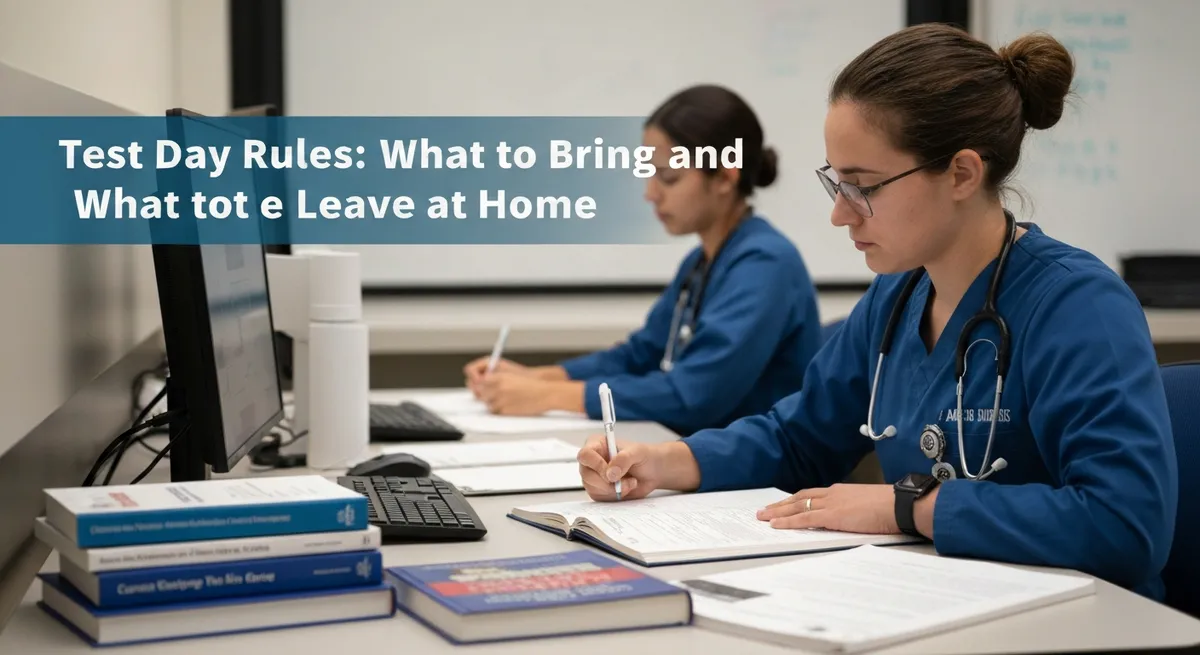
Test Day Rules: What to Bring and What to Leave at Home
Arriving prepared for your ASVAB test day means knowing exactly what to bring and, just as importantly, what to leave behind. The rules are strict and non-negotiable, designed to ensure a standardized and secure testing environment for all applicants. Failure to comply can result in being turned away from the testing center.
The single most critical item you must bring is a valid, government-issued photo ID. This can typically be a driver's license, state identification card, or a U.S. Passport. Your name on the ID must exactly match the name on your registration. Your recruiter will provide you with a definitive list of all acceptable forms of identification; confirm with them before you leave for the test.
You are prohibited from bringing any personal items into the testing room. All of the following must be secured in a locker or left in your vehicle:
- Cell phones, smartwatches, fitness trackers, and all other electronic devices
- Bags, backpacks, purses, and wallets
- Books, notes, or any other reference materials
- Food, drinks, candy, or gum
- Hats, hoods, or non-religious head coverings
The testing center will provide everything you need to take the test. You will be given scratch paper and pencils to use for calculations. You cannot bring your own. This provided paper is especially crucial for subtests like Arithmetic Reasoning and Mathematics Knowledge. To master using it efficiently under time pressure, you should practice with targeted quizzes like the ASVAB Arithmetic Reasoning Test 3.
Finally, dress comfortably and in layers. Testing room temperatures can be unpredictable, and you don't want to be distracted by being too hot or too cold. Being physically comfortable allows you to focus mentally. The best way to reduce test day anxiety is to simulate the experience beforehand. Taking full-length comprehensive ASVAB practice tests gets you accustomed to the timing, format, and pressure of the real exam. Knowing the rules is a critical first step, but a complete strategy is needed for success. For a full breakdown of study tactics and test-taking tips, review our guide on how to pass the ASVAB exam.
Can You Use a Calculator on the ASVAB?
The direct answer to the question, can you use a calculator on the ASVAB?, is no. You are strictly prohibited from bringing a personal calculator into the testing room. This is one of the most critical rules to remember for test day, and it is enforced without exception at all Military Entrance Processing Stations (MEPS) and Military Entrance Test (MET) sites. Attempting to use any unauthorized electronic device, including a calculator, will result in the immediate invalidation of your test score.
The specific tools available depend on the version of the test you take. For the paper-and-pencil (P&P) ASVAB, you must perform every single calculation by hand. The testing center provides scratch paper and pencils specifically for this purpose. For the computer-adaptive test (CAT-ASVAB), the policy is slightly different. While your own calculator is still forbidden, the testing software may provide a very basic on-screen calculator for certain questions in the Arithmetic Reasoning (AR) and Mathematics Knowledge (MK) subtests. This is typically a simple four-function calculator (add, subtract, multiply, divide). However, its availability is not guaranteed for every problem, so you must not rely on it being there.
The math sections of the ASVAB are specifically designed to evaluate your mental math abilities and your foundational problem-solving skills without technological assistance. The military needs to assess your aptitude for performing these calculations accurately under pressure. Therefore, your study strategy must reflect the test's conditions. Every time you practice for the AR and MK subtests, do so without a calculator. Focus on mastering long multiplication and division, operations with fractions and decimals, and solving algebraic expressions using only a pencil and paper. Building these manual calculation skills is not just recommended; it is essential for achieving a high score on these critical subtests.
ASVAB Pros and Cons
- +ASVAB has a defined, publicly available content blueprint — candidates know exactly what to prepare for
- +Multiple preparation pathways (self-study, courses, coaching) accommodate different learning styles and schedules
- +A growing ecosystem of study resources means candidates at any budget level can access quality preparation materials
- +Clear score reporting allows candidates to identify specific strengths and weaknesses for targeted remediation
- +Professional recognition associated with strong performance provides tangible career and academic benefits
- −The scope of tested content requires substantial preparation time that competes with existing professional or academic commitments
- −No single resource covers the full content scope — candidates typically need multiple study tools for comprehensive preparation
- −Test anxiety and exam-day performance variability mean preparation effort does not always translate linearly to scores
- −Registration, preparation, and potential retake costs accumulate into a significant financial investment
- −Content and format can change between exam versions, making older preparation materials less reliable
Sample ASVAB - Armed Services Vocational Aptitude Battery Practice Questions
Try these questions from our free ASVAB - Armed Services Vocational Aptitude Battery practice tests. The correct answer and an explanation follow each question.
A soldier runs 4 miles in 32 minutes. At this pace, how many minutes would it take to run 10 miles?
- A. 80 minutes
- B. 70 minutes
- C. 90 minutes
- D. 75 minutes
Answer: A. 80 minutes
Pace is 32 ÷ 4 = 8 minutes per mile; 10 miles × 8 min/mile = 80 minutes.
If a man uses 200 N of force over a distance of 50 meters, how many joules of work are performed?
- A. 1,000
- B. 5,000
- C. 10,000
- D. 20,000
Answer: C. 10,000
Work is a measure of energy transferred when a force causes displacement. It is calculated by multiplying the force applied by the distance over which the force acts (Work = Force × Distance). In this scenario, a force of 200 Newtons (N) applied over a distance of 50 meters (m) results in 200 N × 50 m = 10,000 Joules (J) of work performed.
If a car uses 4 gallons of gas to travel 120 miles, how many gallons are needed to travel 300 miles?
- A. 10 gallons
- B. 8 gallons
- C. 12 gallons
- D. 15 gallons
Answer: A. 10 gallons
The car gets 120 ÷ 4 = 30 miles per gallon. For 300 miles: 300 ÷ 30 = 10 gallons.
In a purely inductive AC circuit, the current lags the voltage by how many degrees?
- A. 0°
- B. 45°
- C. 90°
- D. 180°
Answer: C. 90°
In a purely inductive circuit, the inductor causes current to lag the applied voltage by exactly 90 degrees.
Take the full ASVAB - Armed Services Vocational Aptitude Battery practice test
ASVAB Questions and Answers
More ASVAB - Armed Services Vocational Aptitude Battery Resources
ASVAB PiCAT

How to Pass the ASVAB Exam in 2026 — Complete Study Guide
ASVAB Scores
ASVAB Practice Test Video Answers

SIFT Exam Guide: ASVAB Word Knowledge, Scoring, and Army Requirements

ASVAB - Armed Services Vocational Aptitude Battery: Complete Study Guide 2026
How this page was made: written with AI tools. Exam facts are checked against the official sources listed below. Not reviewed by a subject-matter expert. Editorial policy
Sources & references
Exam facts on this page (fees, format, dates, passing scores) are checked against these official sources; the date is our last check. Editorial policy
- officialasvab.com — Score validity, test delivery, eligibility, score release, retake policy, passing score, exam format, time limit · verified Oct 2026
- prod-media.asvabprogram.com — Eligibility · verified Oct 2026