
ASVAB Scores: Complete Guide to Understanding Your Military Test Results
Pass the ASVAB Scores: 🔎 Complete Guide to exam with confidence. Practice questions with detailed explanations and instant feedback on every answer.

ASVAB Practice Test Questions
Prepare for the ASVAB - Armed Services Vocational Aptitude Battery exam with our free practice test modules. Each quiz covers key topics to help you pass on your first try.
ASVAB Arithmetic Reasoning Test
ASVAB Exam Questions covering Arithmetic Reasoning Test. Master ASVAB Test concepts for certification prep.
ASVAB Arithmetic Reasoning Word Problems
Free ASVAB Practice Test featuring Arithmetic Reasoning Word Problems. Improve your ASVAB Exam score with mock test prep.
ASVAB Assembling Objects Test
ASVAB Mock Exam on Assembling Objects Test. ASVAB Study Guide questions to pass on your first try.
ASVAB Automotive Information Test
ASVAB Test Prep for Automotive Information Test. Practice ASVAB Quiz questions and boost your score.
ASVAB Electronics Fundamentals and Circuits
ASVAB Questions and Answers on Electronics Fundamentals and Circuits. Free ASVAB practice for exam readiness.
ASVAB Electronics Practice Test
ASVAB Mock Test covering Electronics Practice Test. Online ASVAB Test practice with instant feedback.
ASVAB Electronics Practice Test 1
Free ASVAB Quiz on Electronics Practice Test 1. ASVAB Exam prep questions with detailed explanations.
ASVAB General Science Biology and Ecology
ASVAB Practice Questions for General Science Biology and Ecology. Build confidence for your ASVAB certification exam.
ASVAB General Science Practice Test
ASVAB Test Online for General Science Practice Test. Free practice with instant results and feedback.
ASVAB General Science Practice Test 1
ASVAB Study Material on General Science Practice Test 1. Prepare effectively with real exam-style questions.
ASVAB Mathematics Knowledge Test
Free ASVAB Test covering Mathematics Knowledge Test. Practice and track your ASVAB exam readiness.
ASVAB Mechanical Comprehension Principles
ASVAB Exam Questions covering Mechanical Comprehension Principles. Master ASVAB Test concepts for certification prep.
ASVAB Mechanical Comprehension Test
Free ASVAB Practice Test featuring Mechanical Comprehension Test. Improve your ASVAB Exam score with mock test prep.
ASVAB Paragraph Comprehension and Inference
ASVAB Mock Exam on Paragraph Comprehension and Inference. ASVAB Study Guide questions to pass on your first try.
ASVAB Paragraph Comprehension Test
ASVAB Test Prep for Paragraph Comprehension Test. Practice ASVAB Quiz questions and boost your score.

The ASVAB measures your aptitudes across four domains: Verbal, Math, Science and Technical, and Spatial. Each of the nine subtests evaluates specific knowledge and skills that translate directly to military career requirements. Understanding what each section measures helps you identify your strengths and target areas for improvement when preparing for your ASVAB practice test with score results.
The verbal domain includes Word Knowledge (WK), which tests vocabulary and word meanings, and Paragraph Comprehension (PC), which assesses your ability to extract information from written passages. These sections directly impact your AFQT score and are critical for roles requiring strong communication skills.
| Subtest | Abbreviation | What It Measures |
|---|---|---|
| General Science | GS | Knowledge of physical, earth, and biological sciences |
| Arithmetic Reasoning | AR | Ability to solve word problems using math |
| Word Knowledge | WK | Understanding of word meanings and vocabulary |
| Paragraph Comprehension | PC | Ability to obtain information from written material |
| Mathematics Knowledge | MK | Knowledge of math concepts and applications |
| Electronics Information | EI | Understanding of electrical systems and concepts |
| Auto & Shop Information | AS | Knowledge of automotive and shop practices |
| Mechanical Comprehension | MC | Understanding of mechanical and physical principles |
| Assembling Objects | AO | Spatial relationship and visualization skills |
The math domain consists of Arithmetic Reasoning (AR) and Mathematics Knowledge (MK). AR presents real-world math problems in word format, while MK focuses on mathematical concepts including algebra and geometry. Both contribute to your AFQT score and are essential for technical career fields. A strong GT score opens doors to intelligence and technical specialties.
Technical aptitude is measured through General Science (GS), Electronics Information (EI), Auto & Shop Information (AS), and Mechanical Comprehension (MC). These subtests determine your qualification for hands-on careers in engineering, maintenance, and technical operations. The Assembling Objects (AO) subtest evaluates spatial reasoning—your ability to visualize how objects connect and relate in space. For those interested in Marine Corps careers, taking a Marine ASVAB practice test helps you understand the specific ASVAB requirements needed.
Air Force pilot candidates can prepare for the aviation selection instrument with our free TBAS Test of Basic Aviation Skills practice test — covering psychomotor coordination, complex tracking, and aviation interest.
Army helicopter pilot candidates can prepare for the Selection Instrument for Flight Training with our free SIFT Army helicopter pilot selection test practice — covering simple drawings, hidden figures, aviation information, spatial apperception, and reading comprehension.
Our free ELPT English Language Proficiency Test practice covers listening, reading, writing, and speaking components used in military and government English proficiency screening programs.
If you want more targeted practice, the meps test page covers the same material with additional questions and explanations.
The ASVAB exam uses a multiple-choice format with questions covering all major domains. Most versions allow 2-3 hours for completion.
Questions test both knowledge recall and application skills. A score of 70-75% is typically required to pass.
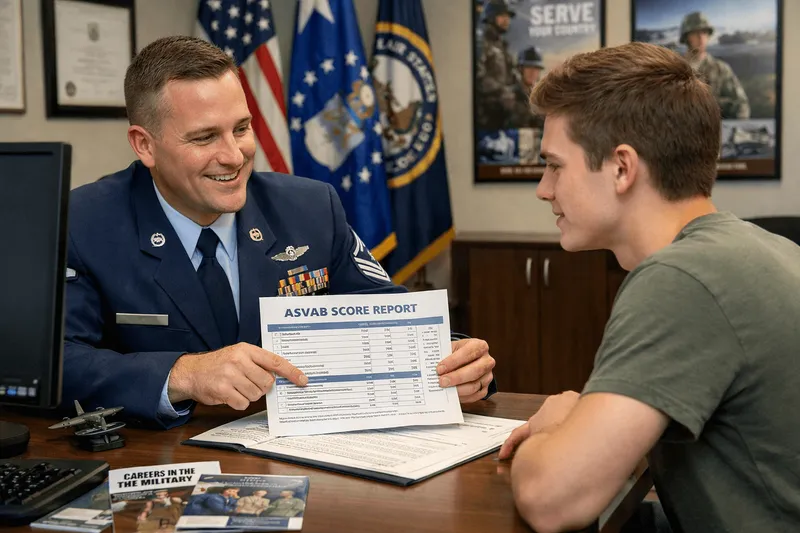
What Makes a Good ASVAB Score
Defining a good ASVAB score depends entirely on your military goals. While meeting the minimum ASVAB score for your branch gets you through the door, higher scores unlock better opportunities, including preferred career fields, enlistment bonuses, and specialized training programs. The average ASVAB score is 50, placing you squarely in the middle of all test-takers. Aiming for the highest ASVAB score possible maximizes your options.
Scores in the 50-70 range make you competitive for most military jobs and qualify you for the majority of career fields. Achieving a score of 70 or above opens nearly all doors, including high-demand technical specialties and intelligence positions. Elite scores of 90+ may qualify you for special programs, advanced training opportunities, and significant enlistment bonuses. Even a lowest ASVAB score that meets branch minimums allows enlistment, but higher scores mean more choices.
Focus your study efforts on the four AFQT subtests first (AR, MK, WK, PC), as these determine your enlistment eligibility. Use an ASVAB GT practice test to strengthen your General Technical score for intelligence and technical careers. Once you've mastered these, target the technical subtests that align with your desired military career field.
Turning Your ASVAB Scores Into Military Success
Your ASVAB scores represent more than just numbers on a page—they're the foundation of your military career pathway. By understanding the distinction between your AFQT score (which determines basic eligibility) and your composite line scores like the GT score (which open doors to specific careers), you can strategically position yourself for success in your chosen branch.
Remember that these scores reflect your potential for learning and growth, not just what you already know. The military invests heavily in training, so recruiters look for candidates who demonstrate strong aptitudes that can be developed further. Whether you're eyeing a technical career in electronics, a role in healthcare, or a position in intelligence, there's a path waiting for qualified candidates who meet the ASVAB requirements.
- Army Minimum AFQT31
- Navy Minimum AFQT35
- Air Force Minimum AFQT36
- Marines Minimum AFQT32
- Coast Guard Minimum AFQT40
Take the time to understand your score report thoroughly, discuss your results with a recruiter, and consider retesting if your scores don't reflect your true potential. Meeting the ASVAB score requirements for your desired branch and career field opens doors to incredible opportunities. Your military career is waiting—and it all begins with achieving a good ASVAB score on the ASVAB.
- ✓Review the official ASVAB exam content outline
- ✓Take a diagnostic practice test to identify weak areas
- ✓Create a study schedule (4-8 weeks recommended)
- ✓Focus on your weakest domains first
- ✓Complete at least 3 full-length practice exams
- ✓Review all incorrect answers with detailed explanations
- ✓Take a final practice test 1 week before exam day

ASVAB: Pros and Cons
- +ASVAB exam preparation strengthens your knowledge across all domains
- +Passing the exam proves competency to employers and clients
- +Study materials and practice tests are widely available
- +Exam-based credentials are portable across states and employers
- +Clear exam objectives help focus your study plan effectively
- −Exam anxiety can affect performance — practice tests help reduce it
- −Registration fees are non-refundable if you miss your test date
- −Limited retake opportunities may apply with waiting periods
- −Exam content updates periodically — use current study materials
- −Testing center availability may require advance scheduling
Sample ASVAB - Armed Services Vocational Aptitude Battery Practice Questions
Try these questions from our free ASVAB - Armed Services Vocational Aptitude Battery practice tests. The correct answer and an explanation follow each question.
When assembling a puzzle, a piece with a straight left edge is placed next to a piece with a straight right edge. What is the expected result?
- A. The two straight edges form a seamless flat junction
- B. The pieces overlap along the straight edges
- C. A gap appears between the two straight edges
- D. The pieces form a right angle at the junction
Answer: A. The two straight edges form a seamless flat junction
Two straight matching edges fit flush together with no gap or overlap.
A flat shape is folded along a dashed center line so that the left half lands exactly on the right half. The result is a shape half the width of the original. If the original was a rectangle 8 cm wide and 5 cm tall, what are the dimensions of the folded shape?
- A. 4 cm wide and 5 cm tall
- B. 8 cm wide and 2.5 cm tall
- C. 4 cm wide and 10 cm tall
- D. 2 cm wide and 5 cm tall
Answer: A. 4 cm wide and 5 cm tall
Folding along the vertical center halves the width (8÷2=4 cm) while the height stays the same at 5 cm.
A military base has 240 soldiers. If 15% are reassigned to another post, how many soldiers remain?
- A. 36
- B. 180
- C. 204
- D. 225
Answer: C. 204
15% of 240 = 0.15 × 240 = 36 soldiers reassigned. Remaining: 240 - 36 = 204 soldiers.
Two identical right-isosceles triangles are shown separately. When their hypotenuses are placed together, the result is:
- A. A larger right-isosceles triangle
- B. A square
- C. A pentagon
- D. A parallelogram
Answer: B. A square
Two congruent right-isosceles triangles joined hypotenuse-to-hypotenuse form a square.
Take the full ASVAB - Armed Services Vocational Aptitude Battery practice test
ASVAB Questions and Answers
About the Author
Retired Military Officer & Armed Forces Test Preparation Specialist
United States Army War CollegeColonel Steven Harris (Ret.) served 28 years in the US Army, earning a Master of Arts in Military Science from the Army War College and a Bachelor of Science in Criminal Justice. He has coached thousands of military enlistment and officer candidate program applicants through the ASVAB, AFQT, AFCT, OAR, and officer selection assessment processes across all military branches.
Join the Discussion
Connect with other students preparing for this exam. Share tips, ask questions, and get advice from people who have been there.
View discussion (5 replies)