
Home Health Aide Training Online: Complete 2026 October Guide to Certification, Cost, and Career Launch
Home health aide training online: certification steps, cost, state requirements, hha exchange login tips, and how to pass your HHA exam in 2026 October. 🏆
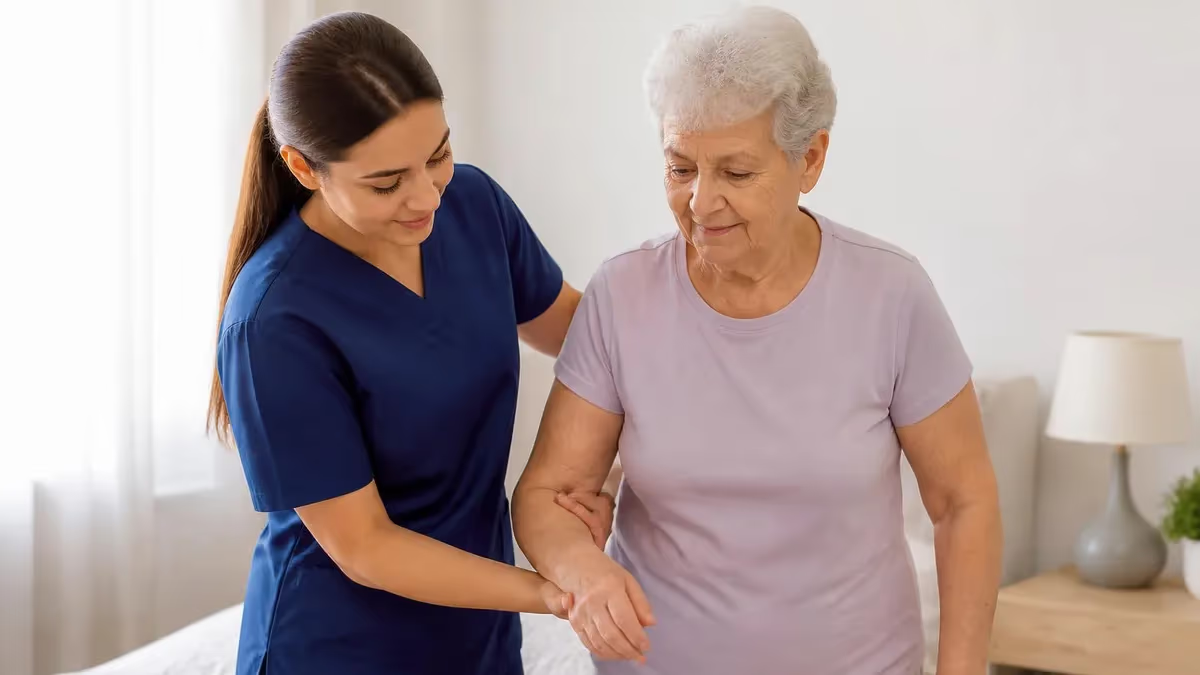
Home health aide training online has become the fastest, most affordable on-ramp into one of the most stable healthcare careers in the United States. With the Bureau of Labor Statistics projecting roughly 21% growth in home health and personal care aide jobs through 2033, hundreds of thousands of new positions will open every year — and most states now permit a hybrid model where lectures, reading, and quizzes happen online while clinical skills are verified in person.
If you can commit 75 to 120 hours over four to twelve weeks, you can finish coursework from your laptop and walk into a paid caregiving role.
This guide is written for the adult learner who wants a clear, no-fluff roadmap. We will cover federal requirements, state-by-state variations, accredited online programs, total out-of-pocket cost, what the competency exam actually looks like, and how to land your first job after certification. We will also explain how scheduling platforms like hha exchange fit into your daily work once you are hired, because understanding the tools agencies use is part of being employable.
The phrase "home health aide" carries legal weight under the Centers for Medicare and Medicaid Services (CMS). To bill Medicare for an aide's visit, an agency must employ someone who has completed at least 75 hours of approved training, passed a competency evaluation, and appears on the state nurse aide registry. Many states stack additional hours on top of that federal floor — New York requires 75 hours plus state-specific modules, California requires 120, and Washington requires 75 with continuing education each year. Online coursework is accepted in nearly every state for the didactic portion.
The economics are compelling. Average tuition for a fully accredited online HHA program ranges from $0 (employer-sponsored) to about $1,300 (private vocational schools). Wages have climbed sharply since 2021: the national median is now about $16.50 per hour, and metro areas like Boston, Seattle, Minneapolis, and the New York City suburbs routinely pay $19 to $24 per hour, often with shift differentials, mileage reimbursement, and health benefits for full-time staff.
Online training works particularly well for career-changers, parents returning to work, and people testing whether nursing is a fit before committing to LPN or RN school. The flexibility lets you keep your current job, and the credential stacks: nearly every CNA, LPN, and RN program in the country will count HHA hours toward prerequisite clinical exposure or waive entry assessments for certified aides.
By the end of this article you will know which programs are legitimate, what to budget, how long it really takes, and exactly which skills the state evaluator will ask you to demonstrate. You will also have a study plan, free practice quizzes, and a checklist you can print and tape to your fridge. Let us begin with the numbers that define the field in 2026.
Home Health Aide Training Online by the Numbers
Federal & State Training Requirements
At least 75 hours of training including 16 hours of supervised practical instruction. Coursework must cover communication, infection control, body mechanics, nutrition, ADLs, and emergency response before unsupervised patient contact.
States can require more. California (120 hrs), New York (75 + state modules), Maryland (100), Washington (75 + 12 CE annually). Always verify with your state's Department of Health before paying tuition.
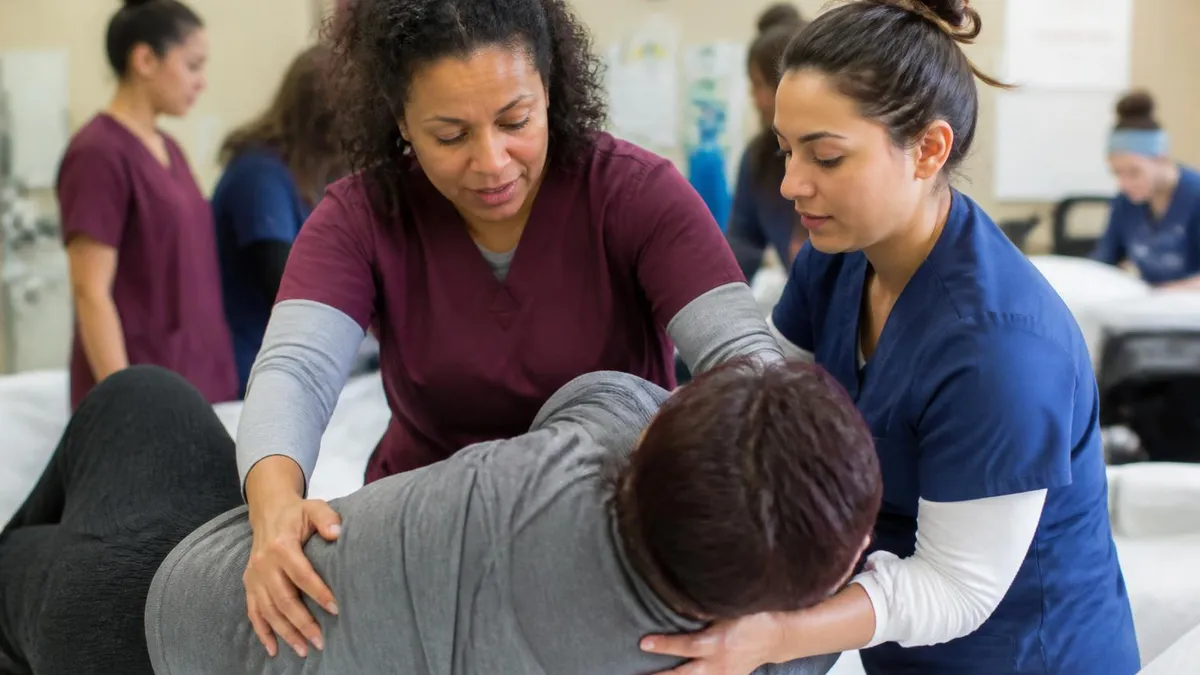
Roughly 59 hours of theory can be completed online in nearly every state. The remaining 16 hours of hands-on lab — bed baths, transfers, vital signs — must be performed in person under an RN's supervision.
After training you must pass a written exam (50–100 multiple-choice questions) and a skills demonstration scored by an RN. Most states require an 80% pass on the written portion and zero critical errors on skills.
Once you pass, your name is added to the state nurse aide registry. Employers are legally required to verify registry status before hiring, and your certification typically renews every two years with 12–48 hours of continuing education.
Online HHA programs are built around a learning management system (LMS) that delivers video lectures, readings, interactive simulations, and chapter quizzes. Most reputable schools use Canvas, Moodle, or a proprietary platform that tracks every minute you spend logged in — important because state regulators audit clock hours. You cannot simply skim and pass; the system pauses videos if you switch tabs, locks quizzes until you finish required modules, and timestamps your activity for the final transcript.
A typical week looks like this: you log in, watch 60 to 90 minutes of video on a topic such as infection control or assisting with ambulation, complete a 10-question knowledge check, read an assigned chapter from a textbook like Hartman's Home Health Aide Handbook, and submit a short reflection. Cohort-based programs add weekly Zoom sessions with an RN instructor where you can ask questions, review case studies, and prepare for the skills exam. Self-paced programs let you compress this into nights and weekends.
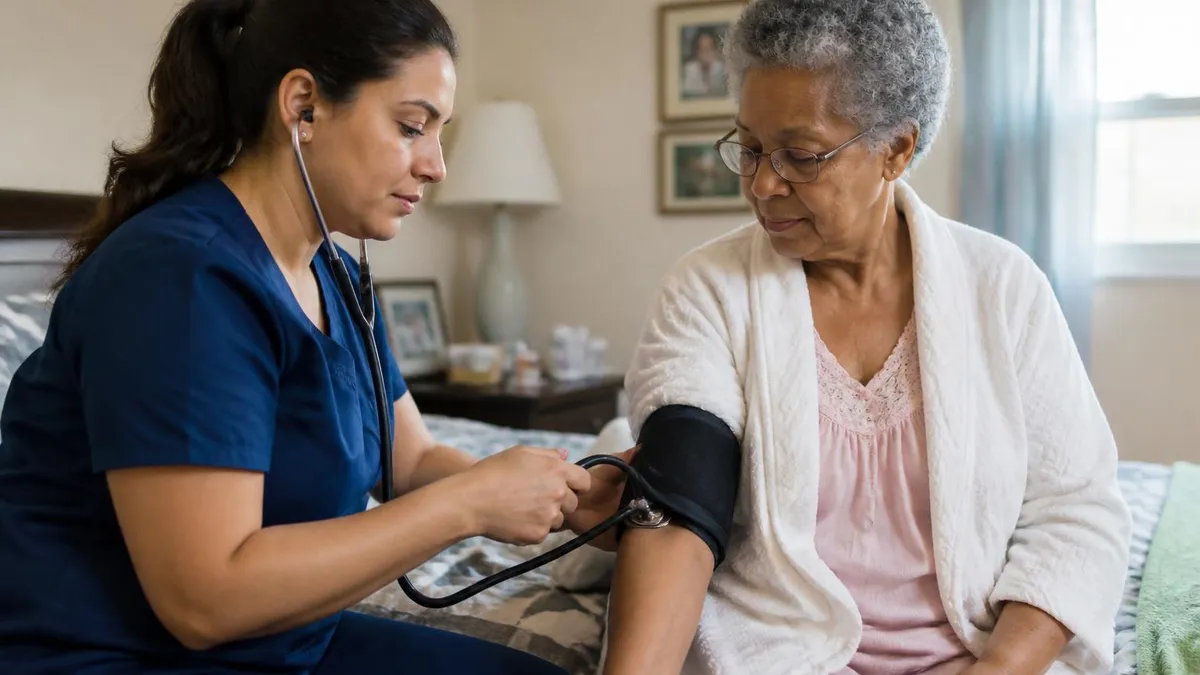
The hands-on clinical hours are where online training stops being online. Programs partner with local skilled nursing facilities, home health agencies, or vocational school labs so you can practice the 22 to 25 skills CMS requires. Expect to demonstrate hand hygiene, donning and doffing PPE, taking radial and apical pulses, blood pressure with a manual cuff, transferring a patient from bed to wheelchair, perineal care, and feeding assistance. An RN signs off on each skill as you master it.
Once hired, you will likely use an electronic visit verification (EVV) system every shift. The most widely deployed in Medicaid-funded home care is hha exchange login, which agencies use to schedule visits, document care, and confirm that you were physically present at the client's home. Your training program may not cover this software directly, but learning the workflow during orientation takes most new aides less than two hours.
Accreditation matters more than marketing. The gold standard is approval by your state's Department of Health or Department of Public Health, which appears on a published list of approved training programs. National accreditors like the National Association for Home Care and Hospice (NAHC) and the Accrediting Bureau of Health Education Schools (ABHES) add a layer of quality assurance, but state approval is what makes you eligible to sit for the competency exam. Always verify the school is on your state's list before paying.
Beware of programs that promise certification "in 7 days" or charge only $49. Federal law requires a minimum of 75 documented hours; no legitimate program can compress that into a week, and no state will accept a transcript from a school not on its approved list. If a program will not name the state agency that approved it, walk away. The investment in a real program pays itself back within your first month on the job.
Finally, factor in your computer setup. You need a reliable laptop or desktop with a webcam (some final exams are proctored), a stable internet connection of at least 10 Mbps, headphones for lecture audio, and a quiet space. Tablets and phones often cannot run the proctoring software. Public library computers will not work because they block the required browser extensions. Budget around $300 for a refurbished Chromebook if you do not already own a device.
HHA Practice Test Questions
Prepare for the HHA - Home Health Aide exam with our free practice test modules. Each quiz covers key topics to help you pass on your first try.
HHA Basic Care and Comfort
HHA Exam Questions covering Basic Care and Comfort. Master HHA Test concepts for certification prep.
HHA Basic Care and Comfort Questions and A...
Free HHA Practice Test featuring Basic Care and Comfort Questions and Answers. Improve your HHA Exam score with mock test prep.
HHA Communication and Interpersonal Skills
HHA Mock Exam on Communication and Interpersonal Skills. HHA Study Guide questions to pass on your first try.
HHA Communication and Interpersonal Skills...
HHA Test Prep for Communication and Interpersonal Skills Questions and Answers. Practice HHA Quiz questions and boost your score.
HHA Infection Control and Safety
HHA Questions and Answers on Infection Control and Safety. Free HHA practice for exam readiness.
HHA Infection Control and Safety Questions...
HHA Mock Test covering Infection Control and Safety Questions and Answers. Online HHA Test practice with instant feedback.
HHA Mental and Emotional Support
Free HHA Quiz on Mental and Emotional Support. HHA Exam prep questions with detailed explanations.
HHA Mental and Emotional Support Questions...
HHA Practice Questions for Mental and Emotional Support Questions and Answers. Build confidence for your HHA certification exam.
HHA Mobility and Transfer Techniques
HHA Test Online for Mobility and Transfer Techniques. Free practice with instant results and feedback.
HHA Mobility and Transfer Techniques Quest...
HHA Study Material on Mobility and Transfer Techniques Questions and Answers. Prepare effectively with real exam-style questions.
HHA Nutrition and Hydration
Free HHA Test covering Nutrition and Hydration. Practice and track your HHA exam readiness.
HHA Nutrition and Hydration Questions and ...
HHA Exam Questions covering Nutrition and Hydration Questions and Answers. Master HHA Test concepts for certification prep.
HHA Observation and Reporting
Free HHA Practice Test featuring Observation and Reporting. Improve your HHA Exam score with mock test prep.
HHA Observation and Reporting Questions an...
HHA Mock Exam on Observation and Reporting Questions and Answers. HHA Study Guide questions to pass on your first try.
HHA Patient Rights and Ethics
HHA Test Prep for Patient Rights and Ethics. Practice HHA Quiz questions and boost your score.
HHA Patient Rights and Ethics Questions an...
HHA Questions and Answers on Patient Rights and Ethics Questions and Answers. Free HHA practice for exam readiness.
HHA Personal Care and Hygiene
HHA Mock Test covering Personal Care and Hygiene. Online HHA Test practice with instant feedback.
HHA Personal Care and Hygiene Questions an...
Free HHA Quiz on Personal Care and Hygiene Questions and Answers. HHA Exam prep questions with detailed explanations.
HHA Home Health Aide Certification Practic...
HHA Practice Questions for Home Health Aide Certification Practice Test. Build confidence for your HHA certification exam.
HHA Home Health Aide Certification Practic...
HHA Test Online for Home Health Aide Certification Practice Test #1. Free practice with instant results and feedback.
HHA Home Health Aide Certification Practic...
HHA Study Material on Home Health Aide Certification Practice Test #2. Prepare effectively with real exam-style questions.
HHA Home Health Aide Certification Practic...
Free HHA Test covering Home Health Aide Certification Practice Test #3. Practice and track your HHA exam readiness.
HHA Home Health Aide Certification Practic...
HHA Exam Questions covering Home Health Aide Certification Practice Test #4. Master HHA Test concepts for certification prep.
HHA HOME HEALTH AIDE COMPETENCY TEST
Free HHA Practice Test featuring HOME HEALTH AIDE COMPETENCY TEST. Improve your HHA Exam score with mock test prep.
HHA HOME HEALTH AIDE COMPETENCY TEST #1
HHA Mock Exam on HOME HEALTH AIDE COMPETENCY TEST #1. HHA Study Guide questions to pass on your first try.
HHA Home Health Aide Competency Test
HHA Test Prep for Home Health Aide Competency Test. Practice HHA Quiz questions and boost your score.
HHA Home Health Aide Competency Test #2
HHA Questions and Answers on Home Health Aide Competency Test #2. Free HHA practice for exam readiness.
Choosing the Right Home Health Aide Training Program
National providers like American Caregiver Association, CareAcademy, and Red Cross offer state-approved online HHA training in most jurisdictions. Tuition runs $300 to $900, and the curriculum is built to CMS specifications. Look for programs that publish their state approval numbers, list named RN instructors, and disclose pass rates on the competency exam.
Community colleges remain the most affordable accredited option. A typical community college HHA certificate costs $400 to $700 in tuition, qualifies for Pell Grants, and often articulates directly into a CNA or LPN program. The downside is rigid scheduling — most community college HHA tracks meet on a fixed cohort calendar rather than open enrollment.
Pros and Cons of Online HHA Training
- +Flexible schedule lets you keep current job or care for family
- +Significantly cheaper than traditional vocational school
- +Lectures can be rewatched as many times as needed
- +Faster start dates — many programs have weekly open enrollment
- +Builds tech skills useful for EVV systems and electronic charting
- +Same state-approved certification as in-person programs
- +Easier to compare programs side-by-side using published reviews
- −Requires self-discipline and a quiet study environment
- −In-person clinical hours still required — must arrange locally
- −Limited peer networking compared with cohort programs
- −Some employers prefer traditional CNA-bridge candidates
- −Technology problems can delay coursework completion
- −Online proctoring can feel intrusive during final exams
- −Not all states accept fully online didactic from every school
Pros and Cons at a Glance
| Pros | Cons |
|---|---|
| Flexible schedule lets you keep current job or care for family | Requires self-discipline and a quiet study environment |
| Significantly cheaper than traditional vocational school | In-person clinical hours still required — must arrange locally |
| Lectures can be rewatched as many times as needed | Limited peer networking compared with cohort programs |
| Faster start dates — many programs have weekly open enrollment | Some employers prefer traditional CNA-bridge candidates |
| Builds tech skills useful for EVV systems and electronic charting | Technology problems can delay coursework completion |
| Same state-approved certification as in-person programs | Online proctoring can feel intrusive during final exams |
Home Health Aide Certification Checklist
- ✓Confirm your state's required hours (75 federal minimum, often more)
- ✓Verify your chosen program is on your state's approved provider list
- ✓Gather ID, high school diploma or equivalent, and proof of immunizations
- ✓Complete required background check and fingerprinting through your state
- ✓Pass a TB test and provide current physical exam documentation
- ✓Finish all online modules and chapter quizzes within program deadline
- ✓Attend every scheduled in-person clinical lab session — no skipped hours
- ✓Pass the written competency exam at 80% or higher on first attempt
- ✓Demonstrate all required skills under RN observation without critical errors
- ✓Register on your state's nurse aide registry within 30 days of passing
Always verify state approval before paying tuition
Every state's Department of Health publishes a current list of approved nurse aide training programs. Search "[your state] approved nurse aide training programs" and look for a .gov result. If the school you are considering is not on that list, your training hours will not count toward certification — no matter how legitimate the program looks online.
Total out-of-pocket cost for HHA certification breaks down into five categories: tuition, supplies, background check, exam fees, and registry placement. Tuition is the largest line item and ranges from $0 for employer-sponsored programs to about $1,300 for premium online vocational schools. The median learner in 2026 spends roughly $650 on tuition through a community college or mid-tier online provider.
Supplies run $40 to $150. You will need a textbook (often included), a gait belt for transfer practice, a manual blood pressure cuff and stethoscope for skills lab, and a digital thermometer. Some schools include a starter kit; others let you bring your own. A reliable nursing watch with a second hand is essential for taking pulses and respirations during the skills exam — analog watches with smooth sweep hands are easier to read than digital displays.
Background checks vary wildly by state. Texas charges about $40, New York runs $99, California is $74 for fingerprinting plus $25 for the state portion. Most states use IdentoGO or Fieldprint, and results take 7 to 21 days. Start this paperwork the day you enroll because slow background checks are the single most common cause of delayed certification.
The competency exam itself costs $80 to $150 in most states, paid directly to the testing vendor (Prometric, Pearson VUE, or Headmaster). The fee covers both the written and skills portions. If you fail one part you usually only retest that section, but each retake is another $40 to $75. Registry placement is often free or bundled into the exam fee.
Financial aid is more available than most students realize. Pell Grants cover community college programs for anyone meeting income limits. Workforce Innovation and Opportunity Act (WIOA) funds run through American Job Centers and can cover the entire cost for unemployed or underemployed adults — call your local center and ask specifically about Eligible Training Provider Lists. State Medicaid programs in 12 states reimburse HHA tuition for aides who commit to working with Medicaid clients for 12 months.
Return on investment is fast. At $16.50 per hour and 30 hours weekly, a new HHA grosses about $25,000 in year one. Subtract program cost ($650 median) and you net roughly $24,350 — a 37x return on tuition before tax. Many aides work overtime, take weekend differentials, or pick up extra hours through the hha staffing platforms used by their agency to push annual earnings above $35,000.
Beyond direct wages, certification opens doors. Hospitals hire certified aides as patient care technicians at $18 to $22 per hour. Assisted living facilities pay $17 to $20 with full benefits. Hospice agencies often offer the highest base rates, plus mileage and shift bonuses. Aides who stack a CNA credential on top of HHA — usually only 50 extra hours of training — typically jump $2 to $4 per hour immediately.
If a website promises HHA certification in 3 days for $49 with no clinical hours, it is not legitimate. Federal law requires a minimum of 75 documented training hours including 16 supervised clinical hours. Programs that bypass these requirements will leave you with a worthless certificate and no path onto the state registry — and no agency will hire you. Always verify state approval before paying anything.
Finishing training is only the first half of the journey. The second half — landing a job you actually want — starts before you take the competency exam. Most successful HHAs apply to three to five agencies during their final week of class, schedule interviews for the week after the exam, and start their first paid shift within ten to fourteen days of certification. Speed matters: agencies fill caseloads quickly and prefer aides whose training is fresh.
Start by mapping the agencies within a 25-minute drive of your home. Use Indeed, ZipRecruiter, and your state's job bank to identify Medicare-certified home health agencies, Medicaid-funded personal care providers, hospice companies, and private-pay caregiver registries. Each pays differently. Medicare agencies tend to offer the most structured benefits; Medicaid agencies have steady volume; private-pay clients often pay the highest hourly rates with the trade-off of less consistent hours.
Your resume should fit on one page. Lead with your certification, registry number, and date of expected or actual completion. Below that, list any caregiving experience — formal or informal. Caring for an aging parent, supervising children with special needs, or volunteering at a senior center all count and signal employability. Add a section for relevant coursework (medication safety, dementia care, infection control) and a brief skills line covering EVV systems, manual vital signs, and Hoyer lift operation.
Interview questions follow predictable patterns. Expect scenarios: "Your client refuses their morning shower — what do you do?" or "You arrive and the client has fallen in the bathroom — describe your response." Practice answers that demonstrate the chain of command (assess, reassure, notify the RN supervisor, document everything), respect for client autonomy, and adherence to your hha login agency's policies. Specifics from your clinical hours make answers credible.
Once hired, your first two weeks are orientation. You will shadow an experienced aide on at least two visits, complete agency-specific competencies on lifts and transfers, learn the EVV scheduling app, and review HIPAA, OSHA bloodborne pathogen, and abuse-reporting policies. Take orientation seriously — agencies use it to decide whether you go onto easy or complex caseloads and which schedule slots you get first.
Build a sustainable schedule from day one. Most new HHAs burn out fast by accepting every available shift. A more durable approach: target 28 to 32 hours of guaranteed weekly visits with one defined day off, then pick up extra shifts only when the rate is worth it. Track mileage with an app like MileIQ — at the 2026 IRS rate of 67 cents per mile, a typical home care aide deducts $2,000 to $4,000 per year in unreimbursed mileage, lowering taxable income substantially.
Finally, plan your next step from week one. HHA is an excellent career on its own, but it is also a launching pad. Roughly 40% of HHAs move into a CNA role within two years, and another 20% bridge into LPN school. Most employers offer tuition assistance for staff who pursue advanced credentials. Talk to your supervisor about an advancement plan during your 90-day review; this signals ambition and often unlocks paid education benefits you did not know existed.
The week before your competency exam is the highest-use time in your entire certification journey. Most failures do not come from lack of knowledge — they come from test-day anxiety, forgotten skill sequences, or simple mistakes like skipping hand hygiene before approaching the manikin. A focused seven-day prep plan can take a borderline student to a confident first-time pass.
Day one through three: drill the 22 required skills in front of a mirror or with a study partner. Say each step out loud. Evaluators score on observable behavior, not what you are thinking — if you wash your hands silently the proctor may mark you down for not announcing it. Practice the sequence: knock, identify yourself, identify the client, explain the procedure, wash hands, gather supplies, provide privacy, perform the skill, return the bed to low position, place the call light within reach, wash hands again, document.
Day four through five: take two full-length written practice tests under timed conditions. Aim for 50 questions in 60 minutes, then review every wrong answer and write a one-sentence explanation of the correct reasoning. The HHA exam favors questions about safety, infection control, reporting changes, abuse recognition, and basic anatomy. Memorize normal vital sign ranges cold: pulse 60–100, respirations 12–20, oral temperature 97.6–99.6, blood pressure under 120/80.
Day six: do a full dress rehearsal. Wear the scrubs you will wear on test day. Pack your watch, two pens, your ID, your testing confirmation email, and a printed copy of your training transcript. Drive to the testing location so you know parking and entry. Eat a normal dinner, set out clothes, and go to bed by 10 p.m. Do not cram new material — at this point, sleep matters more than study.
Day seven (exam day): eat a real breakfast with protein, arrive 30 minutes early, and silence your phone in your car. Take three slow breaths before each station. If you blank on a skill step, restart the sequence calmly from hand hygiene — evaluators score completion, not perfection, and self-correction is allowed. For the written portion, read every question fully before looking at answers, and trust your first instinct unless you find concrete evidence to change it.
After you pass, request your certificate and registry confirmation in writing immediately. Photograph both and store digital copies in your email. Agencies will ask for proof before scheduling you for a single visit, and registry website outages do happen. Having the confirmation on your phone has helped countless new aides start their first shift on time.
One final habit to start now: keep a small notebook for every shift. Jot down questions, unfamiliar conditions, medication names you do not recognize, and feedback from your supervising nurse. Review the notebook weekly and look up what you did not understand. This single habit is what separates aides who plateau at $16 per hour from those who advance to lead caregiver, CNA, and beyond within 18 months. Welcome to a career where curiosity compounds — your patients, your paycheck, and your future self will thank you.
Sample HHA Practice Questions
Try these questions from our free HHA practice tests. The correct answer and an explanation follow each question.
Enteral feeding (tube feeding) is within the home health aide's scope of practice to:
- A. Administer tube feeding independently after watching a nurse once
- B. Position the patient correctly and report any concerns, but initiation/management of tube feeding is performed by licensed nursing staff
- C. Adjust the feeding rate based on the patient's comfort
- D. Flush the tube with any available liquid
Answer: B. Position the patient correctly and report any concerns, but initiation/management of tube feeding is performed by licensed nursing staff
Administering or managing enteral feeding is a licensed nursing task. The HHA supports by positioning the patient properly and reporting observations, not managing the feeding itself.
Why is it important for a home health aide to respect the patient's wishes and preferences?
- A. It is unnecessary as long as the patient receives care.
- B. It helps the patient feel empowered and respected
- C. It is only necessary for elderly patients.
- D. It reduces the amount of care provided.
Answer: B. It helps the patient feel empowered and respected
Respecting a patient's wishes and preferences is crucial because it upholds their autonomy and dignity, allowing them to maintain control over their own life and care decisions. This approach empowers the patient, fostering a sense of respect and self-worth, which is vital for their emotional well-being. It also strengthens the therapeutic relationship and ensures care aligns with their personal values and goals.
A patient has a pressure ulcer on their coccyx. How often should the home health aide reposition them?
- A. Once every 8 hours
- B. Every 2 hours
- C. Once per shift
- D. Only when the patient requests it
Answer: B. Every 2 hours
Repositioning every 2 hours relieves sustained pressure on bony prominences, the primary cause of pressure ulcer formation and progression.
How does a home health aide ensure a safe environment for patients?
- A. By ignoring safety hazards and focusing on care.
- B. By checking for hazards and ensuring accessibility
- C. By allowing the patient to move freely without assistance.
- D. By leaving the patient unattended while working.
Answer: B. By checking for hazards and ensuring accessibility
A home health aide ensures safety by checking for hazards, such as clutter or wet floors, and by ensuring that the patient's living space is accessible and free of risks.
HHA Questions and Answers


About the Author

Registered Nurse & Healthcare Educator
Johns Hopkins University School of NursingDr. Sarah Mitchell is a board-certified registered nurse with over 15 years of clinical and academic experience. She completed her PhD in Nursing Science at Johns Hopkins University and has taught NCLEX preparation and clinical skills courses for nursing students across the United States. Her research focuses on evidence-based exam preparation strategies for healthcare certification candidates.
Join the Discussion
Connect with other students preparing for this exam. Share tips, ask questions, and get advice from people who have been there.
View discussion (8 replies)