
Ham Radio License vs GMRS: Does a Ham Radio License Cover GMRS? 2026
Does a ham radio license cover GMRS? Learn the key differences, frequencies, equipment rules, and how to get licensed for both. 🎯

One of the most common questions new enthusiasts ask when exploring two-way radio communication is: does a ham radio license cover GMRS? The short answer is no — a ham radio license and a GMRS license are two completely separate authorizations issued by the FCC, and one does not substitute for the other.
Understanding exactly why these two services exist independently, and what each one allows you to do, is essential before you invest in ham radio equipment or choose a radio service for your family or business. If you want to operate on GMRS frequencies, you need a dedicated GMRS license regardless of your amateur radio credentials.
Amateur radio — commonly called ham radio — is a broad, technically rich hobby and emergency-communications service that covers an enormous range of ham radio frequencies, from below 2 MHz all the way up to microwave bands above 300 GHz. The FCC grants Technician, General, and Amateur Extra licenses after written examinations, and each license class unlocks progressively more ham radio bands and operating privileges.
A Technician ticket, the entry-level credential, is the starting point for millions of operators in the United States. You can learn more about what is ham radio and why so many people find it invaluable for both everyday use and emergencies.
GMRS, or the General Mobile Radio Service, is a completely different radio service. It operates on a specific set of UHF channels clustered around 462 MHz and 467 MHz. Unlike amateur radio, GMRS is not intended for experimentation, third-party traffic beyond family use, or contact with foreign stations. It is a personal and family communications service — think repeaters at campgrounds, communication during hiking trips, or keeping in touch across a large property. A single GMRS license costs $35, covers the licensee and their immediate family members for ten years, and requires no examination whatsoever.
Many people conflate the two services because some ham radio equipment — particularly dual-band handheld radios — is physically capable of transmitting on GMRS channels. Hardware capability is not legal authorization. Transmitting on GMRS frequencies without a valid GMRS license is an FCC violation, regardless of whether you hold a ham radio license. The FCC treats each service separately under its own regulatory part: amateur radio falls under Part 97, while GMRS operates under Part 95. These rules differ significantly in terms of allowed power levels, repeater coordination, equipment certification requirements, and permitted communications.
For someone just beginning their journey into radio communications, the distinction matters enormously from a practical standpoint. Ham radio opens the door to a vast technical hobby with global reach, digital modes, satellite communication, and a vibrant community of experimenters. GMRS, by contrast, is simpler and family-friendly — no exam, relatively affordable radios, and a straightforward licensing process. Both services have genuine value, and many experienced operators hold both a ham license and a GMRS license simultaneously because the use cases complement each other rather than overlap.
The ham radio license test is structured around the FCC's question pool and covers topics such as operating procedures, ham radio frequencies, basic electronics, antenna theory, and FCC regulations. Passing the 35-question Technician exam with at least 26 correct answers earns you a call sign and operating privileges on most VHF and UHF amateur bands — plus some HF privileges on the 10-meter band.
Preparing thoroughly with practice questions and quality ham radio prep resources dramatically increases your odds of passing on the first attempt. Understanding the regulatory framework tested on that exam also helps you clearly grasp why GMRS is a separate matter entirely.
Throughout this article we will explore the specific frequency allocations, power limits, equipment rules, repeater access, and licensing procedures for both services side by side. By the end, you will have a complete picture of how ham radio and GMRS relate to each other, where they diverge, and how to build the most effective radio communication setup for your specific needs — whether that means pursuing one license, the other, or both.
Ham Radio vs GMRS by the Numbers

Ham Radio vs GMRS: Side-by-Side Comparison
Requires a written FCC exam at any license level. No fee for the license itself (though VEC testing fees apply). Covers dozens of frequency bands from shortwave through microwave. Allows experimentation, digital modes, satellite, and worldwide contacts.
No exam required — simply pay $35 online at the FCC. Covers immediate family members. Restricted to specific UHF channels near 462/467 MHz. Designed for local, family, and recreational communications rather than technical experimentation.
Some dual-band ham radios can physically tune GMRS channels, but transmitting without a GMRS license is illegal. Many operators hold both licenses to take full advantage of community repeaters, family comms, and the full amateur spectrum simultaneously.
GMRS radios must be FCC type-accepted for Part 95. Ham radios do not require type-acceptance — experimentally built gear is allowed under Part 97. Using a non-type-accepted radio on GMRS, even a high-quality ham radio, technically violates FCC rules.
Ham radio frequencies span an extraordinary range of the electromagnetic spectrum, and understanding that range is one of the most intellectually rewarding parts of becoming a licensed amateur operator.
The Technician license grants full privileges on all amateur bands above 50 MHz, which includes the popular 2-meter band (144–148 MHz) and the 70-centimeter band (420–450 MHz). These VHF and UHF allocations are where most new hams begin — they support local repeater networks, APRS packet radio, satellite communications, and even moonbounce experiments. A new ham will find the 2-meter band particularly vibrant because of the widespread repeater infrastructure maintained by local clubs across the country.
Beyond VHF and UHF, General and Amateur Extra license holders unlock access to the HF ham radio bands, which are the shortwave frequencies that enable long-distance and even intercontinental communication. The 40-meter band (7.0–7.3 MHz), 20-meter band (14.0–14.35 MHz), and 10-meter band (28.0–29.7 MHz) are especially popular for voice and digital contacts.
Technician licensees get limited phone privileges on 10 meters, which is enough to make some international contacts during good propagation conditions. The ability to communicate across thousands of miles with relatively modest ham radio equipment — sometimes just a low-power QRP radio and a wire antenna — is what captivates so many operators for life.
GMRS, by contrast, operates exclusively on a narrow slice of UHF spectrum. The primary GMRS simplex channels sit at 462.5625, 462.5875, 462.6125, 462.6375, 462.6625, 462.6875, and 462.7125 MHz, along with repeater output channels at those same frequencies paired with inputs 5 MHz higher on the 467 MHz side.
This deliberate design means GMRS is entirely local in character — without a repeater, typical GMRS range from a handheld unit is 1 to 5 miles in terrain. With a well-placed hilltop repeater, coverage can extend to 50 miles or more, which is genuinely useful for outdoor recreation and emergency preparedness within a community.
A common source of confusion involves FRS — the Family Radio Service. FRS radios are the inexpensive blister-pack walkie-talkies sold at retailers for around $20 to $40 a pair, and they share some frequencies with GMRS. FRS requires no license at all, but power is strictly limited to 2 watts on shared channels and 0.5 watts on FRS-only channels. GMRS allows up to 50 watts on its main channels, making GMRS-capable equipment significantly more powerful and able to support repeater links that FRS radios cannot access. Understanding the FRS/GMRS/ham triangle helps newcomers choose the right tool for each communication need.
For ham radio prep purposes, understanding frequency allocations is directly tested on the Technician exam. Questions cover the specific frequency ranges for each amateur band, which modes are allowed where within a band (the band plan), and how to identify sub-bands reserved for specific purposes such as CW-only segments or weak-signal calling frequencies.
The FCC's rules also specify maximum power levels for each band and license class: Technicians are limited to 1,500 watts PEP output in most cases, though practical station outputs are far more modest. Knowing these rules cold is essential for passing the exam on your first attempt. Resources like hro ham radio outlet can provide additional context on range and equipment selection for new operators.
One fascinating aspect of amateur radio frequency management is the concept of band plans — voluntary agreements within the amateur community that go beyond FCC minimums to keep different modes and activities organized within each band. For example, the lower portion of the 2-meter band is typically reserved for weak-signal SSB and CW work, while the upper portion hosts FM repeaters and simplex channels.
These conventions are not legally mandated but are widely respected because they make efficient use of the shared spectrum. Learning them early establishes good operating habits that experienced hams will appreciate when you get on the air.
Ham radio bands extend all the way into the microwave spectrum, with allocations at 1.2 GHz, 2.4 GHz, 5.8 GHz, 10 GHz, and beyond. These microwave bands are used for experimental wideband digital links, amateur television (ATV), and advanced propagation research. While most new Technician licensees focus on the 2-meter and 70-centimeter bands, knowing that the amateur service extends this far illustrates why ham radio is considered a technical service under Part 97 — the FCC expects licensed amateurs to advance the state of radio art, which requires access to a wide experimental canvas that GMRS could never provide.
Ham Radio Frequencies vs GMRS: Operating Rules Compared
Ham radio technician licensees gain access to all amateur bands above 50 MHz — including the 6-meter, 2-meter, 1.25-meter, and 70-centimeter bands — plus limited HF privileges on the 10-meter band. This covers dozens of sub-bands with allocations for FM voice, SSB, digital modes, satellite uplinks, and experimental work. The breadth of accessible spectrum is one of ham radio's defining advantages over any other personal radio service.
GMRS is confined to 16 channels between 462 MHz and 467 MHz. Eight primary channels handle simplex and repeater output, while eight interstitial channels shared with FRS offer additional simplex options at reduced power. There is no ability to expand beyond this narrow band regardless of your license class — GMRS has no tiered licensing, so every GMRS licensee has access to exactly the same channels from day one.

Ham Radio License vs GMRS License: Pros and Cons
- +Ham license unlocks 30+ frequency bands from shortwave through microwave
- +No exam required for GMRS — just pay $35 and your whole family is covered
- +Amateur radio supports global communication via HF propagation and satellites
- +GMRS repeaters are widely available at campgrounds, parks, and communities
- +Ham radio encourages technical experimentation and self-built equipment
- +GMRS license is valid for 10 years with a simple online renewal process
- −Ham radio requires passing a written exam covering regulations, electronics, and operating procedures
- −GMRS is limited to 16 channels clustered in a narrow UHF band only
- −Ham radio equipment can be expensive, especially for HF stations with antennas
- −GMRS does not allow contacts with unrelated third parties or foreign stations
- −Ham repeater access requires understanding CTCSS tones and local club customs
- −A ham radio license alone does NOT authorize you to operate on GMRS frequencies
Pros and Cons at a Glance
| Pros | Cons |
|---|---|
| Amateur radio supports global communication via HF propagation and satellites | Ham radio requires passing a written exam covering regulations, electronics, and operating procedures |
| GMRS repeaters are widely available at campgrounds, parks, and communities | Ham radio equipment can be expensive, especially for HF stations with antennas |
| Ham radio encourages technical experimentation and self-built equipment | GMRS does not allow contacts with unrelated third parties or foreign stations |
Licensing Checklist: Ham, GMRS, or Both?
- ✓Determine your primary use case: local family comms favor GMRS; wide-ranging technical hobby favors ham.
- ✓Register for the $35 GMRS license at the FCC Universal Licensing System (ULS) if no exam appeals to you.
- ✓Study the official FCC Technician question pool using a structured ham radio prep course or app.
- ✓Schedule your Technician exam through a local VEC-coordinated testing session or online proctored session.
- ✓Purchase FCC type-accepted equipment — check Part 95 certification for GMRS, any radio for ham.
- ✓Program your radio with local ham repeater frequencies and CTCSS tones from repeaterbook.com.
- ✓Program GMRS repeater channels and appropriate CTCSS/DCS codes for your region if using GMRS.
- ✓Join a local amateur radio club to access Elmer mentoring, club repeaters, and emergency-net training.
- ✓Check whether community GMRS networks exist in your area — many neighborhoods and parks maintain them.
- ✓Renew your ham license before it expires (10-year term) at the FCC ULS with zero fee.
- ✓Keep both licenses on file digitally and verify call signs are active at the FCC ULS lookup tool.
Many Experienced Operators Are Licensed for Both Services
A ham radio license and a GMRS license serve genuinely different purposes. Ham radio gives you the technical depth, global reach, and emergency-communications infrastructure of the amateur service. GMRS gives your entire immediate family simple, exam-free access to a reliable local radio network with repeater support. At just $35 for a 10-year family GMRS license, adding GMRS to your amateur credentials costs almost nothing and dramatically expands your practical communication options.
Repeaters are a central feature of both ham radio and GMRS, but the way each service coordinates and operates them differs in important ways that affect real-world range and utility. In the amateur service, repeaters are typically owned and operated by local clubs or individual hams, coordinated through regional frequency coordinators, and accessible to any licensed Technician or higher with the correct CTCSS or DCS tone programmed. Many ham repeaters are linked into wide-area networks using systems such as EchoLink, AllStar, D-STAR, System Fusion (Yaesu), or DMR talkgroups that extend effective range nationally and globally via internet linking.
GMRS repeaters operate under similar technical principles but within a more constrained regulatory framework. A GMRS repeater owner must be a licensed GMRS operator, and the repeater is typically available to other GMRS licensees in the area — either openly or with a programmed CTCSS code that the repeater owner publishes to the community.
GMRS repeater networks have grown significantly in recent years, with organizations like MyGMRS.com serving as a national repeater directory that lets users find repeaters in their area quickly. Some GMRS repeater networks are tied to neighborhood emergency preparedness groups, providing a family-friendly alternative to ham emergency nets.
The question of range is where ham radio and GMRS diverge most dramatically in practical use. With a modest 5-watt handheld radio and a rubber-duck antenna on the 2-meter band, a Technician can access a well-positioned repeater from 20 to 50 miles away under typical conditions.
HF operators with even a small wire antenna and 100 watts can make contacts across the country on the 40-meter band at night or thousands of miles on 20 meters during the day. Tropospheric ducting events on VHF can produce contacts of 1,000 miles or more with no special equipment — something that simply has no parallel in GMRS.
GMRS range with a handheld unit and no repeater is typically 1 to 5 miles in open terrain, dropping significantly in wooded or mountainous areas. A vehicle-mounted GMRS radio running 40 to 50 watts with a proper mobile antenna can push simplex range to 15 to 25 miles in favorable conditions.
With a hilltop repeater in the mix, useful GMRS coverage of a county or even a multi-county region is achievable. For activities like coordinating a hiking group, communicating across a farm or large property, or staying in touch during a road trip caravan, this level of local coverage is entirely sufficient.
Emergency communications is a domain where both services play important but distinct roles. Amateur radio emergency communications (ARES, RACES, SKYWARN) is deeply embedded in the national emergency management structure, with hams serving as trained auxiliary communicators for FEMA, the Red Cross, and local emergency management agencies. The Technician license is the gateway to this entire system. GMRS, while not formally integrated into FEMA structures, is increasingly used by neighborhood emergency preparedness groups (CERT teams and similar organizations) as a low-barrier entry point for family and community resilience communication.
Understanding repeater etiquette and network conventions is part of becoming a competent amateur operator — topics that the ham radio license test addresses directly. Questions about how to initiate a contact through a repeater, the meaning of common procedural terms like QSY and 73, and the rules governing the use of autopatch systems (phone patches through repeaters) are all fair game on the Technician exam. Passing the exam with confidence requires not just memorizing rules but understanding the operating culture of the amateur community, which makes you a better, more effective operator from your very first QSO.
For anyone serious about long-term communication preparedness — whether for outdoor recreation, emergency planning, or the sheer enjoyment of the hobby — the combination of a ham Technician license and a GMRS license offers the most comprehensive coverage. The reagan weinberger achille lauro conversation ham radio page illustrates how important sustained license maintenance is, since both licenses require timely renewal to remain valid. Planning renewal calendars for both services ensures you never find yourself unlicensed at a critical moment.

Even if your dual-band handheld can physically tune to 462 MHz GMRS channels, transmitting on those channels without a valid GMRS license violates FCC Part 95 rules. Additionally, most ham radios are not FCC type-accepted for Part 95 operation, creating a second layer of non-compliance. The FCC can and does issue fines for unlicensed GMRS operation — obtain the appropriate license before transmitting on any regulated frequency.
Preparing for the ham radio license test is a rewarding process that introduces you to a breadth of technical knowledge rarely encountered elsewhere. The Technician exam's 35 questions are drawn from a published pool of approximately 426 questions, all publicly available from the National Council of Volunteer Examiner Coordinators (NCVEC). This transparency means there are no surprises — every question you will face on test day has already been published, and thorough study of the pool virtually guarantees a passing score. Most dedicated studiers reach exam-readiness in two to six weeks with consistent daily practice.
Effective ham radio prep typically combines multiple learning modalities. Reading a study guide provides the conceptual framework — understanding why a half-wave dipole resonates at a specific frequency, for example, is more durable than memorizing a formula in isolation. Flashcard apps and online question simulators then reinforce that understanding through repetition and active recall. Many candidates find that taking full 35-question practice tests under timed conditions in the final week before their exam builds the confidence and pacing skills needed to perform well on test day.
The exam itself is administered by Volunteer Examiner teams coordinated by organizations such as the ARRL VEC, W5YI VEC, or Laurel VEC. Testing sessions happen at ham radio club meetings, hamfests, and increasingly through online remote proctoring services that allow you to test from home. The Laurel VEC in particular offers free online testing, removing the typical $15 testing fee that many VECs charge. Searching the ARRL's online exam session finder or your VEC's website will locate upcoming sessions in your area or online. Results are typically available the same day.
Once you pass, your call sign appears in the FCC database within a few days (sometimes within hours for electronically filed results), and you can legally begin transmitting immediately upon receiving your call sign. Your license is valid for ten years and can be renewed for free through the FCC's ULS website up to 90 days before expiration.
Allowing your license to lapse starts a two-year grace period during which you cannot transmit but can still renew without retesting — after that grace period, you must retake the exam from scratch. Setting a calendar reminder at the nine-year mark eliminates any risk of accidental expiration.
The study topics for the Technician exam give you a solid grounding in practical radio technology that makes you a safer, more effective operator from day one. Electrical safety — including RF exposure limits, tower-climbing practices, and grounding — is covered in detail because antenna work carries real hazards. Regulations governing interference avoidance, band plans, and proper station identification are also heavily tested. These are not arbitrary trivia items but rules that keep the amateur bands functional and interference-free for every operator. You can explore structured practice with a ham license resource that combines video explanations with exam-style questions.
Ham radio equipment choices for new Technicians typically center on VHF/UHF operation given the band privileges granted at that license level. A dual-band handheld (HT) covering 2 meters and 70 centimeters is the classic first radio — affordable (quality options from Yaesu, Kenwood, and Baofeng span roughly $30 to $300), portable, and instantly useful on local repeater networks.
A dual-band mobile radio mounted in a vehicle with a proper magnetic-mount or NMO antenna significantly extends range and makes mobile communication practical. As operators advance and obtain General or Extra class licenses, adding an HF transceiver opens the global communication capabilities that make amateur radio truly unique among personal radio services.
Building a ham radio antenna is one of the most educational and cost-effective investments a new operator can make. A simple half-wave dipole for 2 meters can be assembled from hardware-store materials for a few dollars and will outperform the rubber-duck antenna on any handheld radio by a substantial margin.
As you advance to HF operation, wire antennas such as the end-fed half-wave (EFHW) or a classic 40-meter dipole offer excellent performance at minimal cost. Understanding antenna theory — feedpoint impedance, resonance, SWR, and radiation patterns — is tested on the Technician exam and becomes invaluable practical knowledge when you start building your station.
Making the decision between pursuing a ham radio license, a GMRS license, or both ultimately comes down to how you intend to use radio communication in your daily life, recreational activities, and emergency preparedness plans. If your primary goal is keeping your family connected during camping trips, coordinating across a large property, or building a neighborhood emergency communication network without requiring every participant to pass an exam, GMRS is an excellent and underutilized choice. The $35, no-exam family license is one of the best values in the FCC's entire licensing portfolio.
If you are drawn to the technical side of radio — building antennas, experimenting with digital modes, making contacts across the globe, or serving your community through organized emergency communications — then the amateur radio path is unmatched. The Technician license is genuinely accessible; the exam covers material that is interesting rather than burdensome, and the amateur community is exceptionally welcoming to newcomers. Local clubs routinely offer free study sessions, loaner radios for new hams, and Elmer mentoring programs that pair experienced operators with those just getting started.
The dual-license strategy is increasingly popular among preparedness-minded individuals and families. Getting your Technician ham license gives you access to the national infrastructure of amateur emergency communications — including ARES nets, SKYWARN storm spotting networks, and nationwide digital mesh systems. Adding a GMRS license at $35 for the whole family simultaneously creates a simpler, barrier-free communication channel for relatives who have no interest in studying for an exam but still need to be reachable on a reliable two-way system. The two licenses complement each other without any meaningful conflict.
Ham radio prep resources have never been more accessible than they are today. Free websites like HamStudy.org and ham radio prep apps offer the complete FCC question pool with spaced-repetition flashcard systems, full-length practice exams, and explanations for every question. YouTube channels from experienced operators walk through challenging concepts like antenna theory, propagation, and electronic circuits in visual, easy-to-follow formats. Several ARRL-published study guides remain the gold standard in printed form. With these resources available at no cost, there is no financial barrier to becoming a licensed Technician.
One consideration often overlooked by newcomers is the social dimension of amateur radio. The ham radio community is active at every level from local club meetings to national conventions like Dayton Hamvention, which draws tens of thousands of attendees each year. Online communities, digital nets, and platforms like EchoLink allow operators to connect regardless of geography.
This network of experienced, generous operators accelerates learning, provides access to loaner or borrowed equipment, and makes the hobby far more enjoyable than operating in isolation. Joining a club within the first few months of getting licensed is one of the most consistently recommended pieces of advice from veteran hams.
GMRS communities are also growing rapidly online, with dedicated Facebook groups, the MyGMRS.com forum, and YouTube channels focused entirely on GMRS repeater builds, radio reviews, and operating tips. The GMRS ecosystem has expanded significantly since the FCC reduced the license fee and extended the term to ten years, bringing in a new wave of users who see it as a practical family communication tool rather than a technical hobby.
Some GMRS operators run sophisticated linked repeater networks covering multi-state areas — a technical feat that demonstrates how even a service originally conceived as simple local radio can evolve when operators invest in infrastructure.
Regardless of which path you choose, the fundamentals of radio communication — how signals propagate, how antennas radiate, how receivers filter signals — apply equally to ham radio and GMRS. Time spent learning these fundamentals pays dividends in every radio service you ever operate.
The ham radio license test, while not required for GMRS, teaches exactly these fundamentals in a structured way that makes you a more capable, safer, and more considerate radio operator across every service you touch. Even if GMRS is your primary interest, studying for and passing the Technician exam is an investment that yields lasting technical literacy well beyond what any single radio service requires.
Sample Ham Radio Technician Test Practice Questions
Try these questions from our free Ham Radio Technician Test practice tests. The correct answer and an explanation follow each question.
Which of the following is a valid reason the FCC may revoke an amateur radio license?
- A. Failing to upgrade to a higher license class within 5 years
- B. Causing intentional interference to other stations
- C. Operating with power below the authorized maximum
- D. Using digital modes without prior FCC notification
Answer: B. Causing intentional interference to other stations
Willful or malicious interference is a violation of FCC rules and can result in license revocation and other penalties.
Why does radio wave propagation over the greatest distance primarily occur in the F2 region?
- A. Because of meteor trails at that level
- B. Because it is the highest ionospheric region
- C. Because it is the densest ionospheric layer
- D. Because of the Doppler effect
Answer: B. Because it is the highest ionospheric region
Radio wave propagation over the greatest distance primarily occurs in the F2 region of the ionosphere because it is the highest and most important ionospheric layer for long-distance radio communications. The F2 region, also known as the F layer, is located at the highest altitudes within the ionosphere, extending approximately from 200 to 600 km (125 to 375 miles) above the Earth's surface.
What does 'QRM' mean in amateur radio shorthand?
- A. Interference from other stations
- B. Poor signal quality
- C. Static from atmospheric noise
- D. The operator is busy
Answer: A. Interference from other stations
QRM refers to man-made interference, typically from other radio stations transmitting on or near your frequency.
Which factor does NOT affect RF exposure from an amateur radio station?
- A. The color of the antenna
- B. Transmitter power output
- C. Distance from the antenna
- D. Operating frequency
Answer: A. The color of the antenna
The color of the antenna has no effect on RF exposure; power, distance, frequency, and duty cycle are the factors that determine exposure levels.
Ham Radio Technician Questions and Answers

How Far Can Ham Radio Reach? Complete Guide to Ham Radio Range, Frequencies, and Getting Your License

Ham Radio Mobile: Complete Guide to Getting Your Ham Radio License and Operating on the Go
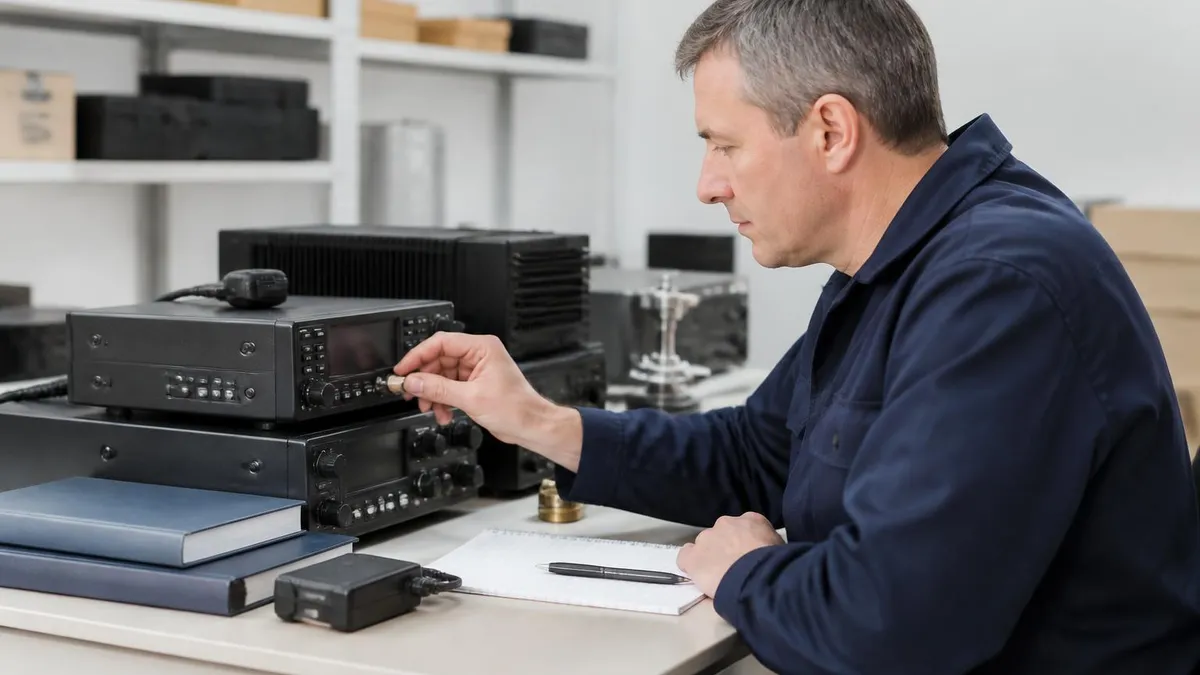
Ham Radio License Renewal: How to Keep Your Technician License Active, Avoid the Grace Period, and Renew Through the FCC
Ham Radio Technician

Do Ham Radios Need Electricity? Complete Guide to Ham Radio Power Requirements
About the Author

Educational Psychologist & Academic Test Preparation Expert
Columbia University Teachers CollegeDr. Lisa Patel holds a Doctorate in Education from Columbia University Teachers College and has spent 17 years researching standardized test design and academic assessment. She has developed preparation programs for SAT, ACT, GRE, LSAT, UCAT, and numerous professional licensing exams, helping students of all backgrounds achieve their target scores.
Join the Discussion
Connect with other students preparing for this exam. Share tips, ask questions, and get advice from people who have been there.
View discussion (3 replies)