
GNA: What Is a Geriatric Nursing Assistant? 2026 June
Pass your GNA: What Is a Geriatric Nursing exam on the first attempt. Practice questions with detailed answer explanations, hints, and instant scoring.
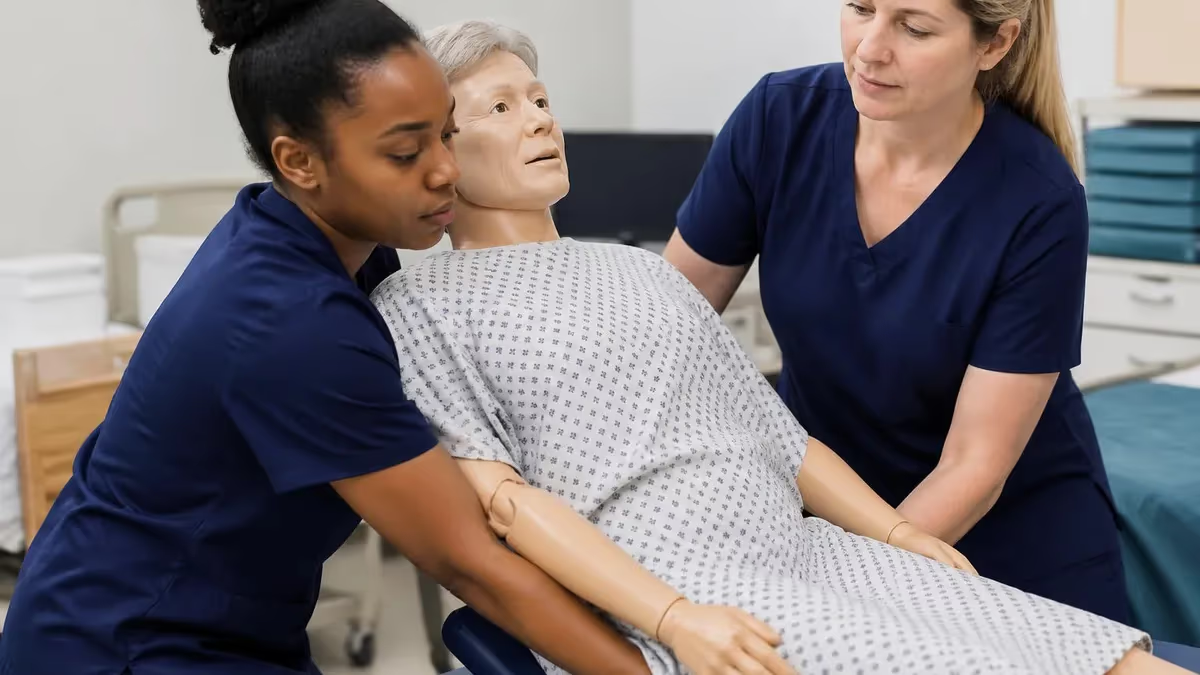
GNA: What Is a Geriatric Nursing Assistant?
GNA stands for Geriatric Nursing Assistant — a certified nursing assistant who has completed specialized training in elder care. While every CNA can work with older patients, a GNA has extra certification focused specifically on the needs of aging adults in nursing homes, assisted living facilities, and long-term care settings. If you've been searching for what GNA means in a job listing or wondering whether this credential is worth pursuing, this guide walks through everything you need to know.
The GNA credential is most prominently required in Maryland, where state law mandates that any nursing assistant working in a long-term care facility hold GNA certification — not just standard CNA certification. Other states have similar requirements under different names, but Maryland's GNA program is the best-defined and most commonly referenced in the U.S. When people ask "what is a GNA," the answer usually centers on this specialized elder care focus and the additional state-level certification requirements.
One practical note: the path to GNA certification runs directly through CNA certification first. You can't skip the foundational cna practice test and jump straight to GNA. The CNA credential is the prerequisite — GNA is the next step for CNAs specializing in geriatric care.
What Does a GNA Do?
A geriatric nursing assistant provides direct patient care for elderly residents in nursing facilities and long-term care settings. Day-to-day responsibilities include helping residents with bathing, dressing, grooming, and toileting; taking and recording vital signs; assisting with meals and hydration; repositioning patients to prevent bedsores; observing and reporting changes in health status to nurses; and providing emotional support and companionship.
What separates GNA work from general CNA work is the depth of knowledge required around geriatric-specific conditions. GNAs are trained to recognize signs of dementia and Alzheimer's progression, understand how medications affect elderly patients differently, manage behaviors associated with cognitive decline, and adapt communication for residents with hearing loss or confusion. The focus is entirely on maximizing quality of life and dignity for older adults — often in the last chapters of their lives.
GNAs work under the supervision of licensed practical nurses (LPNs) and registered nurses (RNs). They don't diagnose conditions or administer most medications, but they are the frontline caregivers — the people residents see most often and rely on most directly.
GNA Certification Requirements
To become a certified geriatric nursing assistant, you must first complete your standard CNA training and pass the CNA competency exam in your state. Once you hold an active CNA license, the GNA certification adds elder-care-specific competencies on top of your foundational skills. In Maryland, the state's official GNA program is administered through the Maryland Board of Nursing and requires completion of a Board-approved geriatric nursing assistant training program.
Standard GNA Training Requirements
GNA training programs typically cover the following areas in addition to standard CNA coursework:
- Gerontology fundamentals — the biology of aging, age-related changes in body systems
- Dementia and Alzheimer's care — communication techniques, behavioral management, safety protocols
- Restorative nursing — helping residents maintain and regain functional abilities
- Mental health in the elderly — depression, anxiety, end-of-life issues
- Nutrition and hydration — managing eating difficulties in older adults
- Infection control in long-term care — preventing spread of infections in group living environments
Maryland's GNA program requires a minimum of 100 hours of training including classroom instruction and supervised clinical hours. Candidates must then pass both a written knowledge test and a skills demonstration competency examination. The Maryland GNA registry tracks certified GNAs much like the national nurse aide registry tracks CNAs.
GNA vs CNA: Key Differences
The CNA credential is the baseline — it qualifies you to work across a range of healthcare settings including hospitals, home health, rehab centers, and long-term care. GNA adds depth in one specific direction: elder care. A GNA has the same clinical skills as a CNA plus specialized knowledge about geriatric populations.
In practical terms: all GNAs are CNAs, but not all CNAs are GNAs. If you plan to build a career in nursing homes or long-term care — especially in Maryland — the GNA certification is either required or strongly preferred by employers. Outside of Maryland, CNAs working in geriatric settings often pursue voluntary dementia care certifications or employer-specific elder care training that achieves a similar outcome.
Both credentials benefit from solid exam preparation. Studying for the gna practice test covers geriatric-specific scenarios, while core CNA content overlaps heavily between the two exams.

GNA Salary and Job Outlook
Geriatric nursing assistants earn slightly more than standard CNAs due to the specialized training and the higher demand for elder care workers as the U.S. population ages. According to Bureau of Labor Statistics data, nursing assistants overall earn a median wage of around $35,000–$37,000 annually, with GNAs at the higher end of that range in states where the credential carries a premium.
Maryland GNAs working in nursing homes in the Baltimore-Washington corridor typically earn $15–$20 per hour depending on facility type, shift differential, and years of experience. Unionized facilities and larger health systems often pay at the top of the range. Part-time and per-diem GNA positions are widely available, which makes this a viable credential for people balancing school or family commitments.
The job outlook for GNAs is strong. The U.S. population over 65 is growing faster than any other age group — the U.S. Census Bureau projects 70 million Americans will be 65 or older by 2030, up from 54 million in 2019. Long-term care facilities are struggling to fill nursing assistant positions in most states. GNA certification gives candidates a competitive edge over uncertified applicants in a tight labor market.
Career advancement from GNA follows a predictable ladder: many GNAs pursue cna classes for additional skills, then LPN programs, and eventually RN licensure. The elder care specialty you develop as a GNA translates directly into high-demand roles in gerontological nursing, memory care management, and long-term care administration.
GNA Training Programs: Where to Find Them
GNA training programs are offered at community colleges, vocational schools, and directly through nursing home facilities. In Maryland, the Board of Nursing maintains an approved provider list at mbon.maryland.gov. Many long-term care facilities offer GNA training as a condition of employment — you complete the training on their dime, then commit to working at the facility for a specified period.
Online GNA training programs exist for the didactic (classroom) portion, but the clinical hours must be completed in person at a licensed healthcare facility. Hybrid programs are common: online lecture content for the knowledge component, in-person skills labs for clinical competency. Programs typically run 4–12 weeks depending on whether you're enrolled full-time or part-time.
When choosing a program, confirm it's approved by the Maryland Board of Nursing (or your state equivalent). Unapproved programs don't qualify you to sit for the GNA exam — a costly mistake to discover after completing training. Check the approval status before enrolling.
For the salary picture by location, the certified nursing assistant salary data applies broadly to GNA roles, with GNAs often earning 5–10% more than uncertified nursing assistants in the same facility.
- ✓Review the official GNA exam content outline
- ✓Take a diagnostic practice test to identify weak areas
- ✓Create a study schedule (4-8 weeks recommended)
- ✓Focus on your weakest domains first
- ✓Complete at least 3 full-length practice exams
- ✓Review all incorrect answers with detailed explanations
- ✓Take a final practice test 1 week before exam day

GNA Work Settings
The primary setting for GNAs. Skilled nursing facilities (SNFs) serve residents who need daily medical care plus help with activities of daily living. Maryland law specifically requires GNA certification for nursing home employment. CNAs without GNA status can work in hospitals and home health but must obtain GNA certification to work in SNFs in Maryland. Nursing homes offer the most consistent full-time hours and the clearest career ladder toward LPN/RN.
Renewing Your GNA Certification
GNA certification must be renewed to stay active. In Maryland, GNA renewal is tied to the CNA renewal cycle — every two years, certified nursing assistants must document a minimum number of hours worked and complete continuing education. For GNAs, the renewal process involves submitting proof of active employment in a long-term care setting during the renewal period, along with any required continuing education hours specified by the Maryland Board of Nursing.
If your GNA certification lapses — meaning you haven't worked the required hours or missed the renewal window — you may need to complete a competency evaluation or additional training before reinstatement. Don't let certification lapse if you plan to continue working in Maryland nursing homes; the process to reinstate is significantly more involved than simple renewal.
For those who studied for and passed their CNA exam, the cna certification renewal process is closely linked to GNA renewal. Most states process both renewals through the nurse aide registry, and tracking your hours carefully throughout the two-year period makes renewal straightforward.
The GNA credential represents a meaningful investment in a career direction with strong long-term demand. As U.S. demographics shift toward an older population, the gap between the number of qualified geriatric care workers and the number needed grows wider each year. GNA-certified professionals are positioned directly in that gap — filling an essential role that requires both technical skill and genuine commitment to the dignity of elderly residents.



GNA Pros and Cons
- +GNA has a defined, publicly available content blueprint — candidates know exactly what to prepare for
- +Multiple preparation pathways (self-study, courses, coaching) accommodate different learning styles and schedules
- +A growing ecosystem of study resources means candidates at any budget level can access quality preparation materials
- +Clear score reporting allows candidates to identify specific strengths and weaknesses for targeted remediation
- +Professional recognition associated with strong performance provides tangible career and academic benefits
- −The scope of tested content requires substantial preparation time that competes with existing professional or academic commitments
- −No single resource covers the full content scope — candidates typically need multiple study tools for comprehensive preparation
- −Test anxiety and exam-day performance variability mean preparation effort does not always translate linearly to scores
- −Registration, preparation, and potential retake costs accumulate into a significant financial investment
- −Content and format can change between exam versions, making older preparation materials less reliable
About the Author
Educational Psychologist & Academic Test Preparation Expert
Columbia University Teachers CollegeDr. Lisa Patel holds a Doctorate in Education from Columbia University Teachers College and has spent 17 years researching standardized test design and academic assessment. She has developed preparation programs for SAT, ACT, GRE, LSAT, UCAT, and numerous professional licensing exams, helping students of all backgrounds achieve their target scores.
Join the Discussion
Connect with other students preparing for this exam. Share tips, ask questions, and get advice from people who have been there.
View discussion (4 replies)