
Geometry Sample Test: Complete Study Guide with Geometry Formulas, Lessons & Free Practice Tests
Master geometry formulas with our geometry sample test guide. Free practice tests, lessons, and tips. 🏆 Score higher today!

A geometry sample test is the single most effective tool you can use to prepare for any geometry exam, whether it is a classroom midterm, a standardized state assessment, or a college placement test. Understanding geometry formulas is the foundation of every geometry course, and practicing them under timed, test-like conditions is what separates students who merely memorize from students who truly master the subject. This guide walks you through everything you need to know, from core formulas and key theorems to proven study strategies that maximize your score.
Geometry is far more than memorizing the area of a circle or the Pythagorean theorem. It is a rigorous system of logical reasoning that connects visual intuition with algebraic precision. When you sit down with a geometry sample test, you are training your brain to move fluidly between diagrams, equations, and proofs. Each practice session reveals exactly which concepts need more attention, giving you targeted feedback that no passive reading or video-watching can match. Students who take at least five full-length practice tests before their actual exam consistently outperform peers who rely on notes alone.
This guide covers the most frequently tested geometry topics in US high school and college curricula: triangles, circles, quadrilaterals, coordinate geometry, transformations, surface area, volume, and geometric proofs. Each section pairs concept explanations with sample questions so you can immediately apply what you learn. Whether you are studying for the SAT, ACT, Regents exam, or a traditional high school final, the geometry lessons and practice resources here will help you build both speed and accuracy. geometry lessons organized by semester are especially useful for students following a full-year course sequence.
One reason students struggle with geometry is that they treat each topic as a separate island rather than as part of a connected system. In reality, the properties of parallel lines feed directly into triangle theorems, which in turn underpin the rules for similar and congruent figures. Volume formulas for prisms are just extensions of area formulas you already know.
When you study with a geometry sample test that covers multiple topics in one sitting, you practice making these connections automatically, which is exactly what high-stakes exams demand. Understanding the web of relationships between concepts is what allows top scorers to handle unfamiliar problem types without panicking.
Molecular geometry may belong to chemistry class, but spatial reasoning skills transfer directly: visualizing three-dimensional figures, rotating shapes mentally, and identifying cross-sections are competencies that geometry and science share. Students who invest time in solid geometry — cones, cylinders, pyramids, and spheres — often find that their overall spatial reasoning improves, benefiting them across multiple subjects. A strong geometry background also supports success in physics, engineering, architecture, and data visualization careers, making this one of the highest-return academic investments a high school student can make.
The structure of this guide mirrors the layout of a well-designed geometry sample test. You will start with a statistical overview of what the exam covers and how difficult each section tends to be. Then you will move into detailed topic reviews, each followed by practice opportunities. Along the way, you will find checklist reminders, study schedules, and expert tips drawn from educators who have coached hundreds of students to strong geometry scores. By the time you finish this guide, you will have a complete, personalized preparation plan ready to execute.
Take note of the free practice quizzes embedded throughout this page. Each quiz targets a specific cluster of skills — from geometric proofs and reasoning to circles and arcs — so you can pinpoint your weakest areas quickly. Regular, low-stakes quizzing is one of the most research-supported study strategies in existence, a technique called retrieval practice that dramatically boosts long-term retention. Start with the quizzes that cover your most challenging topics, then revisit every area at least twice before exam day. Consistent, deliberate practice is the real secret behind every strong geometry score.
Geometry Sample Test by the Numbers

Geometry Sample Test Study Schedule
- ▸Review angle relationships: complementary, supplementary, vertical, corresponding
- ▸Memorize triangle congruence shortcuts: SSS, SAS, ASA, AAS, HL
- ▸Practice 20 triangle classification problems
- ▸Take one mini geometry sample test on triangles and score yourself
- ▸Learn properties of parallelograms, rectangles, rhombuses, and trapezoids
- ▸Study polygon interior and exterior angle sum formulas
- ▸Work through 15 similarity and proportion problems
- ▸Complete a 30-question mixed practice quiz and review every error
- ▸Memorize all circle formulas: circumference, area, arc length, sector area
- ▸Practice chord, secant, and tangent angle theorems
- ▸Drill surface area and volume for prisms, cylinders, pyramids, cones, spheres
- ▸Time yourself on a 40-question geometry sample test under exam conditions
- ▸Review distance formula, midpoint formula, and slope relationships
- ▸Practice writing two-column and paragraph proofs from scratch
- ▸Take two full-length geometry sample tests back-to-back across two days
- ▸Identify remaining weak spots and do a final targeted review in the last 48 hours
Mastering geometry formulas is non-negotiable for a strong geometry sample test score. The good news is that most geometry exams test a finite, predictable set of formulas repeatedly. If you internalize roughly 30 core formulas deeply enough to apply them under pressure and in combination, you will be equipped to handle the vast majority of problems you encounter. The key is not just memorization — it is understanding where each formula comes from so you can reconstruct it if memory fails during an exam.
Start with the area formulas. The area of a rectangle is length times width, and every other area formula derives from this foundation. A parallelogram has the same area as a rectangle with the same base and height because you can slide the slanted side to create a rectangle. A triangle is half a parallelogram, giving you one-half base times height.
A trapezoid is the average of its two parallel bases multiplied by its height. The area of a circle, π r², comes from the formula for the circumference of a circle in a way that calculus formalizes but that intuition can grasp through the idea of infinitely thin rings stacking outward from the center.
Perimeter and circumference formulas are straightforward but frequently misapplied. Students often confuse diameter and radius when computing circumference (C = 2πr = πd) or forget to add all sides when working with irregular polygons. For regular polygons, remember that the perimeter equals the number of sides multiplied by the side length. Arc length is a proportion of circumference: (central angle / 360) × 2πr. Sector area follows the same logic: (central angle / 360) × πr². These proportional relationships appear constantly on geometry sample tests in both straightforward and embedded forms.
The Pythagorean theorem (a² + b² = c²) is arguably the most-tested single formula in all of high school geometry. Beyond its direct application to right triangles, it underlies the distance formula in coordinate geometry: d = √[(x₂−x₁)² + (y₂−y₁)²]. Special right triangles — the 45-45-90 triangle with side ratio 1:1:√2, and the 30-60-90 triangle with ratio 1:√3:2 — appear so frequently that you should be able to apply them in under ten seconds.
Examiners love embedding these triangles inside larger figures precisely because students who recognize them save enormous amounts of time. geometry arrow diagrams are excellent for visualizing how special triangles nest inside complex shapes.
Volume formulas follow a consistent pattern: prisms and cylinders equal base area times height (V = Bh), while pyramids and cones equal one-third of base area times height (V = ⅓Bh). The sphere volume formula, V = (4/3)πr³, must be memorized separately, as must the surface area formula for a sphere, SA = 4πr². For composite figures — which are extremely common on geometry sample tests — break the solid into recognizable pieces, calculate each piece separately, and add or subtract as needed.
Always identify which formula applies before plugging in numbers, and watch for problems that give diameter when you need radius.
Coordinate geometry formulas connect algebra and geometry in ways that trip up many students. The slope formula, m = (y₂−y₁)/(x₂−x₁), determines whether lines are parallel (equal slopes) or perpendicular (slopes that are negative reciprocals). The midpoint formula, M = ((x₁+x₂)/2, (y₁+y₂)/2), is tested both directly and as a step inside larger problems involving segment bisectors or median lengths of triangles on the coordinate plane. The equation of a circle, (x−h)² + (y−k)² = r², requires you to recognize center and radius quickly, including completing the square when the equation is given in general form.
Transformation formulas — for translations, reflections, rotations, and dilations — form a growing portion of geometry sample tests aligned to Common Core and similar standards. A translation by vector (a, b) maps every point (x, y) to (x+a, y+b). A reflection over the x-axis maps (x, y) to (x, −y); over the y-axis it maps to (−x, y); over y = x it maps to (y, x). Rotations of 90°, 180°, and 270° counterclockwise about the origin follow specific sign-change patterns worth memorizing.
Dilations multiply all coordinates by the scale factor relative to the center of dilation. Practice combining two transformations in sequence, because multi-step transformation problems are a staple of advanced geometry sample tests.
Geometry Lessons by Topic
Triangles are the backbone of Euclidean geometry and appear in nearly every section of a geometry sample test. The triangle angle-sum theorem states that all interior angles of any triangle sum to exactly 180°, a fact that unlocks dozens of downstream problem types. Triangle congruence (SSS, SAS, ASA, AAS, and HL for right triangles) and similarity (AA, SAS, SSS) are proof-writing staples. Exterior angle theorem, midsegment theorem, and the triangle inequality rule round out the foundational knowledge every student needs before tackling harder geometry lessons.
Writing geometric proofs can feel intimidating, but they follow a predictable logical structure: state what is given, identify what you need to prove, and build a chain of justified statements using definitions, postulates, and theorems. Two-column proofs and paragraph proofs both appear on exams. Practice proofs daily for at least two weeks before your test, focusing on congruence and similarity proofs first since they are most common. Students who use geometry dash scratch resources with worked solutions find proof writing far less mysterious after seeing five to ten annotated examples.

Geometry Sample Test Practice: Benefits vs. Challenges
- +Reveals exactly which formulas and theorems you have not yet mastered
- +Builds time-management skills by simulating real exam pacing
- +Reinforces long-term memory through retrieval practice better than re-reading notes
- +Provides immediate feedback when you review answers and explanations
- +Reduces test-day anxiety by making the exam format feel familiar
- +Identifies patterns in your errors so you can target studying more precisely
- −Passive test-taking without reviewing errors provides little benefit
- −Low-quality practice tests with errors can reinforce wrong approaches
- −Taking too many tests too close together without studying in between produces diminishing returns
- −Students may over-rely on memorized problem types and struggle with novel question formats
- −Timed practice can create anxiety in test-averse students if introduced too early
- −Without understanding the underlying concepts, score gains from drilling may not transfer to new problems
Geometry Sample Test Prep Checklist
- ✓Write out all 30 core geometry formulas from memory and check against your textbook.
- ✓Complete at least one full-length timed geometry sample test before beginning topic review.
- ✓Review every incorrect answer immediately after each practice session, not days later.
- ✓Practice drawing and labeling geometric figures before setting up any equation.
- ✓Memorize special right triangle ratios (30-60-90 and 45-45-90) until they are automatic.
- ✓Drill five geometric proofs per day for the two weeks leading up to your exam.
- ✓Work through at least 20 circle problems covering every angle theorem type.
- ✓Practice coordinate geometry by writing equations, finding distances, and classifying figures.
- ✓Complete a timed 40-question geometry sample test under real exam conditions in week four.
- ✓Identify your three weakest topic areas and schedule a final targeted review 48 hours before the exam.
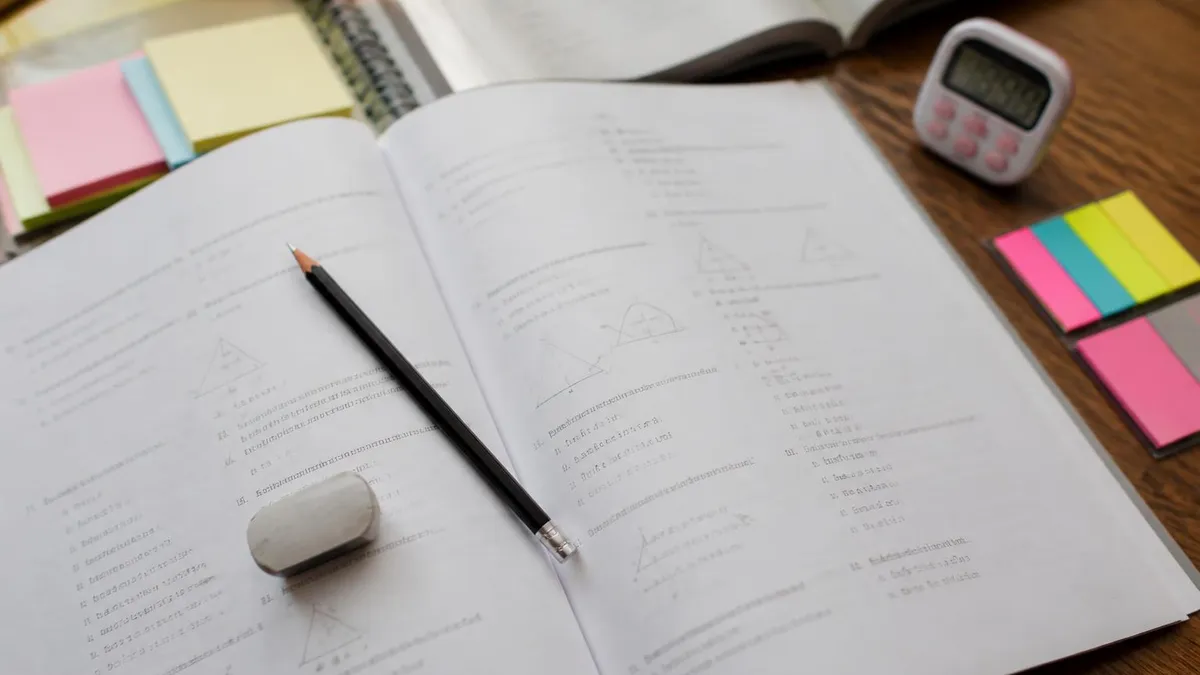
The 5-Test Rule That Boosts Geometry Scores
Research consistently shows that students who complete five or more full-length geometry sample tests before their exam score an average of 12 to 18 percent higher than students who study only from notes and textbooks. The critical ingredient is not just taking the tests — it is reviewing every single error in detail, understanding exactly why the wrong answer was wrong, and reworking the problem correctly from scratch. Schedule your practice tests evenly across your study period rather than cramming them all at the end.
One of the most valuable skills you can develop for a geometry sample test is recognizing the geometry spot — the precise moment in a problem where a key theorem or formula applies. Many students read a geometry problem, see a diagram, and immediately feel lost because they do not know where to start.
Experienced geometry students train themselves to scan for specific geometric markers: parallel lines cut by a transversal (triggering angle pair theorems), right angle marks (triggering the Pythagorean theorem or trigonometry), tick marks indicating congruence (triggering congruence postulates), and circles with labeled points (triggering arc and chord theorems).
Developing this pattern-recognition skill requires deliberate practice. When you review a geometry sample test, do not just check whether your answer was right or wrong. Ask yourself: what was the geometry spot in this problem — the key feature I needed to identify first? Then ask: did I notice it immediately, eventually, or not at all?
Over multiple practice sessions, you will discover which types of visual cues you tend to miss, and you can focus your review on those specifically. Students who train this way often describe a dramatic improvement in their speed and confidence because problems that once seemed opaque become transparent once they spot the right geometric feature.
Common geometry spots that students overlook include: an altitude drawn to the hypotenuse of a right triangle (which creates two smaller triangles similar to each other and to the original), a tangent line from an external point (which creates a right angle at the point of tangency), and a diagonal of a quadrilateral (which splits it into two triangles whose properties you can analyze separately). Each of these features is a signal that a specific theorem applies, and recognizing the signal instantly is what separates a 70-second solution from a 7-minute struggle.
Build a personal "geometry spot" reference card listing the top 15 visual cues and their associated theorems.
Geometry formulas for three-dimensional figures demand special attention because students often confuse lateral surface area, total surface area, and volume. Lateral surface area includes only the sides of a figure, not the bases. Total surface area includes everything.
For a cylinder, lateral SA = 2πrh, while total SA = 2πrh + 2πr². For a cone, lateral SA = πrl (where l is slant height), while total SA = πrl + πr². Mixing these up is one of the most common sources of errors on geometry sample tests, so always pause to confirm which type of surface area a problem is requesting before computing anything.
Geometric proofs remain the topic that most students find most daunting. The secret to writing proofs efficiently is to start from both ends simultaneously. Read the "given" statements and draw their immediate logical consequences. Then read the "prove" statement and ask what the last step before it must be. Work inward from both directions until the two chains of reasoning connect in the middle.
This bidirectional strategy prevents the blank-page paralysis that afflicts students who try to work strictly forward from the given information. It also helps you identify the "hinge" theorem — the pivotal step that makes the whole proof work — which is usually the most creative and instructive part of the problem.
For students studying molecular geometry concepts in chemistry who also need geometry sample test preparation, there is meaningful overlap in spatial visualization skills. Both disciplines require you to mentally rotate three-dimensional shapes, identify planes of symmetry, and reason about angles between bonds or sides. Practicing one strengthens the other. If you find 3D geometry problems particularly challenging, try using physical models — even simple ones made from straws or toothpicks and clay — to build intuition about how faces, edges, and vertices relate in space. Tactile learning can break through conceptual blocks that reading alone cannot.
Time management on a geometry sample test follows a clear strategy: spend no more than 90 seconds on any single problem during a first pass. If you are stuck, mark the problem, move on, and return to it after completing the problems you can answer confidently. This approach guarantees that you earn all the points you are capable of earning before spending extra time on harder questions.
During the second pass, work hardest on problems worth the most points. Use any remaining time to check algebra: verify that you squared correctly, that you used radius and not diameter, that your final answer has the correct units, and that you answered what the problem actually asked.
The three most common errors on geometry sample tests are: (1) using diameter instead of radius in circle formulas, which doubles or halves your answer; (2) forgetting to square the radius when computing area, leading to answers that are off by a factor of r; and (3) misidentifying which angle or arc a theorem refers to in circle problems involving chords, secants, and tangents. Double-check these three things on every circle problem before moving on, and you will avoid the mistakes that cost most students five to ten points.
A complete geometry preparation plan integrates multiple study modes: reading and note-taking for initial concept introduction, worked examples for seeing techniques in action, solo problem-solving for building independence, and timed geometry sample tests for simulating real exam conditions. Each mode plays a specific role, and skipping any one of them creates gaps. The most efficient path to a strong score is to cycle through these modes in order for each major topic rather than spending all your time in any single mode, no matter how comfortable it feels.
Students preparing for geometry exams often underestimate how much of the test involves multi-step problems that require combining two or three concepts in sequence. For example, a single problem might require you to (1) identify that two triangles are similar by AA, (2) set up a proportion to find a missing side, (3) use that side length in the Pythagorean theorem to find an altitude, and (4) use the altitude to compute an area.
None of these individual steps is especially hard, but navigating the full chain under time pressure requires practice. Seek out multi-step problems deliberately when choosing your practice materials.
Accessing structured geometry dash unblocked practice resources provides an organized pathway through exactly these multi-step problem types. Well-sequenced practice materials build from single-concept exercises toward complex, integrated problems in a progression that mirrors how understanding actually develops. When you choose a geometry sample test to practice with, look for materials that include worked solutions with full step-by-step explanations, not just answer keys, because understanding the solution process matters more than simply knowing the final answer.
For students whose geometry sample test covers transformations and constructions, extra preparation time is warranted. Compass-and-straightedge constructions — bisecting an angle, constructing a perpendicular bisector, copying a segment or angle — are motor skills as well as conceptual ones. They require practice with actual tools, not just mental rehearsal.
Similarly, transformation compositions (for example, reflecting a figure and then rotating it) require careful tracking of coordinates through each step. Both topics reward methodical, step-by-step written work over mental shortcuts, especially in a timed exam environment where a small arithmetic error early in the process propagates to a completely wrong final answer.
Geometry reasoning extends into real-world applications that make excellent sample test problems. Architects use similar triangles to scale blueprints. Engineers use the Pythagorean theorem to ensure structures meet at right angles. Urban planners use coordinate geometry to design road grids. Astronomers use circle and arc formulas to describe planetary orbits.
When you encounter a word problem on your geometry sample test, look for these real-world contexts as clues about which geometric concept is being tested. The context is not just flavor text — it tells you what kind of figure to draw, what quantities are given, and what you are being asked to find.
Practice with diverse problem formats strengthens your adaptability. Multiple-choice questions test recognition and efficiency. Free-response questions test your ability to show organized work and justify each step. Proof-writing questions test logical rigor. Construction problems test procedural accuracy. If your upcoming geometry exam includes all of these formats, allocate your practice time proportionally to the point values each format carries, but do not neglect any format entirely. Weakness in one format can pull down an otherwise strong score significantly, especially if proofs or extended-response problems carry heavy point weights.
As your exam date approaches, shift from learning new material to consolidating what you already know. In the final week before your geometry sample test, focus on reviewing formulas, reworking previously missed problems, and taking one or two final full-length timed tests under authentic conditions — no phone, no music, no pausing the timer.
Eat well, sleep adequately, and arrive at the exam with a clear head. Students who follow this final-week protocol consistently report feeling more confident and performing more accurately than those who try to cram new content at the last minute. Confidence built on genuine preparation is the most reliable test-day asset you can bring.
Test-day strategy begins the night before your geometry sample test. Lay out everything you need — pencils, compass, ruler, calculator (if permitted), photo ID, and your admission ticket — so morning logistics are frictionless. Review your personal formula card one final time, then stop studying. Your brain consolidates information during sleep, and a well-rested mind retrieves geometry formulas faster and makes fewer careless errors than a tired one. Aim for eight hours of sleep. If anxiety makes sleep difficult, a short relaxation routine and limiting screen time after 9 PM will help significantly.
On exam morning, eat a nutritious breakfast that includes protein and complex carbohydrates. Avoid heavy sugar loads that cause energy spikes and crashes. Arrive at the testing location early enough to settle in, take a few deep breaths, and review your mental checklist of the five most commonly tested geometry formulas. This brief warm-up primes your working memory and reduces the disorientation some students feel when they open an exam booklet cold. Starting the test with two or three problems you find straightforward builds positive momentum that carries through harder sections.
During the exam, read every problem twice before writing anything. Geometry problems often contain critical information — a right angle symbol, a statement that two sides are equal, a note that a line is tangent — that is easy to miss on a first hurried read. Underline or circle given information as you read.
Draw or re-draw the diagram if the printed one is unclear or missing. Label all known measurements on your diagram before setting up equations. These habits take only a few extra seconds but prevent the misreads that cause students to solve the right procedure for the wrong problem.
Show all work, even on multiple-choice problems. Written work serves two purposes: it reduces errors by externalizing your calculations, and on free-response sections it earns partial credit even if your final answer is wrong. Do not erase work that led you in a wrong direction — cross it out neatly and continue. Examiners grading open-response sections can sometimes award process points for correct reasoning even when arithmetic errors produced an incorrect numerical answer. Tidy, organized work also makes it easier for you to check your own solutions during any remaining time.
After completing all problems you can solve confidently, return to the ones you skipped. On multiple-choice sections, eliminate obviously wrong answers first. If a problem asks for area and one answer choice is negative, eliminate it immediately. If the problem involves a circle with radius 5 and one answer is 1000π, that is probably too large — use estimation to narrow choices. Educated guessing on remaining questions is almost always better than leaving them blank, especially when wrong answers do not carry a penalty, which is the case for most modern geometry exams aligned to Common Core standards.
After the exam, regardless of how you feel it went, avoid the temptation to immediately discuss every problem with classmates. Post-exam rehashing often creates false memories and anxiety without providing any actionable benefit. Instead, give yourself a deliberate break — a full day away from geometry — before reviewing any returned work.
When results arrive, treat them analytically: categorize errors by type (formula error, misread problem, conceptual gap, arithmetic slip), identify which category was largest, and use that data to inform any future geometry study. Even if this was your only geometry exam, these analytical habits will serve you in every subsequent quantitative course you take.
Students who continue practicing with a variety of geometry sample tests between courses — over summers or during other school years — maintain and extend their geometry skills in ways that pay dividends in later mathematics classes including pre-calculus, calculus, and statistics. Geometric intuition built through years of practice makes abstract algebraic concepts more concrete and manageable.
If you are a student who genuinely enjoys geometry, consider exploring advanced topics like non-Euclidean geometry, projective geometry, or topology, which extend the logical structures of high school geometry into fascinating and practically important mathematical territory. The foundation you build now will serve you across decades of learning.
Geometry Questions and Answers

Chapter 9 Test Geometry Answers Big Ideas Math: Complete Study Guide with Geometry Formulas, Lessons & Free Practice Tests

Cross Section Geometry: Complete Guide with Geometry Formulas, Lessons & Free Practice Tests
Geometry Practice Test Video Answers

Honors Geometry Semester 2 Exam Practice Test: Complete Study Guide with Geometry Formulas, Lessons & Free Tests

Geometry Proofs Practice: Master Every Theorem with Step-by-Step Strategies & Free Tests
About the Author

Educational Psychologist & Academic Test Preparation Expert
Columbia University Teachers CollegeDr. Lisa Patel holds a Doctorate in Education from Columbia University Teachers College and has spent 17 years researching standardized test design and academic assessment. She has developed preparation programs for SAT, ACT, GRE, LSAT, UCAT, and numerous professional licensing exams, helping students of all backgrounds achieve their target scores.