
Physics Equation Sheet GCSE: Formulas, Units and Worked Examples 2026
🎓 A physics equation sheet GCSE students can trust: key formulas, units, worked examples and exam tips for AQA, Edexcel and OCR physics.
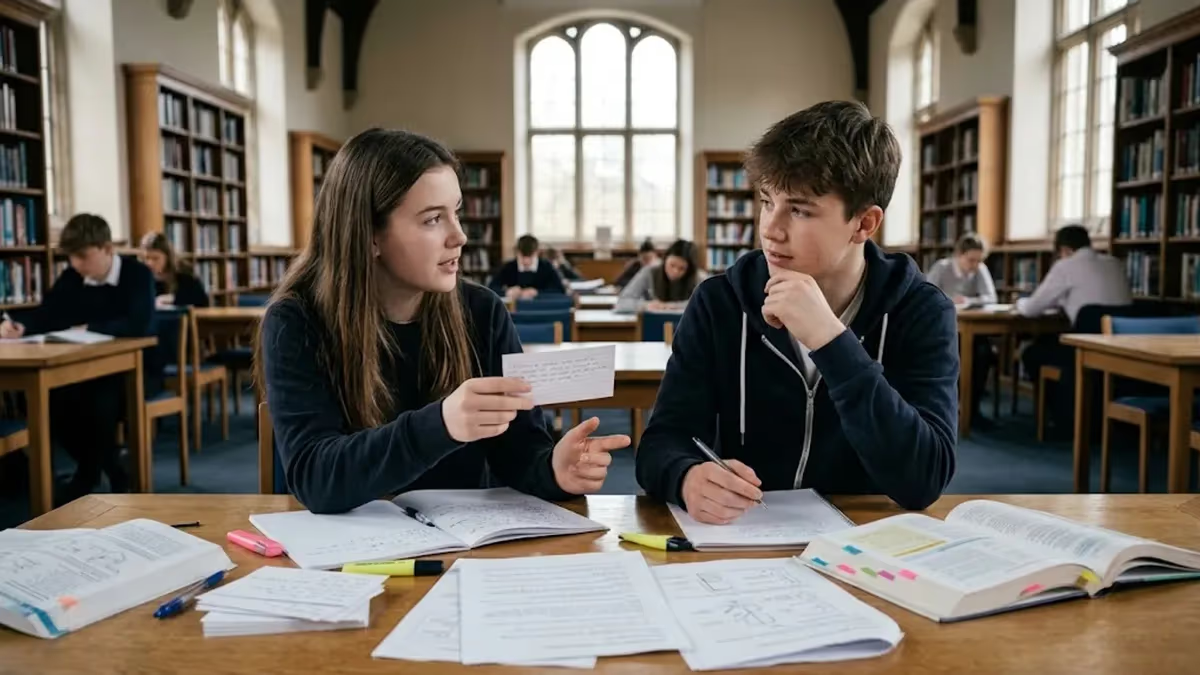
A physics equation sheet GCSE students can rely on lists the formulas for motion, forces, energy, electricity, waves and matter, with units, plus a note on which ones you must memorise. Exam boards such as AQA, Edexcel and OCR give some equations in the paper and expect you to recall the rest.
Physics Equation Sheet Gcse: Key Facts (Updated October 2026)
| Fact | Details | Source |
|---|---|---|
| Qualification | GCSE (General Certificate of Secondary Education), taken mainly in England, Wales and Northern Ireland | Ofqual |
| Grading in England | Numbered 9 (highest) to 1, with U for ungraded | Ofqual |
| AQA GCSE Physics (8463) format | Two written papers, each 1 hour 45 minutes and 100 marks | AQA |
| Paper coverage | Paper 1: energy, electricity, particle model, atomic structure. Paper 2: forces, waves, magnetism, space | AQA |
| Equation sheet | Boards publish equations to recall and a shorter list supplied in the exam; check your own specification | AQA, Edexcel, OCR |
| Main exam window | Written exams normally run from May to June | Joint Council for Qualifications |
This guide explains how the gcse physics equation sheet works for readers in the United States who meet the qualification for the first time. The gcse meaning is General Certificate of Secondary Education, a subject-by-subject exam taken around age 16 in England, Wales and Northern Ireland. The definition of gcse is simple: it is the main school-leaving qualification, comparable to end-of-course exams in high school, and physics is one of its most formula-heavy subjects.
Learning equations is not just memorising symbols. Each formula links physical quantities, and the units tell you whether your answer is sensible. If you calculate a speed and finish with kilograms, something went wrong. A good sheet therefore pairs every equation with its symbols, SI units and a worked example. Examiners award marks for the correct substitution, the rearrangement and the final unit, so even a wrong final number can still earn two of three marks.
Most students meet two kinds of equations. The first group must be recalled from memory, such as speed equals distance divided by time, force equals mass times acceleration, and potential difference equals current times resistance. The second group is printed on an equation sheet inside the exam, and usually covers harder relationships such as the change in thermal energy or the pressure in a column of liquid. Your specification and past papers show exactly which equations fall into each group.
Be careful with online searches. Pages promising leaked gcse papers appear every year, yet they are unreliable, often fake, and sharing real exam content counts as malpractice that can lead to disqualification. Official past papers and mark schemes are free from the exam boards, and they teach the same skills. Spending an evening on a genuine paper with the equation sheet beside you does far more for your grade than chasing rumours.
The sheet in this article follows the content shared by AQA, Edexcel and OCR physics and combined science courses. Where boards differ, such as the value of gravitational field strength, which is 9.8 N/kg in some papers and 10 N/kg in others, always use the number printed in your question. Combined science students learn a slightly shorter list than separate physics students, so tick off the equations your own specification names.
Use the sections below in order. First you will see the equations grouped by topic, then a guide to using the sheet in the exam, then practical checklists, worked examples, a four-step learning plan and answers to common questions. Keep a calculator in degree mode, a pencil and a copy of your specification nearby. By the end you should be able to pick the right equation within ten seconds of reading a question.
GCSE Physics Equations by the Numbers
What Equations Are on the GCSE Physics Equation Sheet?
Speed = distance ÷ time, acceleration = change in velocity ÷ time, F = ma, W = mg, momentum p = mv, and v² − u² = 2as. Units are metres, seconds, newtons and kilograms, so convert everything first.
Kinetic energy = ½mv², gravitational potential energy = mgh, work done = Fs, power = energy ÷ time, and efficiency = useful output ÷ total input. All energies are measured in joules and power in watts.
Q = It, V = IR, P = VI, P = I²R and E = Pt. Potential difference is in volts, current in amps, resistance in ohms and charge in coulombs. Transformer equations link primary and secondary voltages in higher questions.
Wave speed = frequency × wavelength, frequency = 1 ÷ period, Hooke's law F = ke and elastic energy = ½ke². Wavelength must be in metres and extension in metres before you substitute any numbers.
Density = mass ÷ volume, pressure = force ÷ area, ΔE = mcΔθ for heating, and E = mL for changes of state. Specific heat capacity and latent heat values are usually given in the question.
How Do You Use a Physics Formula Sheet in the GCSE Exam?
Start by reading the question for the quantity you must find, then list every number given with its unit. Next scan your equation sheet for the relationship that links those quantities. If the sheet lists the equation, copy it exactly, substitute values, and show each line of working. This habit protects marks in the gcse exam because examiners follow your method even when arithmetic slips, awarding marks for the correct equation, substitution and final answer.
Rearranging is where most marks are lost. Take force equals mass times acceleration. To find mass you divide force by acceleration, and to find acceleration you divide force by mass. A formula triangle can help, but algebra is safer because triangles fail for equations with squares, such as kinetic energy. Practise rearranging each equation until you can do it on paper without hesitation, ideally with the quantity you want alone on the left of the equals sign.
Convert units before you substitute. Grams must become kilograms, kilometres become metres, minutes become seconds, and kilojoules become joules. A mass of 500 g in a kinetic energy question is 0.5 kg, so a speed of 4 m/s gives half times 0.5 times 16, which is 4 J. Using 500 instead would give 4,000 J, a thousand times too large. Unit conversion is the most common hidden trap on physics papers.
Significant figures matter as well. Examiners usually accept answers within a small tolerance, yet they expect you to give a sensible number of significant figures, matching the least precise value in the question, or two to three figures if unsure. Do not round in the middle of a calculation; keep the full calculator value and round only at the end. Include the unit and, when asked, give the answer in standard form, for example 3.2 × 10^4 W.
For results-day terms, read our guide on what does mark equivalent mean on gcse results, which explains boundaries, raw marks and how grades from 9 to 1 are awarded. Physics boundaries move every year depending on how hard the papers were, so never rely on a single remembered percentage. Focus on securing marks you can control, such as correct equations, units and clear working throughout each paper.
Use the revision resources from your board too. For aqa science, the specification lists every required equation and marks which ones are supplied, and our aqa science checklist turns that into a tick-box plan. Edexcel and OCR publish similar lists. Print the one for your course, highlight the equations you cannot yet recall, and test yourself on those first each morning before attempting any timed questions or longer practice papers.
Finally, time yourself. A 100-mark paper in 105 minutes gives roughly one minute per mark. A four-mark calculation should take about four minutes, including finding the equation, rearranging, substituting and writing the unit. If you spend ten minutes hunting for a formula, you have lost marks elsewhere. Practising with the sheet open trains your eyes to find equations fast, and trains your brain to recall the others unaided.
What Is the Meaning of GCSE and When Are the Exams?
The gcse meaning is General Certificate of Secondary Education. Students in England usually start two-year courses at about age 14 and sit exams at 16. Wales and Northern Ireland use the same name with some different rules. For readers in the US, imagine a set of end-of-course exams in each subject, with results counted as a national qualification that colleges, sixth forms and employers recognise.
The definition of gcse also includes grading. Most subjects in England now use a 9 to 1 scale, where 9 is the highest, grade 4 is regarded as a standard pass and grade 5 as a strong pass. Many students take around nine subjects, including English, maths and science, so physics equations form just one part of a wider qualification that follows them into further study.
Is a Formula Triangle Better Than Rearranging Equations?
- +Triangles are quick to learn for simple three-quantity equations
- +They reduce panic when you need to rearrange under time pressure
- +Visual memory helps students who find algebra stressful
- +They work well for speed, density and V = IR
- +They make flashcards and wall posters easy to create
- +They help younger students start rearranging with confidence
- −Triangles fail for equations with squares such as kinetic energy
- −They do not work for equations with four or more quantities
- −Students may memorise the shape without understanding the relationship
- −Examiners expect algebra in higher-tier questions
- −Triangles are not printed on the official exam sheet
- −Over-reliance can slow you down on multi-step calculations
What Should a GCSE Physics Equation Checklist Include?
- ✓Download your exam board's official equation list.
- ✓Highlight which equations you must recall and which are supplied.
- ✓Write every equation with symbols and units on one page.
- ✓Practise rearranging each formula for every quantity.
- ✓Memorise the unit for every quantity in the list.
- ✓Convert grams, minutes and kilometres before substituting.
- ✓Complete one timed past paper each week.
- ✓Keep an error log of mistakes and fixes.
- ✓Test yourself with flashcards for ten minutes daily.
- ✓Check your calculator mode and spare batteries before the exam.
Write the equation, the substitution and the unit
In multi-mark calculations, examiners award separate marks for choosing the correct equation, substituting values and giving the final answer with a unit. Writing all three steps can turn a wrong number into two out of three marks.
What Are the Most Important Equations for GCSE Physics?
Start with motion. Speed equals distance divided by time, so a cyclist covering 600 m in 50 s travels at 12 m/s. Acceleration equals change in velocity divided by time, so going from 0 to 12 m/s in 4 s gives 3 m/s². The equation v² − u² = 2as links final velocity v, initial velocity u, acceleration a and displacement s, and is often printed on the sheet for higher-tier questions.
Next come forces. Force equals mass times acceleration, F = ma, so a 1,200 kg car accelerating at 2.5 m/s² needs a resultant force of 3,000 N. Weight equals mass times gravitational field strength, W = mg, so a 60 kg student weighs 588 N with g = 9.8 N/kg. Momentum equals mass times velocity, p = mv, so the same car moving at 10 m/s has momentum 12,000 kg m/s.
Energy equations appear on both papers. Work done equals force times distance, W = Fs, so pushing a crate with 80 N through 5 m transfers 400 J. Power equals energy transferred divided by time, so 400 J in 20 s is 20 W. Kinetic energy is half mass times speed squared, and gravitational potential energy is mass times g times height: a 2 kg book lifted 1.5 m gains 29.4 J.
Electricity equations are heavy on units. Charge flow equals current times time, Q = It, so 3 A for 10 s moves 30 C. Potential difference equals current times resistance, V = IR, so 0.5 A through a 12 Ω resistor needs 6 V. Electrical power is P = VI or P = I²R, so a 230 V kettle drawing 10 A transfers 2,300 W. Energy transferred equals power times time, E = Pt.
Wave questions use wave speed equals frequency times wavelength, v = fλ. A wave at 50 Hz with a wavelength of 6 m travels at 300 m/s. Frequency equals one divided by period, so a period of 0.02 s means 50 Hz. Remember to convert wavelengths given in centimetres or nanometres into metres first, otherwise the answer will be out by a power of ten, which is a very common slip.
Matter and thermal equations finish the core list. Density equals mass divided by volume, so 270 g of aluminium occupying 100 cm³ has a density of 2.7 g/cm³. Hooke's law states force equals spring constant times extension, F = ke. Specific heat capacity uses ΔE = mcΔθ, so heating 2 kg of water by 10 °C, with c = 4,200 J/kg°C, needs 84,000 J of energy.
Students across the gcse uk system, and curious readers elsewhere, often ask about leaked gcse papers 2019. Treat any such claim sceptically; real papers are kept secure until the exam, and the same equations appear in legitimate past papers anyway. To compare subjects, understand which are compulsory and plan your options sensibly, use our subject guide and then return to the equations here for practice.
Equation lists, symbols and the value of g differ between AQA, Edexcel and OCR, and between Combined Science and Separate Physics. Always confirm the exact list in your current specification and use the data printed in each exam question.
How Can You Learn a Physics Formula Sheet in Four Steps?
Collect and sort
Learn the units
Practise rearranging
Apply under time
What Is the Efficiency Equation in GCSE Physics?
Efficiency equals useful output energy transfer divided by total input energy transfer. It is a ratio with no unit, usually written as a decimal or multiplied by 100 to give a percentage. A motor takes in 500 J of electrical energy and delivers 350 J as useful kinetic energy, so its efficiency is 350 divided by 500, which is 0.70 or 70 percent. Always put the useful value on top.
The same efficiency formula physics students use also works with power: efficiency equals useful power output divided by total power input. A lamp that uses 40 W and gives 4 W as light is 10 percent efficient. Efficiency can never exceed 100 percent because energy cannot be created. If your answer is 120 percent, you have probably divided the wrong way round, so swap the numerator and denominator and check again.
Wasted energy usually appears as heat or sound, spreading into the surroundings and becoming less useful. You can reduce waste by lubrication, thermal insulation or better design. Questions often ask you to compare two devices, so calculate both efficiencies, state which is higher, and explain why. Mention that materials with low thermal conductivity slow heat loss, and that thicker insulation reduces the rate of energy transfer.
Combine efficiency with other equations in multi-step problems. A crane lifts a 500 kg load through 10 m, so the weight is 4,900 N and the useful work is 49,000 J. If the motor takes in 70,000 J, efficiency is 0.70. Writing each step on its own line earns marks for method even if the final line contains an error, and keeps your working readable for examiners.
Physics is not the only paper where clear communication earns marks. Six-mark explanation questions reward structured sentences, a skill also tested in English. If you are balancing subjects, practise with our gcse english language questions alongside physics. Writing precise short explanations helps you describe energy transfers, evaluate designs and justify conclusions in both subjects, and it improves your speed under pressure.
Another claim you will see is leaked gcse papers 2020. Exams that summer were cancelled because of the pandemic, and grades were awarded using teacher-assessed evidence, so there were no real papers to leak. Anything labelled that way is mislabelled or old material. Use official past papers and our video walkthroughs to practise genuine exam technique, and treat the gcse exam as a skill you can train.
Know the gcse's overall rhythm too. The gcse's are assessed mostly by final exams, with practical skills tested through required practicals that appear as exam questions. In physics these include specific heat capacity, resistance, density and waves. Equations from these practicals, such as finding the resistance of a wire or the density of an irregular solid, are frequent four-mark and six-mark questions, so rehearse them with real numbers.
How Should You Revise Physics Equations Before the GCSE Exam?
Begin with a one-page summary. Copy every equation from your board's list onto a single sheet, grouped by topic, with symbols and units beside each. Writing it by hand forces recall and shows gaps. Then cover the page and rewrite from memory. Repeat daily for ten minutes; within two weeks most students can reproduce thirty or more equations accurately, which frees thinking time for the harder application questions in the exam.
Use flashcards with the quantity name on the front and the equation, symbol meanings and unit on the back. Shuffle them, and add a second pile for rearrangements. Spaced repetition works best: review new cards daily, then every third day, then weekly. Digital decks are fine, though handwritten cards give a tactile cue. Retire a card only after you answer it correctly five sessions in a row.
Work through official past papers under timed conditions. Mark them against the published scheme, and keep an error log recording the topic, the mistake and the fix. Typical errors include forgetting to convert units, squaring only part of a term, and using the wrong equation. After three papers, patterns appear, and you can target the equations that cost you marks instead of revising everything equally.
Maths overlaps with physics more than most students expect. Linear equations gcse questions teach you to isolate an unknown, the same skill used to rearrange v = u + at. The equation of a circle gcse topic, x² + y² = r², belongs to maths rather than physics, yet it uses squares and roots just like kinetic energy. Compound interest, A = P(1 + r/100)^n, also rewards careful substitution.
Learn the sizes of common quantities so you can sense-check answers. A walking speed is about 1.5 m/s, a car on a motorway about 30 m/s, and sound travels at roughly 340 m/s in air. A household mains supply in the UK is 230 V, and a phone charger delivers a few watts. If your answer says a person walks at 150 m/s, you know to revisit the calculation.
On the day before the exam, avoid cramming new material. Skim your summary sheet, redo five calculations you previously got wrong, pack your calculator, spare batteries, pens and ruler, and sleep properly. In the exam, read all questions, start with ones you find easy, and leave marks on the table only when truly stuck. A calm approach beats last-minute panic every time.
Finally, remember that equations are tools rather than the whole subject. Examiners also test understanding of concepts like conservation of energy, the difference between series and parallel circuits, and how to evaluate evidence. Pair every calculation practice session with a few explanation questions. Free quizzes on this site let you check your knowledge quickly, and the related guides below cover subject choices, results terms and further practice resources.
GCSE Questions and Answers





About the Author

Educational Psychologist & Academic Test Preparation Expert
Columbia University Teachers CollegeDr. Lisa Patel holds a Doctorate in Education from Columbia University Teachers College and has spent 17 years researching standardized test design and academic assessment. She has developed preparation programs for SAT, ACT, GRE, LSAT, UCAT, and numerous professional licensing exams, helping students of all backgrounds achieve their target scores.