
Who Can Sit a GCSE: Age, Retakes and Private Candidate Routes 2026 October
GCSE exam eligibility explained: 🟢 typical age, no upper limit, private candidate routes, 2026 October registration dates, retake rules and Australian equivalents.

Who is actually allowed to sit a GCSE? The short version: pretty much anyone, at almost any age, as long as you can find a centre to enter you and you meet the registration deadline. The longer version is what most parents, mature learners and international students searching this question really want — the typical age in the UK system, the legal floor (or lack of one), how to register as a private candidate when you're not attached to a school, what the 2025 booking windows look like, and whether the GCSE you sat in 1998 still means something today.
We'll walk through it in plain English. You'll see the standard Year 11 route most British teenagers take, the resit windows in November and the following May/June, the JCQ-approved exam centre process for adult candidates, and an honest comparison with the closest Australian equivalents (Year 10 certificates and how they line up with NSW HSC components). No fluff, no padding — the answers you came here for, with the dates and the rules that actually apply.
Why does this matter beyond curiosity? Because eligibility is the single biggest blocker for people trying to get back into education or apply for a university course later in life. A maths or English GCSE at a grade 4 is still the baseline qualification UK employers and universities ask for, and the rules for getting one are easier to navigate than the official guidance makes them look.
Our deeper walk-throughs on the GCSE exam format itself, on the GCSE grading system, and on the broader question of what is GCSE in the UK system round out the picture this article focuses on — the eligibility piece specifically.
One quick framing point before the detail. Eligibility splits into three audiences with very different concerns. Teenagers in Year 11 who just need to know which subjects they're entered for. Adults — career changers, returners, parents wanting to support their kids — who never sat GCSEs or want to upgrade old grades. International students trying to figure out whether their qualifications convert. Each of those groups gets its own section below. Skim to the one that matches you, then cross-check with the FAQ at the bottom for the question your specific situation throws up.
GCSE Eligibility Snapshot
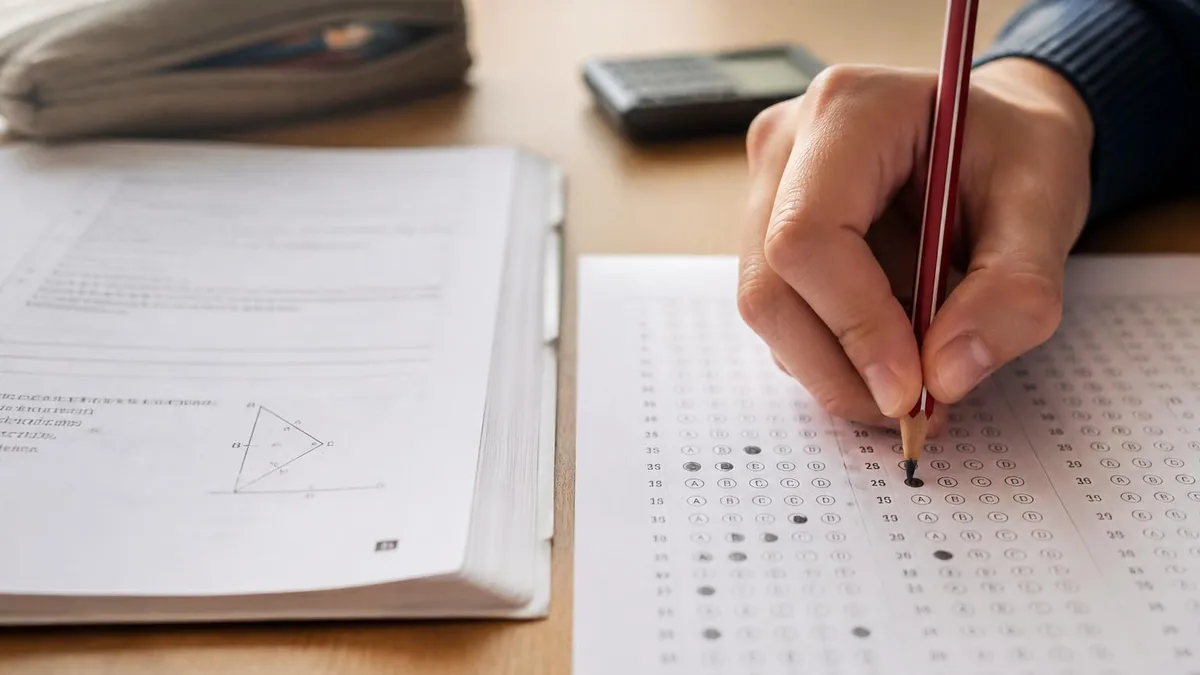
What age do people sit GCSEs in the UK?
The standard age is 15 going into 16 — Year 11 of secondary school in England, Wales and Northern Ireland. Students are entered by their school in the autumn term, typically take mock exams in December or January, and sit the real papers in a single examination window across May and June. Results day for that summer series falls on the third Thursday of August, when teenagers across the UK refresh the school's website at 8 a.m. to find out whether their grade-4 maths plan held.
That said, the "age you sit GCSEs" question is more nuanced than the headline answer. Some schools, particularly grammars and selective independents, enter strong students for one or two GCSEs a year early — often maths, sometimes a modern foreign language — which means a fourteen-year-old can legitimately hold a GCSE certificate. At the other end, a meaningful share of UK students retake GCSE English Language or Maths in November of Year 12 or beyond, because a grade 4 is required to leave the post-16 system without continuing those two subjects.
The legal floor matters too. There is no minimum age in regulation — Ofqual and JCQ do not specify one. The practical floor is whatever an exam centre will accept, and most centres are comfortable entering candidates aged 14 or above. Below that, the centre is making a judgement call about safeguarding, exam-room behaviour and whether the candidate can realistically sit a 90-minute paper. Cases of very young children sitting GCSEs (eight, nine, ten years old) make headlines because they are unusual, not because they are forbidden.
No formal upper age limit and no formal lower age limit. JCQ regulations (the Joint Council for Qualifications, which oversees GCSE administration in the UK) require centres to satisfy themselves that a candidate can meet the demands of the assessment — that's the only gate. In practice that means 14+ for almost any centre, with younger candidates assessed case-by-case.
Adults sit GCSEs every year in their thirties, fifties, seventies. The OCR, AQA, Edexcel and WJEC entry forms do not ask for age beyond a date-of-birth field used for safeguarding and JCQ statistics. If you have £40-£250 per subject and a centre willing to enter you, you're eligible.
The reasons adults sit GCSEs vary widely. Some are returning to formal study after years out and need GCSE maths to qualify for a teacher training course (a grade 4 in English and Maths is a Department for Education requirement for PGCE entry). Others are immigrants who arrived after the school years and want a UK-recognised qualification on their CV. A meaningful chunk are parents who want to model serious study for their kids, or career changers who need a science GCSE to apply to a nursing access course at a further-education college.
The route for any of them is the same in structure: pick the board (AQA, Edexcel/Pearson, OCR, WJEC/Eduqas), find a JCQ-approved exam centre that accepts private candidates, register before the deadline, study independently or with an online provider, sit the papers in the May/June or November series, and receive the certificate on results day with everyone else. The mechanics below are identical for a 16-year-old retaker and a 45-year-old career changer.
One important caveat for adults. Some GCSE subjects have a coursework or non-exam assessment (NEA) component that's hard to complete as a private candidate. English Language, English Literature, Maths, and the three sciences are typically straightforward because they're largely exam-based. Drama, Art and Design, PE, and Design Technology involve practical assessments that centres often won't supervise for external candidates. Check the subject's specification before registering — the board's website spells out exactly which components are exam-only and which require centre supervision.
Four GCSE Candidate Profiles — and the Route for Each
Entered automatically by the school in the autumn term. Sits 8-10 GCSEs across the May/June window. No registration paperwork from the family — the school handles JCQ entries and fees.
- ▸School enters the student in October/November
- ▸Mocks in December or January
- ▸Real papers May–June
- ▸Results third Thursday of August
- ▸Resit options if needed for English/Maths
Failed to reach grade 4 in English Language or Maths at age 16. By law, must continue studying these until 18 if remaining in education or training. Resits in November or the following May/June.
- ▸Sixth form or college enters the student
- ▸November and May/June windows available
- ▸Funding usually covered by the college
- ▸Grade 4 unlocks most apprenticeships
- ▸Grade 5 'strong pass' for some universities
Studying independently, often years after leaving school. Books an exam centre directly, pays per subject, and sits in the centre's exam room alongside school candidates. No coursework? Easier subjects to enter for.
- ▸Pick AQA, Edexcel, OCR or WJEC board
- ▸Find a JCQ-approved private candidate centre
- ▸Register by JCQ Feb deadline for summer
- ▸£40-£250 per subject (centre fees vary)
- ▸Sit papers May–June at the centre
Outside the UK, taking IGCSE (the international version) or sitting GCSEs at a British school abroad. IGCSEs are the more common international route and are widely recognised by UK universities.
- ▸British international schools offer IGCSE
- ▸Cambridge and Pearson run global series
- ▸Two main exam windows: May/June and Nov
- ▸Grades convert directly to UK GCSE 9-1
- ▸Australian Year 10 students typically pick this
How do you sit GCSEs as a private candidate?
If you're outside the school system — adult learner, home-educated teen, international student returning to the UK — you sit GCSEs as a private candidate. The mechanic is straightforward once you know the right vocabulary. A private candidate is anyone who isn't entered by a school they attend; you book the exam directly with a centre that's registered with JCQ to accept external entries, pay their fee, and arrive on exam day with your photo ID and your statement of entry.
Finding a centre is the part most adults get stuck on. Not every school accepts private candidates — many state schools won't, citing safeguarding and exam-room logistics — but a network of further-education colleges, independent schools and dedicated private candidate centres do.
The board's website is the starting point: AQA, Pearson Edexcel and OCR each publish a list of approved centres that accept external candidates, often searchable by postcode. Tutor companies that run online GCSE courses also have centre partnerships and can book the exam for you as part of the package, which is worth paying for if you're nervous about the administration.
Pricing varies more than you'd expect. The board itself charges roughly £40-£60 per GCSE subject for the entry — that's the wholesale rate centres pass through. On top of that, the centre charges an administration fee for managing your entry, providing the exam room, invigilating, and storing your work.
That mark-up ranges from a modest £30 at a community college to £150-£200 at a private candidate-specialist centre in central London. Budget £100-£250 per subject total, with discounts at some centres for booking several subjects at once. Our deeper guide on online GCSE courses covers the providers that bundle centre access with tuition.

GCSE Registration Dates — 2025 Series
The biggest exam window of the year. Almost every Year 11 student sits the summer series, and it's the only window for most subjects beyond English and Maths.
Standard entry deadline: 21 February 2025 (some boards 4 March). Beyond that, late entries are accepted up to about 21 April but with escalating late fees — typically £15-£30 per subject on top of the standard fee. After mid-April, entries are rarely accepted at any price.
Exam window: from mid-May through the third week of June. The exact paper-by-paper schedule is published each autumn by JCQ. Results day: Thursday 21 August 2025 for all GCSE candidates, including private candidates.
Can you resit a GCSE? And what's the rule on retakes?
Yes. Anyone can resit a GCSE, in any subject, at any age, as many times as they like. The only practical limits are the exam windows for each subject (most subjects offer May/June only; English Language and Maths add a November window) and the cost of repeated entries. There is no rule against showing five attempts at GCSE Maths on a transcript — universities and employers care about the grade you eventually achieved, not the number of attempts it took.
The post-16 retake rule is the one that catches families out. If you finish Year 11 without a grade 4 in GCSE English Language or Maths, and you remain in compulsory education or training until 18, you are legally required to continue studying those subjects.
In practice, that usually means resitting at sixth form or college — often in November first, then again the following May/June if needed. The college handles the entry and the fee; you handle showing up to lessons. This rule does not apply to adults out of full-time education or to people who passed but want to upgrade a grade 4 to a grade 7.
One nuance for ambitious students. Universities that ask for a "strong pass" — typically grade 5 or above in GCSE English and Maths — do allow you to resit specifically to hit that threshold, even if you already passed at grade 4. Medicine and dentistry programmes in particular often ask for grade 6 or 7 across multiple subjects.
If that's your goal, a focused resit in November the year after Year 11 can be the difference between a UCAS offer and a rejection. Plan it around your A-level workload, though — many sixth-formers underestimate how much resit prep eats into A-level revision time.
If you're booking GCSEs as a private candidate for the May/June 2025 series, the standard entry deadline is 21 February 2025 with most boards (some give until 4 March). Miss it and you're into the late-entry window with surcharges of £15-£30 per subject. After mid-April, most centres will refuse the entry regardless of fee, because boards stop accepting them.
Book your centre by mid-January to leave yourself time for the centre's own admin (which often closes 2-4 weeks before the JCQ deadline). The November 2025 resit deadline is 4 October. If you're an adult planning around work or childcare, put both dates in your calendar the moment you decide to sit.
What about Australia — is there a GCSE equivalent?
Australia doesn't run GCSEs, but the closest structural match is the Year 10 stage of secondary school — typically taken at age 15-16, the same age band as a UK GCSE candidate. Until the early 2010s most Australian states issued a formal Year 10 certificate (the School Certificate in NSW, for example), but those have been phased out in most jurisdictions. Year 10 is now usually an internal school assessment marking the end of the junior secondary phase, with the proper credential — the NSW HSC, VCE in Victoria, QCE in Queensland — coming at Year 12.
The Year 12 certificates are not GCSE equivalents either, though. They're closer to the UK A-Level: the qualification you sit at 17-18 to apply for university. So the honest answer to "what is the Australian GCSE equivalent?" is "there isn't one cleanly mapped." If you're an Australian student moving to the UK at 14-16 and trying to slot into a school's GCSE year, your Year 9 or Year 10 academic record will be assessed by the receiving school as a guide to setting; nobody will award you a GCSE certificate for it.
If you're going the other direction — UK student moving to Australia at 16 — your GCSEs will be recognised as evidence of completing junior secondary education and you'd typically enter Year 11 in the new state. For university applications later, your A-Levels are the primary qualification Australian universities will assess; your GCSEs are background context.
For employment in Australia, GCSEs are recognised as broadly equivalent to a Year 10 standard but not formally certified within the Australian Qualifications Framework. The same applies in reverse for Australians applying to UK jobs: a Year 10 academic record is usually accepted as GCSE-equivalent by employers, though formal qualification-recognition services like UK ENIC may grade it slightly below.
Private Candidate Booking Checklist (May/June 2025)
- ✓Decide which subjects and how many — most adults sit 1-3 in a single window, not the school standard of 8-10
- ✓Pick your exam board (AQA is the largest; Edexcel/Pearson, OCR and WJEC/Eduqas also offer external entries)
- ✓Confirm the subject has no centre-supervised coursework, or that your centre can supervise it
- ✓Search the board's website for JCQ-approved private candidate centres in your region
- ✓Contact 2-3 centres by mid-January for availability and total cost per subject (board fee + admin)
- ✓Complete the centre's registration form and pay deposit before the JCQ standard deadline (21 Feb 2025)
- ✓Order the official specification, past papers and at least one revision guide for each subject
- ✓Build a 100-150 hour study plan per subject, weighted toward past paper practice in the final six weeks
- ✓Confirm exam timetable with the centre in March-April and arrange ID (passport or photo driving licence)
- ✓Arrive at the centre 30 minutes before the first paper with ID, statement of entry and approved equipment
So what does the right candidate profile actually look like?
Eligibility on paper is one thing — anyone over 14 with the fee can register. Eligibility in the realistic sense (who actually completes the qualification with a usable grade) is something else. The honest pros and cons below are what a careers adviser at a sixth-form college or an adult-education tutor would tell you across a desk if you asked for the unvarnished take before booking a centre.
If you're a Year 11 student reading this with your parents over your shoulder, the calculus is straightforward — you'll sit them because the school has entered you. The choice you have is how seriously you take revision and whether the grade you walk out with reflects what you're actually capable of.
If you're an adult considering a return, the calculus is harder. You'll need real study time, and the qualification only pays off if it unlocks something specific: a university course, a teaching qualification, a professional registration. "GCSEs would be nice to have" is rarely enough to sustain the effort.
Sitting GCSEs as an Adult — Honest Trade-offs
- +Recognised by every UK university, FE college, employer and professional body — the floor qualification
- +No upper age limit means you can sit at 25, 45 or 75 with the same paper as a 16-year-old
- +GCSE Maths and English unlock teacher training, nursing, and most apprenticeships
- +Per-subject cost (£100-£250) is modest compared with most professional qualifications
- +Two exam windows per year for English and Maths means a shorter wait if you miss the summer
- +Studying independently builds the self-directed learning habits any further qualification will need
- −Finding a private candidate centre takes more legwork than the school-entry route
- −Subjects with coursework (Drama, PE, Art, DT) are hard to complete outside a school setting
- −100-150 study hours per subject competes with full-time work and caring responsibilities
- −A grade 4 GCSE may not be enough — competitive courses want 5, 6 or 7, and resits add cost
- −Boards do not refund entry fees if you miss the exam, so a flu in May/June costs the full fee
- −Older qualifications (pre-2017 A*-G grades) sometimes need explanation on a CV — boards do issue equivalence guidance
Pros and Cons at a Glance
| Pros | Cons |
|---|---|
| Recognised by every UK university, FE college, employer and professional body — the floor qualification | Finding a private candidate centre takes more legwork than the school-entry route |
| GCSE Maths and English unlock teacher training, nursing, and most apprenticeships | Subjects with coursework (Drama, PE, Art, DT) are hard to complete outside a school setting |
| Two exam windows per year for English and Maths means a shorter wait if you miss the summer | Boards do not refund entry fees if you miss the exam, so a flu in May/June costs the full fee |
One more thing — what does GCSE eligibility look like in 2026 and beyond?
The system is stable but the edges keep moving. JCQ tightens private-candidate guidance most years, and Ofqual periodically reviews subject content and grading rules. The big constants — no upper age limit, the Feb/March entry deadlines, the August results day — are not going to change. The variables are which subjects offer a November resit window (currently English and Maths only, but Functional Skills and a small list of vocational options are sometimes added), how digital exams roll out (Edexcel is piloting on-screen GCSEs in a small number of subjects from 2026), and how centre fees track inflation.
For adults thinking about a 2026 or 2027 entry: the eligibility rules are unlikely to change. The exam mechanics — sitting at a centre, with paper-and-pen for now, in a single exam window — will look the same. The only thing worth tracking is whether your specific subject is in the digital pilot, because the prep is meaningfully different for an on-screen paper. Check the board's specification each autumn before you finalise your plan.
For Year 9 and 10 students choosing options for the 2026 or 2027 exam series: the choices you make now (which optional subjects to take) matter more than the eligibility question. The compulsory core — English, Maths, double or triple science — is fixed by your school. The choices are about humanities (history, geography, RE), languages, arts, and technologies. Pick subjects you can imagine spending 150 hours on, not just the ones with the easiest reputation.
Final thoughts on GCSE eligibility
The myth is that GCSEs are something you only get one shot at, at age 16, in a school. The reality is that the qualification was designed to be flexible — different boards, different subjects, multiple exam windows, no age cap, a private candidate route that's been baked into the system since the 1980s. If you can find a centre and pay the fee, you are eligible. The friction is administrative, not legal.
Pick the subject you actually need. Find the centre by mid-January for a summer entry. Pay the fee. Study for 100-150 hours per subject. Sit the paper. Get the grade. The system rewards completion, not academic precocity, and it has no preference between a 16-year-old in their school uniform and a 53-year-old in their reading glasses sitting the same paper next to them.
We've answered the broad question — who's eligible to sit GCSEs — at the level you need to make a decision. The FAQ below covers the specific situations the categories above don't address cleanly: retake limits at university, costs for international candidates, special educational needs adjustments, certificate replacement rules, and the resit timeline for sixth-formers. Read whichever ones apply, then bookmark this page in case the question changes shape next year.
Sample GCSE - General Certificate of Secondary Education Practice Questions
Try these questions from our free GCSE - General Certificate of Secondary Education practice tests. The correct answer and an explanation follow each question.
The "Buy a Cardinal, Save a Tree" initiative urged fish owners in developed economies to purchase aquarium fish that had been sustainably captured by Amazonians. How does this support the Amazon's sustainability?
- A. Species kept in captivity can be released back into the wild at a later date
- B. The fish would have damaged the natural environment if left in the wild
- C. The local people protect the forest and the river system in order to protect the fish which provide a worthwhile income
- D. People are made aware of the importance of the ecosystem and will be more inclined to protect it
Answer: C. The local people protect the forest and the river system in order to protect the fish which provide a worthwhile income
This initiative supports sustainability by providing a direct economic incentive for local Amazonian communities to protect their natural environment. By earning a worthwhile income from sustainably capturing and selling aquarium fish, the local people are motivated to conserve the forest and river system that are essential habitats for these fish. This economic link encourages them to act as stewards of their ecosystem, preventing destructive practices like deforestation.
What is the median of the data set: 7, 3, 9, 1, 5, 8, 4?
- A. 4
- B. 5
- C. 6
- D. 7
Answer: B. 5
Arranged in order: 1, 3, 4, 5, 7, 8, 9 — the middle value is 5.
In a class, the ratio of boys to girls is 3 : 4. There are 12 boys. How many students are in the class altogether?
- A. 16
- B. 21
- C. 24
- D. 28
Answer: D. 28
3 parts = 12 boys, so 1 part = 4. Girls = 4 × 4 = 16. Total = 12 + 16 = 28.
What does the area under a velocity-time graph represent?
- A. Acceleration
- B. Speed
- C. Distance travelled
- D. Resultant force
Answer: C. Distance travelled
The area under a velocity-time graph equals the distance (displacement) travelled.
Take the full GCSE - General Certificate of Secondary Education practice test
GCSE Questions and Answers
About the Author

Educational Psychologist & Academic Test Preparation Expert
Columbia University Teachers CollegeDr. Lisa Patel holds a Doctorate in Education from Columbia University Teachers College and has spent 17 years researching standardized test design and academic assessment. She has developed preparation programs for SAT, ACT, GRE, LSAT, UCAT, and numerous professional licensing exams, helping students of all backgrounds achieve their target scores.